Classroom-Based-Action-Research , A learning Action Cell . PowerPoint Presentation .
1.
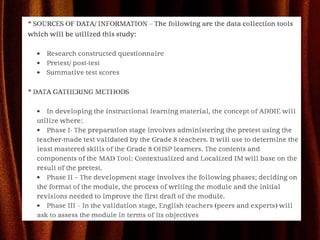
Classroom-Based
Action Research
September 15,2022 @ 9:30 PM
Department of Education
Division of Cebu City
City Central National High School- Cebu
Learning Action Cell (LAC) Session
Resource Speaker
REYNALDO V. MORAL, PhD
MT-1, DepEd Division of Cebu City
IREO, Inc. Editor-in-Chief
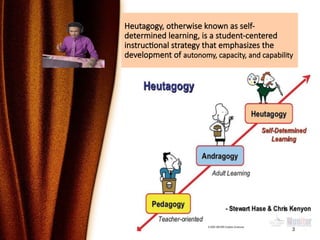
Heutagogy, otherwise knownas self-
determined learning, is a student-centered
instructional strategy that emphasizes the
development of autonomy, capacity, and capability
3
4.
At the endof the session, the
participants will be able to:
1. Describe the parts of action research;
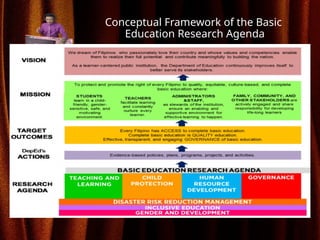
2. Analyze the conceptual framework of
action research in education;
3. Understand the concepts of research
gaps and methodological approach to
the formulation of an action research
paper; and
4. Make meaningful connections with
other educators in terms of creative
investigations.
Date Your Footer Here 4
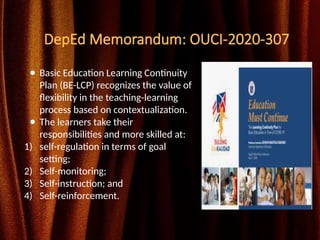
DepEd Memorandum: OUCI-2020-307
●Basic Education Learning Continuity
Plan (BE-LCP) recognizes the value of
flexibility in the teaching-learning
process based on contextualization.
● The learners take their
responsibilities and more skilled at:
1) self-regulation in terms of goal
setting;
2) Self-monitoring;
3) Self-instruction; and
4) Self-reinforcement.
13.
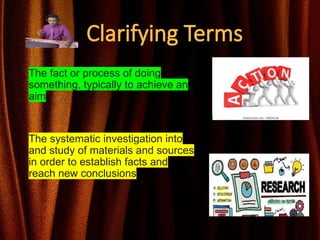
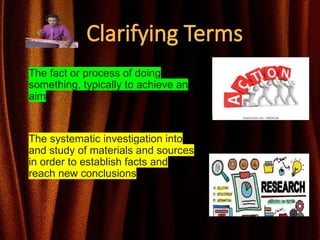
Clarifying Terms
The factor process of doing
something, typically to achieve an
aim
The systematic investigation into
and study of materials and sources
in order to establish facts and
reach new conclusions.
14.
Clarifying Terms
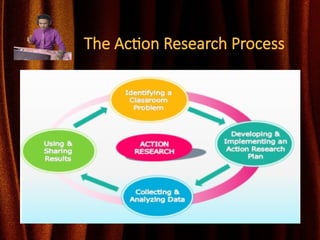
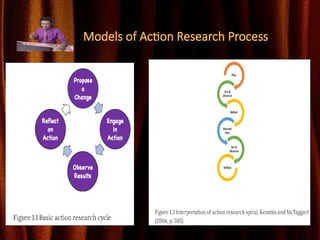
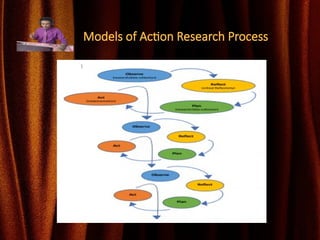
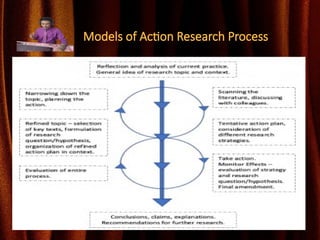
Action Researchis a method of systematic inquiry that teachers
undertake as researchers of their own practice. The inquiry
involved in Action Research is often visualized as a cyclical
process.
Action research in education has also been called different
names such as:
(a) Classroom research
(b) Self-reflective inquiry
(c) Teacher research
(d) Teacher self- evaluation
(e) Teacher as a researcher
15.
Clarifying Terms
The factor process of doing
something, typically to achieve an
aim
The systematic investigation into
and study of materials and sources
in order to establish facts and
reach new conclusions.
17.
Why should educatorsconduct
action research?
1. To improve education practice/learning outcomes.
2. To respond to the call of the 21st
Century Learning where
learners’ talents and potentials must be developed and honed
in a learner-centered school environment.
3. Educators can improve their own craft when they are involved
in action research.
4. Educators can soon develop into transformational leaders who
shall initiate efforts for school-wide transformation.
5. Educators are engaged in deep and critical reflection which
leads to a better understanding of themselves and other
people for a better humanity.
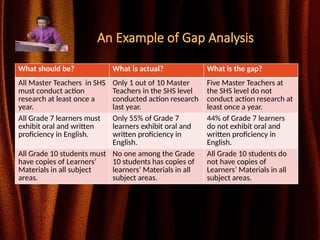
An Example ofGap Analysis
What should be? What is actual? What is the gap?
All Master Teachers in SHS
must conduct action
research at least once a
year.
Only 1 out of 10 Master
Teachers in the SHS level
conducted action research
last year.
Five Master Teachers at
the SHS level do not
conduct action research at
least once a year.
All Grade 7 learners must
exhibit oral and written
proficiency in English.
Only 55% of Grade 7
learners exhibit oral and
written proficiency in
English.
44% of Grade 7 learners
do not exhibit oral and
written proficiency in
English.
All Grade 10 students must
have copies of Learners’
Materials in all subject
areas.
No one among the Grade
10 students has copies of
learners’ Materials in all
subject areas.
All Grade 10 students do
not have copies of
Learners’ Materials in all
subject areas.
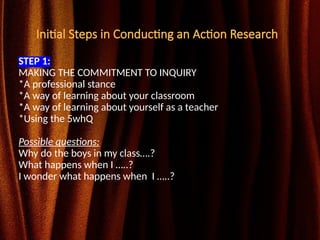
Initial Steps inConducting an Action Research
STEP 1:
MAKING THE COMMITMENT TO INQUIRY
*A professional stance
*A way of learning about your classroom
*A way of learning about yourself as a teacher
*Using the 5whQ
Possible questions:
Why do the boys in my class….?
What happens when I …..?
I wonder what happens when I …..?
27.
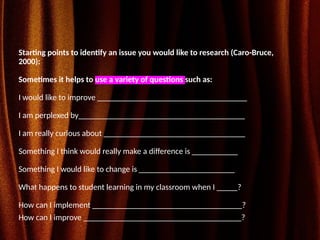
Starting points toidentify an issue you would like to research (Caro-Bruce,
2000):
Sometimes it helps to use a variety of questions such as:
I would like to improve ____________________________________
I am perplexed by________________________________________
I am really curious about __________________________________
Something I think would really make a difference is ___________
Something I would like to change is _______________________
What happens to student learning in my classroom when I _____?
How can I implement ____________________________________?
How can I improve ______________________________________?
28.
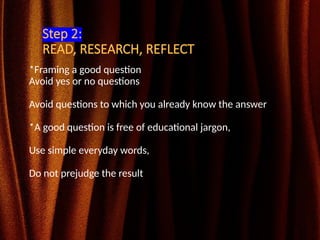
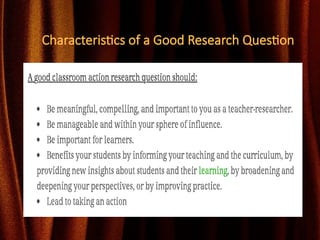
*Framing a goodquestion
Avoid yes or no questions
Avoid questions to which you already know the answer
*A good question is free of educational jargon,
Use simple everyday words,
Do not prejudge the result
Step 2:
READ, RESEARCH, REFLECT
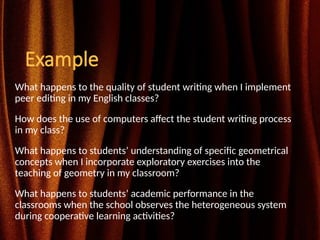
Example
What happens tothe quality of student writing when I implement
peer editing in my English classes?
How does the use of computers affect the student writing process
in my class?
What happens to students’ understanding of specific geometrical
concepts when I incorporate exploratory exercises into the
teaching of geometry in my classroom?
What happens to students’ academic performance in the
classrooms when the school observes the heterogeneous system
during cooperative learning activities?
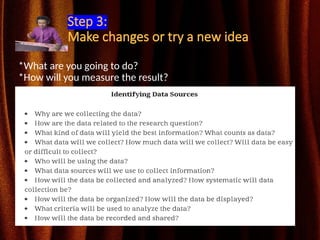
Step 3:
Make changesor try a new idea
*What are you going to do?
*How will you measure the result?
33.
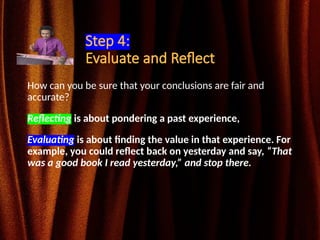
Step 4:
Evaluate andReflect
How can you be sure that your conclusions are fair and
accurate?
Reflecting is about pondering a past experience,
Evaluating is about finding the value in that experience. For
example, you could reflect back on yesterday and say, “That
was a good book I read yesterday,” and stop there.
34.
Step 5:
Improve oramend your practice
How will I do things differently?
What have you learned from the project?
Have your questions been answered?
How will you share the results?
Could they be useful to others in your school/ community?
Philosophical Stances inAction Research
Ontology, or the theory of being, is concerned with the claims or
assumptions we make about ourselves within our social reality
– what do we think exists, what does it look like, what entities
are involved and how do these entities interact with each other
(Blaikie, 2007).
For example, a group of teachers may look at why fewer female
students enroll in upper-level science courses at their school. This
question deals directly with the social construction of gender and
specifically what careers females have been conditioned to pursue.
39.
Philosophical Stances inAction Research
Epistemology, or the theory of knowledge, signifies a
philosophical view of what counts as knowledge – it justifies
what is possible to be known and what criteria distinguish
knowledge from beliefs (Blaikie, 1993)
Positivist researchers, for example, consider knowledge to be
certain and discovered through scientific processes. Action
researchers collect data that is more subjective and examine
personal experiences, insights, and beliefs.
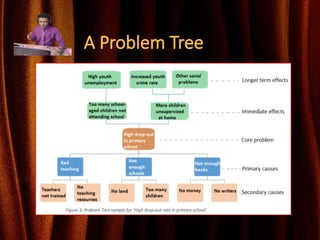
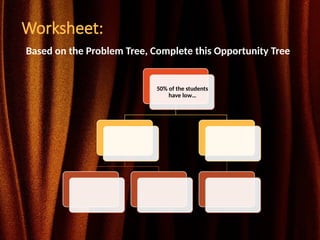
Worksheet:
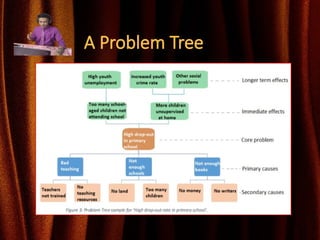
Based on theProblem Tree, Complete this Opportunity Tree
50% of the students
have low…
42.
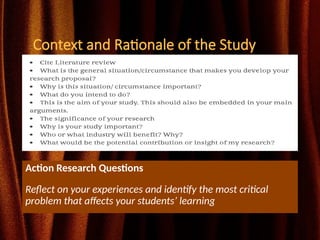
Context and Rationaleof the Study
Action Research Questions
Reflect on your experiences and identify the most critical
problem that affects your students’ learning