Classification by
Classification by
Decision Tree Induction
Classification by Decision Tree
Induction
Induction
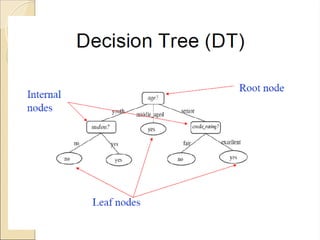
 A decision tree is a flowchart-like tree
structure, where each internal node
(nonleaf node) denotes a test on an
attribute, each branch represents an
outcome of the test, and each leaf node
(or terminal node) holds a class label.
 The topmost node in a tree is the root
node.
Contd…
Contd…
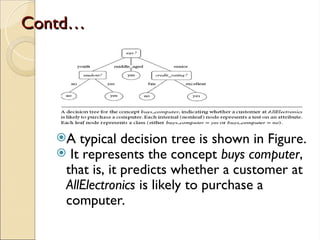
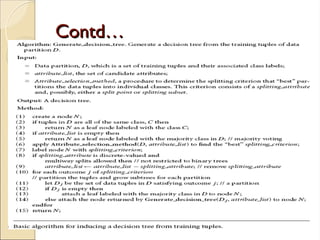
A typical decision tree is shown in Figure.
 It represents the concept buys computer,
that is, it predicts whether a customer at
AllElectronics is likely to purchase a
computer.
Contd…
Contd…
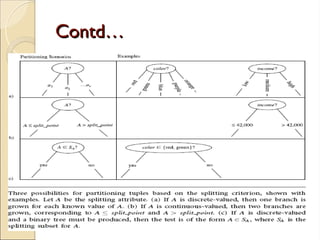
 Internal nodes are denoted by rectangles,
and leaf nodes are denoted by ovals.
 Some decision tree algorithms produce
only binary trees (where each internal
node branches to exactly two other
nodes), whereas others can produce non
binary trees.
Decision Tree Induction
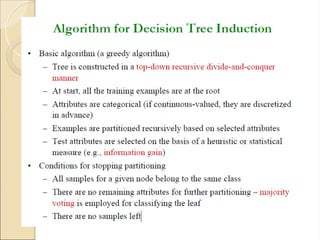
 The algorithm is called with three
parameters: D, attribute list, and Attribute
selection method.
 We refer to D as a data partition.
 Initially, it is the complete set of training
tuples and their associated class labels.
 The parameter attribute list is a list of
attributes describing the tuples.
 Attribute selection method specifies a
heuristic procedure for selecting the
attribute that “best” discriminates the given
tuples accordingto class.
Contd…
Contd…
Contd…
Contd…
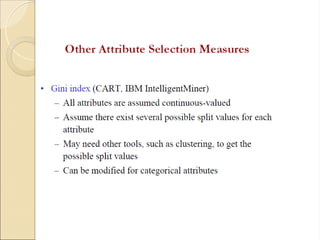
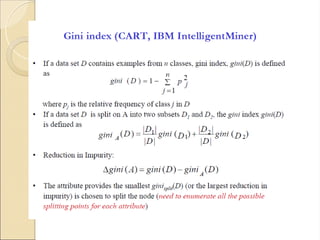
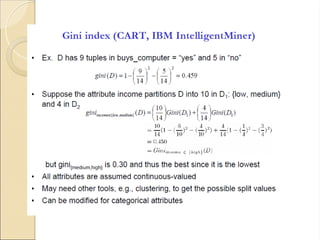
Attribute Selection Measures
 Attribute selection measures are also known as
splitting rules because they determine how the tuples
at a given node are to be split.
 The attribute selection measure provides a ranking
for each attribute describing the given training tuples.
 The attribute having the best score for the measure
is chosen as the splitting attribute for the given tuples.
 This section describes three popular attribute
selection measures—information gain, gain ratio, and
gini index.
Information gain
Information gain
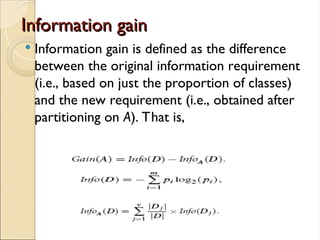
 Information gain is defined as the difference
between the original information requirement
(i.e., based on just the proportion of classes)
and the new requirement (i.e., obtained after
partitioning on A). That is,
Example
Example
Contd…
Contd…
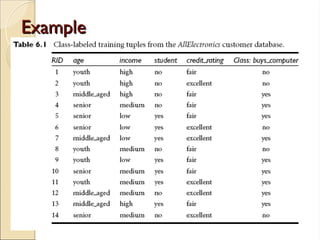
 Table 6.1 presents a training set, D, of class-labeled tuples
randomly selected from the AllElectronics customer
database.
 The class label attribute, buys computer, has two distinct
values (namely, {yes, no}); therefore, there are two distinct
classes (that is, m = 2).
 Let class C1 correspond to yes and class C2 correspond to
no.
 There are nine tuples of class yes and five tuples of class no.
 A (root) node N is created for the tuples in D.
 To find the splitting criterion for these tuples, we must
compute the information gain of each attribute.
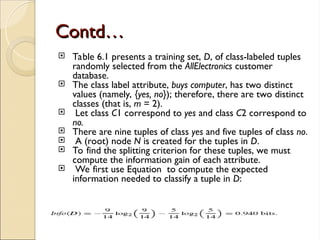
 We first use Equation to compute the expected
information needed to classify a tuple in D:
Contd…
Contd…
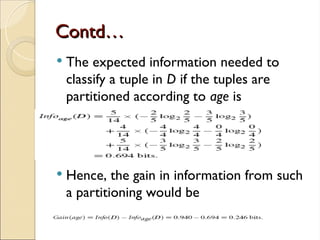
 The expected information needed to
classify a tuple in D if the tuples are
partitioned according to age is
 Hence, the gain in information from such
a partitioning would be
Contd…
Contd…
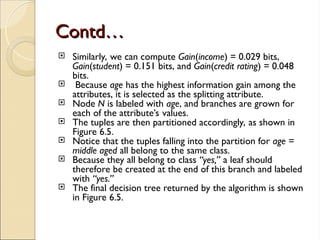
 Similarly, we can compute Gain(income) = 0.029 bits,
Gain(student) = 0.151 bits, and Gain(credit rating) = 0.048
bits.
 Because age has the highest information gain among the
attributes, it is selected as the splitting attribute.
 Node N is labeled with age, and branches are grown for
each of the attribute’s values.
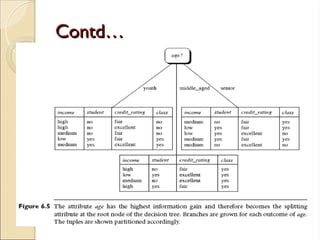
 The tuples are then partitioned accordingly, as shown in
Figure 6.5.
 Notice that the tuples falling into the partition for age =
middle aged all belong to the same class.
 Because they all belong to class “yes,” a leaf should
therefore be created at the end of this branch and labeled
with “yes.”
 The final decision tree returned by the algorithm is shown
in Figure 6.5.
Contd…
Contd…
Thank You…

classification_by_decission_tree_induction_iv1.ppt

  • 1.
    Classification by Classification by DecisionTree Induction Decision Tree Induction
  • 2.
    Classification by DecisionTree Classification by Decision Tree Induction Induction  A decision tree is a flowchart-like tree structure, where each internal node (nonleaf node) denotes a test on an attribute, each branch represents an outcome of the test, and each leaf node (or terminal node) holds a class label.  The topmost node in a tree is the root node.
  • 3.
    Contd… Contd… A typical decisiontree is shown in Figure.  It represents the concept buys computer, that is, it predicts whether a customer at AllElectronics is likely to purchase a computer.
  • 4.
    Contd… Contd…  Internal nodesare denoted by rectangles, and leaf nodes are denoted by ovals.  Some decision tree algorithms produce only binary trees (where each internal node branches to exactly two other nodes), whereas others can produce non binary trees.
  • 7.
    Decision Tree Induction DecisionTree Induction  The algorithm is called with three parameters: D, attribute list, and Attribute selection method.  We refer to D as a data partition.  Initially, it is the complete set of training tuples and their associated class labels.  The parameter attribute list is a list of attributes describing the tuples.  Attribute selection method specifies a heuristic procedure for selecting the attribute that “best” discriminates the given tuples accordingto class.
  • 8.
  • 9.
  • 10.
    Attribute Selection Measures AttributeSelection Measures  Attribute selection measures are also known as splitting rules because they determine how the tuples at a given node are to be split.  The attribute selection measure provides a ranking for each attribute describing the given training tuples.  The attribute having the best score for the measure is chosen as the splitting attribute for the given tuples.  This section describes three popular attribute selection measures—information gain, gain ratio, and gini index.
  • 11.
    Information gain Information gain Information gain is defined as the difference between the original information requirement (i.e., based on just the proportion of classes) and the new requirement (i.e., obtained after partitioning on A). That is,
  • 12.
  • 13.
    Contd… Contd…  Table 6.1presents a training set, D, of class-labeled tuples randomly selected from the AllElectronics customer database.  The class label attribute, buys computer, has two distinct values (namely, {yes, no}); therefore, there are two distinct classes (that is, m = 2).  Let class C1 correspond to yes and class C2 correspond to no.  There are nine tuples of class yes and five tuples of class no.  A (root) node N is created for the tuples in D.  To find the splitting criterion for these tuples, we must compute the information gain of each attribute.  We first use Equation to compute the expected information needed to classify a tuple in D:
  • 14.
    Contd… Contd…  The expectedinformation needed to classify a tuple in D if the tuples are partitioned according to age is  Hence, the gain in information from such a partitioning would be
  • 15.
    Contd… Contd…  Similarly, wecan compute Gain(income) = 0.029 bits, Gain(student) = 0.151 bits, and Gain(credit rating) = 0.048 bits.  Because age has the highest information gain among the attributes, it is selected as the splitting attribute.  Node N is labeled with age, and branches are grown for each of the attribute’s values.  The tuples are then partitioned accordingly, as shown in Figure 6.5.  Notice that the tuples falling into the partition for age = middle aged all belong to the same class.  Because they all belong to class “yes,” a leaf should therefore be created at the end of this branch and labeled with “yes.”  The final decision tree returned by the algorithm is shown in Figure 6.5.
  • 16.
  • 23.