Classification of malocclusion
Orthodontic PG program/ IOM-2017
Malocclusion
Need for classification
 Grouping of the orthodontic problems
 Location of problems to be treated
 Diagnosis and treatment plan
 Comparison of different types of malocclusion
 For self communication
 Documentation of problems
 Assessment of treatment effects
Orthodontic PG program/ IOM-2017
Malocclusion
Orthodontic PG program/ IOM-2017
Malocclusion
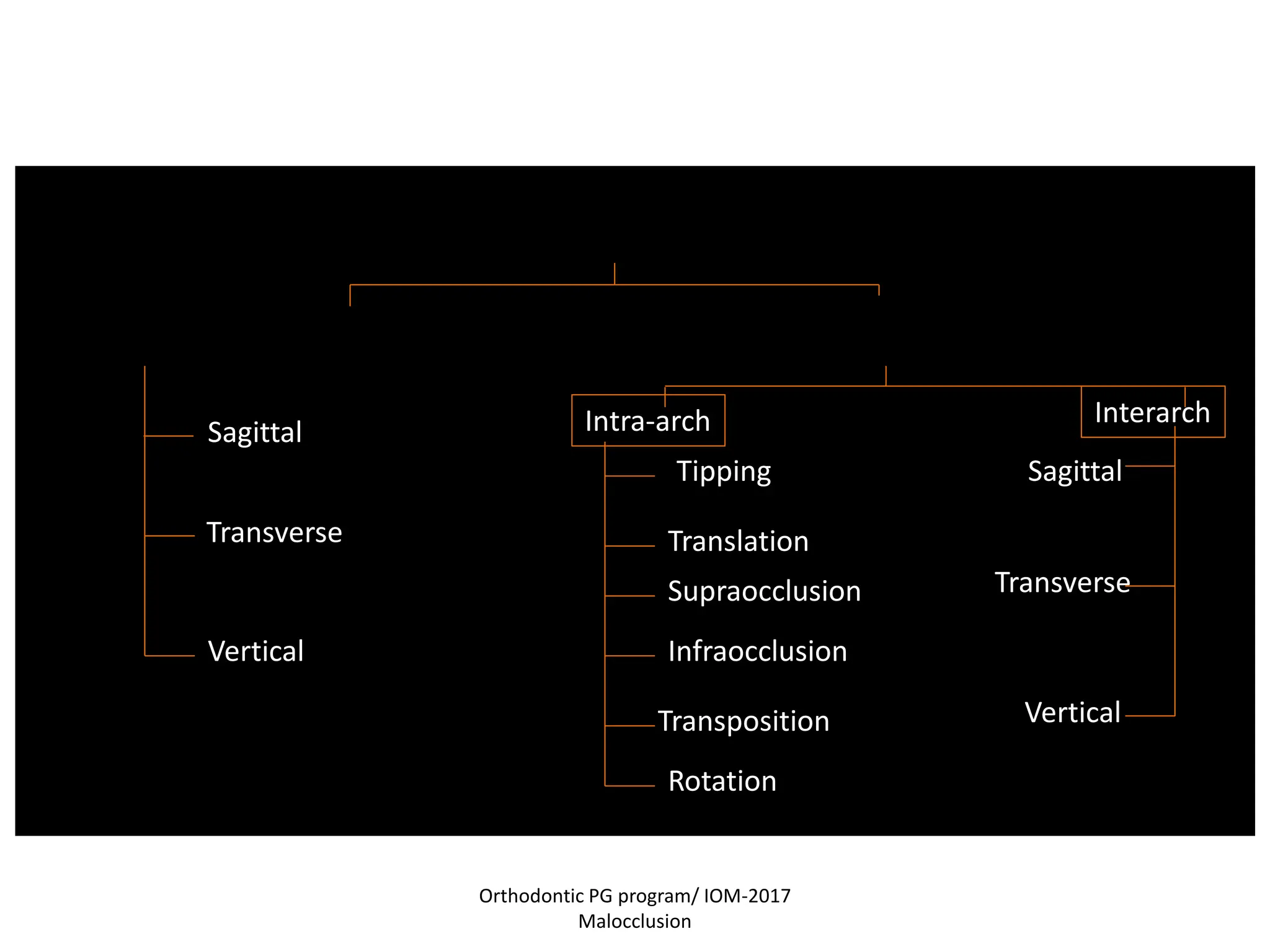
Sagittal
Transverse
Vertical
Intra-arch Interarch
Sagittal
Transverse
Vertical
Tipping
Translation
Supraocclusion
Infraocclusion
Transposition
Rotation
3
skeletal
• Sagittal plane & Vertical plane
Orthodontic PG program/ IOM-2017
Malocclusion
• Abnormal relation of maxillary and
mandibular teeth in transverse plane
Orthodontic PG program/ IOM-2017
Malocclusion
Transverse plane( crossbite)
Skeletal
• Crossbite can be
• Unilateral/bilateral
• Single tooth/ group of teeth
• Lingual/buccal
• Scissor bite/Brodie bite/complete maxillary
buccal crossbite
Orthodontic PG program/ IOM-2017
Malocclusion
skeletal
• Anterior posterior plane
• Skeletal class I
• Skeletal class II
• Skeletal class III
Orthodontic PG program/ IOM-2017
Malocclusion
skeletal
• Mid-sagittal plane
• Deep bite
• Open bite
• Collapsed bite
Orthodontic PG program/ IOM-2017
Malocclusion
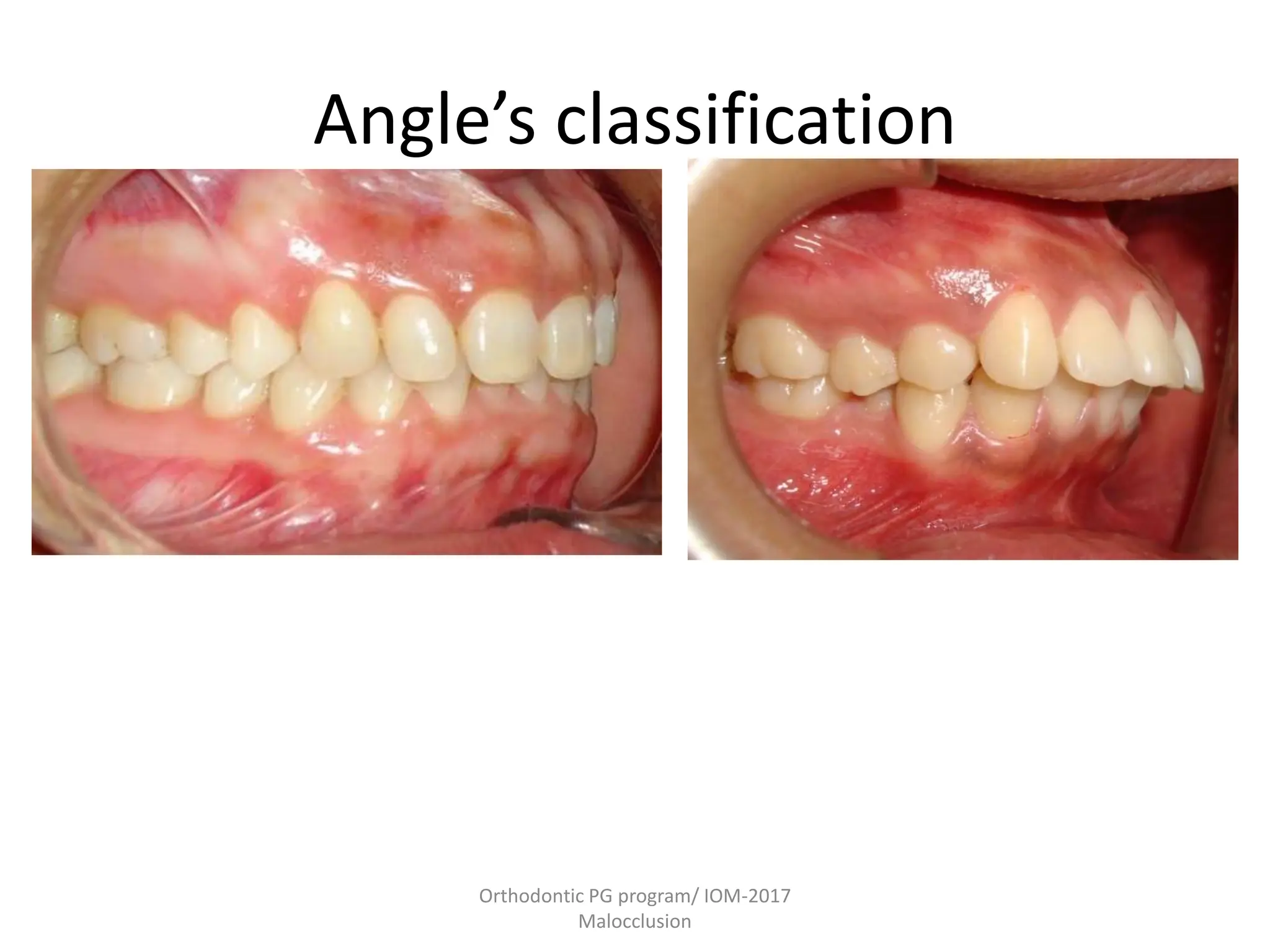
Angle’s classification
Orthodontic PG program/ IOM-2017
Malocclusion
Normal occlusion
Class I mal occlusion
Orthodontic PG program/ IOM-2017
Malocclusion
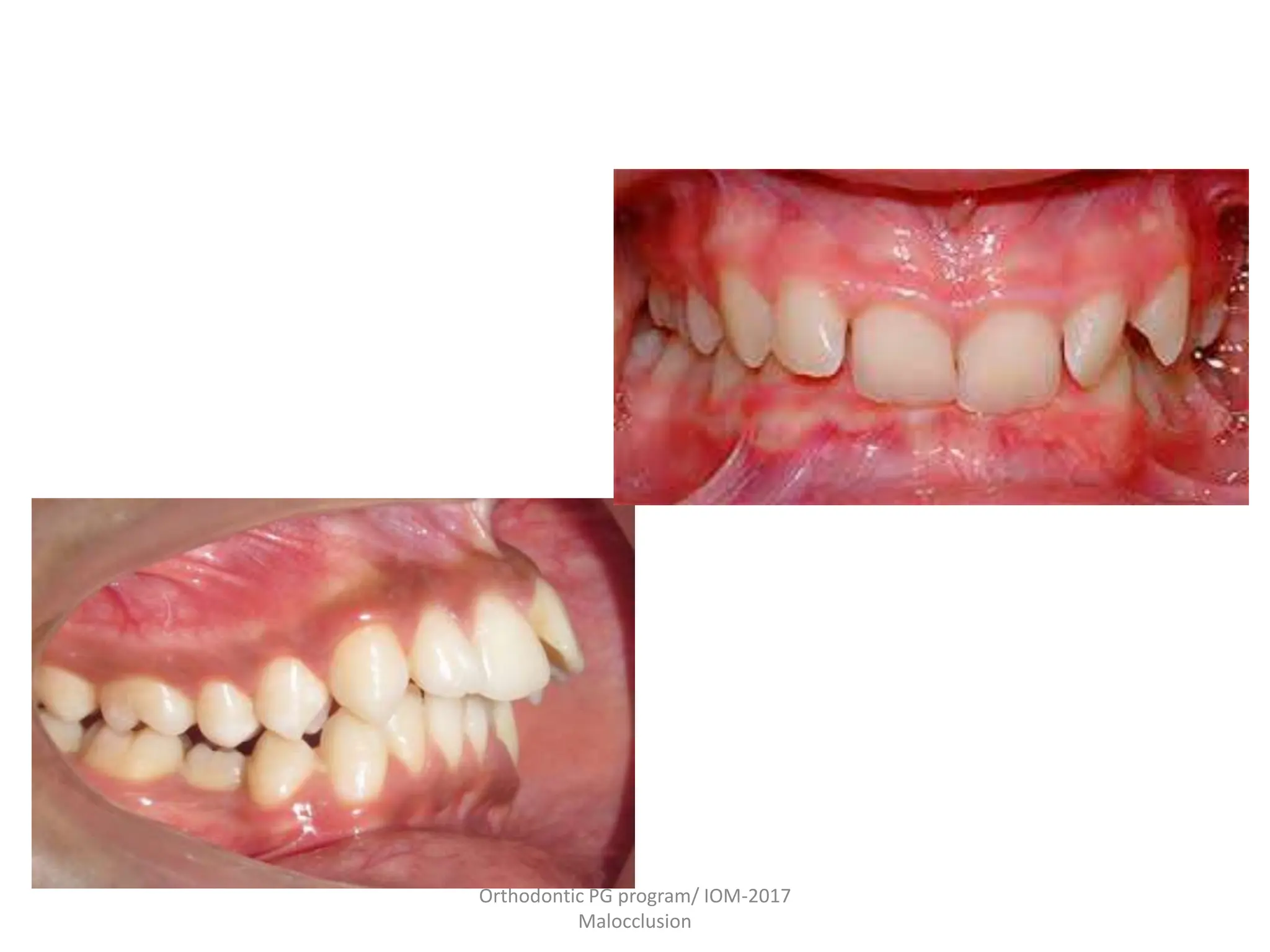
Class II Div 1 malocclusion
Class II Div 2 malocclusion
Angle’s class III
Orthodontic PG program/ IOM-2017
Malocclusion
Orthodontic PG program/ IOM-2017
Malocclusion
Features True class III Pseudoclass III
Profile Concave Straight to concave
Premature contacts
Path of closure
Absent Present
Path of closure Smooth Deviated
Further retrusion of mandible Not possible Possible
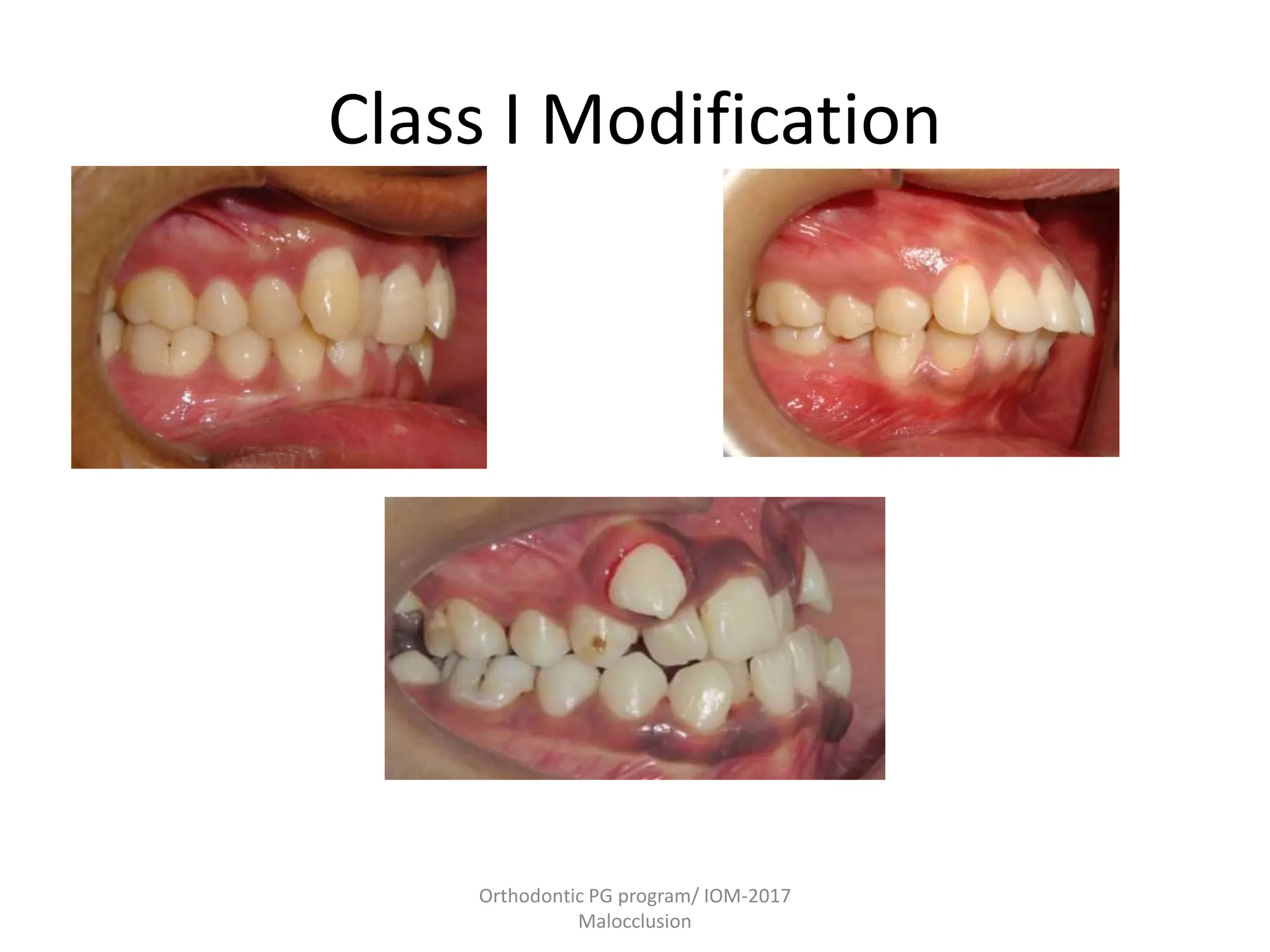
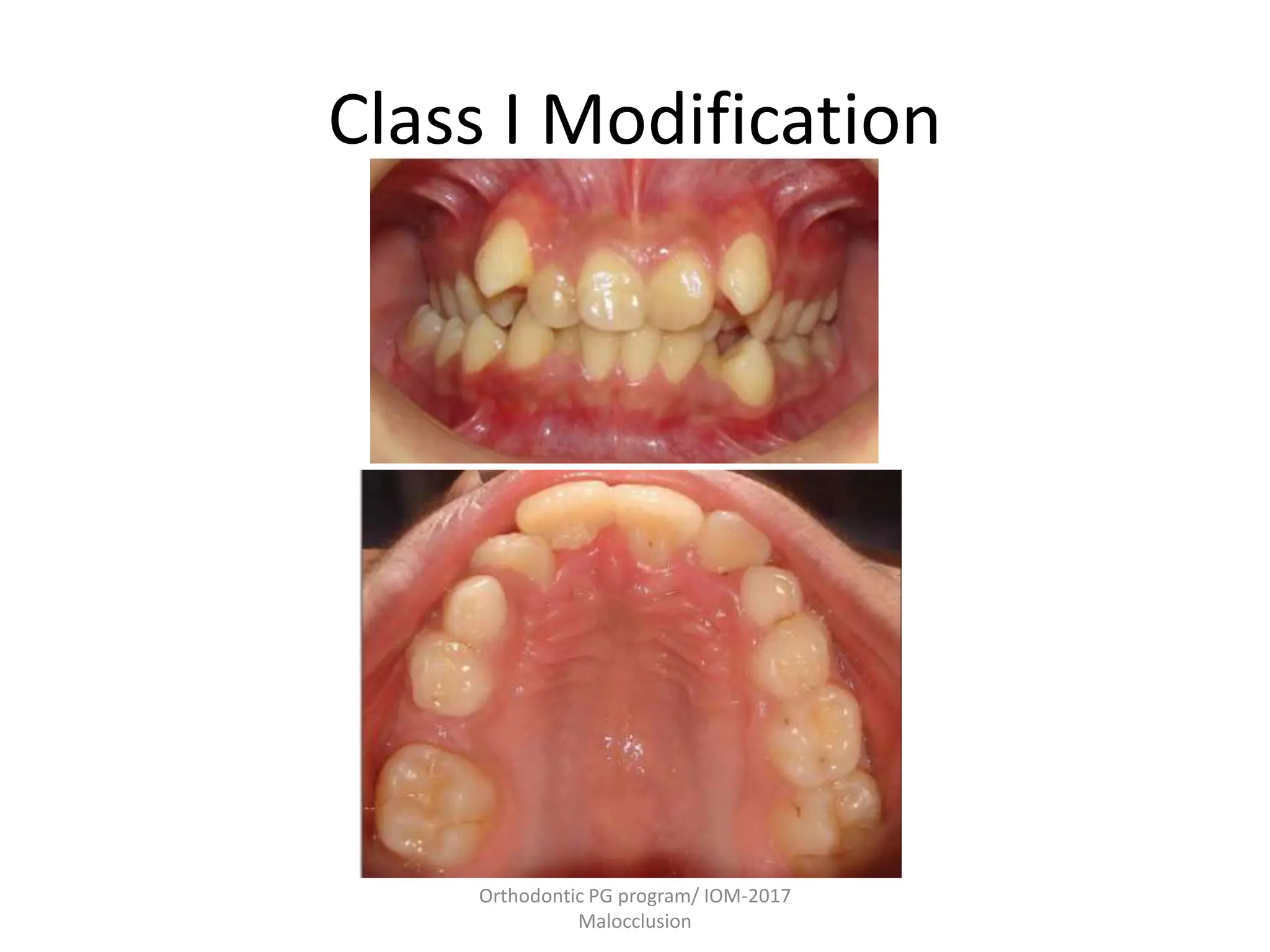
Dewey’s modification (1915)
1.Angle’s class I into 5 types.
2.Angle’s class III into 3 types.
Orthodontic PG program/ IOM-2017
Malocclusion
Class I Modification
Orthodontic PG program/ IOM-2017
Malocclusion
Class I Modification
Orthodontic PG program/ IOM-2017
Malocclusion
Class III modification
• Type 1: Edge to edge incisor alignment.
• Type 2: Mandibular incisors are crowded and
are in lingual relation to the maxillary incisors
• Type 3: Maxillary incisors are crowded and are
in crossbite in relation to the mandibular
anteriors.
Orthodontic PG program/ IOM-2017
Malocclusion
Lischer’s modification()1933
• In addition to these he added the suffix
“version” to the word – indicate deviation
from normal position.
• Neutrocclusion: Angle’s class I
• Distocclusion: Angle’s class II
• Mesiocclusion: Angle’s class III
Orthodontic PG program/ IOM-2017
Malocclusion
Lischer’s modification
• Buccocclusion
• Linguocclusion
• Supraocclusion
• Infraocclusion
• Mesioversion
• Distoversion
• Transversion
• torsiversion
Orthodontic PG program/ IOM-2017
Malocclusion
Simon’s modification (1924)
• Frankfort horizontal plane
• Orbital plane
• Midsagittal plane
Orthodontic PG program/ IOM-2017
Malocclusion
Simon’s modification
Frankfort horizontal plane :
• Attraction (closer)
• Abstraction (farther)
Orbital plane :
• Distal third of upper canine - Simon’s law of canine.
• Protraction (farther)
• Retraction (closer)
Mid-sagittal plane
• Transverse direction
• Distraction (away)
• Contraction (closer)
Orthodontic PG program/ IOM-2017
Malocclusion
Bennet classification
Based on its etiology
• Class I: abnormal position of teeth due to local
causes.
• Class II: abnormal formation of arch due to
developmental defects of bone.
• Class III: abnormal relationship between upper
and lower arches and between either arch &
facial contour and correlated abnormal formation
of either arch.
Orthodontic PG program/ IOM-2017
Malocclusion
Ackermann and Proffit (1960)
Based on Venn symbolic diagram that identifies
five major characteristics :
• Step 1 ( Alignment)
• Step 2 (Profile)
• Step 3 (Transverse)
• Step 4 (Sagittal)
• Step 5 (Vertical)
Orthodontic PG program/ IOM-2017
Malocclusion
Ackermann and Proffit (1960)
Orthodontic PG program/ IOM-2017
Malocclusion
WHO / FDI CLASSIFICATION
Recording four major group of items :
• Group 1 : Gross anomalies like dentofacial
abnormalities.
• Group 2 : Individual tooth malpositions like
anodontia, malformed incisors.
• Group 3 : Arch length problems like spacing &
crowding.
• Group 4 : Evaluation of occlusion
• Incisal segment : Deep bite, Open bite, Midline shift,
crossbite Orthodontic PG program/ IOM-2017
Malocclusion
British Classification
• British Standards Institute (1983).
Orthodontic PG program/ IOM-2017
Malocclusion
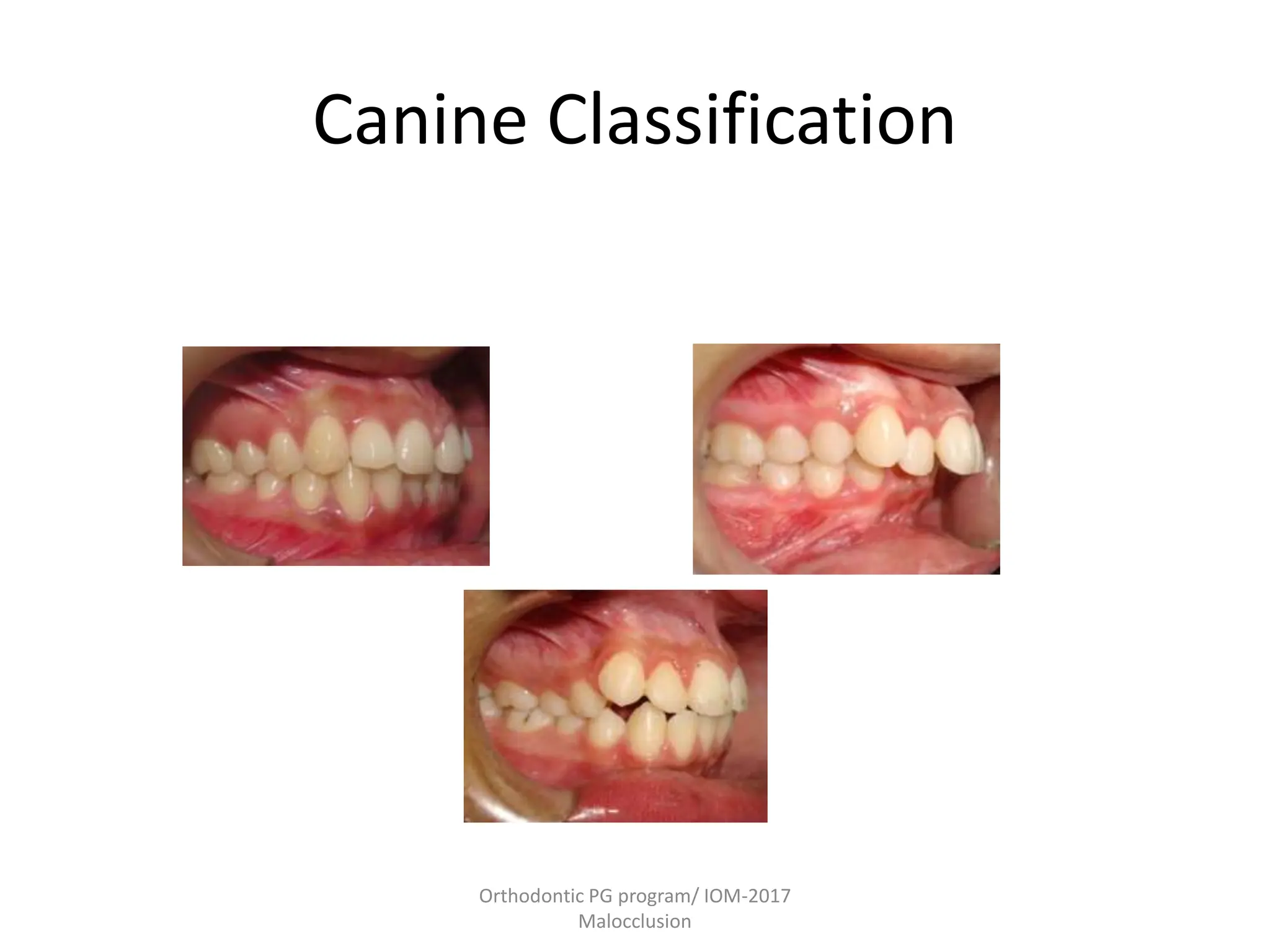
Canine Classification
Orthodontic PG program/ IOM-2017
Malocclusion
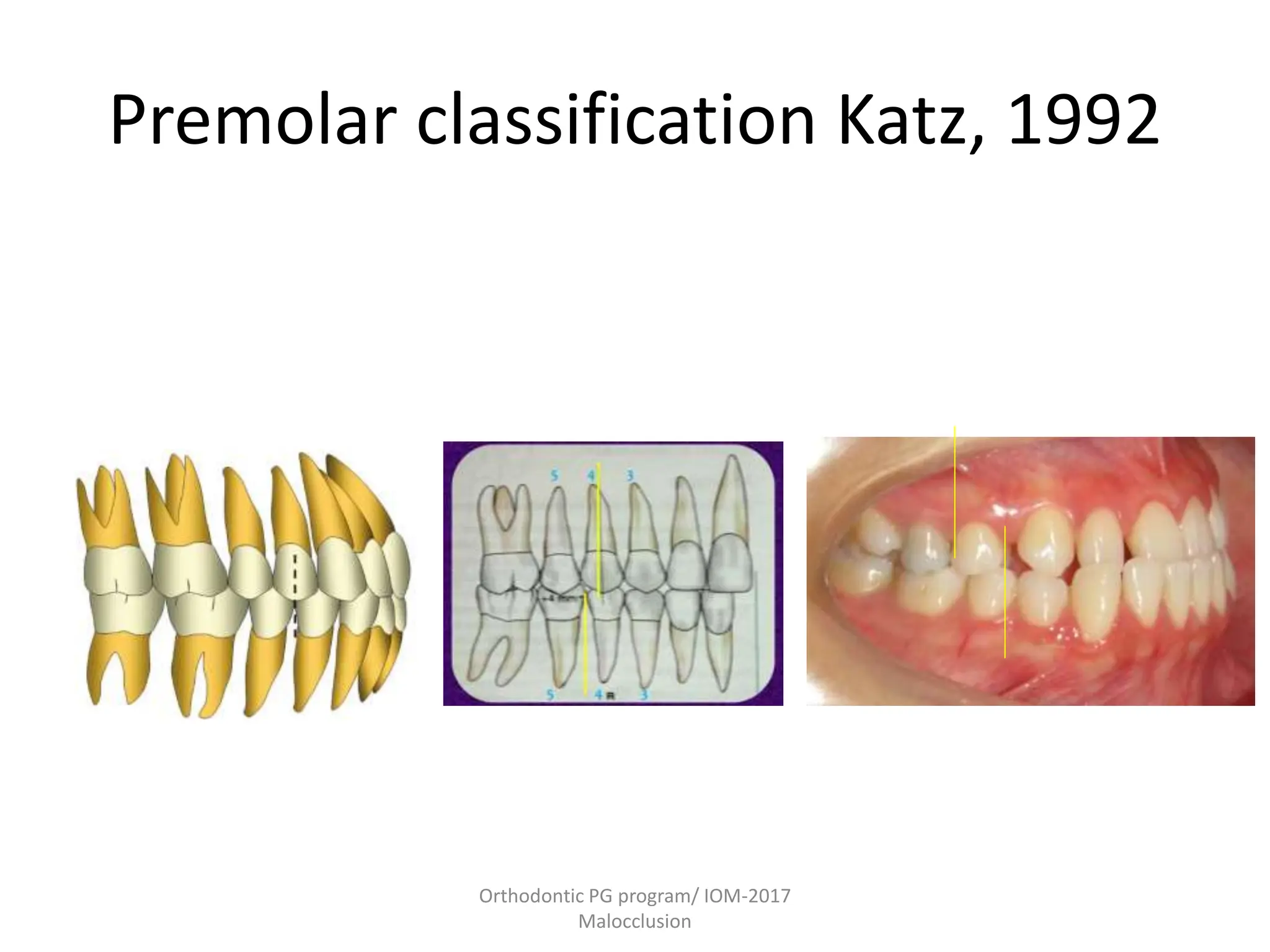
Premolar classification Katz, 1992
Orthodontic PG program/ IOM-2017
Malocclusion
Class I Class II Class III
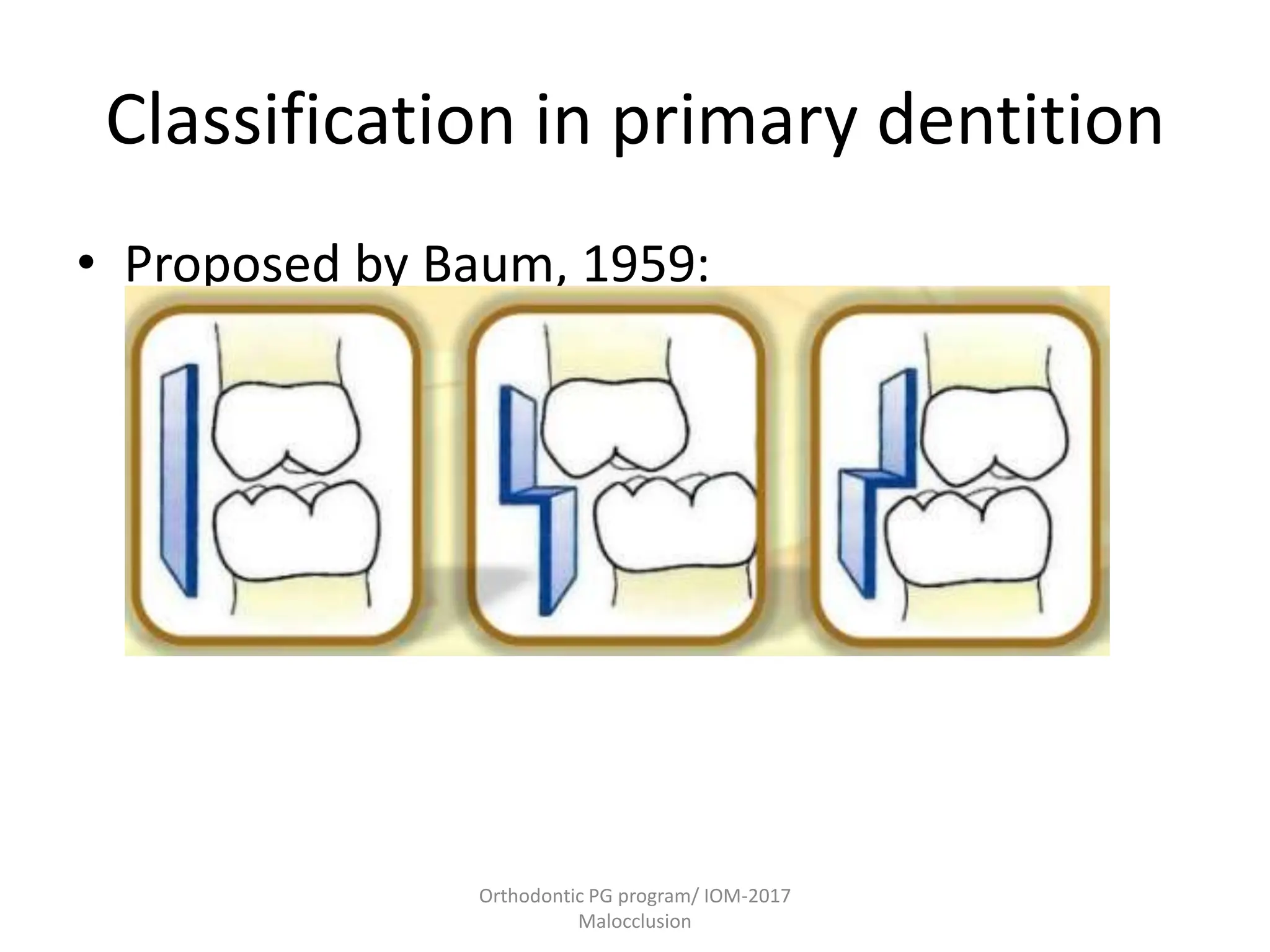
Classification in primary dentition
• Proposed by Baum, 1959:
Orthodontic PG program/ IOM-2017
Malocclusion
Flush terminal plane Mesial step Distal step
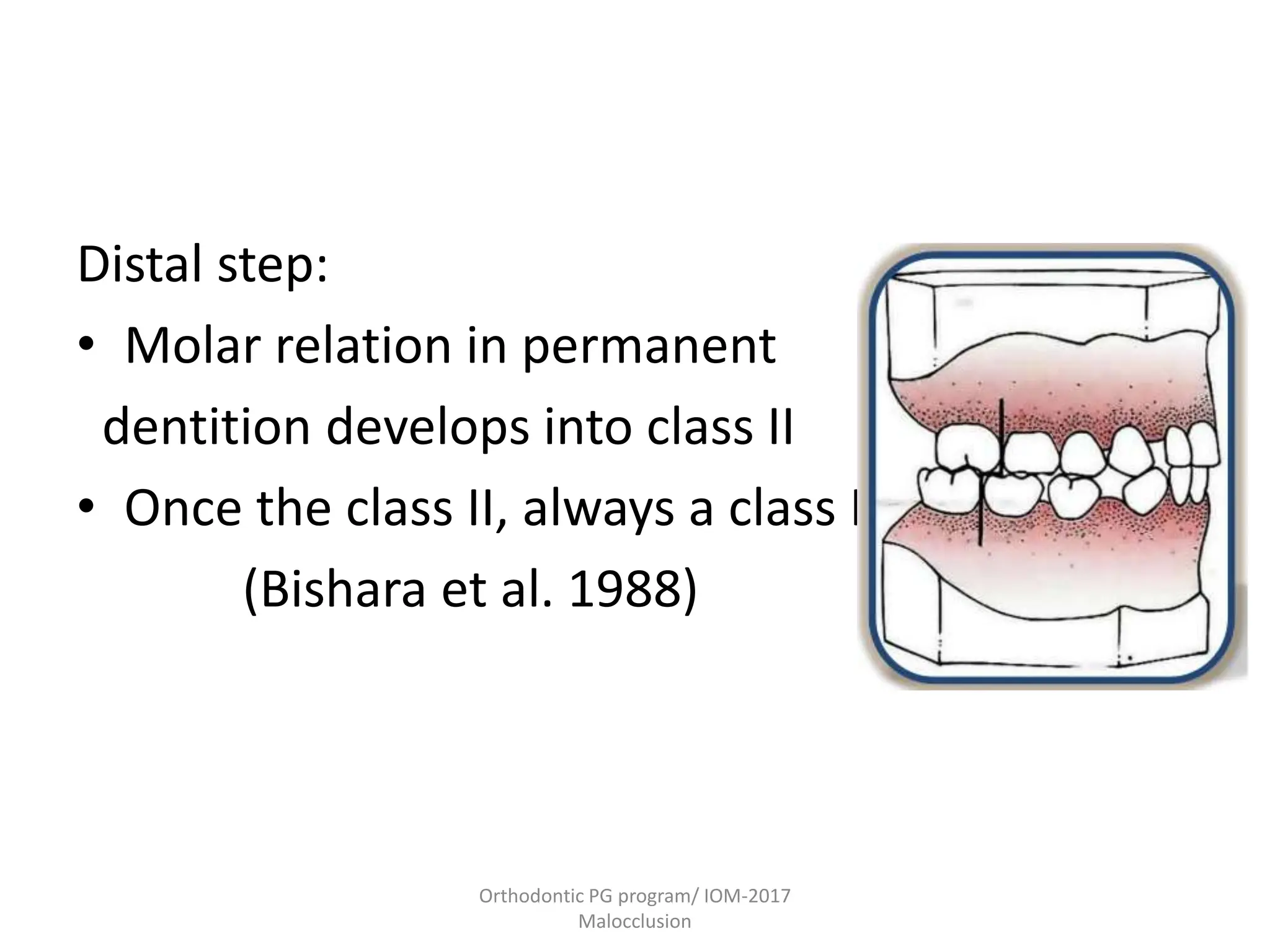
Distal step:
• Molar relation in permanent
dentition develops into class II
• Once the class II, always a class II
(Bishara et al. 1988)
Orthodontic PG program/ IOM-2017
Malocclusion
Flush terminal plane:
• 56% : become class I
• 44%: become class II
(Bishara et al. 1988)
Orthodontic PG program/ IOM-2017
Malocclusion
• 1mm mesial step:
-76%: become class I
-23%: become class II
-1%: become class III
• 2mm or more mesial step:
-68%: become class I
-13%: become class II
-19%: become class III (Bishara et al.
1988)
Orthodontic PG program/ IOM-2017
Malocclusion
Conclusion
 Etiology of malocclusion is a complex
including general & local factors
 Elimination of cause of malocclusion helps in
retention
 Malocclusion should be corrected as soon it is
diagnosed
 Interception of habit if present should be
done
 Periodic dental visit helps in prediction,
course, outcome, treatment planning,
evalautuion of effect of malocclusion
Orthodontic PG program/ IOM-2017
Malocclusion
Thankyou
Orthodontic PG program/ IOM-2017
Malocclusion

Classification of malocclusion.pptx

  • 1.
    Classification of malocclusion OrthodonticPG program/ IOM-2017 Malocclusion
  • 2.
    Need for classification Grouping of the orthodontic problems  Location of problems to be treated  Diagnosis and treatment plan  Comparison of different types of malocclusion  For self communication  Documentation of problems  Assessment of treatment effects Orthodontic PG program/ IOM-2017 Malocclusion
  • 3.
    Orthodontic PG program/IOM-2017 Malocclusion Sagittal Transverse Vertical Intra-arch Interarch Sagittal Transverse Vertical Tipping Translation Supraocclusion Infraocclusion Transposition Rotation 3
  • 4.
    skeletal • Sagittal plane& Vertical plane Orthodontic PG program/ IOM-2017 Malocclusion
  • 5.
    • Abnormal relationof maxillary and mandibular teeth in transverse plane Orthodontic PG program/ IOM-2017 Malocclusion Transverse plane( crossbite) Skeletal
  • 6.
    • Crossbite canbe • Unilateral/bilateral • Single tooth/ group of teeth • Lingual/buccal • Scissor bite/Brodie bite/complete maxillary buccal crossbite Orthodontic PG program/ IOM-2017 Malocclusion
  • 7.
    skeletal • Anterior posteriorplane • Skeletal class I • Skeletal class II • Skeletal class III Orthodontic PG program/ IOM-2017 Malocclusion
  • 8.
    skeletal • Mid-sagittal plane •Deep bite • Open bite • Collapsed bite Orthodontic PG program/ IOM-2017 Malocclusion
  • 9.
    Angle’s classification Orthodontic PGprogram/ IOM-2017 Malocclusion Normal occlusion Class I mal occlusion
  • 10.
    Orthodontic PG program/IOM-2017 Malocclusion Class II Div 1 malocclusion Class II Div 2 malocclusion
  • 11.
    Angle’s class III OrthodonticPG program/ IOM-2017 Malocclusion
  • 12.
    Orthodontic PG program/IOM-2017 Malocclusion Features True class III Pseudoclass III Profile Concave Straight to concave Premature contacts Path of closure Absent Present Path of closure Smooth Deviated Further retrusion of mandible Not possible Possible
  • 13.
    Dewey’s modification (1915) 1.Angle’sclass I into 5 types. 2.Angle’s class III into 3 types. Orthodontic PG program/ IOM-2017 Malocclusion
  • 14.
    Class I Modification OrthodonticPG program/ IOM-2017 Malocclusion
  • 15.
    Class I Modification OrthodonticPG program/ IOM-2017 Malocclusion
  • 16.
    Class III modification •Type 1: Edge to edge incisor alignment. • Type 2: Mandibular incisors are crowded and are in lingual relation to the maxillary incisors • Type 3: Maxillary incisors are crowded and are in crossbite in relation to the mandibular anteriors. Orthodontic PG program/ IOM-2017 Malocclusion
  • 17.
    Lischer’s modification()1933 • Inaddition to these he added the suffix “version” to the word – indicate deviation from normal position. • Neutrocclusion: Angle’s class I • Distocclusion: Angle’s class II • Mesiocclusion: Angle’s class III Orthodontic PG program/ IOM-2017 Malocclusion
  • 18.
    Lischer’s modification • Buccocclusion •Linguocclusion • Supraocclusion • Infraocclusion • Mesioversion • Distoversion • Transversion • torsiversion Orthodontic PG program/ IOM-2017 Malocclusion
  • 19.
    Simon’s modification (1924) •Frankfort horizontal plane • Orbital plane • Midsagittal plane Orthodontic PG program/ IOM-2017 Malocclusion
  • 20.
    Simon’s modification Frankfort horizontalplane : • Attraction (closer) • Abstraction (farther) Orbital plane : • Distal third of upper canine - Simon’s law of canine. • Protraction (farther) • Retraction (closer) Mid-sagittal plane • Transverse direction • Distraction (away) • Contraction (closer) Orthodontic PG program/ IOM-2017 Malocclusion
  • 21.
    Bennet classification Based onits etiology • Class I: abnormal position of teeth due to local causes. • Class II: abnormal formation of arch due to developmental defects of bone. • Class III: abnormal relationship between upper and lower arches and between either arch & facial contour and correlated abnormal formation of either arch. Orthodontic PG program/ IOM-2017 Malocclusion
  • 22.
    Ackermann and Proffit(1960) Based on Venn symbolic diagram that identifies five major characteristics : • Step 1 ( Alignment) • Step 2 (Profile) • Step 3 (Transverse) • Step 4 (Sagittal) • Step 5 (Vertical) Orthodontic PG program/ IOM-2017 Malocclusion
  • 23.
    Ackermann and Proffit(1960) Orthodontic PG program/ IOM-2017 Malocclusion
  • 24.
    WHO / FDICLASSIFICATION Recording four major group of items : • Group 1 : Gross anomalies like dentofacial abnormalities. • Group 2 : Individual tooth malpositions like anodontia, malformed incisors. • Group 3 : Arch length problems like spacing & crowding. • Group 4 : Evaluation of occlusion • Incisal segment : Deep bite, Open bite, Midline shift, crossbite Orthodontic PG program/ IOM-2017 Malocclusion
  • 25.
    British Classification • BritishStandards Institute (1983). Orthodontic PG program/ IOM-2017 Malocclusion
  • 26.
    Canine Classification Orthodontic PGprogram/ IOM-2017 Malocclusion
  • 27.
    Premolar classification Katz,1992 Orthodontic PG program/ IOM-2017 Malocclusion Class I Class II Class III
  • 28.
    Classification in primarydentition • Proposed by Baum, 1959: Orthodontic PG program/ IOM-2017 Malocclusion Flush terminal plane Mesial step Distal step
  • 29.
    Distal step: • Molarrelation in permanent dentition develops into class II • Once the class II, always a class II (Bishara et al. 1988) Orthodontic PG program/ IOM-2017 Malocclusion
  • 30.
    Flush terminal plane: •56% : become class I • 44%: become class II (Bishara et al. 1988) Orthodontic PG program/ IOM-2017 Malocclusion
  • 31.
    • 1mm mesialstep: -76%: become class I -23%: become class II -1%: become class III • 2mm or more mesial step: -68%: become class I -13%: become class II -19%: become class III (Bishara et al. 1988) Orthodontic PG program/ IOM-2017 Malocclusion
  • 32.
    Conclusion  Etiology ofmalocclusion is a complex including general & local factors  Elimination of cause of malocclusion helps in retention  Malocclusion should be corrected as soon it is diagnosed  Interception of habit if present should be done  Periodic dental visit helps in prediction, course, outcome, treatment planning, evalautuion of effect of malocclusion Orthodontic PG program/ IOM-2017 Malocclusion
  • 33.
    Thankyou Orthodontic PG program/IOM-2017 Malocclusion

Editor's Notes

  • #27 Class I : mesial incline of the upper canine overlaps the distal incline of the lower canine Class II : upper canine is placed forward i.e. distal incline of upper canine contacts the mesial incline of the lower canine Class III: the lower canine is placed forward to the upper canine and there is no overlapping