Object – Oriented Programming
Week 7 – Objects
Ferdin Joe John Joseph, PhD
Faculty of Information Technology
Thai-Nichi Institute of Technology
Classes and Objects in Java
3
Classes and Objects
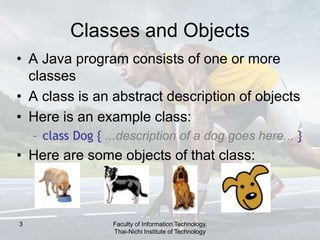
• A Java program consists of one or more
classes
• A class is an abstract description of objects
• Here is an example class:
– class Dog { ...description of a dog goes here... }
• Here are some objects of that class:
Faculty of Information Technology,
Thai-Nichi Institute of Technology
4
More Objects
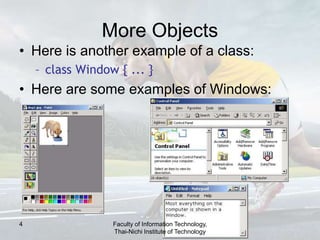
• Here is another example of a class:
– class Window { ... }
• Here are some examples of Windows:
Faculty of Information Technology,
Thai-Nichi Institute of Technology
5
Classes contain data definitions
• Classes describe the data held by each of its
objects
• Example:
– class Dog {
String name;
int age;
...rest of the class...
}
Data usually goes first in a class
• A class may describe any number of objects
– Examples: "Fido", 3; "Rover", 5; "Spot", 3;
• A class may describe a single object, or even no objects at
all Faculty of Information Technology,
Thai-Nichi Institute of Technology
6
Classes contain methods
• A class may contain methods that describe the behavior of
objects
• Example:
– class Dog {
...
void bark() {
System.out.println("Woof!");
}
}
Methods usually go after the data
• When we ask a particular Dog to bark, it says “Woof!”
• Only Dog objects can bark; the class Dog cannot bark
Faculty of Information Technology,
Thai-Nichi Institute of Technology
7
Methods contain statements
• A statement causes the object to do
something
– (A better word would be “command”—but it
isn’t)
• Example:
– System.out.println("Woof!");
– This causes the particular Dog to “print”
(actually, display on the screen) the
characters Woof!
Faculty of Information Technology,
Thai-Nichi Institute of Technology
8
Methods may contain temporary
data
• Data described in a class exists in all objects
of that class
– Example: Every Dog has its own name and age
• A method may contain local temporary data
that exists only until the method finishes
• Example:
– void wakeTheNeighbors( ) {
int i = 50; // i is a temporary variable
while (i > 0) {
bark( );
i = i – 1;
} Faculty of Information Technology,
Thai-Nichi Institute of Technology
9
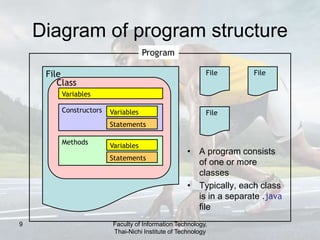
Diagram of program structure
• A program consists
of one or more
classes
• Typically, each class
is in a separate .java
file
Program
File File
File
File
Class
Variables
Constructors
Methods
Variables
Variables
Statements
Statements
Faculty of Information Technology,
Thai-Nichi Institute of Technology
10
Summary
• A program consists of one or more classes
• A class is a description of a kind of object
– In most cases, it is the objects that do the actual work
• A class describes data, constructors, and methods
– An object’s data is information about that object
– An object’s methods describe how the object behaves
– A constructor is used to create objects of the class
• Methods (and constructors) may contain temporary data
and statements (commands)
Faculty of Information Technology,
Thai-Nichi Institute of Technology
Writing and running programs
• When you write a program, you are writing classes and all
the things that go into classes
• Your program typically contains commands to create
objects (that is, “calls” to constructors)
– Analogy: A class is like a cookie cutter, objects are like cookies.
• When you run a program, it creates objects, and those
objects interact with one another and do whatever they do
to cause something to happen
– Analogy: Writing a program is like writing the rules to a game;
running a program is like actually playing the game
• You never know how well the rules are going to work until
you try them out
Faculty of Information Technology,
Thai-Nichi Institute of Technology
Getting started
• Question: Where do objects come from?
– Answer: They are created by other objects.
• Question: Where does the first object come from?
– Answer: Programs have a special main method, not part of any
object, that is executed in order to get things started
• public static void main(String[ ] args) {
Dog fido = new Dog("Fido", 5); // creates a Dog
}
• The special keyword static says that the main method
belongs to the class itself, not to objects of the class
– Hence, the main method can be “called” before any objects are
created
– Usually, the main method gets things started by creating one or
more objects and telling them what to do
Faculty of Information Technology,
Thai-Nichi Institute of Technology
12
13
A bad program
• public class Dog {
String name;
int age;
Dog(String name, int age) {
this.name = name;
this.age = age;
}
public static void main(String[] args) {
bark();
}
void bark() {
System.out.println("Woof!");
}
}
--------- new Dog("Fido", 5).bark();
Faculty of Information Technology,
Thai-Nichi Institute of Technology
14
A complete program
class Dog {
String name;
int age;
Dog(String n, int age) {
name = n;
this.age = age;
}
void bark() {
System.out.println("Woof!");
}
void wakeTheNeighbors( ) {
int i = 50;
while (i > 0) {
bark( );
i = i – 1;
}
}
public static void main(String[ ] args) {
Dog fido = new Dog("Fido", 5);
fido.wakeTheNeighbors();
}
} // ends the class
Faculty of Information Technology,
Thai-Nichi Institute of Technology

Classes and Objects

  • 1.
    Object – OrientedProgramming Week 7 – Objects Ferdin Joe John Joseph, PhD Faculty of Information Technology Thai-Nichi Institute of Technology
  • 2.
  • 3.
    3 Classes and Objects •A Java program consists of one or more classes • A class is an abstract description of objects • Here is an example class: – class Dog { ...description of a dog goes here... } • Here are some objects of that class: Faculty of Information Technology, Thai-Nichi Institute of Technology
  • 4.
    4 More Objects • Hereis another example of a class: – class Window { ... } • Here are some examples of Windows: Faculty of Information Technology, Thai-Nichi Institute of Technology
  • 5.
    5 Classes contain datadefinitions • Classes describe the data held by each of its objects • Example: – class Dog { String name; int age; ...rest of the class... } Data usually goes first in a class • A class may describe any number of objects – Examples: "Fido", 3; "Rover", 5; "Spot", 3; • A class may describe a single object, or even no objects at all Faculty of Information Technology, Thai-Nichi Institute of Technology
  • 6.
    6 Classes contain methods •A class may contain methods that describe the behavior of objects • Example: – class Dog { ... void bark() { System.out.println("Woof!"); } } Methods usually go after the data • When we ask a particular Dog to bark, it says “Woof!” • Only Dog objects can bark; the class Dog cannot bark Faculty of Information Technology, Thai-Nichi Institute of Technology
  • 7.
    7 Methods contain statements •A statement causes the object to do something – (A better word would be “command”—but it isn’t) • Example: – System.out.println("Woof!"); – This causes the particular Dog to “print” (actually, display on the screen) the characters Woof! Faculty of Information Technology, Thai-Nichi Institute of Technology
  • 8.
    8 Methods may containtemporary data • Data described in a class exists in all objects of that class – Example: Every Dog has its own name and age • A method may contain local temporary data that exists only until the method finishes • Example: – void wakeTheNeighbors( ) { int i = 50; // i is a temporary variable while (i > 0) { bark( ); i = i – 1; } Faculty of Information Technology, Thai-Nichi Institute of Technology
  • 9.
    9 Diagram of programstructure • A program consists of one or more classes • Typically, each class is in a separate .java file Program File File File File Class Variables Constructors Methods Variables Variables Statements Statements Faculty of Information Technology, Thai-Nichi Institute of Technology
  • 10.
    10 Summary • A programconsists of one or more classes • A class is a description of a kind of object – In most cases, it is the objects that do the actual work • A class describes data, constructors, and methods – An object’s data is information about that object – An object’s methods describe how the object behaves – A constructor is used to create objects of the class • Methods (and constructors) may contain temporary data and statements (commands) Faculty of Information Technology, Thai-Nichi Institute of Technology
  • 11.
    Writing and runningprograms • When you write a program, you are writing classes and all the things that go into classes • Your program typically contains commands to create objects (that is, “calls” to constructors) – Analogy: A class is like a cookie cutter, objects are like cookies. • When you run a program, it creates objects, and those objects interact with one another and do whatever they do to cause something to happen – Analogy: Writing a program is like writing the rules to a game; running a program is like actually playing the game • You never know how well the rules are going to work until you try them out Faculty of Information Technology, Thai-Nichi Institute of Technology
  • 12.
    Getting started • Question:Where do objects come from? – Answer: They are created by other objects. • Question: Where does the first object come from? – Answer: Programs have a special main method, not part of any object, that is executed in order to get things started • public static void main(String[ ] args) { Dog fido = new Dog("Fido", 5); // creates a Dog } • The special keyword static says that the main method belongs to the class itself, not to objects of the class – Hence, the main method can be “called” before any objects are created – Usually, the main method gets things started by creating one or more objects and telling them what to do Faculty of Information Technology, Thai-Nichi Institute of Technology 12
  • 13.
    13 A bad program •public class Dog { String name; int age; Dog(String name, int age) { this.name = name; this.age = age; } public static void main(String[] args) { bark(); } void bark() { System.out.println("Woof!"); } } --------- new Dog("Fido", 5).bark(); Faculty of Information Technology, Thai-Nichi Institute of Technology
  • 14.
    14 A complete program classDog { String name; int age; Dog(String n, int age) { name = n; this.age = age; } void bark() { System.out.println("Woof!"); } void wakeTheNeighbors( ) { int i = 50; while (i > 0) { bark( ); i = i – 1; } } public static void main(String[ ] args) { Dog fido = new Dog("Fido", 5); fido.wakeTheNeighbors(); } } // ends the class Faculty of Information Technology, Thai-Nichi Institute of Technology