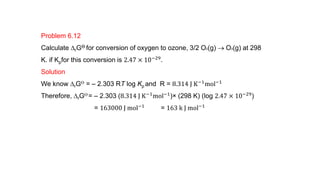
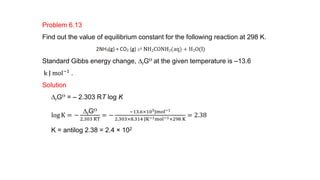
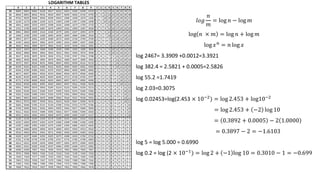
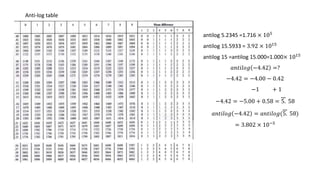
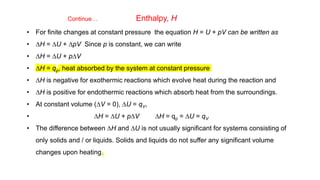
1. Enthalpy (H) is the sum of internal energy (U) and pressure-volume work (pV) for a system. It is a state function that depends on the initial and final states.
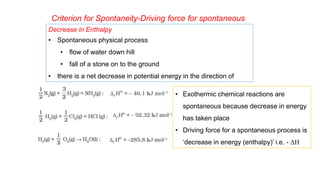
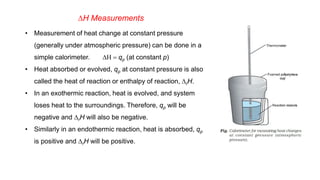
2. The change in enthalpy (ΔH) of a system is equal to the heat (q) absorbed by the system during a process at constant pressure. For a reaction, ΔH is negative if heat is evolved (exothermic) and positive if heat is absorbed (endothermic).
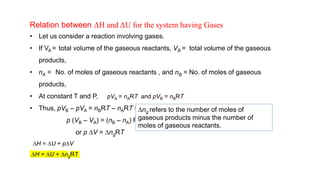
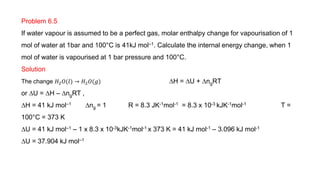
3. For a gas-phase system, the difference between ΔH and ΔU depends on the volume change between reactants and products. If there is a volume increase (products larger

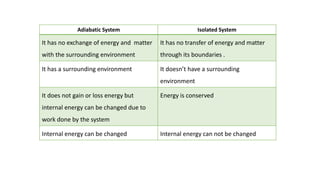
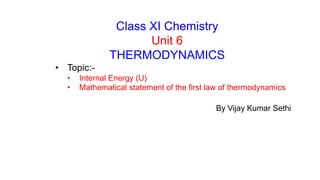
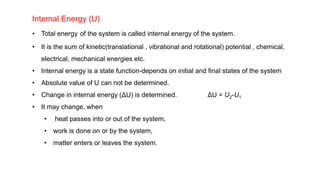
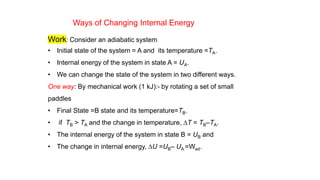
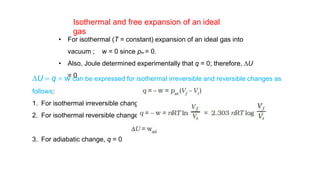
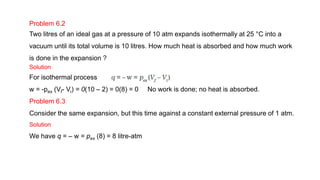
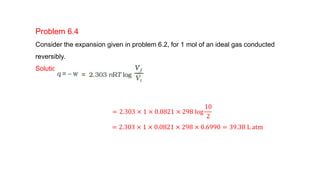

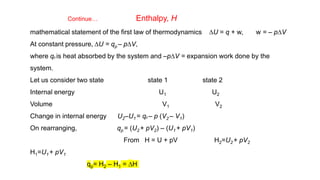
![Enthalpy, H
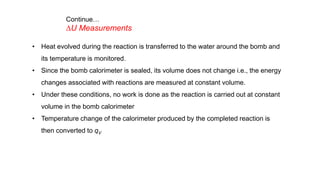
• The heat absorbed at constant volume is equal to change in the Internal Energy i.e.,
DU = qv
• But most of chemical reactions are carried out not at constant volume, but in flasks or
test tubes under constant atmospheric pressure.
• Another thermodynamic function, the enthalpy H [Greek word enthalpien, to warm or
heat content] as : H = U + pV
• Enthalpy is the sum of internal energy and product of pressure-volume.
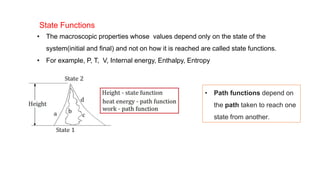
• Enthalpy is a state function-depends on initial and final states of the system
• Absolute value of H can not be determined.
• Change in enthalpy (ΔH) is determined. ΔH = H2-H1](https://image.slidesharecdn.com/sblhprqs7cnkjpgb62zg-class11chapter6thermodynamics-230102105503-77b13671-240115123920-bcefb7ba/85/class11chapter6thermodynamics-230102105503-77b13671-pdf-34-320.jpg)
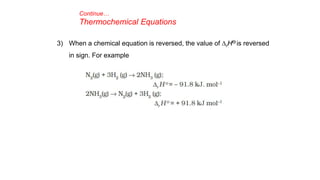
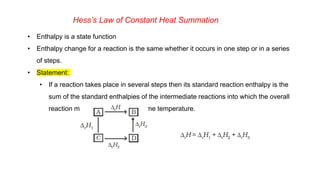
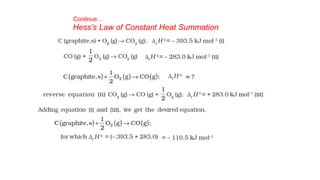
![Continue.. Solution of Problem 6.9
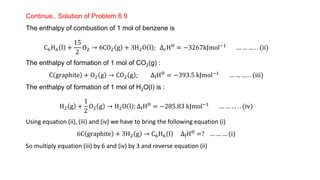
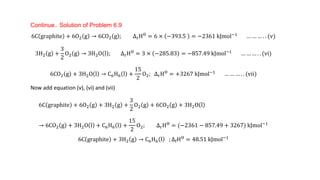
Alternate method
Given DfHƟ CO2(g) = –393.5 kJ mol–1 and DfHƟ H2O(l) = – 285.83 kJ mol–1 , DfHƟ
O2 g = 0
∆rH
Ɵ
= 6 × ∆fH
Ɵ
CO2 + 3 × ∆fH
Ɵ
H2O − [∆fH
Ɵ
C6H6 +
15
2
× ∆f H
Ɵ
O2 ]
−3267 = 6 × −393.5 + 3 × −285.83 − ∆fH
Ɵ
C6H6 + 0
−3267 = −2361 + −857.49 − ∆fH
Ɵ
C6H6 + 0
∆fH
Ɵ
C6H6 = −3218.49 + 3267 = 48.51k Jmol−1](https://image.slidesharecdn.com/sblhprqs7cnkjpgb62zg-class11chapter6thermodynamics-230102105503-77b13671-240115123920-bcefb7ba/85/class11chapter6thermodynamics-230102105503-77b13671-pdf-68-320.jpg)