EXEMPLAR
SOLUTIONS
SOLUTIONS
SOLUTIONS
SCIENCE
For Revised Syllabus Session 2024-25
Artham
Resource Material
9
Powered by
Class
Chapter :Is Matter around Us pure
Chapter 2
Is Matter around Us pure
Multiple Choice Questions
1. Which of the following statements are true for pure substances?
(i) Pure substances contain only one kind of particles
(ii) Pure substances may be compounds or mixtures
(iii) Pure substances have the same composition throughout
(iv) Pure substances can be exemplified by all elements other than nickel
(a) (i) and (ii)
(b) (i) and (iii)
(c) (iii) and (iv)
(d) (ii) and (iii)
Soln
Answer is b) (i) and (iii)
2. Rusting of an article made up of iron is called
(a) corrosion and it is a physical as well as chemical change
(b) dissolution and it is a physical change
(c) corrosion and it is a chemical change
d) dissolution and it is a chemical change
Soln:
Answer is c corrosion and it is a chemical change.
Explanation :
Rusting of iron is corrosion and it’s a chemical change because rust is a chemical compound called hydrate iron
oxide Fe2O3. nH2O, iron(III) which is different from elemental iron.
Physical changes are those changes in which substance identity is not changed and it can get back to
its original form ex: water freezing to ice can be melted back to water. Whereas chemical changes are
those in which original substance identity is changed and they cannot be restored to their original form.
On adding solid solute is to the solvent, some solute dissolves and its concentration increases in solution. This
process is known as dissolution.
Crystallization is a process in which Solute particles in solution collide with the solid solute particles to get
separated out of solution.
3. A mixture of sulphur and carbon disulphide is
(a) heterogeneous and shows Tyndall effect
(b) homogeneous and shows Tyndall effect
(c) heterogeneous and does not show Tyndall effect
(d) homogeneous and does not show Tyndall effect
Soln:
A mixture of sulphur and carbon disulphide is a heterogeneous colloid and shows Tyndall effect. In a colloidal
solution, the particles are big enough to scatter light. The scattering of light by colloidal particles is known as
Tyndall effect. Colloids are actually heterogeneous in nature though they appear to be homogeneous.
Answer is a) heterogeneous and shows Tyndall effect.
Explanation:
A mixture of sulphur and carbon disulphide is heterogeneous and shows Tyndall effect because in a colloidal
solution the particles are big enough to scatter light.
4. Tincture of iodine has antiseptic properties. This solution is made by dissolving
(a) iodine in potassium iodide
(b) iodine in vaseline
(c) iodine in water
(d) iodine in alcohol
Soln:
Answer is (d) iodine in alcohol
Explanation:
Tincture is prepared by using 2-7% elemental iodine and either of potassium iodide or sodium dissolved in
alcohol. Since alcohol is a good solvent and iodine does not dissolve in water answer should be alcohol.
5. Which of the following are homogeneous in nature?
(i) ice
(ii) wood
(iii) soil
(iv) air
(i) and (iii)
(ii) and (iv)
(i) and (iv)
(iii) and (iv)
Soln:
Answer is a) (i) and (iii)
Explanation
Air and ice are homogeneous mixture because its elements are not visible and cannot be distinguished from one
another.
6. Which of the following are physical changes?
(i) Melting of iron metal
(ii) Rusting of iron
(iii) Bending of an iron rod
(iv) Drawing a wire of iron metal
(a) (i), (ii) and (iii)
(b) (i), (ii) and (iv)
(c) (i), (iii) and (iv)
(d) (ii), (iii) and (iv)
Soln:
Answer is (c) (i), (iii) and (iv)
Explanation
Rusting of iron is a chemical process where iron reacts with water and oxygen to produce iron oxide whereas
others given processes are physical changes.
7. Which of the following are chemical changes?
(i) Decaying of wood
(ii) Burning of wood
(iii) Sawing of wood
(iv) Hammering of a nail into a piece of wood
(a) (i) and (ii)
(b) (ii) and (iii)
(c) (iii) and (iv)
(d) (i) and (iv)
Soln:
Answer is (a) (i) and (ii)
Explanation
Decaying of wood and burning of wood because there will be change of chemical composition and wood cannot
be restored to its original form.
Sawing of wood and hammering of nail into a piece of wood are physical process where compounds chemical
composition is not changed.
8. Two substances, A and B were made to react to form a third substance, A2B according to the following
reaction 2 A + B → A2 B which of the following statements concerning this reaction are incorrect?
(i) The product A2B shows the properties of substances A and B
(ii) The product will always have a fixed composition
(iii) The product so formed cannot be classified as a compound
(iv) The product so formed is an element
(a) (i), (ii) and (iii),
(b) (ii), (iii) and (iv)
(c) (i), (iii) and (iv)
(d) (ii), (iii) and (iv)
Soln:
Answer is (c) (i), (iii) and (iv)
Explanation:
A2B is a compound made up of two elements A and B in a fixed ratio. The properties of a compound (e.g., A2B)
are entirely different from those of its constituent elements (ie.g A and B). The composition of a compound is
fixed.
9. Two chemical species X and Y combine together to form a product P which contains both X and Y X + Y
→ P X and Y cannot be broken down into simpler substances by simple chemical reactions. Which of the
following concerning the species X, Y and P are correct?
(i) P is a compound
(ii) X and Y are compounds
(iii) X and Y
(iv) P has a fixed composition
(a) (i), (ii) and (iii),
(b) (i), (ii) and (iv)
(c) (ii), (iii) and (iv)
(d) (i), (iii) and (iv)
Soln:
Here X and Y cannot be further broken down into simpler substance. Hence X and Y are elements and P can be
broken down to its elements hence P is a compound.
Short Answer Questions
10. Suggest separation technique(s) one would need to employ to separate the following mixtures.
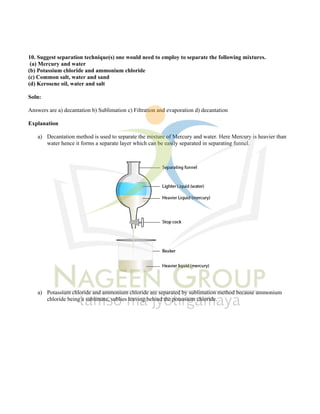
(a) Mercury and water
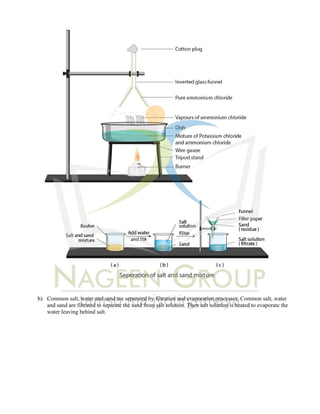
(b) Potassium chloride and ammonium chloride
(c) Common salt, water and sand
(d) Kerosene oil, water and salt
Soln:
Answers are a) decantation b) Sublimation c) Filtration and evaporation d) decantation
Explanation
a) Decantation method is used to separate the mixture of Mercury and water. Here Mercury is heavier than
water hence it forms a separate layer which can be easily separated in separating funnel.
a) Potassium chloride and ammonium chloride are separated by sublimation method because ammonium
chloride being a sublimate, sublies leaving behind the potassium chloride.
b) Common salt, water and sand are separated by filtration and evaporation processes. Common salt, water
and sand are filtrated to separate the sand from salt solution. Then salt solution is heated to evaporate the
water leaving behind salt.
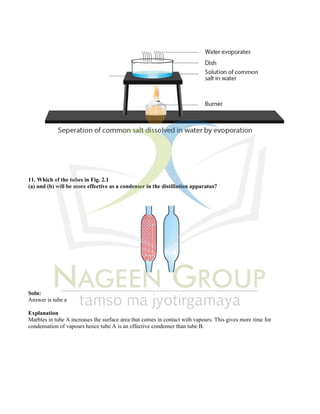
11. Which of the tubes in Fig. 2.1
(a) and (b) will be more effective as a condenser in the distillation apparatus?
Soln:
Answer is tube a
Explanation
Marbles in tube A increases the surface area that comes in contact with vapours. This gives more time for
condensation of vapours hence tube A is an effective condenser than tube B.
12. Salt can be recovered from its solution by evaporation. Suggest some other technique for the same?
Soln:
Answer is crystallization
Explanation:
Salt can be recovered from its solution by crystallization. Crystallization is a more efficient process as it removes
soluble impurities which cannot be done by evaporation.
13. The ‘sea-water’ can be classified as a homogeneous as well as heterogeneous mixture. Comment.
Soln
If we consider the sea water on the surface it comprises water and salts hence it is homogenous mixture. If we
consider the sea water from deep sea it consists of salts, water, mud, decayed plants etc which will be
heterogeneous mixture.
14. While diluting a solution of salt in water, a student by mistake added acetone (boiling point 56°C).
What technique can be employed to get back the acetone? Justify your choice.
Soln:
Distillation can be used to separate acetone from the mixture of salt and water.
Explanation
There is considerable differences in the boiling points of acetone (56°C) and water (100°C). When the solution is
heated acetone evaporates first which can be collected to obtain acetone.
15. What would you observe when
(a) a saturated solution of potassium chloride prepared at 60°C is allowed to cool to room temperature.
(b) an aqueous sugar solution is heated to dryness.
(c) a mixture of iron filings and sulphur powder is heated strongly.
Soln:
a) Sodium potassium chloride will separate out from the saturated solution when the temperature of the
solution reduced from 60°C to room temperature. Solubility of the solid state is affected by the changed
temperature.
b) When aqueous sugar solution is heated forst water gets evaporated upto some extent then sugar gets
charred.
c) Iron combines with sulphur and forms iron sulphide (FES).
16. Explain why particles of a colloidal solution do not settle down when left undisturbed, while in the case
of a suspension they do.
Soln:
Size of the particles in suspension is relatively larger than size of the particles in a solution. Moreover in
suspension molecular interaction is weaker to keep the molecules in suspended form. Hence the particles settle
down. Similarly in colloidal solution molecular interaction is strong hence they remain in suspended form.
17. Smoke and fog both are aerosols. In what way are they different?
Soln:
Both smoke and fog have gas as the dispersion medium (continuous phase). But the difference lies in dispersed
phase .Dispersed phase in fog is liquid whereas in smoke it is solid (particulate matter).
18. Classify the following as physical or chemical properties
(a) The composition of a sample of steel is: 98% iron, 1.5% carbon and 0.5% other elements.
(b) Zinc dissolves in hydrochloric acid with the evolution of hydrogen gas.
(c) Metallic sodium is soft enough to be cut with a knife.
(d) Most metal oxides form alkalis on interacting with water.
Soln:
Ans: Physical properties are a) and c). Chemical properties are b) and d)
Explanation
a) Composition of a sample of steel is: 98% iron, 1.5% carbon and 0.5% other elements. It is a chemical
property because no new compound is formed as the steel is an alloy and alloy and is a homogeneous
mixture of two or more metals or of metallic elements with non-metallic elements.
b) It is chemical property because zinc reacts with HCL to give out zinc chloride and Hydrogen gas.
c) Cutting knife will not involve any chemicals reaction and did not form new compound hence it is a
physical property.
d) It is chemical property as new compound is form by the interaction of metal oxides with alkalis.
19. The teacher instructed three students ‘A’, ‘B’ and ‘C’ respectively to prepare a 50% (mass by volume)
solution of sodium hydroxide (NaOH). ‘A’ dissolved 50g of NaOH in 100 mL of water, ‘B’ dissolved 50g of
NaOH in 100g of water while ‘C’ dissolved 50g of NaOH in water to make 100 mL of solution. Which one
of them has made the desired solution and why?
Soln:
Answer is student C because both B and A has made the solution of 150ml whereas student C prepared required
quantity.
Explanation
Student A and B prepare 150 ml solution, so student c make desire solution because he add water to make 100 ml
solution. and from calculation,
%w/v = 100 × weight of sub (solute)
volume of solution
∴ %50 = 100 × weight of sub
100 ml
weight of sub = 50 ×100 ml
100
∴ weight of sub = 50 g
Here the 50g NaOH requred for 50% w/v 100ml solution of NaOH
20. Name the process associated with the following
(a) Dry ice is kept at room temperature and at one atmospheric pressure.
(b) A drop of ink placed on the surface of water contained in a glass spreads throughout the water.
(c) A potassium permanganate crystal is in a beaker and water is poured into the beaker with stirring.
(d) A acetone bottle is left open and the bottle becomes empty.
(e) Milk is churned to separate cream from it.
(f) Settling of sand when a mixture of sand and water is left undisturbed for some time.
(g) Fine beam of light entering through a small hole in a dark room, illuminates the particles in its paths
Soln:
Answers a) sublimation
b) Diffusion
c) Dissolution/ diffusion
d) Evaporation
e) Centrifugation
f) Sedimentation
g) Tyndall effect (Scattering of light)
21. You are given two samples of water labelled as ‘A’ and ‘B’. Sample ‘A’ boils at 100°C and sample ‘B’
boils at 102°C. Which sample of water will not freeze at 0°C? Comment.
Soln:
Answer is sample B
Explanation
Sample B may consists of impurities. At 1 atm boiling point of water is 100°C and freezing point is 0°C. Hence
sample B which will not boil at 102°C will not freeze at 0°C.
22. What are the favourable qualities given to gold when it is alloyed with copper or silver for the purpose
of making ornaments?
Soln:
Pure gold (24) karat) is soft and does not have strength. In order to give strength to gold silver and copper is
alloyed to gold. An alloy that has 20 parts of gold and 4 parts of silver is known as 24 karat gold.
23. An element is sonorous and highly ductile. Under which category would you classify this element? What
other characteristics do you expect the element to possess?
Soln:
An element which is sonorous and highly ductile can be classified as metal. Other characterised than can be
expected are lustre, malleability, heat and electrical conductivity.
24. Give an example each for the mixture having the following characteristics. Suggest a suitable method to
separate the components of these mixtures
(a) A volatile and a non-volatile component.
(b) Two volatile components with appreciable difference in boiling points.
(c) Two immiscible liquids.
(d) One of the components changes directly from solid to gaseous state.
(e) Two or more coloured constituents soluble in some solvent.
Soln:
It will be a pure substance because chemical structure of the sugar remains same despite of change in source of
their extraction.
25. Fill in the blanks
(a) A colloid is a ——— mixture and its components can be separated by the technique known as ———.
(b) Ice, water and water vapour look different and display different —— properties but they are ———
the same.
(c) A mixture of chloroform and water taken in a separating funnel is mixed and left undisturbed for some
time. The upper layer in the separating funnel will be of——— and the lower layer will be that of ———.
(d) A mixture of two or more miscible liquids, for which the difference in the boiling points is less than 25
K can be separated by the process called———.
(e) When light is passed through water containing a few drops of milk, it shows a bluish tinge. This is due to
the ——— of light by milk and the phenomenon is called ——— . This indicates that milk is a ———
solution.
Soln:
Answers
a) Heterogeneous
b) Physical
c) Water, Chloroform
d) Distillation
e) Scattering, Tyndall effect, colloidal
26. Sucrose (sugar) crystals obtained from sugarcane and beetroot are mixed together. Will it be a pure
substance or a mixture? Give reasons for the same.
Soln:
It will be a pure substance because chemical structure of the sugar remains same despite of change in source of
their extraction.
27. Give some examples of Tyndall effect observed in your surroundings?
Soln
1. The beam of light passing on screen in a theatre.
2. When light passes through a dark room.
28. Can we separate alcohol dissolved in water by using a separating funnel? If yes, then describe the
procedure. If not, explain.
Soln:
We cannot separate alcohol dissolved in water by separating funnel as they both are miscible solvents.
29. On heating calcium carbonate gets converted into calcium oxide and carbon dioxide.
(a) Is this a physical or a chemical change?
(b) Can you prepare one acidic and one basic solution by using the products formed in the above process?
If so, write the chemical equation involved
Soln:
Answers:
a) It is a chemical change
CaCO3+H2O →CaO+CO2
b) Acidic and basic solutions can be prepared by dissolving the products of the above process in water
CaO+H2O →Ca(OH)2 (basic solution) CO2 + H2O→H2 CO3 (acidic solution)
30. Non metals are usually poor conductors of heat and electricity. They are non-lustrous, non-sonorous,
non-malleable and are coloured.
(a) Name a lustrous non-metal.
(b) Name a non-metal which exists as a liquid at room temperature.
(c) The allotropic form of a non-metal is a good conductor of electricity. Name the allotrope.
(d) Name a non-metal which is known to form the largest number of compounds.
(e) Name a non-metal other than carbon which shows allotropy.
(f) Name a non-metal which is required for combustion.
Soln:
Answers
a) Iodine is a lustrous non-metal.
b) Bromine is liquid at room temperature
c) Graphite is allotropic form of Carbon (non-metal) which is a good conductor of electricity.
d) Carbon is a non-metal which can form the largest number of compounds.
e) Sulphur and Phosphorous are the non-metals which shows allotropy.
f) Oxygen is a non-metal which is required for combustion.
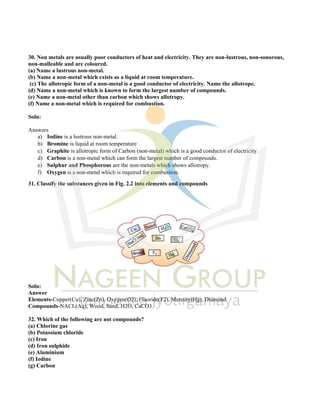
31. Classify the substances given in Fig. 2.2 into elements and compounds
Soln:
Answer
Elements-Copper(Cu), Zinc(Zn), Oxygen(O2), Fluoride(F2), Mercury(Hg), Diamond
Compounds-NACL(Aq), Wood, Sand, H2O, CaCO3
32. Which of the following are not compounds?
(a) Chlorine gas
(b) Potassium chloride
(c) Iron
(d) Iron sulphide
(e) Aluminium
(f) Iodine
(g) Carbon
(h) Carbon monoxide
(i) Sulphur powder
Soln:
Answers
a.Chlorine gas
c.Iron
e. Aluminium
f. Iodine
g.Carbon
i.Sulphur powder
Long Answer Questions
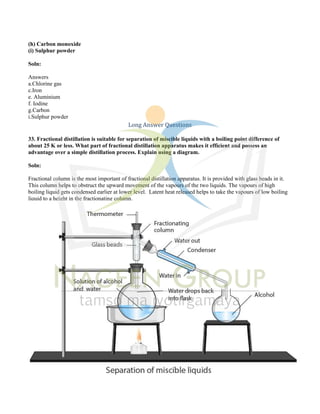
33. Fractional distillation is suitable for separation of miscible liquids with a boiling point difference of
about 25 K or less. What part of fractional distillation apparatus makes it efficient and possess an
advantage over a simple distillation process. Explain using a diagram.
Soln:
Fractional column is the most important of fractional distillation apparatus. It is provided with glass beads in it.
This column helps to obstruct the upward movement of the vapours of the two liquids. The vapours of high
boiling liquid gets condensed earlier at lower level. Latent heat released helps to take the vapours of low boiling
liquid to a height in the fractionating column.
The advantages are as
given below
1. This method can separate the liquids with a boiling point difference about or less than 25 K,
2. During the process, both evaporation and condensation take place simultaneously.
3. A mixture (like petroleum) can also be separated by fractional distillation process which contains several
components.
34.
(a)Under which category of mixtures will you classify alloys and why?
(b) A solution is always a liquid. Comment.
(c) Can a solution be heterogeneous?
Soln:
a) An alloy is a homogenous mixture of two or more elements. Elements can be two metals or a metal with a
non-metal.
An alloy is classified as a homogenous mixture because it shows properties of two or more elements it is made of.
It constituents are in varied composition. Ex: Brass is an alloy which shows characteristics of copper and Zinc and
their composition varies from 20 to 35 %.
b) No the solution cannot be always liquid
35. Iron filings and sulphur were mixed together and divided into two parts, ‘A’ and ‘B’. Part ‘A’ was
heated strongly while Part ‘B’ was not heated. Dilute hydrochloric acid was added to both the Parts and
evolution of gas was seen in both the cases. How will you identify the gases evolved?
Soln:
When iron fillings and sulphur is heated it will give following reaction
Fe(s)+S(s) FeS
When HCl is added to this mixture ferric chloride is produces and Hydrogen Sulphide gas is produced. Foul rotten
egg smell of Hydrogen sulphide is the indicator of H2S production.
When dilute HCL is added to setup B Hydrogen gas is evolved and sulphur does not take part in the reaction.
When a burning match stick is brought near the evolved gas, matchstick burns with a pop. This is the indication of
production of Hydrogen gas.
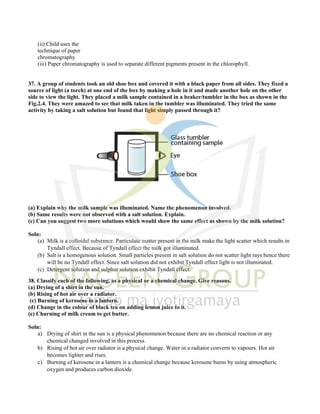
36. A child wanted to separate the mixture of dyes constituting a sample of ink. He marked a line by the ink
on the filter paper and placed the filter paper in a glass containing water as shown in Fig.2.3. The filter
paper was removed when the water moved near the top of the filter paper.
(i) What would you expect to see, if the ink contains three different coloured components?
(ii) Name the technique used by the child.
(iii) Suggest one more application of this technique.
Soln:
(i) If the ink contains three different coloured components then you can observe three different bands on the
paper
(ii) Child uses the
technique of paper
chromatography
(iii) Paper chromatography is used to separate different pigments present in the chlorophyll.
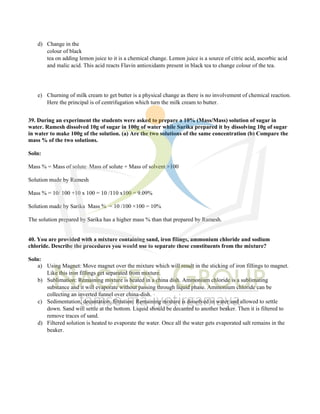
37. A group of students took an old shoe box and covered it with a black paper from all sides. They fixed a
source of light (a torch) at one end of the box by making a hole in it and made another hole on the other
side to view the light. They placed a milk sample contained in a beaker/tumbler in the box as shown in the
Fig.2.4. They were amazed to see that milk taken in the tumbler was illuminated. They tried the same
activity by taking a salt solution but found that light simply passed through it?
(a) Explain why the milk sample was illuminated. Name the phenomenon involved.
(b) Same results were not observed with a salt solution. Explain.
(c) Can you suggest two more solutions which would show the same effect as shown by the milk solution?
Soln:
(a) Milk is a colloidal substance. Particulate matter present in the milk make the light scatter which results in
Tyndall effect. Because of Tyndall effect the milk got illuminated.
(b) Salt is a homogenous solution. Small particles present in salt solution do not scatter light rays hence there
will be no Tyndall effect. Since salt solution did not exhibit Tyndall effect light is not illuminated.
(c) Detergent solution and sulphur solution exhibit Tyndall effect.
38. Classify each of the following, as a physical or a chemical change. Give reasons.
(a) Drying of a shirt in the sun.
(b) Rising of hot air over a radiator.
(c) Burning of kerosene in a lantern.
(d) Change in the colour of black tea on adding lemon juice to it.
(e) Churning of milk cream to get butter.
Soln:
a) Drying of shirt in the sun is a physical phenomenon because there are no chemical reaction or any
chemical changed involved in this process.
b) Rising of hot air over radiator is a physical change. Water in a radiator converts to vapours. Hot air
becomes lighter and rises.
c) Burning of kerosene in a lantern is a chemical change because kerosene burns by using atmospheric
oxygen and produces carbon dioxide.
d) Change in the
colour of black
tea on adding lemon juice to it is a chemical change. Lemon juice is a source of citric acid, ascorbic acid
and malic acid. This acid reacts Flavin antioxidants present in black tea to change colour of the tea.
e) Churning of milk cream to get butter is a physical change as there is no involvement of chemical reaction.
Here the principal is of centrifugation which turn the milk cream to butter.
39. During an experiment the students were asked to prepare a 10% (Mass/Mass) solution of sugar in
water. Ramesh dissolved 10g of sugar in 100g of water while Sarika prepared it by dissolving 10g of sugar
in water to make 100g of the solution. (a) Are the two solutions of the same concentration (b) Compare the
mass % of the two solutions.
Soln:
Mass % = Mass of solute Mass of solute + Mass of solvent ×100
Solution made by Ramesh
Mass % = 10/ 100 +10 x 100 = 10 /110 x100 = 9.09%
Solution made by Sarika Mass % = 10 /100 ×100 = 10%
The solution prepared by Sarika has a higher mass % than that prepared by Ramesh.
40. You are provided with a mixture containing sand, iron filings, ammonium chloride and sodium
chloride. Describe the procedures you would use to separate these constituents from the mixture?
Soln:
a) Using Magnet: Move magnet over the mixture which will result in the sticking of iron fillings to magnet.
Like this iron fillings get separated from mixture.
b) Sublimation: Remaining mixture is heated in a china dish. Ammonium chloride is a sublimating
substance and it will evaporate without passing through liquid phase. Ammonium chloride can be
collecting an inverted funnel over china-dish.
c) Sedimentation, decantation, filtration: Remaining mixture is dissolved in water and allowed to settle
down. Sand will settle at the bottom. Liquid should be decanted to another beaker. Then it is filtered to
remove traces of sand.
d) Filtered solution is heated to evaporate the water. Once all the water gets evaporated salt remains in the
beaker.
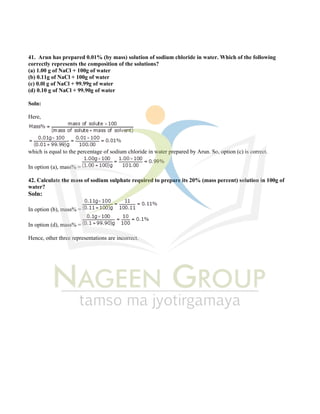
41. Arun has prepared 0.01% (by mass) solution of sodium chloride in water. Which of the following
correctly represents the composition of the solutions?
(a) 1.00 g of NaCl + 100g of water
(b) 0.11g of NaCl + 100g of water
(c) 0.0l g of NaCl + 99.99g of water
(d) 0.10 g of NaCl + 99.90g of water
Soln:
Here,
which is equal to the percentage of sodium chloride in water prepared by Arun. So, option (c) is correct.
In option (a), mass% =
42. Calculate the mass of sodium sulphate required to prepare its 20% (mass percent) solution in 100g of
water?
Soln:
In option (b), mass% =
In option (d), mass% =
Hence, other three representations are incorrect.
CLICK TO DOWNLOAD NCERT EXEMPLAR
SOLUTIONS
CLASS 9: SCIENCE (ALL CHAPTERS)
Dear Teachers and Students,
Join School of Educators' exclusive WhatsApp, Telegram, and Signal groups for FREE access
to a vast range of educational resources designed to help you achieve 100/100 in exams!
Separate groups for teachers and students are available, packed with valuable content to
boost your performance.
Additionally, benefit from expert tips, practical advice, and study hacks designed to enhance
performance in both CBSE exams and competitive entrance tests.
Don’t miss out—join today and take the first step toward academic excellence!
Join the Teachers and Students
Group by Clicking the Link Below
JOIN OUR
WHATSAPP
GROUPS
FOR FREE EDUCATIONAL
RESOURCES
JOIN SCHOOL OF EDUCATORS WHATSAPP GROUPS
FOR FREE EDUCATIONAL RESOURCES
BENEFITS OF SOE WHATSAPP GROUPS
We are thrilled to introduce the School of Educators WhatsApp Group, a
platform designed exclusively for educators to enhance your teaching & Learning
experience and learning outcomes. Here are some of the key benefits you can
expect from joining our group:
Abundance of Content: Members gain access to an extensive repository of
educational materials tailored to their class level. This includes various formats such
as PDFs, Word files, PowerPoint presentations, lesson plans, worksheets, practical
tips, viva questions, reference books, smart content, curriculum details, syllabus,
marking schemes, exam patterns, and blueprints. This rich assortment of resources
enhances teaching and learning experiences.
Immediate Doubt Resolution: The group facilitates quick clarification of doubts.
Members can seek assistance by sending messages, and experts promptly respond
to queries. This real-time interaction fosters a supportive learning environment
where educators and students can exchange knowledge and address concerns
effectively.
Access to Previous Years' Question Papers and Topper Answers: The group
provides access to previous years' question papers (PYQ) and exemplary answer
scripts of toppers. This resource is invaluable for exam preparation, allowing
individuals to familiarize themselves with the exam format, gain insights into scoring
techniques, and enhance their performance in assessments.
Free and Unlimited Resources: Members enjoy the benefit of accessing an array of
educational resources without any cost restrictions. Whether its study materials,
teaching aids, or assessment tools, the group offers an abundance of resources
tailored to individual needs. This accessibility ensures that educators and students
have ample support in their academic endeavors without financial constraints.
Instant Access to Educational Content: SOE WhatsApp groups are a platform where
teachers can access a wide range of educational content instantly. This includes study
materials, notes, sample papers, reference materials, and relevant links shared by
group members and moderators.
Timely Updates and Reminders: SOE WhatsApp groups serve as a source of timely
updates and reminders about important dates, exam schedules, syllabus changes, and
academic events. Teachers can stay informed and well-prepared for upcoming
assessments and activities.
Interactive Learning Environment: Teachers can engage in discussions, ask questions,
and seek clarifications within the group, creating an interactive learning environment.
This fosters collaboration, peer learning, and knowledge sharing among group
members, enhancing understanding and retention of concepts.
Access to Expert Guidance: SOE WhatsApp groups are moderated by subject matter
experts, teachers, or experienced educators can benefit from their guidance,
expertise, and insights on various academic topics, exam strategies, and study
techniques.
Join the School of Educators WhatsApp Group today and unlock a world of resources,
support, and collaboration to take your teaching to new heights. To join, simply click
on the group links provided below or send a message to +91-95208-77777 expressing
your interest.
Together, let's empower ourselves & Our Students and
inspire the next generation of learners.
Best Regards,
Team
School of Educators
Join School of Educators WhatsApp Groups
You will get Pre- Board Papers PDF, Word file, PPT, Lesson Plan, Worksheet, practical
tips and Viva questions, reference books, smart content, curriculum, syllabus,
marking scheme, toppers answer scripts, revised exam pattern, revised syllabus,
Blue Print etc. here . Join Your Subject / Class WhatsApp Group.
Kindergarten to Class XII (For Teachers Only)
Class 1 Class 2 Class 3
Class 4 Class 5 Class 6
Class 7 Class 8 Class 9
Class 10 Class 11 (Science) Class 11 (Humanities)
Class 11 (Commerce)
Class 12 (Commerce)
Class 12 (Science) Class 12 (Humanities)
Kindergarten
Subject Wise Secondary and Senior Secondary Groups
(IX & X For Teachers Only)
Secondary Groups (IX & X)
Senior Secondary Groups (XI & XII For Teachers Only)
SST Mathematics Science
English Hindi-A IT Code-402
Physics Chemistry English
Mathematics
Economics
Biology
BST
Accountancy
History
Hindi-B Artificial Intelligence
Hindi Core Home Science Sanskrit
Psychology Political Science Painting
Vocal Music Comp. Science IP
Physical Education APP. Mathematics Legal Studies
Entrepreneurship French
Teachers Jobs
Principal’s Group IIT/NEET
Other Important Groups (For Teachers & Principal’s)
IT
Sociology Hindi Elective
Geography
Artificial Intelligence
Join School of Educators WhatsApp Groups
You will get Pre- Board Papers PDF, Word file, PPT, Lesson Plan, Worksheet, practical
tips and Viva questions, reference books, smart content, curriculum, syllabus,
marking scheme, toppers answer scripts, revised exam pattern, revised syllabus,
Blue Print etc. here . Join Your Subject / Class WhatsApp Group.
Kindergarten to Class XII (For Students Only)
Class 1 Class 2 Class 3
Class 4 Class 5 Class 6
Class 7 Class 8 Class 9
Class 10 Class 11 (Science) Class 11 (Humanities)
Class 11 (Commerce)
Class 12 (Commerce)
Class 12 (Science) Class 12 (Humanities)
Artificial Intelligence
(VI TO VIII)
Subject Wise Secondary and Senior Secondary Groups
(IX & X For Students Only)
Secondary Groups (IX & X)
Senior Secondary Groups (XI & XII For Students Only)
SST Mathematics Science
English Hindi IT Code
Physics Chemistry English
Mathematics
Economics
Biology
BST
Accountancy
History
Artificial Intelligence
Hindi Core Home Science Sanskrit
Psychology Political Science Painting
Music Comp. Science IP
Physical Education APP. Mathematics Legal Studies
Entrepreneurship French IT
Sociology Hindi Elective
Geography
IIT/NEET
AI CUET
To maximize the benefits of these WhatsApp groups, follow these guidelines:
1. Share your valuable resources with the group.
2. Help your fellow educators by answering their queries.
3. Watch and engage with shared videos in the group.
4. Distribute WhatsApp group resources among your students.
5. Encourage your colleagues to join these groups.
Additional notes:
1. Avoid posting messages between 9 PM and 7 AM.
2. After sharing resources with students, consider deleting outdated data if necessary.
3. It's a NO Nuisance groups, single nuisance and you will be removed.
No introductions.
No greetings or wish messages.
No personal chats or messages.
No spam. Or voice calls
Share and seek learning resources only.
Groups Rules & Regulations:
Please only share and request learning resources. For assistance,
contact the helpline via WhatsApp: +91-95208-77777.
Join Premium WhatsApp Groups
Ultimate Educational Resources!!
Join our premium groups and just Rs. 1000 and gain access to all our exclusive
materials for the entire academic year. Whether you're a student in Class IX, X, XI, or
XII, or a teacher for these grades, Artham Resources provides the ultimate tools to
enhance learning. Pay now to delve into a world of premium educational content!
Class 9 Class 10 Class 11
Click here for more details
📣 Don't Miss Out! Elevate your academic journey with top-notch study materials and secure
your path to top scores! Revolutionize your study routine and reach your academic goals with
our comprehensive resources. Join now and set yourself up for success! 📚🌟
Best Wishes,
Team
School of Educators & Artham Resources
Class 12
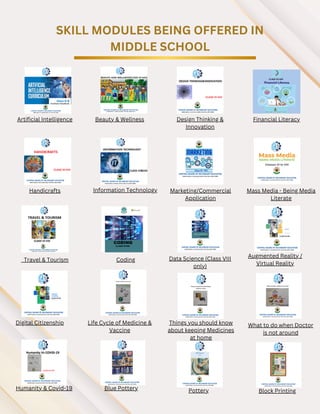
SKILL MODULES BEING OFFERED IN
MIDDLE SCHOOL
Artificial Intelligence Beauty & Wellness Design Thinking &
Innovation
Financial Literacy
Handicrafts Information Technology Marketing/Commercial
Application
Mass Media - Being Media
Literate
Travel & Tourism Coding Data Science (Class VIII
only)
Augmented Reality /
Virtual Reality
Digital Citizenship Life Cycle of Medicine &
Vaccine
Things you should know
about keeping Medicines
at home
What to do when Doctor
is not around
Humanity & Covid-19 Blue Pottery Pottery Block Printing
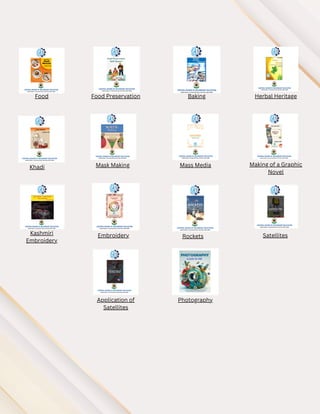
Food Food Preservation Baking Herbal Heritage
Khadi Mask Making Mass Media Making of a Graphic
Novel
Kashmiri
Embroidery
Embroidery Rockets Satellites
Application of
Satellites
Photography
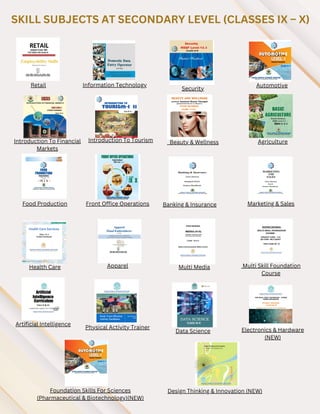
SKILL SUBJECTS AT SECONDARY LEVEL (CLASSES IX – X)
Retail Information Technology
Security
Automotive
Introduction To Financial
Markets
Introduction To Tourism Beauty & Wellness Agriculture
Food Production Front Office Operations Banking & Insurance Marketing & Sales
Health Care Apparel Multi Media Multi Skill Foundation
Course
Artificial Intelligence
Physical Activity Trainer
Data Science Electronics & Hardware
(NEW)
Design Thinking & Innovation (NEW)
Foundation Skills For Sciences
(Pharmaceutical & Biotechnology)(NEW)
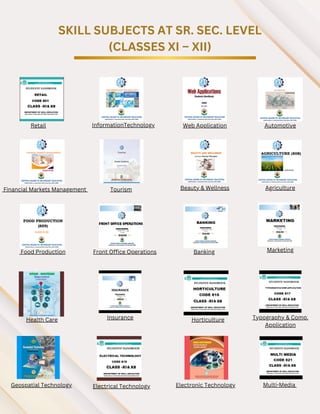
SKILL SUBJECTS AT SR. SEC. LEVEL
(CLASSES XI – XII)
Retail InformationTechnology Web Application Automotive
Financial Markets Management Tourism Beauty & Wellness Agriculture
Food Production Front Office Operations Banking Marketing
Health Care Insurance Horticulture Typography & Comp.
Application
Geospatial Technology Electrical Technology Electronic Technology Multi-Media
Taxation Cost Accounting Office Procedures &
Practices
Shorthand (English)
Shorthand (Hindi) Air-Conditioning &
Refrigeration
Medical Diagnostics Textile Design
Design Salesmanship Business
Administration
Food Nutrition &
Dietetics
Mass Media Studies Library & Information
Science
Fashion Studies Applied Mathematics
Yoga Early Childhood Care &
Education
Artificial Intelligence Data Science
Physical Activity
Trainer(new)
Land Transportation
Associate (NEW)
Electronics &
Hardware (NEW)
Design Thinking &
Innovation (NEW)
Join School of Educators Signal Groups
You will get Pre- Board Papers PDF, Word file, PPT, Lesson Plan, Worksheet, practical
tips and Viva questions, reference books, smart content, curriculum, syllabus,
marking scheme, toppers answer scripts, revised exam pattern, revised syllabus,
Blue Print etc. here . Join Your Subject / Class signal Group.
Kindergarten to Class XII
Class 2 Class 3
Class 4
Class 5 Class 6
Class 7 Class 8 Class 9
Class 10
Class 1
Class 11 (Humanities)
Class 11 (Science)
Class 11 (Commerce) Class 12 (Science) Class 12 (Humanities)
Class 12 (Commerce) Kindergarten Artifical intelligence
Subject Wise Secondary and Senior Secondary
Groups IX & X
Secondary Groups (IX & X)
SST Mathematics Science
English Hindi-A
IT Code-402
Hindi-B
Senior Secondary Groups XI & XII
Physics Chemistry English
Mathematics Biology Accountancy
Economics
BST History
IT Artifical intelligence
Geography Sociology Hindi Elective
Hindi Core Home Science Sanskrit
Psychology Political Science Painting
Vocal Music Comp. Science
IP
Physical Education APP. Mathematics Legal Studies
Entrepreneurship French
Artifical intelligence CUET
IIT/NEET
Join School of Educators CBSE Telegram Groups
Kindergarten
All classes Class 1 Class 2
Class 3 Class 4 Class 5
Class 6 Class 7 Class 8
Class 9 Class 10 Class 11 (Sci)
Class 11 (Com) Class 11 (Hum) Class 12 (Sci)
Class 12 (Com) Class 12 (Hum) JEE/NEET
CUET NDA, OLYMPIAD, NTSE Principal Professional Group
Teachers Professional Group Project File Group
Join School of Educators ICSE Telegram Groups
Kindergarten Class 1 Class 2
Class 3 Class 4 Class 5
Class 6 Class 7 Class 8
Class 9 Class 10 Class 11 (Sci)
Class 11 (Com) Class 11 (Hum) Class 12 (Sci)
Class 12 (Com) Class 12 (Hum)

Class 9 Science Exemplar Solution Chapter-2 Is Matter Around Us Pure

  • 1.
    EXEMPLAR SOLUTIONS SOLUTIONS SOLUTIONS SCIENCE For Revised SyllabusSession 2024-25 Artham Resource Material 9 Powered by Class Chapter :Is Matter around Us pure
  • 2.
    Chapter 2 Is Matteraround Us pure Multiple Choice Questions 1. Which of the following statements are true for pure substances? (i) Pure substances contain only one kind of particles (ii) Pure substances may be compounds or mixtures (iii) Pure substances have the same composition throughout (iv) Pure substances can be exemplified by all elements other than nickel (a) (i) and (ii) (b) (i) and (iii) (c) (iii) and (iv) (d) (ii) and (iii) Soln Answer is b) (i) and (iii) 2. Rusting of an article made up of iron is called (a) corrosion and it is a physical as well as chemical change (b) dissolution and it is a physical change (c) corrosion and it is a chemical change d) dissolution and it is a chemical change Soln: Answer is c corrosion and it is a chemical change. Explanation : Rusting of iron is corrosion and it’s a chemical change because rust is a chemical compound called hydrate iron oxide Fe2O3. nH2O, iron(III) which is different from elemental iron. Physical changes are those changes in which substance identity is not changed and it can get back to its original form ex: water freezing to ice can be melted back to water. Whereas chemical changes are those in which original substance identity is changed and they cannot be restored to their original form. On adding solid solute is to the solvent, some solute dissolves and its concentration increases in solution. This process is known as dissolution. Crystallization is a process in which Solute particles in solution collide with the solid solute particles to get separated out of solution. 3. A mixture of sulphur and carbon disulphide is (a) heterogeneous and shows Tyndall effect (b) homogeneous and shows Tyndall effect (c) heterogeneous and does not show Tyndall effect (d) homogeneous and does not show Tyndall effect
  • 3.
    Soln: A mixture ofsulphur and carbon disulphide is a heterogeneous colloid and shows Tyndall effect. In a colloidal solution, the particles are big enough to scatter light. The scattering of light by colloidal particles is known as Tyndall effect. Colloids are actually heterogeneous in nature though they appear to be homogeneous. Answer is a) heterogeneous and shows Tyndall effect. Explanation: A mixture of sulphur and carbon disulphide is heterogeneous and shows Tyndall effect because in a colloidal solution the particles are big enough to scatter light. 4. Tincture of iodine has antiseptic properties. This solution is made by dissolving (a) iodine in potassium iodide (b) iodine in vaseline (c) iodine in water (d) iodine in alcohol Soln: Answer is (d) iodine in alcohol Explanation: Tincture is prepared by using 2-7% elemental iodine and either of potassium iodide or sodium dissolved in alcohol. Since alcohol is a good solvent and iodine does not dissolve in water answer should be alcohol. 5. Which of the following are homogeneous in nature? (i) ice (ii) wood (iii) soil (iv) air (i) and (iii) (ii) and (iv) (i) and (iv) (iii) and (iv) Soln: Answer is a) (i) and (iii) Explanation Air and ice are homogeneous mixture because its elements are not visible and cannot be distinguished from one another.
  • 4.
    6. Which ofthe following are physical changes? (i) Melting of iron metal (ii) Rusting of iron (iii) Bending of an iron rod (iv) Drawing a wire of iron metal (a) (i), (ii) and (iii) (b) (i), (ii) and (iv) (c) (i), (iii) and (iv) (d) (ii), (iii) and (iv) Soln: Answer is (c) (i), (iii) and (iv) Explanation Rusting of iron is a chemical process where iron reacts with water and oxygen to produce iron oxide whereas others given processes are physical changes. 7. Which of the following are chemical changes? (i) Decaying of wood (ii) Burning of wood (iii) Sawing of wood (iv) Hammering of a nail into a piece of wood (a) (i) and (ii) (b) (ii) and (iii) (c) (iii) and (iv) (d) (i) and (iv) Soln: Answer is (a) (i) and (ii) Explanation Decaying of wood and burning of wood because there will be change of chemical composition and wood cannot be restored to its original form. Sawing of wood and hammering of nail into a piece of wood are physical process where compounds chemical composition is not changed.
  • 5.
    8. Two substances,A and B were made to react to form a third substance, A2B according to the following reaction 2 A + B → A2 B which of the following statements concerning this reaction are incorrect? (i) The product A2B shows the properties of substances A and B (ii) The product will always have a fixed composition (iii) The product so formed cannot be classified as a compound (iv) The product so formed is an element (a) (i), (ii) and (iii), (b) (ii), (iii) and (iv) (c) (i), (iii) and (iv) (d) (ii), (iii) and (iv) Soln: Answer is (c) (i), (iii) and (iv) Explanation: A2B is a compound made up of two elements A and B in a fixed ratio. The properties of a compound (e.g., A2B) are entirely different from those of its constituent elements (ie.g A and B). The composition of a compound is fixed. 9. Two chemical species X and Y combine together to form a product P which contains both X and Y X + Y → P X and Y cannot be broken down into simpler substances by simple chemical reactions. Which of the following concerning the species X, Y and P are correct? (i) P is a compound (ii) X and Y are compounds (iii) X and Y (iv) P has a fixed composition (a) (i), (ii) and (iii), (b) (i), (ii) and (iv) (c) (ii), (iii) and (iv) (d) (i), (iii) and (iv) Soln: Here X and Y cannot be further broken down into simpler substance. Hence X and Y are elements and P can be broken down to its elements hence P is a compound. Short Answer Questions
  • 6.
    10. Suggest separationtechnique(s) one would need to employ to separate the following mixtures. (a) Mercury and water (b) Potassium chloride and ammonium chloride (c) Common salt, water and sand (d) Kerosene oil, water and salt Soln: Answers are a) decantation b) Sublimation c) Filtration and evaporation d) decantation Explanation a) Decantation method is used to separate the mixture of Mercury and water. Here Mercury is heavier than water hence it forms a separate layer which can be easily separated in separating funnel. a) Potassium chloride and ammonium chloride are separated by sublimation method because ammonium chloride being a sublimate, sublies leaving behind the potassium chloride.
  • 7.
    b) Common salt,water and sand are separated by filtration and evaporation processes. Common salt, water and sand are filtrated to separate the sand from salt solution. Then salt solution is heated to evaporate the water leaving behind salt.
  • 8.
    11. Which ofthe tubes in Fig. 2.1 (a) and (b) will be more effective as a condenser in the distillation apparatus? Soln: Answer is tube a Explanation Marbles in tube A increases the surface area that comes in contact with vapours. This gives more time for condensation of vapours hence tube A is an effective condenser than tube B.
  • 9.
    12. Salt canbe recovered from its solution by evaporation. Suggest some other technique for the same? Soln: Answer is crystallization Explanation: Salt can be recovered from its solution by crystallization. Crystallization is a more efficient process as it removes soluble impurities which cannot be done by evaporation. 13. The ‘sea-water’ can be classified as a homogeneous as well as heterogeneous mixture. Comment. Soln If we consider the sea water on the surface it comprises water and salts hence it is homogenous mixture. If we consider the sea water from deep sea it consists of salts, water, mud, decayed plants etc which will be heterogeneous mixture. 14. While diluting a solution of salt in water, a student by mistake added acetone (boiling point 56°C). What technique can be employed to get back the acetone? Justify your choice. Soln: Distillation can be used to separate acetone from the mixture of salt and water. Explanation There is considerable differences in the boiling points of acetone (56°C) and water (100°C). When the solution is heated acetone evaporates first which can be collected to obtain acetone. 15. What would you observe when (a) a saturated solution of potassium chloride prepared at 60°C is allowed to cool to room temperature. (b) an aqueous sugar solution is heated to dryness. (c) a mixture of iron filings and sulphur powder is heated strongly. Soln: a) Sodium potassium chloride will separate out from the saturated solution when the temperature of the solution reduced from 60°C to room temperature. Solubility of the solid state is affected by the changed temperature. b) When aqueous sugar solution is heated forst water gets evaporated upto some extent then sugar gets charred. c) Iron combines with sulphur and forms iron sulphide (FES).
  • 10.
    16. Explain whyparticles of a colloidal solution do not settle down when left undisturbed, while in the case of a suspension they do. Soln: Size of the particles in suspension is relatively larger than size of the particles in a solution. Moreover in suspension molecular interaction is weaker to keep the molecules in suspended form. Hence the particles settle down. Similarly in colloidal solution molecular interaction is strong hence they remain in suspended form. 17. Smoke and fog both are aerosols. In what way are they different? Soln: Both smoke and fog have gas as the dispersion medium (continuous phase). But the difference lies in dispersed phase .Dispersed phase in fog is liquid whereas in smoke it is solid (particulate matter). 18. Classify the following as physical or chemical properties (a) The composition of a sample of steel is: 98% iron, 1.5% carbon and 0.5% other elements. (b) Zinc dissolves in hydrochloric acid with the evolution of hydrogen gas. (c) Metallic sodium is soft enough to be cut with a knife. (d) Most metal oxides form alkalis on interacting with water. Soln: Ans: Physical properties are a) and c). Chemical properties are b) and d) Explanation a) Composition of a sample of steel is: 98% iron, 1.5% carbon and 0.5% other elements. It is a chemical property because no new compound is formed as the steel is an alloy and alloy and is a homogeneous mixture of two or more metals or of metallic elements with non-metallic elements. b) It is chemical property because zinc reacts with HCL to give out zinc chloride and Hydrogen gas. c) Cutting knife will not involve any chemicals reaction and did not form new compound hence it is a physical property. d) It is chemical property as new compound is form by the interaction of metal oxides with alkalis. 19. The teacher instructed three students ‘A’, ‘B’ and ‘C’ respectively to prepare a 50% (mass by volume) solution of sodium hydroxide (NaOH). ‘A’ dissolved 50g of NaOH in 100 mL of water, ‘B’ dissolved 50g of NaOH in 100g of water while ‘C’ dissolved 50g of NaOH in water to make 100 mL of solution. Which one of them has made the desired solution and why? Soln: Answer is student C because both B and A has made the solution of 150ml whereas student C prepared required quantity.
  • 11.
    Explanation Student A andB prepare 150 ml solution, so student c make desire solution because he add water to make 100 ml solution. and from calculation, %w/v = 100 × weight of sub (solute) volume of solution ∴ %50 = 100 × weight of sub 100 ml weight of sub = 50 ×100 ml 100 ∴ weight of sub = 50 g Here the 50g NaOH requred for 50% w/v 100ml solution of NaOH 20. Name the process associated with the following (a) Dry ice is kept at room temperature and at one atmospheric pressure. (b) A drop of ink placed on the surface of water contained in a glass spreads throughout the water. (c) A potassium permanganate crystal is in a beaker and water is poured into the beaker with stirring. (d) A acetone bottle is left open and the bottle becomes empty. (e) Milk is churned to separate cream from it. (f) Settling of sand when a mixture of sand and water is left undisturbed for some time. (g) Fine beam of light entering through a small hole in a dark room, illuminates the particles in its paths Soln: Answers a) sublimation b) Diffusion c) Dissolution/ diffusion d) Evaporation e) Centrifugation f) Sedimentation g) Tyndall effect (Scattering of light) 21. You are given two samples of water labelled as ‘A’ and ‘B’. Sample ‘A’ boils at 100°C and sample ‘B’ boils at 102°C. Which sample of water will not freeze at 0°C? Comment. Soln: Answer is sample B Explanation Sample B may consists of impurities. At 1 atm boiling point of water is 100°C and freezing point is 0°C. Hence sample B which will not boil at 102°C will not freeze at 0°C.
  • 12.
    22. What arethe favourable qualities given to gold when it is alloyed with copper or silver for the purpose of making ornaments? Soln: Pure gold (24) karat) is soft and does not have strength. In order to give strength to gold silver and copper is alloyed to gold. An alloy that has 20 parts of gold and 4 parts of silver is known as 24 karat gold. 23. An element is sonorous and highly ductile. Under which category would you classify this element? What other characteristics do you expect the element to possess? Soln: An element which is sonorous and highly ductile can be classified as metal. Other characterised than can be expected are lustre, malleability, heat and electrical conductivity. 24. Give an example each for the mixture having the following characteristics. Suggest a suitable method to separate the components of these mixtures (a) A volatile and a non-volatile component. (b) Two volatile components with appreciable difference in boiling points. (c) Two immiscible liquids. (d) One of the components changes directly from solid to gaseous state. (e) Two or more coloured constituents soluble in some solvent. Soln: It will be a pure substance because chemical structure of the sugar remains same despite of change in source of their extraction. 25. Fill in the blanks (a) A colloid is a ——— mixture and its components can be separated by the technique known as ———. (b) Ice, water and water vapour look different and display different —— properties but they are ——— the same. (c) A mixture of chloroform and water taken in a separating funnel is mixed and left undisturbed for some time. The upper layer in the separating funnel will be of——— and the lower layer will be that of ———. (d) A mixture of two or more miscible liquids, for which the difference in the boiling points is less than 25 K can be separated by the process called———. (e) When light is passed through water containing a few drops of milk, it shows a bluish tinge. This is due to the ——— of light by milk and the phenomenon is called ——— . This indicates that milk is a ——— solution.
  • 13.
    Soln: Answers a) Heterogeneous b) Physical c)Water, Chloroform d) Distillation e) Scattering, Tyndall effect, colloidal 26. Sucrose (sugar) crystals obtained from sugarcane and beetroot are mixed together. Will it be a pure substance or a mixture? Give reasons for the same. Soln: It will be a pure substance because chemical structure of the sugar remains same despite of change in source of their extraction. 27. Give some examples of Tyndall effect observed in your surroundings? Soln 1. The beam of light passing on screen in a theatre. 2. When light passes through a dark room. 28. Can we separate alcohol dissolved in water by using a separating funnel? If yes, then describe the procedure. If not, explain. Soln: We cannot separate alcohol dissolved in water by separating funnel as they both are miscible solvents. 29. On heating calcium carbonate gets converted into calcium oxide and carbon dioxide. (a) Is this a physical or a chemical change? (b) Can you prepare one acidic and one basic solution by using the products formed in the above process? If so, write the chemical equation involved Soln: Answers: a) It is a chemical change CaCO3+H2O →CaO+CO2 b) Acidic and basic solutions can be prepared by dissolving the products of the above process in water CaO+H2O →Ca(OH)2 (basic solution) CO2 + H2O→H2 CO3 (acidic solution)
  • 14.
    30. Non metalsare usually poor conductors of heat and electricity. They are non-lustrous, non-sonorous, non-malleable and are coloured. (a) Name a lustrous non-metal. (b) Name a non-metal which exists as a liquid at room temperature. (c) The allotropic form of a non-metal is a good conductor of electricity. Name the allotrope. (d) Name a non-metal which is known to form the largest number of compounds. (e) Name a non-metal other than carbon which shows allotropy. (f) Name a non-metal which is required for combustion. Soln: Answers a) Iodine is a lustrous non-metal. b) Bromine is liquid at room temperature c) Graphite is allotropic form of Carbon (non-metal) which is a good conductor of electricity. d) Carbon is a non-metal which can form the largest number of compounds. e) Sulphur and Phosphorous are the non-metals which shows allotropy. f) Oxygen is a non-metal which is required for combustion. 31. Classify the substances given in Fig. 2.2 into elements and compounds Soln: Answer Elements-Copper(Cu), Zinc(Zn), Oxygen(O2), Fluoride(F2), Mercury(Hg), Diamond Compounds-NACL(Aq), Wood, Sand, H2O, CaCO3 32. Which of the following are not compounds? (a) Chlorine gas (b) Potassium chloride (c) Iron (d) Iron sulphide (e) Aluminium (f) Iodine (g) Carbon
  • 15.
    (h) Carbon monoxide (i)Sulphur powder Soln: Answers a.Chlorine gas c.Iron e. Aluminium f. Iodine g.Carbon i.Sulphur powder Long Answer Questions 33. Fractional distillation is suitable for separation of miscible liquids with a boiling point difference of about 25 K or less. What part of fractional distillation apparatus makes it efficient and possess an advantage over a simple distillation process. Explain using a diagram. Soln: Fractional column is the most important of fractional distillation apparatus. It is provided with glass beads in it. This column helps to obstruct the upward movement of the vapours of the two liquids. The vapours of high boiling liquid gets condensed earlier at lower level. Latent heat released helps to take the vapours of low boiling liquid to a height in the fractionating column.
  • 16.
    The advantages areas given below 1. This method can separate the liquids with a boiling point difference about or less than 25 K, 2. During the process, both evaporation and condensation take place simultaneously. 3. A mixture (like petroleum) can also be separated by fractional distillation process which contains several components. 34. (a)Under which category of mixtures will you classify alloys and why? (b) A solution is always a liquid. Comment. (c) Can a solution be heterogeneous? Soln: a) An alloy is a homogenous mixture of two or more elements. Elements can be two metals or a metal with a non-metal. An alloy is classified as a homogenous mixture because it shows properties of two or more elements it is made of. It constituents are in varied composition. Ex: Brass is an alloy which shows characteristics of copper and Zinc and their composition varies from 20 to 35 %. b) No the solution cannot be always liquid 35. Iron filings and sulphur were mixed together and divided into two parts, ‘A’ and ‘B’. Part ‘A’ was heated strongly while Part ‘B’ was not heated. Dilute hydrochloric acid was added to both the Parts and evolution of gas was seen in both the cases. How will you identify the gases evolved? Soln: When iron fillings and sulphur is heated it will give following reaction Fe(s)+S(s) FeS When HCl is added to this mixture ferric chloride is produces and Hydrogen Sulphide gas is produced. Foul rotten egg smell of Hydrogen sulphide is the indicator of H2S production. When dilute HCL is added to setup B Hydrogen gas is evolved and sulphur does not take part in the reaction. When a burning match stick is brought near the evolved gas, matchstick burns with a pop. This is the indication of production of Hydrogen gas. 36. A child wanted to separate the mixture of dyes constituting a sample of ink. He marked a line by the ink on the filter paper and placed the filter paper in a glass containing water as shown in Fig.2.3. The filter paper was removed when the water moved near the top of the filter paper. (i) What would you expect to see, if the ink contains three different coloured components? (ii) Name the technique used by the child. (iii) Suggest one more application of this technique. Soln: (i) If the ink contains three different coloured components then you can observe three different bands on the paper
  • 17.
    (ii) Child usesthe technique of paper chromatography (iii) Paper chromatography is used to separate different pigments present in the chlorophyll. 37. A group of students took an old shoe box and covered it with a black paper from all sides. They fixed a source of light (a torch) at one end of the box by making a hole in it and made another hole on the other side to view the light. They placed a milk sample contained in a beaker/tumbler in the box as shown in the Fig.2.4. They were amazed to see that milk taken in the tumbler was illuminated. They tried the same activity by taking a salt solution but found that light simply passed through it? (a) Explain why the milk sample was illuminated. Name the phenomenon involved. (b) Same results were not observed with a salt solution. Explain. (c) Can you suggest two more solutions which would show the same effect as shown by the milk solution? Soln: (a) Milk is a colloidal substance. Particulate matter present in the milk make the light scatter which results in Tyndall effect. Because of Tyndall effect the milk got illuminated. (b) Salt is a homogenous solution. Small particles present in salt solution do not scatter light rays hence there will be no Tyndall effect. Since salt solution did not exhibit Tyndall effect light is not illuminated. (c) Detergent solution and sulphur solution exhibit Tyndall effect. 38. Classify each of the following, as a physical or a chemical change. Give reasons. (a) Drying of a shirt in the sun. (b) Rising of hot air over a radiator. (c) Burning of kerosene in a lantern. (d) Change in the colour of black tea on adding lemon juice to it. (e) Churning of milk cream to get butter. Soln: a) Drying of shirt in the sun is a physical phenomenon because there are no chemical reaction or any chemical changed involved in this process. b) Rising of hot air over radiator is a physical change. Water in a radiator converts to vapours. Hot air becomes lighter and rises. c) Burning of kerosene in a lantern is a chemical change because kerosene burns by using atmospheric oxygen and produces carbon dioxide.
  • 18.
    d) Change inthe colour of black tea on adding lemon juice to it is a chemical change. Lemon juice is a source of citric acid, ascorbic acid and malic acid. This acid reacts Flavin antioxidants present in black tea to change colour of the tea. e) Churning of milk cream to get butter is a physical change as there is no involvement of chemical reaction. Here the principal is of centrifugation which turn the milk cream to butter. 39. During an experiment the students were asked to prepare a 10% (Mass/Mass) solution of sugar in water. Ramesh dissolved 10g of sugar in 100g of water while Sarika prepared it by dissolving 10g of sugar in water to make 100g of the solution. (a) Are the two solutions of the same concentration (b) Compare the mass % of the two solutions. Soln: Mass % = Mass of solute Mass of solute + Mass of solvent ×100 Solution made by Ramesh Mass % = 10/ 100 +10 x 100 = 10 /110 x100 = 9.09% Solution made by Sarika Mass % = 10 /100 ×100 = 10% The solution prepared by Sarika has a higher mass % than that prepared by Ramesh. 40. You are provided with a mixture containing sand, iron filings, ammonium chloride and sodium chloride. Describe the procedures you would use to separate these constituents from the mixture? Soln: a) Using Magnet: Move magnet over the mixture which will result in the sticking of iron fillings to magnet. Like this iron fillings get separated from mixture. b) Sublimation: Remaining mixture is heated in a china dish. Ammonium chloride is a sublimating substance and it will evaporate without passing through liquid phase. Ammonium chloride can be collecting an inverted funnel over china-dish. c) Sedimentation, decantation, filtration: Remaining mixture is dissolved in water and allowed to settle down. Sand will settle at the bottom. Liquid should be decanted to another beaker. Then it is filtered to remove traces of sand. d) Filtered solution is heated to evaporate the water. Once all the water gets evaporated salt remains in the beaker.
  • 19.
    41. Arun hasprepared 0.01% (by mass) solution of sodium chloride in water. Which of the following correctly represents the composition of the solutions? (a) 1.00 g of NaCl + 100g of water (b) 0.11g of NaCl + 100g of water (c) 0.0l g of NaCl + 99.99g of water (d) 0.10 g of NaCl + 99.90g of water Soln: Here, which is equal to the percentage of sodium chloride in water prepared by Arun. So, option (c) is correct. In option (a), mass% = 42. Calculate the mass of sodium sulphate required to prepare its 20% (mass percent) solution in 100g of water? Soln: In option (b), mass% = In option (d), mass% = Hence, other three representations are incorrect.
  • 20.
    CLICK TO DOWNLOADNCERT EXEMPLAR SOLUTIONS CLASS 9: SCIENCE (ALL CHAPTERS)
  • 21.
    Dear Teachers andStudents, Join School of Educators' exclusive WhatsApp, Telegram, and Signal groups for FREE access to a vast range of educational resources designed to help you achieve 100/100 in exams! Separate groups for teachers and students are available, packed with valuable content to boost your performance. Additionally, benefit from expert tips, practical advice, and study hacks designed to enhance performance in both CBSE exams and competitive entrance tests. Don’t miss out—join today and take the first step toward academic excellence! Join the Teachers and Students Group by Clicking the Link Below
  • 22.
    JOIN OUR WHATSAPP GROUPS FOR FREEEDUCATIONAL RESOURCES
  • 23.
    JOIN SCHOOL OFEDUCATORS WHATSAPP GROUPS FOR FREE EDUCATIONAL RESOURCES BENEFITS OF SOE WHATSAPP GROUPS We are thrilled to introduce the School of Educators WhatsApp Group, a platform designed exclusively for educators to enhance your teaching & Learning experience and learning outcomes. Here are some of the key benefits you can expect from joining our group: Abundance of Content: Members gain access to an extensive repository of educational materials tailored to their class level. This includes various formats such as PDFs, Word files, PowerPoint presentations, lesson plans, worksheets, practical tips, viva questions, reference books, smart content, curriculum details, syllabus, marking schemes, exam patterns, and blueprints. This rich assortment of resources enhances teaching and learning experiences. Immediate Doubt Resolution: The group facilitates quick clarification of doubts. Members can seek assistance by sending messages, and experts promptly respond to queries. This real-time interaction fosters a supportive learning environment where educators and students can exchange knowledge and address concerns effectively. Access to Previous Years' Question Papers and Topper Answers: The group provides access to previous years' question papers (PYQ) and exemplary answer scripts of toppers. This resource is invaluable for exam preparation, allowing individuals to familiarize themselves with the exam format, gain insights into scoring techniques, and enhance their performance in assessments.
  • 24.
    Free and UnlimitedResources: Members enjoy the benefit of accessing an array of educational resources without any cost restrictions. Whether its study materials, teaching aids, or assessment tools, the group offers an abundance of resources tailored to individual needs. This accessibility ensures that educators and students have ample support in their academic endeavors without financial constraints. Instant Access to Educational Content: SOE WhatsApp groups are a platform where teachers can access a wide range of educational content instantly. This includes study materials, notes, sample papers, reference materials, and relevant links shared by group members and moderators. Timely Updates and Reminders: SOE WhatsApp groups serve as a source of timely updates and reminders about important dates, exam schedules, syllabus changes, and academic events. Teachers can stay informed and well-prepared for upcoming assessments and activities. Interactive Learning Environment: Teachers can engage in discussions, ask questions, and seek clarifications within the group, creating an interactive learning environment. This fosters collaboration, peer learning, and knowledge sharing among group members, enhancing understanding and retention of concepts. Access to Expert Guidance: SOE WhatsApp groups are moderated by subject matter experts, teachers, or experienced educators can benefit from their guidance, expertise, and insights on various academic topics, exam strategies, and study techniques. Join the School of Educators WhatsApp Group today and unlock a world of resources, support, and collaboration to take your teaching to new heights. To join, simply click on the group links provided below or send a message to +91-95208-77777 expressing your interest. Together, let's empower ourselves & Our Students and inspire the next generation of learners. Best Regards, Team School of Educators
  • 25.
    Join School ofEducators WhatsApp Groups You will get Pre- Board Papers PDF, Word file, PPT, Lesson Plan, Worksheet, practical tips and Viva questions, reference books, smart content, curriculum, syllabus, marking scheme, toppers answer scripts, revised exam pattern, revised syllabus, Blue Print etc. here . Join Your Subject / Class WhatsApp Group. Kindergarten to Class XII (For Teachers Only) Class 1 Class 2 Class 3 Class 4 Class 5 Class 6 Class 7 Class 8 Class 9 Class 10 Class 11 (Science) Class 11 (Humanities) Class 11 (Commerce) Class 12 (Commerce) Class 12 (Science) Class 12 (Humanities) Kindergarten
  • 26.
    Subject Wise Secondaryand Senior Secondary Groups (IX & X For Teachers Only) Secondary Groups (IX & X) Senior Secondary Groups (XI & XII For Teachers Only) SST Mathematics Science English Hindi-A IT Code-402 Physics Chemistry English Mathematics Economics Biology BST Accountancy History Hindi-B Artificial Intelligence
  • 27.
    Hindi Core HomeScience Sanskrit Psychology Political Science Painting Vocal Music Comp. Science IP Physical Education APP. Mathematics Legal Studies Entrepreneurship French Teachers Jobs Principal’s Group IIT/NEET Other Important Groups (For Teachers & Principal’s) IT Sociology Hindi Elective Geography Artificial Intelligence
  • 28.
    Join School ofEducators WhatsApp Groups You will get Pre- Board Papers PDF, Word file, PPT, Lesson Plan, Worksheet, practical tips and Viva questions, reference books, smart content, curriculum, syllabus, marking scheme, toppers answer scripts, revised exam pattern, revised syllabus, Blue Print etc. here . Join Your Subject / Class WhatsApp Group. Kindergarten to Class XII (For Students Only) Class 1 Class 2 Class 3 Class 4 Class 5 Class 6 Class 7 Class 8 Class 9 Class 10 Class 11 (Science) Class 11 (Humanities) Class 11 (Commerce) Class 12 (Commerce) Class 12 (Science) Class 12 (Humanities) Artificial Intelligence (VI TO VIII)
  • 29.
    Subject Wise Secondaryand Senior Secondary Groups (IX & X For Students Only) Secondary Groups (IX & X) Senior Secondary Groups (XI & XII For Students Only) SST Mathematics Science English Hindi IT Code Physics Chemistry English Mathematics Economics Biology BST Accountancy History Artificial Intelligence
  • 30.
    Hindi Core HomeScience Sanskrit Psychology Political Science Painting Music Comp. Science IP Physical Education APP. Mathematics Legal Studies Entrepreneurship French IT Sociology Hindi Elective Geography IIT/NEET AI CUET
  • 31.
    To maximize thebenefits of these WhatsApp groups, follow these guidelines: 1. Share your valuable resources with the group. 2. Help your fellow educators by answering their queries. 3. Watch and engage with shared videos in the group. 4. Distribute WhatsApp group resources among your students. 5. Encourage your colleagues to join these groups. Additional notes: 1. Avoid posting messages between 9 PM and 7 AM. 2. After sharing resources with students, consider deleting outdated data if necessary. 3. It's a NO Nuisance groups, single nuisance and you will be removed. No introductions. No greetings or wish messages. No personal chats or messages. No spam. Or voice calls Share and seek learning resources only. Groups Rules & Regulations: Please only share and request learning resources. For assistance, contact the helpline via WhatsApp: +91-95208-77777.
  • 32.
    Join Premium WhatsAppGroups Ultimate Educational Resources!! Join our premium groups and just Rs. 1000 and gain access to all our exclusive materials for the entire academic year. Whether you're a student in Class IX, X, XI, or XII, or a teacher for these grades, Artham Resources provides the ultimate tools to enhance learning. Pay now to delve into a world of premium educational content! Class 9 Class 10 Class 11 Click here for more details 📣 Don't Miss Out! Elevate your academic journey with top-notch study materials and secure your path to top scores! Revolutionize your study routine and reach your academic goals with our comprehensive resources. Join now and set yourself up for success! 📚🌟 Best Wishes, Team School of Educators & Artham Resources Class 12
  • 33.
    SKILL MODULES BEINGOFFERED IN MIDDLE SCHOOL Artificial Intelligence Beauty & Wellness Design Thinking & Innovation Financial Literacy Handicrafts Information Technology Marketing/Commercial Application Mass Media - Being Media Literate Travel & Tourism Coding Data Science (Class VIII only) Augmented Reality / Virtual Reality Digital Citizenship Life Cycle of Medicine & Vaccine Things you should know about keeping Medicines at home What to do when Doctor is not around Humanity & Covid-19 Blue Pottery Pottery Block Printing
  • 34.
    Food Food PreservationBaking Herbal Heritage Khadi Mask Making Mass Media Making of a Graphic Novel Kashmiri Embroidery Embroidery Rockets Satellites Application of Satellites Photography
  • 35.
    SKILL SUBJECTS ATSECONDARY LEVEL (CLASSES IX – X) Retail Information Technology Security Automotive Introduction To Financial Markets Introduction To Tourism Beauty & Wellness Agriculture Food Production Front Office Operations Banking & Insurance Marketing & Sales Health Care Apparel Multi Media Multi Skill Foundation Course Artificial Intelligence Physical Activity Trainer Data Science Electronics & Hardware (NEW) Design Thinking & Innovation (NEW) Foundation Skills For Sciences (Pharmaceutical & Biotechnology)(NEW)
  • 36.
    SKILL SUBJECTS ATSR. SEC. LEVEL (CLASSES XI – XII) Retail InformationTechnology Web Application Automotive Financial Markets Management Tourism Beauty & Wellness Agriculture Food Production Front Office Operations Banking Marketing Health Care Insurance Horticulture Typography & Comp. Application Geospatial Technology Electrical Technology Electronic Technology Multi-Media
  • 37.
    Taxation Cost AccountingOffice Procedures & Practices Shorthand (English) Shorthand (Hindi) Air-Conditioning & Refrigeration Medical Diagnostics Textile Design Design Salesmanship Business Administration Food Nutrition & Dietetics Mass Media Studies Library & Information Science Fashion Studies Applied Mathematics Yoga Early Childhood Care & Education Artificial Intelligence Data Science Physical Activity Trainer(new) Land Transportation Associate (NEW) Electronics & Hardware (NEW) Design Thinking & Innovation (NEW)
  • 38.
    Join School ofEducators Signal Groups You will get Pre- Board Papers PDF, Word file, PPT, Lesson Plan, Worksheet, practical tips and Viva questions, reference books, smart content, curriculum, syllabus, marking scheme, toppers answer scripts, revised exam pattern, revised syllabus, Blue Print etc. here . Join Your Subject / Class signal Group. Kindergarten to Class XII Class 2 Class 3 Class 4 Class 5 Class 6 Class 7 Class 8 Class 9 Class 10 Class 1 Class 11 (Humanities) Class 11 (Science) Class 11 (Commerce) Class 12 (Science) Class 12 (Humanities) Class 12 (Commerce) Kindergarten Artifical intelligence
  • 39.
    Subject Wise Secondaryand Senior Secondary Groups IX & X Secondary Groups (IX & X) SST Mathematics Science English Hindi-A IT Code-402 Hindi-B Senior Secondary Groups XI & XII Physics Chemistry English Mathematics Biology Accountancy Economics BST History IT Artifical intelligence
  • 40.
    Geography Sociology HindiElective Hindi Core Home Science Sanskrit Psychology Political Science Painting Vocal Music Comp. Science IP Physical Education APP. Mathematics Legal Studies Entrepreneurship French Artifical intelligence CUET IIT/NEET
  • 41.
    Join School ofEducators CBSE Telegram Groups Kindergarten All classes Class 1 Class 2 Class 3 Class 4 Class 5 Class 6 Class 7 Class 8 Class 9 Class 10 Class 11 (Sci) Class 11 (Com) Class 11 (Hum) Class 12 (Sci) Class 12 (Com) Class 12 (Hum) JEE/NEET CUET NDA, OLYMPIAD, NTSE Principal Professional Group Teachers Professional Group Project File Group
  • 42.
    Join School ofEducators ICSE Telegram Groups Kindergarten Class 1 Class 2 Class 3 Class 4 Class 5 Class 6 Class 7 Class 8 Class 9 Class 10 Class 11 (Sci) Class 11 (Com) Class 11 (Hum) Class 12 (Sci) Class 12 (Com) Class 12 (Hum)