 Prepared by-
 Name - Yashovardhan Phadtare
 Class - 9
 Academey – Wilson’s Coaching Academy
Pune
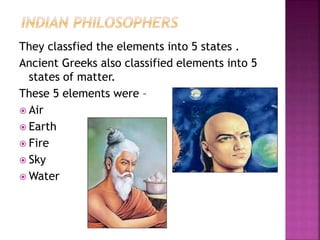
They classfied the elements into 5 states .
Ancient Greeks also classified elements into 5
states of matter.
These 5 elements were –
 Air
 Earth
 Fire
 Sky
 Water
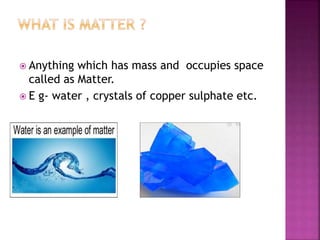
 Anything which has mass and occupies space
called as Matter.
 E g- water , crystals of copper sulphate etc.
Take 2-3 crystals of potassium permanganate
(KMnO4) and dissolve them in 100 ml of water.
Take out approximately 10ml of this solution
and put it into 90 ml of water.
Take 10 ml of this solution and put it into
another 90 ml of clear water.
Keep diluting the solution up to 5-8 times.
Is the water still coloured?
This shows that just a few crystals of KMnO4
can colour a huge amount of water. So we
can conclude that there must be millions of
tiny particles in just one crystal.
You can do same with dettol.
You can also watch this activity by give link-
https://youtu.be/ikOA8i055yQ
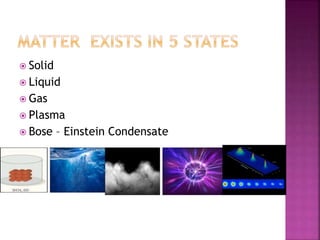
 Solid
 Liquid
 Gas
 Plasma
 Bose – Einstein Condensate
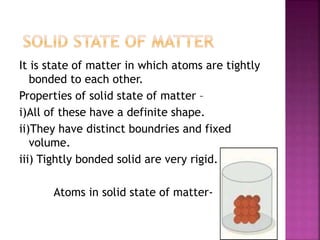
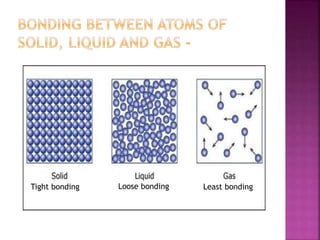
It is state of matter in which atoms are tightly
bonded to each other.
Properties of solid state of matter –
i)All of these have a definite shape.
ii)They have distinct boundries and fixed
volume.
iii) Tightly bonded solid are very rigid.
Atoms in solid state of matter-
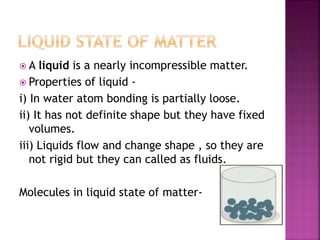
 A liquid is a nearly incompressible matter.
 Properties of liquid -
i) In water atom bonding is partially loose.
ii) It has not definite shape but they have fixed
volumes.
iii) Liquids flow and change shape , so they are
not rigid but they can called as fluids.
Molecules in liquid state of matter-
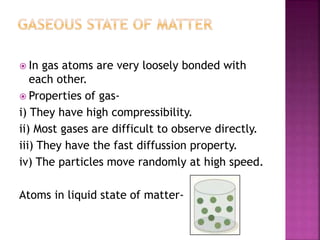
 In gas atoms are very loosely bonded with
each other.
 Properties of gas-
i) They have high compressibility.
ii) Most gases are difficult to observe directly.
iii) They have the fast diffussion property.
iv) The particles move randomly at high speed.
Atoms in liquid state of matter-
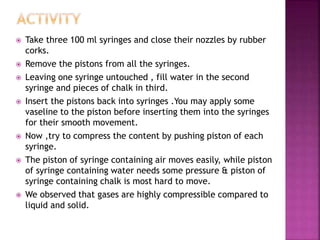
 Take three 100 ml syringes and close their nozzles by rubber
corks.
 Remove the pistons from all the syringes.
 Leaving one syringe untouched , fill water in the second
syringe and pieces of chalk in third.
 Insert the pistons back into syringes .You may apply some
vaseline to the piston before inserting them into the syringes
for their smooth movement.
 Now ,try to compress the content by pushing piston of each
syringe.
 The piston of syringe containing air moves easily, while piston
of syringe containing water needs some pressure & piston of
syringe containing chalk is most hard to move.
 We observed that gases are highly compressible compared to
liquid and solid.
Tight bonding Loose bonding Least bonding
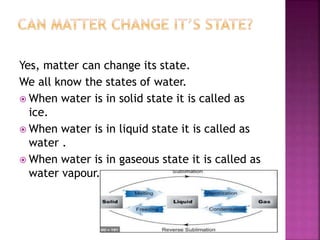
Yes, matter can change its state.
We all know the states of water.
 When water is in solid state it is called as
ice.
 When water is in liquid state it is called as
water .
 When water is in gaseous state it is called as
water vapour.
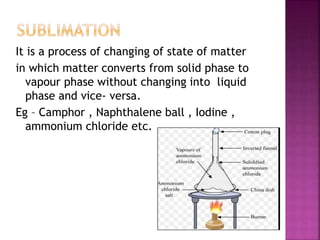
It is a process of changing of state of matter
in which matter converts from solid phase to
vapour phase without changing into liquid
phase and vice- versa.
Eg – Camphor , Naphthalene ball , Iodine ,
ammonium chloride etc.
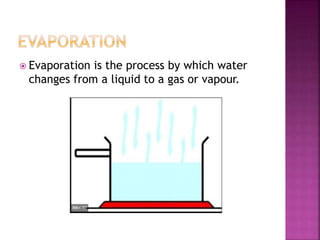
 Evaporation is the process by which water
changes from a liquid to a gas or vapour.
 Surface area: Increase in surface area of
water will increase its rate of evaporation .
 Temperature: Increase in temperature of
water will increase its rate of evaporation .
 Humidity: Increase in humidity of air will
decrease its rate of evaporation.
 Wind Speed : Increase in wind speed will
increase its rate of evaporation.
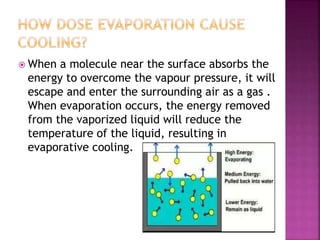
 When a molecule near the surface absorbs the
energy to overcome the vapour pressure, it will
escape and enter the surrounding air as a gas .
When evaporation occurs, the energy removed
from the vaporized liquid will reduce the
temperature of the liquid, resulting in
evaporative cooling.
 During summer , we perspire more because
this mechanism keeps our body cool.
 Cotton is a strong water absorber helps to
absorb the sweat and introduce to the
environment by evaporation. Our body takes
out heat as the sweat evaporates from our
body.
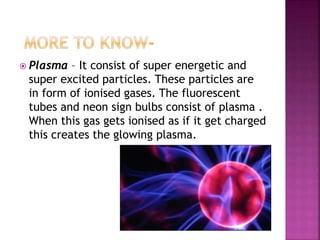
 Plasma – It consist of super energetic and
super excited particles. These particles are
in form of ionised gases. The fluorescent
tubes and neon sign bulbs consist of plasma .
When this gas gets ionised as if it get charged
this creates the glowing plasma.
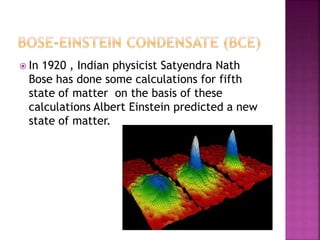
 In 1920 , Indian physicist Satyendra Nath
Bose has done some calculations for fifth
state of matter on the basis of these
calculations Albert Einstein predicted a new
state of matter.
Class 9 presentation chemistry  ch  1

Class 9 presentation chemistry ch 1

  • 1.
     Prepared by- Name - Yashovardhan Phadtare  Class - 9  Academey – Wilson’s Coaching Academy Pune
  • 2.
    They classfied theelements into 5 states . Ancient Greeks also classified elements into 5 states of matter. These 5 elements were –  Air  Earth  Fire  Sky  Water
  • 3.
     Anything whichhas mass and occupies space called as Matter.  E g- water , crystals of copper sulphate etc.
  • 4.
    Take 2-3 crystalsof potassium permanganate (KMnO4) and dissolve them in 100 ml of water. Take out approximately 10ml of this solution and put it into 90 ml of water. Take 10 ml of this solution and put it into another 90 ml of clear water. Keep diluting the solution up to 5-8 times. Is the water still coloured? This shows that just a few crystals of KMnO4 can colour a huge amount of water. So we can conclude that there must be millions of tiny particles in just one crystal. You can do same with dettol. You can also watch this activity by give link- https://youtu.be/ikOA8i055yQ
  • 5.
     Solid  Liquid Gas  Plasma  Bose – Einstein Condensate
  • 6.
    It is stateof matter in which atoms are tightly bonded to each other. Properties of solid state of matter – i)All of these have a definite shape. ii)They have distinct boundries and fixed volume. iii) Tightly bonded solid are very rigid. Atoms in solid state of matter-
  • 7.
     A liquidis a nearly incompressible matter.  Properties of liquid - i) In water atom bonding is partially loose. ii) It has not definite shape but they have fixed volumes. iii) Liquids flow and change shape , so they are not rigid but they can called as fluids. Molecules in liquid state of matter-
  • 8.
     In gasatoms are very loosely bonded with each other.  Properties of gas- i) They have high compressibility. ii) Most gases are difficult to observe directly. iii) They have the fast diffussion property. iv) The particles move randomly at high speed. Atoms in liquid state of matter-
  • 9.
     Take three100 ml syringes and close their nozzles by rubber corks.  Remove the pistons from all the syringes.  Leaving one syringe untouched , fill water in the second syringe and pieces of chalk in third.  Insert the pistons back into syringes .You may apply some vaseline to the piston before inserting them into the syringes for their smooth movement.  Now ,try to compress the content by pushing piston of each syringe.  The piston of syringe containing air moves easily, while piston of syringe containing water needs some pressure & piston of syringe containing chalk is most hard to move.  We observed that gases are highly compressible compared to liquid and solid.
  • 10.
    Tight bonding Loosebonding Least bonding
  • 11.
    Yes, matter canchange its state. We all know the states of water.  When water is in solid state it is called as ice.  When water is in liquid state it is called as water .  When water is in gaseous state it is called as water vapour.
  • 12.
    It is aprocess of changing of state of matter in which matter converts from solid phase to vapour phase without changing into liquid phase and vice- versa. Eg – Camphor , Naphthalene ball , Iodine , ammonium chloride etc.
  • 13.
     Evaporation isthe process by which water changes from a liquid to a gas or vapour.
  • 14.
     Surface area:Increase in surface area of water will increase its rate of evaporation .  Temperature: Increase in temperature of water will increase its rate of evaporation .  Humidity: Increase in humidity of air will decrease its rate of evaporation.  Wind Speed : Increase in wind speed will increase its rate of evaporation.
  • 15.
     When amolecule near the surface absorbs the energy to overcome the vapour pressure, it will escape and enter the surrounding air as a gas . When evaporation occurs, the energy removed from the vaporized liquid will reduce the temperature of the liquid, resulting in evaporative cooling.
  • 16.
     During summer, we perspire more because this mechanism keeps our body cool.  Cotton is a strong water absorber helps to absorb the sweat and introduce to the environment by evaporation. Our body takes out heat as the sweat evaporates from our body.
  • 17.
     Plasma –It consist of super energetic and super excited particles. These particles are in form of ionised gases. The fluorescent tubes and neon sign bulbs consist of plasma . When this gas gets ionised as if it get charged this creates the glowing plasma.
  • 18.
     In 1920, Indian physicist Satyendra Nath Bose has done some calculations for fifth state of matter on the basis of these calculations Albert Einstein predicted a new state of matter.