Class #9
EWRT 1A
Agenda
 Reminders
• Revising Essay #2
• Video: Proofreading Tips
• Reading the four stories in the text
 Reading: Basic Features (40-41)
 Lecture: Formatting dialogue
 Writing: Practicing dialogue
Revision Tips
Look over the notes from your peers and make any changes that seem
appropriate.
Do a spellcheck of your draft. You should revise your paper in terms of
misspelled words, typos, and accidental word repetitions; Look for
punctuation errors.
Do a grammar check. Correct run-on sentences, fragments, faulty
parallelisms, problems with noun-verb agreement, dangling participles,
improper usage of passive voice, and so on.
Next, check the formatting style, your works cited page, and in-text
citations. Have you introduced each quotation? Have you cited quoted,
summarized, and paraphrased material?
Read the whole essay aloud, looking for missing words and awkward
sentences. Evaluate the structure of your essay, the way your arguments
are organized, and the credibility of these arguments. Check for weak
transitions between paragraphs one last time.
https://www.youtube.com/watch?v=6kXR4Xtx3Mk
Before you begin, make sure you have
finished your homework from class #3.
The reading is essential, including the
Jean Brandt Essay!
 Read: SMG 16-38
o You can find this chapter on the website: “Primary Texts”
and “Remembering and Event”
 Post #3:
o Answer the questions in the “Analyzing Writing
Strategies” section after the Dillard essay on pages 25-26
o Answer the questions in the “Analyzing Writing
Strategies” section after the Wolff essay on page 31-32
o Answer the questions in the “Analyzing Writing
Strategies” section after the Bragg essay on page 36-37.
 Bring: SMG
BASIC FEATURES OF A
NARRATIVE ESSAY
Read the next slides carefully. They are your
directions for writing essay #2.
LEARNING TO WRITE DIALOGUE
Vividly recreating people!
Writing dialogue
• Dialogue is an important part of any remembered event.
• It shows what happens instead of telling it. For example,
you can say “she was so mad she yelled at me.” Or you can
show the dialogue and let the reader “see” her mad at you.
“You did what? You threw out my best shirt?!”
“I am sorry, but I didn’t think you wanted that shirt any more. It was
torn and stained”
“What kind of ass are you? Was that your shirt? No, it was mine!”
“But…..ummm”
“DON’T TOUCH MY STUFF! IN FACT, GET OUT!”
DIALOGUE MOVES THE STORY
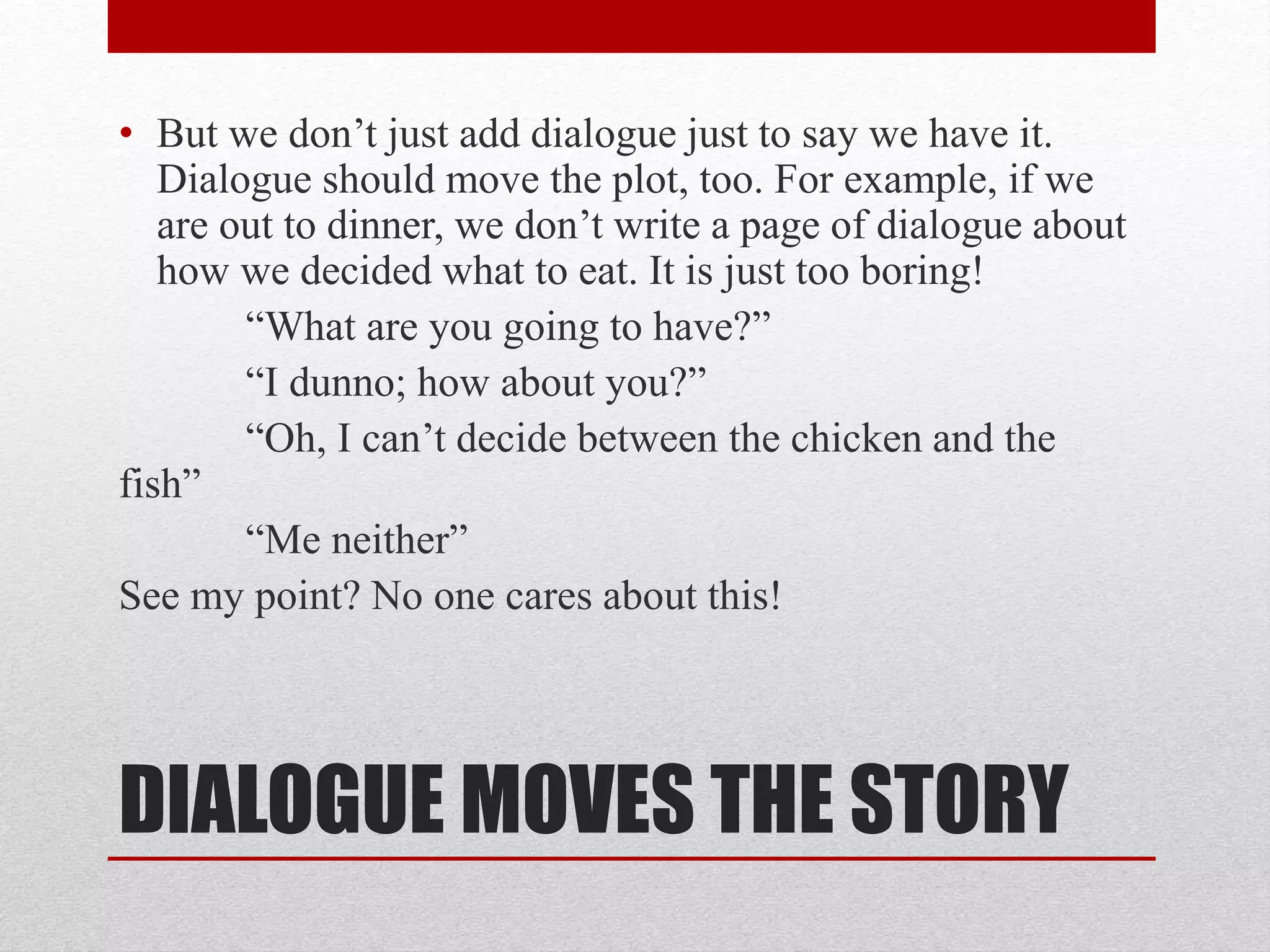
• But we don’t just add dialogue just to say we have it.
Dialogue should move the plot, too. For example, if we
are out to dinner, we don’t write a page of dialogue about
how we decided what to eat. It is just too boring!
“What are you going to have?”
“I dunno; how about you?”
“Oh, I can’t decide between the chicken and the
fish”
“Me neither”
See my point? No one cares about this!
Formatting Dialogue
• Each speaker gets his or her own paragraph; a return and indent. This mimics real conversation,
indicating pauses and so forth.
• Attributions (“He said,” “She said” and variations) should be used, but not too much, and varied so
they’re not repetitious; they can be used at the start of quotations, in the middle, or at the end.
When attributions are overused, they get in the way; the key is that the reader should always know
who’s speaking.
• Always use a comma after attribution (She said,) when introducing a quote.
• Example:
“What’s wrong with you?” he asked.
“Nothing,” I said.
“You lit my shirts on fire? Where’d you learn that?
“Daycare.”
“What? Daycare? You learned how to light shirts on fire at daycare? I can’t believe this
kind of behavior is going on there!”
“A kid brought matches one day.”
“I’m calling your daycare.”
“No,” I said. Okay, I screamed it, and he scowled at me.
“Tell me the truth, boy.”
I took a deep breath and let it slide out: “I hate your shirts, Dad.”
Write a scene in which one person tells another person a story. Make sure
that you write it as a dialogue and not just a first person narrative; have one
person telling the story and the other person listening and asking questions or
making comments. The purpose of this scene will be both to have the story
stand alone as a subject, and to have the characters’ reactions to the story be
the focal point of the scene. Choose one of the following to write about:
1. Tell someone you live with about a robbery you just witnessed at 7-11
2. Tell someone you live with about a car accident you just had
3. Tell someone you live with about a car accident you almost had
4. Tell someone you live with about catching a person trying to pick-pocket
you
5. Tell someone you live with about another event you want to write about
Exercise #1
Exercise #2
Write a short conversation between multiple people (three or
more) in which no character speaks more than three or four
words per line of dialogue. You can use minimal narration to
enhance the scene, not explain the dialogue.
A man is walking down a deserted street after the bar
closes. He moves quickly but unsteadily. Suddenly,
three teenagers come out of an alley. They grab him and
drag back into the alley. Write the dialogue.
HOMEWORK
Quiz #8
Read: HG Finish. Consider a passage in the novel that
reminds you of a personal experience.
Post #11: The dialogues from slides 14 and 15
Bring: HG and SMG

Class 9 online

  • 1.
  • 2.
    Agenda  Reminders • RevisingEssay #2 • Video: Proofreading Tips • Reading the four stories in the text  Reading: Basic Features (40-41)  Lecture: Formatting dialogue  Writing: Practicing dialogue
  • 3.
    Revision Tips Look overthe notes from your peers and make any changes that seem appropriate. Do a spellcheck of your draft. You should revise your paper in terms of misspelled words, typos, and accidental word repetitions; Look for punctuation errors. Do a grammar check. Correct run-on sentences, fragments, faulty parallelisms, problems with noun-verb agreement, dangling participles, improper usage of passive voice, and so on. Next, check the formatting style, your works cited page, and in-text citations. Have you introduced each quotation? Have you cited quoted, summarized, and paraphrased material? Read the whole essay aloud, looking for missing words and awkward sentences. Evaluate the structure of your essay, the way your arguments are organized, and the credibility of these arguments. Check for weak transitions between paragraphs one last time. https://www.youtube.com/watch?v=6kXR4Xtx3Mk
  • 4.
    Before you begin,make sure you have finished your homework from class #3. The reading is essential, including the Jean Brandt Essay!  Read: SMG 16-38 o You can find this chapter on the website: “Primary Texts” and “Remembering and Event”  Post #3: o Answer the questions in the “Analyzing Writing Strategies” section after the Dillard essay on pages 25-26 o Answer the questions in the “Analyzing Writing Strategies” section after the Wolff essay on page 31-32 o Answer the questions in the “Analyzing Writing Strategies” section after the Bragg essay on page 36-37.  Bring: SMG
  • 5.
    BASIC FEATURES OFA NARRATIVE ESSAY Read the next slides carefully. They are your directions for writing essay #2.
  • 9.
    LEARNING TO WRITEDIALOGUE Vividly recreating people!
  • 10.
    Writing dialogue • Dialogueis an important part of any remembered event. • It shows what happens instead of telling it. For example, you can say “she was so mad she yelled at me.” Or you can show the dialogue and let the reader “see” her mad at you. “You did what? You threw out my best shirt?!” “I am sorry, but I didn’t think you wanted that shirt any more. It was torn and stained” “What kind of ass are you? Was that your shirt? No, it was mine!” “But…..ummm” “DON’T TOUCH MY STUFF! IN FACT, GET OUT!”
  • 11.
    DIALOGUE MOVES THESTORY • But we don’t just add dialogue just to say we have it. Dialogue should move the plot, too. For example, if we are out to dinner, we don’t write a page of dialogue about how we decided what to eat. It is just too boring! “What are you going to have?” “I dunno; how about you?” “Oh, I can’t decide between the chicken and the fish” “Me neither” See my point? No one cares about this!
  • 12.
    Formatting Dialogue • Eachspeaker gets his or her own paragraph; a return and indent. This mimics real conversation, indicating pauses and so forth. • Attributions (“He said,” “She said” and variations) should be used, but not too much, and varied so they’re not repetitious; they can be used at the start of quotations, in the middle, or at the end. When attributions are overused, they get in the way; the key is that the reader should always know who’s speaking. • Always use a comma after attribution (She said,) when introducing a quote. • Example: “What’s wrong with you?” he asked. “Nothing,” I said. “You lit my shirts on fire? Where’d you learn that? “Daycare.” “What? Daycare? You learned how to light shirts on fire at daycare? I can’t believe this kind of behavior is going on there!” “A kid brought matches one day.” “I’m calling your daycare.” “No,” I said. Okay, I screamed it, and he scowled at me. “Tell me the truth, boy.” I took a deep breath and let it slide out: “I hate your shirts, Dad.”
  • 13.
    Write a scenein which one person tells another person a story. Make sure that you write it as a dialogue and not just a first person narrative; have one person telling the story and the other person listening and asking questions or making comments. The purpose of this scene will be both to have the story stand alone as a subject, and to have the characters’ reactions to the story be the focal point of the scene. Choose one of the following to write about: 1. Tell someone you live with about a robbery you just witnessed at 7-11 2. Tell someone you live with about a car accident you just had 3. Tell someone you live with about a car accident you almost had 4. Tell someone you live with about catching a person trying to pick-pocket you 5. Tell someone you live with about another event you want to write about Exercise #1
  • 14.
    Exercise #2 Write ashort conversation between multiple people (three or more) in which no character speaks more than three or four words per line of dialogue. You can use minimal narration to enhance the scene, not explain the dialogue. A man is walking down a deserted street after the bar closes. He moves quickly but unsteadily. Suddenly, three teenagers come out of an alley. They grab him and drag back into the alley. Write the dialogue.
  • 15.
    HOMEWORK Quiz #8 Read: HGFinish. Consider a passage in the novel that reminds you of a personal experience. Post #11: The dialogues from slides 14 and 15 Bring: HG and SMG