God & Good I. Ethics:  crucial preliminary questions A.  John Dwyer:  Objectivism  or  Relativism?    the ‘Auschwitz Principle’  Implications for ethics classes B.  David Carlin:  Tolerance of the Believer   or   Tolerance of the Sceptic?  What’s  wrong (!)   with saying “Everyone should be tolerant/nonjudgmental/open-minded”? C.  Three components of ethical analysis II.  CHRISTIAN  Ethics:  God & Good A.  Goodness & the purpose something serves B.  Kushner:  “The affirmation of monotheism … is a moral statement….” (XP, p. 10)
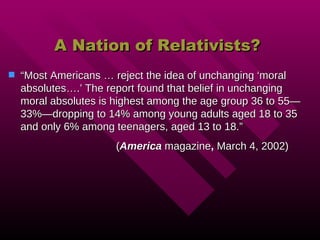
A Nation of Relativists? “ Most Americans … reject the idea of unchanging ‘moral absolutes….’ The report found that belief in unchanging moral absolutes is highest among the age group 36 to 55—33%—dropping to 14% among young adults aged 18 to 35 and only 6% among teenagers, aged 13 to 18.”  ( America   magazine ,  March 4, 2002)
John Dwyer’s Conclusion “ The multiple ambiguities of ‘doing what we feel is right’ can be resolved in only two ways:  either  we agree that there are ways of acting which, in and of themselves, are worthy of being chosen (and others which are unworthy), whether we admit it, like it, or even know it,  or  we must admit that in finding fault with Auschwitz (which stands here for all of the inhumanity human beings have been inflicting on each other from the beginning), we have no coherent arguments at our disposal.”  [XP, p. 6]
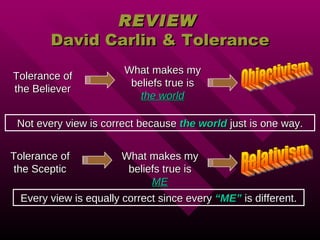
REVIEW   David Carlin & Tolerance Tolerance of the Believer Tolerance of the Sceptic What makes my beliefs true is  the world What makes my beliefs true is  ME Relativism Objectivism Not every view is correct because  the world  just is one way. Every view is equally correct since every  “ME”   is different.
REVIEW So, if morality is relative…   It would mean we cannot consistently say even very horrible actions are wrong (Dwyer’s “Auschwitz Principle”). It would mean that we couldn’t intelligibly use the words “good” and “bad,” “right” and “wrong” in a public setting, because everyone could legitimately mean different things by these terms. Therefore, it would mean that we cannot do ethics as a group because it would be foolish to raise questions of right or wrong if we can’t hope to be right or wrong about them! And it would mean that we’d be contradicting ourselves if we ever said we shouldn’t judge or criticize another’s morality out of a respect for tolerance or diversity.
Questions Ethicists Ask Three Components of Ethical Analysis Absolutism vs. Consequentialism Pope John Paul II on “intrinsically evil acts” The Action itself The Reason/Intention for the Action The Consequences of the Action
God, Good, & Purpose Good and Purpose Theology & Ethics come together Theology tells you the purpose of life Ethics tells you how to live to attain it JP II on the “final end,” “purpose of life,” “definitive goal,” “ultimate end” Adding Jesus Ralph Waldo Emerson: “What we are worshipping we are becoming.”
The Purpose of Life “ All people comprise a single community and have a single origin—God.  One also is their final goal—God.”  (Nostra Aetate,  §1) Good Bad GOD Jesus

Class #02

  • 1.
    God & GoodI. Ethics: crucial preliminary questions A. John Dwyer: Objectivism or Relativism?  the ‘Auschwitz Principle’  Implications for ethics classes B. David Carlin: Tolerance of the Believer or Tolerance of the Sceptic?  What’s wrong (!) with saying “Everyone should be tolerant/nonjudgmental/open-minded”? C. Three components of ethical analysis II. CHRISTIAN Ethics: God & Good A. Goodness & the purpose something serves B. Kushner: “The affirmation of monotheism … is a moral statement….” (XP, p. 10)
  • 2.
    A Nation ofRelativists? “ Most Americans … reject the idea of unchanging ‘moral absolutes….’ The report found that belief in unchanging moral absolutes is highest among the age group 36 to 55—33%—dropping to 14% among young adults aged 18 to 35 and only 6% among teenagers, aged 13 to 18.” ( America magazine , March 4, 2002)
  • 3.
    John Dwyer’s Conclusion“ The multiple ambiguities of ‘doing what we feel is right’ can be resolved in only two ways: either we agree that there are ways of acting which, in and of themselves, are worthy of being chosen (and others which are unworthy), whether we admit it, like it, or even know it, or we must admit that in finding fault with Auschwitz (which stands here for all of the inhumanity human beings have been inflicting on each other from the beginning), we have no coherent arguments at our disposal.” [XP, p. 6]
  • 4.
    REVIEW David Carlin & Tolerance Tolerance of the Believer Tolerance of the Sceptic What makes my beliefs true is the world What makes my beliefs true is ME Relativism Objectivism Not every view is correct because the world just is one way. Every view is equally correct since every “ME” is different.
  • 5.
    REVIEW So, ifmorality is relative… It would mean we cannot consistently say even very horrible actions are wrong (Dwyer’s “Auschwitz Principle”). It would mean that we couldn’t intelligibly use the words “good” and “bad,” “right” and “wrong” in a public setting, because everyone could legitimately mean different things by these terms. Therefore, it would mean that we cannot do ethics as a group because it would be foolish to raise questions of right or wrong if we can’t hope to be right or wrong about them! And it would mean that we’d be contradicting ourselves if we ever said we shouldn’t judge or criticize another’s morality out of a respect for tolerance or diversity.
  • 6.
    Questions Ethicists AskThree Components of Ethical Analysis Absolutism vs. Consequentialism Pope John Paul II on “intrinsically evil acts” The Action itself The Reason/Intention for the Action The Consequences of the Action
  • 7.
    God, Good, &Purpose Good and Purpose Theology & Ethics come together Theology tells you the purpose of life Ethics tells you how to live to attain it JP II on the “final end,” “purpose of life,” “definitive goal,” “ultimate end” Adding Jesus Ralph Waldo Emerson: “What we are worshipping we are becoming.”
  • 8.
    The Purpose ofLife “ All people comprise a single community and have a single origin—God. One also is their final goal—God.” (Nostra Aetate, §1) Good Bad GOD Jesus