OpenCred Study – Recognition of 
open learning in Europe: some 
issues for institutions to consider 
Gabi Witthaus 
Institute of Learning Innovation, 
University of Leicester 
EUA Webinar, 19 Nov 2014
OpenCred Study 
This presentation reflects work in progress 
from the OpenCred study of the OpenEdu 
project by the Institute of Learning Innovation 
(University of Leicester), in collaboration with 
the IPTS. Funded by IPTS. 
Study team: Gabi Witthaus, Mark Childs, 
Grainne Conole and Bernard Nkuyubwatsi (ILI, 
Leicester); Andreia Inamorato Dos Santos and 
Yves Punie (IPTS) 
Legal Notice re Copyright: http://ec.europa.eu/geninfo/legal_notices_en.htm
Recognition of learning is… 
a process of granting official status to learning 
outcomes and/or competences, which can lead 
to the acknowledgement of their value in 
society (UNESCO 2012)
Recognition has a range of levels of 
formality 
Pic by fdecomite on Flickr (CC-BY)
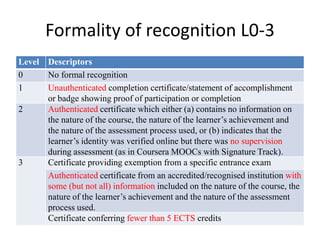
Formality of recognition L0-3 
Level Descriptors 
0 No formal recognition 
1 Unauthenticated completion certificate/statement of accomplishment 
or badge showing proof of participation or completion 
2 Authenticated certificate which either (a) contains no information on 
the nature of the course, the nature of the learner’s achievement and 
the nature of the assessment process used, or (b) indicates that the 
learner’s identity was verified online but there was no supervision 
during assessment (as in Coursera MOOCs with Signature Track). 
3 Certificate providing exemption from a specific entrance exam 
Authenticated certificate from an accredited/recognised institution with 
some (but not all) information included on the nature of the course, the 
nature of the learner’s achievement and the nature of the assessment 
process used. 
Certificate conferring fewer than 5 ECTS credits
Formality of recognition L4 
Level Descriptors 
4 Certificate conferring a minimum of 5 ECTS credits 
Certificate providing exemption from a specific module/course or part 
of qualification at the issuing institution 
Certificate which ‘(a) formally and clearly states on whose authority it 
was issued, provides information on the content, level and study load, 
states that the holder has achieved the desired learning objectives, 
provides information on the testing methods employed and lists the 
credits obtained, according to a standard international system or in 
some other acceptable format, (b) is demonstrably and clearly based 
on authentication [i.e. student’s identity is verified] and (c) states that 
the examinations have been administered under supervision and 
specifies the nature of this supervision.’ (NVAO 2014, p.9)
Question: What has the greatest 
impact on formality of recognition 
in open learning?
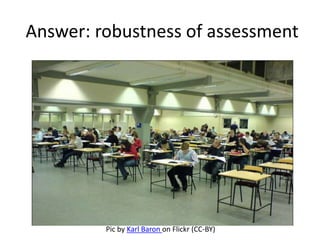
Answer: robustness of assessment 
Pic by Karl Baron on Flickr (CC-BY)
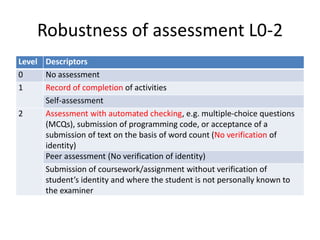
Robustness of assessment L0-2 
Level Descriptors 
0 No assessment 
1 Record of completion of activities 
Self-assessment 
2 Assessment with automated checking, e.g. multiple-choice questions 
(MCQs), submission of programming code, or acceptance of a 
submission of text on the basis of word count (No verification of 
identity) 
Peer assessment (No verification of identity) 
Submission of coursework/assignment without verification of 
student’s identity and where the student is not personally known to 
the examiner
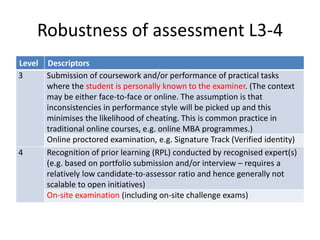
Robustness of assessment L3-4 
Level Descriptors 
3 Submission of coursework and/or performance of practical tasks 
where the student is personally known to the examiner. (The context 
may be either face-to-face or online. The assumption is that 
inconsistencies in performance style will be picked up and this 
minimises the likelihood of cheating. This is common practice in 
traditional online courses, e.g. online MBA programmes.) 
Online proctored examination, e.g. Signature Track (Verified identity) 
4 Recognition of prior learning (RPL) conducted by recognised expert(s) 
(e.g. based on portfolio submission and/or interview – requires a 
relatively low candidate-to-assessor ratio and hence generally not 
scalable to open initiatives) 
On-site examination (including on-site challenge exams)
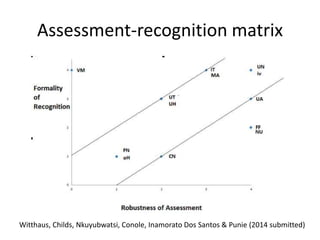
Assessment-recognition matrix 
Witthaus, Childs, Nkuyubwatsi, Conole, Inamorato Dos Santos & Punie (2014 submitted)
Question: What other aspects of 
open learning have an impact on 
recognition?
Affordability for learners 
Pic by epSos.de on Flickr (CC-BY)
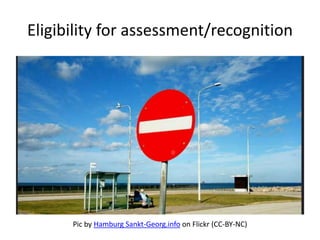
Eligibility for assessment/recognition 
Pic by Hamburg Sankt-Georg.info on Flickr (CC-BY-NC)
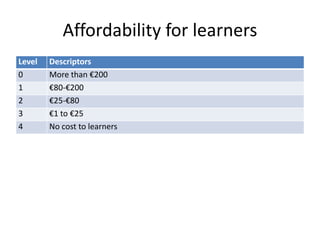
Affordability for learners 
Level Descriptors 
0 More than €200 
1 €80-€200 
2 €25-€80 
3 €1 to €25 
4 No cost to learners
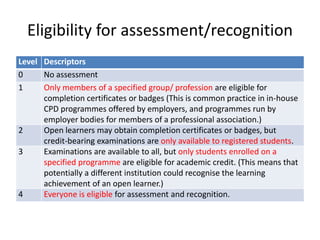
Eligibility for assessment/recognition 
Level Descriptors 
0 No assessment 
1 Only members of a specified group/ profession are eligible for 
completion certificates or badges (This is common practice in in-house 
CPD programmes offered by employers, and programmes run by 
employer bodies for members of a professional association.) 
2 Open learners may obtain completion certificates or badges, but 
credit-bearing examinations are only available to registered students. 
3 Examinations are available to all, but only students enrolled on a 
specified programme are eligible for academic credit. (This means that 
potentially a different institution could recognise the learning 
achievement of an open learner.) 
4 Everyone is eligible for assessment and recognition.
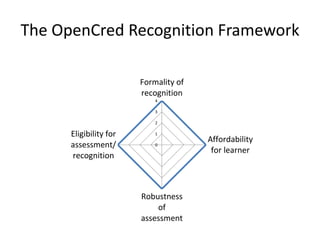
The OpenCred Recognition Framework 
Formality of 
recognition 
4 
3 
2 
1 
0 
Affordability 
for learner 
Robustness 
of 
assessment 
Eligibility for 
assessment/ 
recognition
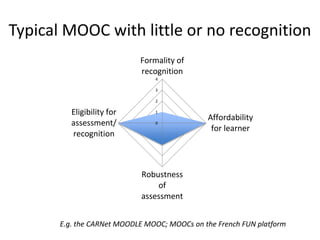
Typical MOOC with little or no recognition 
Formality of 
recognition 
4 
3 
2 
1 
0 
Affordability 
for learner 
Robustness 
of 
assessment 
Eligibility for 
assessment/ 
recognition 
E.g. the CARNet MOODLE MOOC; MOOCs on the French FUN platform
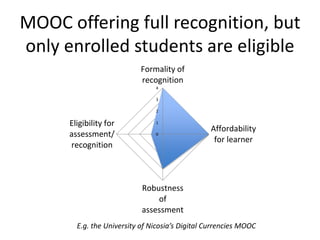
MOOC offering full recognition, but 
only enrolled students are eligible 
Formality of 
recognition 
4 
3 
2 
1 
0 
Affordability 
for learner 
Robustness 
of 
assessment 
Eligibility for 
assessment/ 
recognition 
E.g. the University of Nicosia’s Digital Currencies MOOC
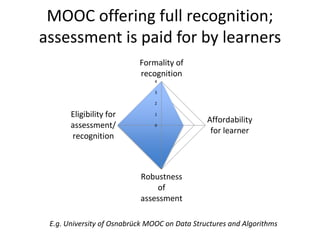
MOOC offering full recognition; 
assessment is paid for by learners 
Formality of 
recognition 
4 
3 
2 
1 
0 
Affordability 
for learner 
Robustness 
of 
assessment 
Eligibility for 
assessment/ 
recognition 
E.g. University of Osnabrück MOOC on Data Structures and Algorithms
What shape is your MOOC? 
Pic: Sir Mildred Pierce on Flickr (CC BY)
References 
– NVAO (2014) MOOCs and Online HE: A Survey, The Hague: 
Accreditation Organisation of the Netherlands and 
Flanders (NVAO), Available at 
http://www.nvao.net/page/downloads/NVAO_MOOCs_an 
d_online_HE_A_survey_June_2014.pdf 
– UNESCO Institute for Lifelong Learning (2012). UNESCO 
GUIDELINES for the Recognition, Validation and 
Accreditation of the Outcomes of Non-formal and Informal 
Learning. Hamburg: UIL. www.unesco.org/uil 
– Witthaus, G., Childs, M., Nkuyubwatsi, B., Conole, G., 
Inamorato dos Santos, A. & Punie, Y. (2014 submitted) An 
Assessment-Recognition Matrix for Analysing Institutional 
Practices in the Recognition of Open Learning (Submitted 
to elearning papers, Issue 41)
Thank you! 
Gabi.Witthaus@le.ac.uk 
@twitthaus

OpenCred Study – Recognition of open learning in Europe: some issues for institutions to consider

  • 1.
    OpenCred Study –Recognition of open learning in Europe: some issues for institutions to consider Gabi Witthaus Institute of Learning Innovation, University of Leicester EUA Webinar, 19 Nov 2014
  • 2.
    OpenCred Study Thispresentation reflects work in progress from the OpenCred study of the OpenEdu project by the Institute of Learning Innovation (University of Leicester), in collaboration with the IPTS. Funded by IPTS. Study team: Gabi Witthaus, Mark Childs, Grainne Conole and Bernard Nkuyubwatsi (ILI, Leicester); Andreia Inamorato Dos Santos and Yves Punie (IPTS) Legal Notice re Copyright: http://ec.europa.eu/geninfo/legal_notices_en.htm
  • 3.
    Recognition of learningis… a process of granting official status to learning outcomes and/or competences, which can lead to the acknowledgement of their value in society (UNESCO 2012)
  • 4.
    Recognition has arange of levels of formality Pic by fdecomite on Flickr (CC-BY)
  • 5.
    Formality of recognitionL0-3 Level Descriptors 0 No formal recognition 1 Unauthenticated completion certificate/statement of accomplishment or badge showing proof of participation or completion 2 Authenticated certificate which either (a) contains no information on the nature of the course, the nature of the learner’s achievement and the nature of the assessment process used, or (b) indicates that the learner’s identity was verified online but there was no supervision during assessment (as in Coursera MOOCs with Signature Track). 3 Certificate providing exemption from a specific entrance exam Authenticated certificate from an accredited/recognised institution with some (but not all) information included on the nature of the course, the nature of the learner’s achievement and the nature of the assessment process used. Certificate conferring fewer than 5 ECTS credits
  • 6.
    Formality of recognitionL4 Level Descriptors 4 Certificate conferring a minimum of 5 ECTS credits Certificate providing exemption from a specific module/course or part of qualification at the issuing institution Certificate which ‘(a) formally and clearly states on whose authority it was issued, provides information on the content, level and study load, states that the holder has achieved the desired learning objectives, provides information on the testing methods employed and lists the credits obtained, according to a standard international system or in some other acceptable format, (b) is demonstrably and clearly based on authentication [i.e. student’s identity is verified] and (c) states that the examinations have been administered under supervision and specifies the nature of this supervision.’ (NVAO 2014, p.9)
  • 7.
    Question: What hasthe greatest impact on formality of recognition in open learning?
  • 8.
    Answer: robustness ofassessment Pic by Karl Baron on Flickr (CC-BY)
  • 9.
    Robustness of assessmentL0-2 Level Descriptors 0 No assessment 1 Record of completion of activities Self-assessment 2 Assessment with automated checking, e.g. multiple-choice questions (MCQs), submission of programming code, or acceptance of a submission of text on the basis of word count (No verification of identity) Peer assessment (No verification of identity) Submission of coursework/assignment without verification of student’s identity and where the student is not personally known to the examiner
  • 10.
    Robustness of assessmentL3-4 Level Descriptors 3 Submission of coursework and/or performance of practical tasks where the student is personally known to the examiner. (The context may be either face-to-face or online. The assumption is that inconsistencies in performance style will be picked up and this minimises the likelihood of cheating. This is common practice in traditional online courses, e.g. online MBA programmes.) Online proctored examination, e.g. Signature Track (Verified identity) 4 Recognition of prior learning (RPL) conducted by recognised expert(s) (e.g. based on portfolio submission and/or interview – requires a relatively low candidate-to-assessor ratio and hence generally not scalable to open initiatives) On-site examination (including on-site challenge exams)
  • 11.
    Assessment-recognition matrix Witthaus,Childs, Nkuyubwatsi, Conole, Inamorato Dos Santos & Punie (2014 submitted)
  • 12.
    Question: What otheraspects of open learning have an impact on recognition?
  • 13.
    Affordability for learners Pic by epSos.de on Flickr (CC-BY)
  • 14.
    Eligibility for assessment/recognition Pic by Hamburg Sankt-Georg.info on Flickr (CC-BY-NC)
  • 15.
    Affordability for learners Level Descriptors 0 More than €200 1 €80-€200 2 €25-€80 3 €1 to €25 4 No cost to learners
  • 16.
    Eligibility for assessment/recognition Level Descriptors 0 No assessment 1 Only members of a specified group/ profession are eligible for completion certificates or badges (This is common practice in in-house CPD programmes offered by employers, and programmes run by employer bodies for members of a professional association.) 2 Open learners may obtain completion certificates or badges, but credit-bearing examinations are only available to registered students. 3 Examinations are available to all, but only students enrolled on a specified programme are eligible for academic credit. (This means that potentially a different institution could recognise the learning achievement of an open learner.) 4 Everyone is eligible for assessment and recognition.
  • 17.
    The OpenCred RecognitionFramework Formality of recognition 4 3 2 1 0 Affordability for learner Robustness of assessment Eligibility for assessment/ recognition
  • 18.
    Typical MOOC withlittle or no recognition Formality of recognition 4 3 2 1 0 Affordability for learner Robustness of assessment Eligibility for assessment/ recognition E.g. the CARNet MOODLE MOOC; MOOCs on the French FUN platform
  • 19.
    MOOC offering fullrecognition, but only enrolled students are eligible Formality of recognition 4 3 2 1 0 Affordability for learner Robustness of assessment Eligibility for assessment/ recognition E.g. the University of Nicosia’s Digital Currencies MOOC
  • 20.
    MOOC offering fullrecognition; assessment is paid for by learners Formality of recognition 4 3 2 1 0 Affordability for learner Robustness of assessment Eligibility for assessment/ recognition E.g. University of Osnabrück MOOC on Data Structures and Algorithms
  • 21.
    What shape isyour MOOC? Pic: Sir Mildred Pierce on Flickr (CC BY)
  • 22.
    References – NVAO(2014) MOOCs and Online HE: A Survey, The Hague: Accreditation Organisation of the Netherlands and Flanders (NVAO), Available at http://www.nvao.net/page/downloads/NVAO_MOOCs_an d_online_HE_A_survey_June_2014.pdf – UNESCO Institute for Lifelong Learning (2012). UNESCO GUIDELINES for the Recognition, Validation and Accreditation of the Outcomes of Non-formal and Informal Learning. Hamburg: UIL. www.unesco.org/uil – Witthaus, G., Childs, M., Nkuyubwatsi, B., Conole, G., Inamorato dos Santos, A. & Punie, Y. (2014 submitted) An Assessment-Recognition Matrix for Analysing Institutional Practices in the Recognition of Open Learning (Submitted to elearning papers, Issue 41)
  • 23.

Editor's Notes

  • #3 http://is.jrc.ec.europa.eu/pages/OpenCred/ISUNITWEBSITE-IPTS-JRC-EC.htm
  • #19 CARNet MOOC (Also the French FUN model)
  • #20 University of Nicosia Digital Currencies MOOC