KDIGO GUIDELINES
CKD- MBD
PRESENTER- DR.URVASHI
DNB NEPHROLOGY
COMPONENTS
BASICS
GUIDELINES
MANAGEMENT
TRIALS
WHAT I
THOUGHT?
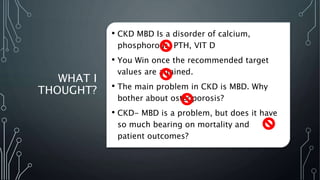
• CKD MBD Is a disorder of calcium,
phosphorous, PTH, VIT D
• You Win once the recommended target
values are attained.
• The main problem in CKD is MBD. Why
bother about osteoporosis?
• CKD- MBD is a problem, but does it have
so much bearing on mortality and
patient outcomes?
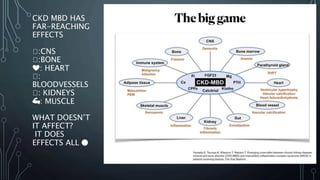
THE BIG
GAME
Systemic disorder-Wide variety of systems
Characterised by biochemical and bone abnormalities
Vascular, soft tissue calcification
CKD MBD HAS
FAR-REACHING
EFFECTS
🧠:CNS
🧠:BONE
❤️: HEART
🧠:
BLOODVESSELS
🧠: KIDNEYS
💪: MUSCLE
WHAT DOESN’T
IT AFFECT?
IT DOES
EFFECTS ALL 🔴
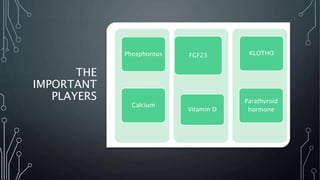
THE
IMPORTANT
PLAYERS
i
Phosphorous
Calcium
l
FGF23
Vitamin D
i
KLOTHO
Parathyroid
hormone
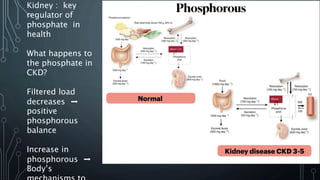
Kidney : key
regulator of
phosphate in
health
What happens to
the phosphate in
CKD?
Filtered load
decreases ➡️
positive
phosphorous
balance
Increase in
phosphorous ➡️
Body’s
Mechanisms of
decreasing
phosphate
increase in PTH ➡️
decreases
phosphate
Increase in PTH ➡️
decreases sodium
phosphate
transporter in
tubules ➡️
Phosphaturia
Increase in FGF 23
➡️ Phosphaturia
By the time you see
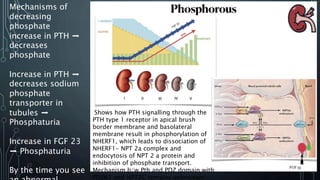
IShows how PTH signalling through the
PTH type 1 receptor in apical brush
border membrane and basolateral
membrane result in phosphorylation of
NHERF1, which leads to dissociation of
NHERF1- NPT 2a complex and
endocytosis of NPT 2 a protein and
inhibition of phosphate transport.
Mechanism b/w Pth and PDZ domain with
PDZK1 and NPT2C remains unknwown
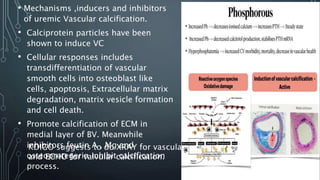
• Mechanisms ,inducers and inhibitors
of uremic Vascular calcification.
• Calciprotein particles have been
shown to induce VC
• Cellular responses includes
transdifferentiation of vascular
smooth cells into osteoblast like
cells, apoptosis, Extracellular matrix
degradation, matrix vesicle formation
and cell death.
• Promote calcification of ECM in
medial layer of BV. Meanwhile
inhibitors feutin A , Mg and
osteoprotegerin inhibit calcification
process.
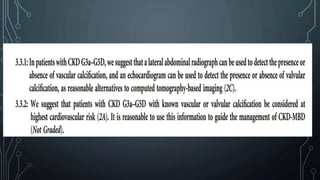
KDIGO suggests to do XRAY for vascular
and ECHO for valvular calcification.
The conference concluded most of the 2009 recommendations in
current practice, however 12 recommendations were revised.
Selective update.
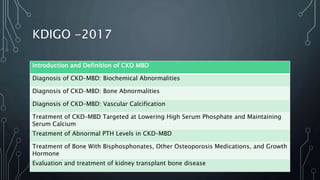
KDIGO -2017
Introduction and Definition of CKD MBD
Diagnosis of CKD–MBD: Biochemical Abnormalities
Diagnosis of CKD–MBD: Bone Abnormalities
Diagnosis of CKD–MBD: Vascular Calcification
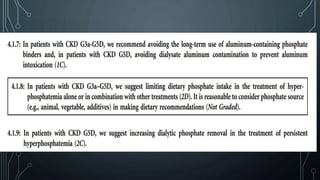
Treatment of CKD–MBD Targeted at Lowering High Serum Phosphate and Maintaining
Serum Calcium
Treatment of Abnormal PTH Levels in CKD–MBD
Treatment of Bone With Bisphosphonates, Other Osteoporosis Medications, and Growth
Hormone
Evaluation and treatment of kidney transplant bone disease
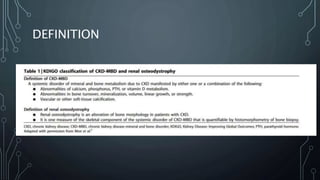
DEFINITION
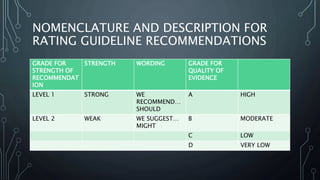
NOMENCLATURE AND DESCRIPTION FOR
RATING GUIDELINE RECOMMENDATIONS
GRADE FOR
STRENGTH OF
RECOMMENDAT
ION
STRENGTH WORDING GRADE FOR
QUALITY OF
EVIDENCE
LEVEL 1 STRONG WE
RECOMMEND…
SHOULD
A HIGH
LEVEL 2 WEAK WE SUGGEST…
MIGHT
B MODERATE
C LOW
D VERY LOW
CHAPTER 3.1
DIAGNOSIS OF CKD MBD:
BIOCHEMICAL ABNORMALITIES
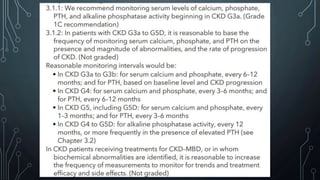
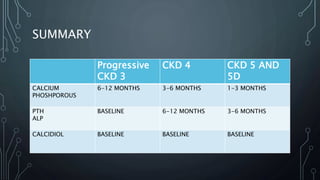
SUMMARY
Progressive
CKD 3
CKD 4 CKD 5 AND
5D
CALCIUM
PHOSHPOROUS
6-12 MONTHS 3-6 MONTHS 1-3 MONTHS
PTH
ALP
BASELINE 6-12 MONTHS 3-6 MONTHS
CALCIDIOL BASELINE BASELINE BASELINE
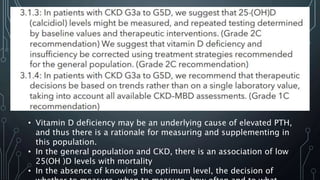
• Vitamin D deficiency may be an underlying cause of elevated PTH,
and thus there is a rationale for measuring and supplementing in
this population.
• In the general population and CKD, there is an association of low
25(OH )D levels with mortality
• In the absence of knowing the optimum level, the decision of
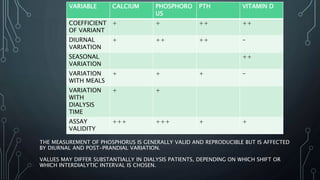
THE MEASUREMENT OF PHOSPHORUS IS GENERALLY VALID AND REPRODUCIBLE BUT IS AFFECTED
BY DIURNAL AND POST-PRANDIAL VARIATION.
VALUES MAY DIFFER SUBSTANTIALLY IN DIALYSIS PATIENTS, DEPENDING ON WHICH SHIFT OR
WHICH INTERDIALYTIC INTERVAL IS CHOSEN.
VARIABLE CALCIUM PHOSPHORO
US
PTH VITAMIN D
COEFFICIENT
OF VARIANT
+ + ++ ++
DIURNAL
VARIATION
+ ++ ++ -
SEASONAL
VARIATION
++
VARIATION
WITH MEALS
+ + + -
VARIATION
WITH
DIALYSIS
TIME
+ +
ASSAY
VALIDITY
+++ +++ + +
CHAPTER 3.2
DIAGNOSIS OF CKD MBD:
BONE ABNORMALITIES
BACKGROUND
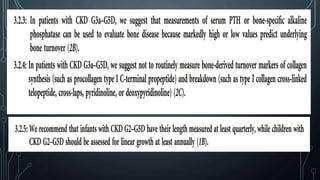
• It is well established that patients with CKD G3a–G5D have
increased fracture rates compared with the general population,
and moreover, incident hip fractures are associated with
substantial morbidity and mortality.
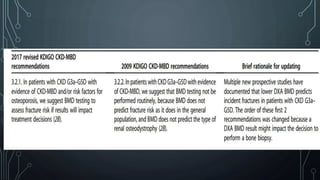
• Non invasive techniques BMD measurement – DXA and
quantitative CT
• DXA- Dual energy Xray absorptiometry cannot differentiate
between cortical and trabecular bone.(Bone remodeling is
different)
• Quantitative CT can measure as it is a 3D measurement.
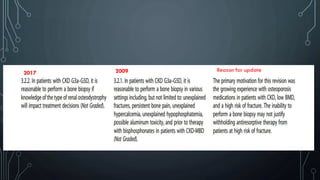
BONE BIOPSY
• A bone biopsy should also be considered in patients with unexplained fractures,
refractory hypercalcemia, suspicion of osteomalacia, an atypical response to
standard therapies for elevated PTH, or progressive decreases in BMD despite
standard therapy
• The goal of a bone biopsy would be to:
• (i) rule out atypical or unexpected bone pathology;
• (ii) determine whether the patient has high- or low-turnover disease, which may
alter the dose of medications to treat renal osteodystrophy (e.g., initiate or
discontinue calcimimetics, calcitriol, or vitamin D analogs); or
• (iii) identify a mineralization defect that would alter treatment (e.g., stop intake
of aluminum, or aggressively treat hypophosphatemia or vitamin D deficiency)
CLASSIFICATION OF RENAL
OSTEODYSTROPHY BY BONE BIOPSY
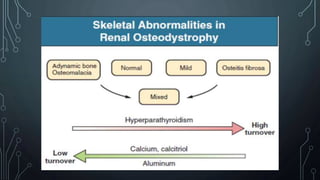
• Turnover – A spectrum of turnover rates from osteitis fibrosa to
adynamic bone disease
• Mineralisation- Classic abnormality is osteomalacia( bone
formation rate is low and osteoid volume is high)
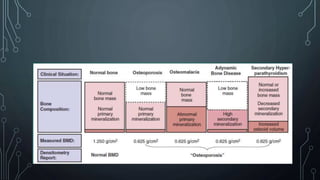
• Volume- in osteoporosis, both cortical and cancellous bone
volumes decrease, but in CKD, in High turnover MBD, cortical
bone volume is decreased but cancellous volume is increased.
CHAPTER 3.3
DIAGNOSIS OF CKD MBD:
VASCULAR ABNORMALITIES
CHAPTER 4.1
DIAGNOSIS OF CKD MBD:
TARGETED AT LOWERING HIGH
SERUM PHOSPHATE AND
MAINTAINING SERUM CALCIUM
LEVELS
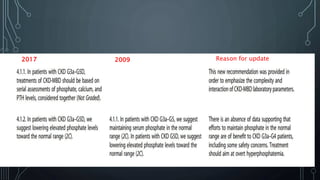
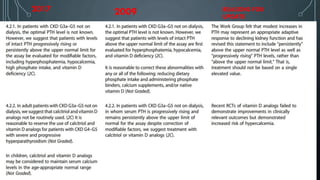
2017 2009 Reason for update
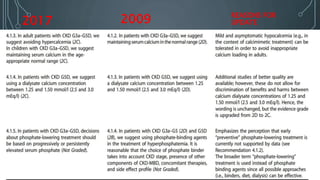
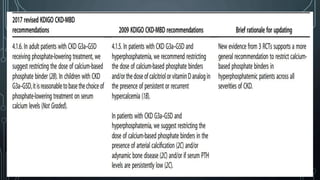
2017 2009 REASONS FOR
UPDATE
CHAPTER 4.2
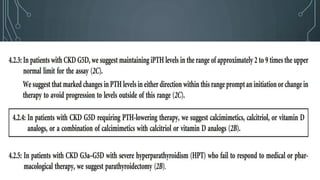
TREATMENT OF ABNORMAL PTH
LEVELS IN CKD-MBD
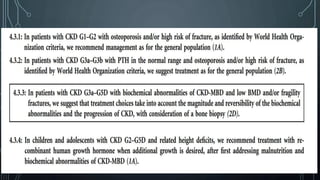
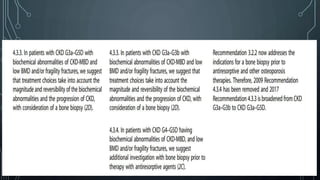
CHAPTER 4.3
TREATMENT OF BONE WITH
BISPHOSPHONATES, OTHER
OSTEOPOROSIS MEDICATIONS,
AND GROWTH HORMONE.
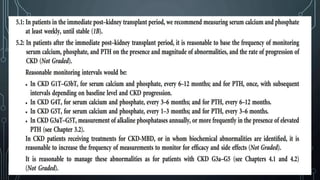
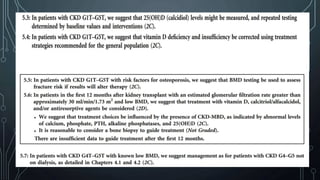
CHAPTER 5
EVALUATION AND TREATMENT
OF KIDNEY TRANSPLANT BONE
DISEASE.
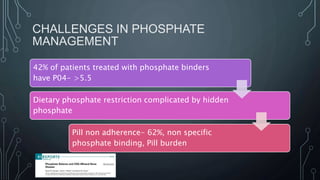
CHALLENGES IN PHOSPHATE
MANAGEMENT
42% of patients treated with phosphate binders
have P04- >5.5
Dietary phosphate restriction complicated by hidden
phosphate
Pill non adherence- 62%, non specific
phosphate binding, Pill burden
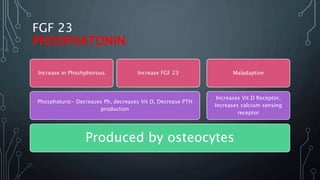
FGF 23
PHOSPHATONIN
Produced by osteocytes
Phosphaturic- Decreases Ph, decreases Vit D, Decrease PTH
production
Increase in Phoshphorous Increase FGF 23
Increases Vit D Receptor,
Increases calcium sensing
receptor
Maladaptive
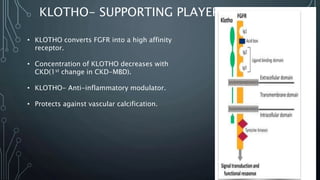
KLOTHO- SUPPORTING PLAYER
• KLOTHO converts FGFR into a high affinity
receptor.
• Concentration of KLOTHO decreases with
CKD(1st change in CKD-MBD).
• KLOTHO- Anti-inflammatory modulator.
• Protects against vascular calcification.
TRIALS
VITAMIN D ANALOGUE –OPERA (2014)
• Duration of study – 3 years
• Single centre, Hong Kong
• Type of study: RCT
• No. Of patients included:Screened 441, 229 eligible, 60 randomised (30 placebo, 30
paricalcitol)
• Aim : Treatment with oral activated Vit D, reduces LV mass in CKD 3-5 with LVH
• What was compared : effect of paricalcitol(oral activated Vit D reduces LV mass and function
in CKD 3-5
• Primary endpoint: change in LV mass over 52 weeks
• Secondary endpoint:changes in LV volume, Echo measures of systolic and diastolic
dysfunction, biochemical parameters of MBD, KFT
• Conclusion: 52 weeks of treatment improved SHPT, but did not alter LV str and function in
CKD.
• Major adverse event : Hypercalcemia
• Major limitation: 52 weeks, short sample size, proteinuria low so couldn’t assess
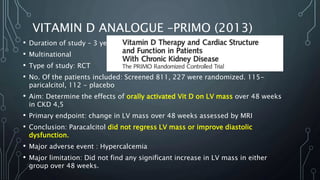
VITAMIN D ANALOGUE –PRIMO (2013)
• Duration of study – 3 years
• Multinational
• Type of study: RCT
• No. Of the patients included: Screened 811, 227 were randomized. 115-
paricalcitol, 112 - placebo
• Aim: Determine the effects of orally activated Vit D on LV mass over 48 weeks
in CKD 4,5
• Primary endpoint: change in LV mass over 48 weeks assessed by MRI
• Conclusion: Paracalcitol did not regress LV mass or improve diastolic
dysfunction.
• Major adverse event : Hypercalcemia
• Major limitation: Did not find any significant increase in LV mass in either
group over 48 weeks.
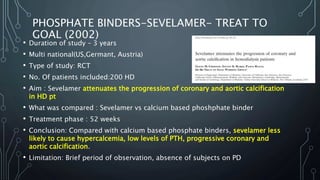
PHOSPHATE BINDERS-SEVELAMER- TREAT TO
GOAL (2002)
• Duration of study – 3 years
• Multi national(US,Germant, Austria)
• Type of study: RCT
• No. Of patients included:200 HD
• Aim : Sevelamer attenuates the progression of coronary and aortic calcification
in HD pt
• What was compared : Sevelamer vs calcium based phoshphate binder
• Treatment phase : 52 weeks
• Conclusion: Compared with calcium based phosphate binders, sevelamer less
likely to cause hypercalcemia, low levels of PTH, progressive coronary and
aortic calcification.
• Limitation: Brief period of observation, absence of subjects on PD
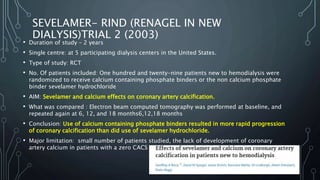
SEVELAMER- RIND (RENAGEL IN NEW
DIALYSIS)TRIAL 2 (2003)
• Duration of study – 2 years
• Single centre: at 5 participating dialysis centers in the United States.
• Type of study: RCT
• No. Of patients included: One hundred and twenty-nine patients new to hemodialysis were
randomized to receive calcium containing phosphate binders or the non calcium phosphate
binder sevelamer hydrochloride
• AIM: Sevelamer and calcium effects on coronary artery calcification.
• What was compared : Electron beam computed tomography was performed at baseline, and
repeated again at 6, 12, and 18 months6,12,18 months
• Conclusion: Use of calcium containing phosphate binders resulted in more rapid progression
of coronary calcification than did use of sevelamer hydrochloride.
• Major limitation: small number of patients studied, the lack of development of coronary
artery calcium in patients with a zero CACS at entry
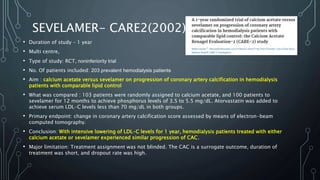
SEVELAMER- CARE2(2002)
• Duration of study – 1 year
• Multi centre,
• Type of study: RCT, noninferiority trial
• No. Of patients included: 203 prevalent hemodialysis patients
• Aim : calcium acetate versus sevelamer on progression of coronary artery calcification in hemodialysis
patients with comparable lipid control
• What was compared : 103 patients were randomly assigned to calcium acetate, and 100 patients to
sevelamer for 12 months to achieve phosphorus levels of 3.5 to 5.5 mg/dL. Atorvastatin was added to
achieve serum LDL-C levels less than 70 mg/dL in both groups.
• Primary endpoint: change in coronary artery calcification score assessed by means of electron-beam
computed tomography.
• Conclusion: With intensive lowering of LDL-C levels for 1 year, hemodialysis patients treated with either
calcium acetate or sevelamer experienced similar progression of CAC.
• Major limitation: Treatment assignment was not blinded. The CAC is a surrogate outcome, duration of
treatment was short, and dropout rate was high.
MORTALITY RELATED TO PHOSPHATE BINDERS-
INDEPENDENT STUDY(2012)
• Duration of study – 36 months
• Multi centre,
• Type of study: RCT
• No. Of patients included: 107 – Sevelamer group and 105 in calcium group
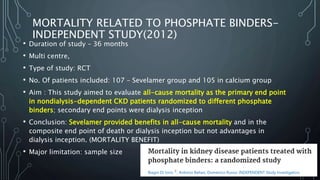
• Aim : This study aimed to evaluate all-cause mortality as the primary end point
in nondialysis-dependent CKD patients randomized to different phosphate
binders; secondary end points were dialysis inception
• Conclusion: Sevelamer provided benefits in all-cause mortality and in the
composite end point of death or dialysis inception but not advantages in
dialysis inception. (MORTALITY BENEFIT)
• Major limitation: sample size
MORTALITY- METAANLAYSIS(2013)
• Duration of study – 5 YEARS
• Type of study: all randomised and non-randomised trials
• No. Of patients included: Analysis of the 11 randomised trials
(4622 patients)
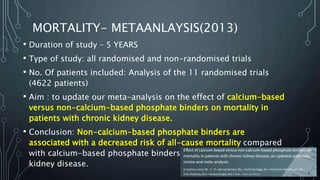
• Aim : to update our meta-analysis on the effect of calcium-based
versus non-calcium-based phosphate binders on mortality in
patients with chronic kidney disease.
• Conclusion: Non-calcium-based phosphate binders are
associated with a decreased risk of all-cause mortality compared
with calcium-based phosphate binders in patients with chronic
kidney disease.
MORTALITY- DCOR STUDY(2008)
• Duration of study – The trial was completed at the end of 2004.
• Multi centre,
• Type of study: RCT
• No. Of patients included: Participants were 18 years or older and on hemodialysis therapy for more than 3
months, with Medicare as primary payor.
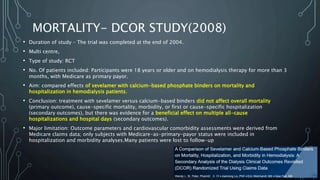
• Aim: compared effects of sevelamer with calcium-based phosphate binders on mortality and
hospitalization in hemodialysis patients.
• Conclusion: treatment with sevelamer versus calcium-based binders did not affect overall mortality
(primary outcome), cause-specific mortality, morbidity, or first or cause-specific hospitalization
(secondary outcomes), but there was evidence for a beneficial effect on multiple all-cause
hospitalizations and hospital days (secondary outcomes).
• Major limitation: Outcome parameters and cardiovascular comorbidity assessments were derived from
Medicare claims data; only subjects with Medicare-as-primary-payor status were included in
hospitalization and morbidity analyses.Many patients were lost to follow-up
CALCIMIMETIC- EVOLVE(2012)
• Duration of study – 64 months.
• Type of study: RCT
• No. Of patients included: 3800
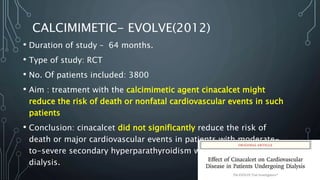
• Aim : treatment with the calcimimetic agent cinacalcet might
reduce the risk of death or nonfatal cardiovascular events in such
patients
• Conclusion: cinacalcet did not significantly reduce the risk of
death or major cardiovascular events in patients with moderate-
to-severe secondary hyperparathyroidism who were undergoing
dialysis.
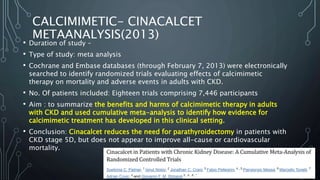
CALCIMIMETIC- CINACALCET
METAANALYSIS(2013)
• Duration of study –
• Type of study: meta analysis
• Cochrane and Embase databases (through February 7, 2013) were electronically
searched to identify randomized trials evaluating effects of calcimimetic
therapy on mortality and adverse events in adults with CKD.
• No. Of patients included: Eighteen trials comprising 7,446 participants
• Aim : to summarize the benefits and harms of calcimimetic therapy in adults
with CKD and used cumulative meta-analysis to identify how evidence for
calcimimetic treatment has developed in this clinical setting.
• Conclusion: Cinacalcet reduces the need for parathyroidectomy in patients with
CKD stage 5D, but does not appear to improve all-cause or cardiovascular
mortality.
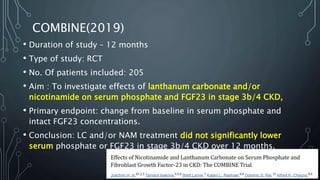
COMBINE(2019)
• Duration of study – 12 months
• Type of study: RCT
• No. Of patients included: 205
• Aim : To investigate effects of lanthanum carbonate and/or
nicotinamide on serum phosphate and FGF23 in stage 3b/4 CKD,
• Primary endpoint: change from baseline in serum phosphate and
intact FGF23 concentrations.
• Conclusion: LC and/or NAM treatment did not significantly lower
serum phosphate or FGF23 in stage 3b/4 CKD over 12 months.
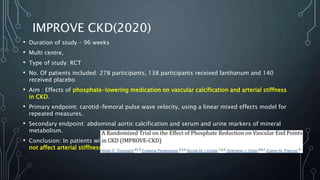
IMPROVE CKD(2020)
• Duration of study – 96 weeks
• Multi centre,
• Type of study: RCT
• No. Of patients included: 278 participants, 138 participants received lanthanum and 140
received placebo
• Aim : Effects of phosphate-lowering medication on vascular calcification and arterial stiffness
in CKD.
• Primary endpoint: carotid-femoral pulse wave velocity, using a linear mixed effects model for
repeated measures.
• Secondary endpoint: abdominal aortic calcification and serum and urine markers of mineral
metabolism.
• Conclusion: In patients with stage 3b/4 CKD, treatment with lanthanum over 96 weeks did
not affect arterial stiffness or aortic calcification compared with placebo.
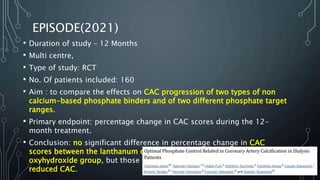
EPISODE(2021)
• Duration of study – 12 Months
• Multi centre,
• Type of study: RCT
• No. Of patients included: 160
• Aim : to compare the effects on CAC progression of two types of non
calcium-based phosphate binders and of two different phosphate target
ranges.
• Primary endpoint: percentage change in CAC scores during the 12-
month treatment.
• Conclusion: no significant difference in percentage change in CAC
scores between the lanthanum carbonate group and the sucroferric
oxyhydroxide group, but those who had strict control of phosphate had
reduced CAC.
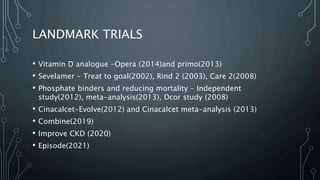
LANDMARK TRIALS
• Vitamin D analogue -Opera (2014)and primo(2013)
• Sevelamer - Treat to goal(2002), Rind 2 (2003), Care 2(2008)
• Phosphate binders and reducing mortality - Independent
study(2012), meta-analysis(2013), Dcor study (2008)
• Cinacalcet-Evolve(2012) and Cinacalcet meta-analysis (2013)
• Combine(2019)
• Improve CKD (2020)
• Episode(2021)
THANKYOU

CKD MBD PRESENTATION.pptx

  • 1.
    KDIGO GUIDELINES CKD- MBD PRESENTER-DR.URVASHI DNB NEPHROLOGY
  • 2.
  • 3.
    WHAT I THOUGHT? • CKDMBD Is a disorder of calcium, phosphorous, PTH, VIT D • You Win once the recommended target values are attained. • The main problem in CKD is MBD. Why bother about osteoporosis? • CKD- MBD is a problem, but does it have so much bearing on mortality and patient outcomes?
  • 4.
    THE BIG GAME Systemic disorder-Widevariety of systems Characterised by biochemical and bone abnormalities Vascular, soft tissue calcification
  • 5.
    CKD MBD HAS FAR-REACHING EFFECTS 🧠:CNS 🧠:BONE ❤️:HEART 🧠: BLOODVESSELS 🧠: KIDNEYS 💪: MUSCLE WHAT DOESN’T IT AFFECT? IT DOES EFFECTS ALL 🔴
  • 6.
  • 7.
    Kidney : key regulatorof phosphate in health What happens to the phosphate in CKD? Filtered load decreases ➡️ positive phosphorous balance Increase in phosphorous ➡️ Body’s
  • 8.
    Mechanisms of decreasing phosphate increase inPTH ➡️ decreases phosphate Increase in PTH ➡️ decreases sodium phosphate transporter in tubules ➡️ Phosphaturia Increase in FGF 23 ➡️ Phosphaturia By the time you see IShows how PTH signalling through the PTH type 1 receptor in apical brush border membrane and basolateral membrane result in phosphorylation of NHERF1, which leads to dissociation of NHERF1- NPT 2a complex and endocytosis of NPT 2 a protein and inhibition of phosphate transport. Mechanism b/w Pth and PDZ domain with PDZK1 and NPT2C remains unknwown
  • 9.
    • Mechanisms ,inducersand inhibitors of uremic Vascular calcification. • Calciprotein particles have been shown to induce VC • Cellular responses includes transdifferentiation of vascular smooth cells into osteoblast like cells, apoptosis, Extracellular matrix degradation, matrix vesicle formation and cell death. • Promote calcification of ECM in medial layer of BV. Meanwhile inhibitors feutin A , Mg and osteoprotegerin inhibit calcification process. KDIGO suggests to do XRAY for vascular and ECHO for valvular calcification.
  • 10.
    The conference concludedmost of the 2009 recommendations in current practice, however 12 recommendations were revised. Selective update.
  • 11.
    KDIGO -2017 Introduction andDefinition of CKD MBD Diagnosis of CKD–MBD: Biochemical Abnormalities Diagnosis of CKD–MBD: Bone Abnormalities Diagnosis of CKD–MBD: Vascular Calcification Treatment of CKD–MBD Targeted at Lowering High Serum Phosphate and Maintaining Serum Calcium Treatment of Abnormal PTH Levels in CKD–MBD Treatment of Bone With Bisphosphonates, Other Osteoporosis Medications, and Growth Hormone Evaluation and treatment of kidney transplant bone disease
  • 12.
  • 13.
    NOMENCLATURE AND DESCRIPTIONFOR RATING GUIDELINE RECOMMENDATIONS GRADE FOR STRENGTH OF RECOMMENDAT ION STRENGTH WORDING GRADE FOR QUALITY OF EVIDENCE LEVEL 1 STRONG WE RECOMMEND… SHOULD A HIGH LEVEL 2 WEAK WE SUGGEST… MIGHT B MODERATE C LOW D VERY LOW
  • 14.
    CHAPTER 3.1 DIAGNOSIS OFCKD MBD: BIOCHEMICAL ABNORMALITIES
  • 16.
    SUMMARY Progressive CKD 3 CKD 4CKD 5 AND 5D CALCIUM PHOSHPOROUS 6-12 MONTHS 3-6 MONTHS 1-3 MONTHS PTH ALP BASELINE 6-12 MONTHS 3-6 MONTHS CALCIDIOL BASELINE BASELINE BASELINE
  • 17.
    • Vitamin Ddeficiency may be an underlying cause of elevated PTH, and thus there is a rationale for measuring and supplementing in this population. • In the general population and CKD, there is an association of low 25(OH )D levels with mortality • In the absence of knowing the optimum level, the decision of
  • 19.
    THE MEASUREMENT OFPHOSPHORUS IS GENERALLY VALID AND REPRODUCIBLE BUT IS AFFECTED BY DIURNAL AND POST-PRANDIAL VARIATION. VALUES MAY DIFFER SUBSTANTIALLY IN DIALYSIS PATIENTS, DEPENDING ON WHICH SHIFT OR WHICH INTERDIALYTIC INTERVAL IS CHOSEN. VARIABLE CALCIUM PHOSPHORO US PTH VITAMIN D COEFFICIENT OF VARIANT + + ++ ++ DIURNAL VARIATION + ++ ++ - SEASONAL VARIATION ++ VARIATION WITH MEALS + + + - VARIATION WITH DIALYSIS TIME + + ASSAY VALIDITY +++ +++ + +
  • 20.
    CHAPTER 3.2 DIAGNOSIS OFCKD MBD: BONE ABNORMALITIES
  • 21.
    BACKGROUND • It iswell established that patients with CKD G3a–G5D have increased fracture rates compared with the general population, and moreover, incident hip fractures are associated with substantial morbidity and mortality. • Non invasive techniques BMD measurement – DXA and quantitative CT • DXA- Dual energy Xray absorptiometry cannot differentiate between cortical and trabecular bone.(Bone remodeling is different) • Quantitative CT can measure as it is a 3D measurement.
  • 22.
    BONE BIOPSY • Abone biopsy should also be considered in patients with unexplained fractures, refractory hypercalcemia, suspicion of osteomalacia, an atypical response to standard therapies for elevated PTH, or progressive decreases in BMD despite standard therapy • The goal of a bone biopsy would be to: • (i) rule out atypical or unexpected bone pathology; • (ii) determine whether the patient has high- or low-turnover disease, which may alter the dose of medications to treat renal osteodystrophy (e.g., initiate or discontinue calcimimetics, calcitriol, or vitamin D analogs); or • (iii) identify a mineralization defect that would alter treatment (e.g., stop intake of aluminum, or aggressively treat hypophosphatemia or vitamin D deficiency)
  • 23.
    CLASSIFICATION OF RENAL OSTEODYSTROPHYBY BONE BIOPSY • Turnover – A spectrum of turnover rates from osteitis fibrosa to adynamic bone disease • Mineralisation- Classic abnormality is osteomalacia( bone formation rate is low and osteoid volume is high) • Volume- in osteoporosis, both cortical and cancellous bone volumes decrease, but in CKD, in High turnover MBD, cortical bone volume is decreased but cancellous volume is increased.
  • 29.
    CHAPTER 3.3 DIAGNOSIS OFCKD MBD: VASCULAR ABNORMALITIES
  • 31.
    CHAPTER 4.1 DIAGNOSIS OFCKD MBD: TARGETED AT LOWERING HIGH SERUM PHOSPHATE AND MAINTAINING SERUM CALCIUM LEVELS
  • 32.
    2017 2009 Reasonfor update
  • 33.
  • 36.
    CHAPTER 4.2 TREATMENT OFABNORMAL PTH LEVELS IN CKD-MBD
  • 39.
    CHAPTER 4.3 TREATMENT OFBONE WITH BISPHOSPHONATES, OTHER OSTEOPOROSIS MEDICATIONS, AND GROWTH HORMONE.
  • 42.
    CHAPTER 5 EVALUATION ANDTREATMENT OF KIDNEY TRANSPLANT BONE DISEASE.
  • 45.
    CHALLENGES IN PHOSPHATE MANAGEMENT 42%of patients treated with phosphate binders have P04- >5.5 Dietary phosphate restriction complicated by hidden phosphate Pill non adherence- 62%, non specific phosphate binding, Pill burden
  • 46.
    FGF 23 PHOSPHATONIN Produced byosteocytes Phosphaturic- Decreases Ph, decreases Vit D, Decrease PTH production Increase in Phoshphorous Increase FGF 23 Increases Vit D Receptor, Increases calcium sensing receptor Maladaptive
  • 47.
    KLOTHO- SUPPORTING PLAYER •KLOTHO converts FGFR into a high affinity receptor. • Concentration of KLOTHO decreases with CKD(1st change in CKD-MBD). • KLOTHO- Anti-inflammatory modulator. • Protects against vascular calcification.
  • 48.
  • 49.
    VITAMIN D ANALOGUE–OPERA (2014) • Duration of study – 3 years • Single centre, Hong Kong • Type of study: RCT • No. Of patients included:Screened 441, 229 eligible, 60 randomised (30 placebo, 30 paricalcitol) • Aim : Treatment with oral activated Vit D, reduces LV mass in CKD 3-5 with LVH • What was compared : effect of paricalcitol(oral activated Vit D reduces LV mass and function in CKD 3-5 • Primary endpoint: change in LV mass over 52 weeks • Secondary endpoint:changes in LV volume, Echo measures of systolic and diastolic dysfunction, biochemical parameters of MBD, KFT • Conclusion: 52 weeks of treatment improved SHPT, but did not alter LV str and function in CKD. • Major adverse event : Hypercalcemia • Major limitation: 52 weeks, short sample size, proteinuria low so couldn’t assess
  • 50.
    VITAMIN D ANALOGUE–PRIMO (2013) • Duration of study – 3 years • Multinational • Type of study: RCT • No. Of the patients included: Screened 811, 227 were randomized. 115- paricalcitol, 112 - placebo • Aim: Determine the effects of orally activated Vit D on LV mass over 48 weeks in CKD 4,5 • Primary endpoint: change in LV mass over 48 weeks assessed by MRI • Conclusion: Paracalcitol did not regress LV mass or improve diastolic dysfunction. • Major adverse event : Hypercalcemia • Major limitation: Did not find any significant increase in LV mass in either group over 48 weeks.
  • 51.
    PHOSPHATE BINDERS-SEVELAMER- TREATTO GOAL (2002) • Duration of study – 3 years • Multi national(US,Germant, Austria) • Type of study: RCT • No. Of patients included:200 HD • Aim : Sevelamer attenuates the progression of coronary and aortic calcification in HD pt • What was compared : Sevelamer vs calcium based phoshphate binder • Treatment phase : 52 weeks • Conclusion: Compared with calcium based phosphate binders, sevelamer less likely to cause hypercalcemia, low levels of PTH, progressive coronary and aortic calcification. • Limitation: Brief period of observation, absence of subjects on PD
  • 52.
    SEVELAMER- RIND (RENAGELIN NEW DIALYSIS)TRIAL 2 (2003) • Duration of study – 2 years • Single centre: at 5 participating dialysis centers in the United States. • Type of study: RCT • No. Of patients included: One hundred and twenty-nine patients new to hemodialysis were randomized to receive calcium containing phosphate binders or the non calcium phosphate binder sevelamer hydrochloride • AIM: Sevelamer and calcium effects on coronary artery calcification. • What was compared : Electron beam computed tomography was performed at baseline, and repeated again at 6, 12, and 18 months6,12,18 months • Conclusion: Use of calcium containing phosphate binders resulted in more rapid progression of coronary calcification than did use of sevelamer hydrochloride. • Major limitation: small number of patients studied, the lack of development of coronary artery calcium in patients with a zero CACS at entry
  • 53.
    SEVELAMER- CARE2(2002) • Durationof study – 1 year • Multi centre, • Type of study: RCT, noninferiority trial • No. Of patients included: 203 prevalent hemodialysis patients • Aim : calcium acetate versus sevelamer on progression of coronary artery calcification in hemodialysis patients with comparable lipid control • What was compared : 103 patients were randomly assigned to calcium acetate, and 100 patients to sevelamer for 12 months to achieve phosphorus levels of 3.5 to 5.5 mg/dL. Atorvastatin was added to achieve serum LDL-C levels less than 70 mg/dL in both groups. • Primary endpoint: change in coronary artery calcification score assessed by means of electron-beam computed tomography. • Conclusion: With intensive lowering of LDL-C levels for 1 year, hemodialysis patients treated with either calcium acetate or sevelamer experienced similar progression of CAC. • Major limitation: Treatment assignment was not blinded. The CAC is a surrogate outcome, duration of treatment was short, and dropout rate was high.
  • 54.
    MORTALITY RELATED TOPHOSPHATE BINDERS- INDEPENDENT STUDY(2012) • Duration of study – 36 months • Multi centre, • Type of study: RCT • No. Of patients included: 107 – Sevelamer group and 105 in calcium group • Aim : This study aimed to evaluate all-cause mortality as the primary end point in nondialysis-dependent CKD patients randomized to different phosphate binders; secondary end points were dialysis inception • Conclusion: Sevelamer provided benefits in all-cause mortality and in the composite end point of death or dialysis inception but not advantages in dialysis inception. (MORTALITY BENEFIT) • Major limitation: sample size
  • 55.
    MORTALITY- METAANLAYSIS(2013) • Durationof study – 5 YEARS • Type of study: all randomised and non-randomised trials • No. Of patients included: Analysis of the 11 randomised trials (4622 patients) • Aim : to update our meta-analysis on the effect of calcium-based versus non-calcium-based phosphate binders on mortality in patients with chronic kidney disease. • Conclusion: Non-calcium-based phosphate binders are associated with a decreased risk of all-cause mortality compared with calcium-based phosphate binders in patients with chronic kidney disease.
  • 56.
    MORTALITY- DCOR STUDY(2008) •Duration of study – The trial was completed at the end of 2004. • Multi centre, • Type of study: RCT • No. Of patients included: Participants were 18 years or older and on hemodialysis therapy for more than 3 months, with Medicare as primary payor. • Aim: compared effects of sevelamer with calcium-based phosphate binders on mortality and hospitalization in hemodialysis patients. • Conclusion: treatment with sevelamer versus calcium-based binders did not affect overall mortality (primary outcome), cause-specific mortality, morbidity, or first or cause-specific hospitalization (secondary outcomes), but there was evidence for a beneficial effect on multiple all-cause hospitalizations and hospital days (secondary outcomes). • Major limitation: Outcome parameters and cardiovascular comorbidity assessments were derived from Medicare claims data; only subjects with Medicare-as-primary-payor status were included in hospitalization and morbidity analyses.Many patients were lost to follow-up
  • 57.
    CALCIMIMETIC- EVOLVE(2012) • Durationof study – 64 months. • Type of study: RCT • No. Of patients included: 3800 • Aim : treatment with the calcimimetic agent cinacalcet might reduce the risk of death or nonfatal cardiovascular events in such patients • Conclusion: cinacalcet did not significantly reduce the risk of death or major cardiovascular events in patients with moderate- to-severe secondary hyperparathyroidism who were undergoing dialysis.
  • 58.
    CALCIMIMETIC- CINACALCET METAANALYSIS(2013) • Durationof study – • Type of study: meta analysis • Cochrane and Embase databases (through February 7, 2013) were electronically searched to identify randomized trials evaluating effects of calcimimetic therapy on mortality and adverse events in adults with CKD. • No. Of patients included: Eighteen trials comprising 7,446 participants • Aim : to summarize the benefits and harms of calcimimetic therapy in adults with CKD and used cumulative meta-analysis to identify how evidence for calcimimetic treatment has developed in this clinical setting. • Conclusion: Cinacalcet reduces the need for parathyroidectomy in patients with CKD stage 5D, but does not appear to improve all-cause or cardiovascular mortality.
  • 59.
    COMBINE(2019) • Duration ofstudy – 12 months • Type of study: RCT • No. Of patients included: 205 • Aim : To investigate effects of lanthanum carbonate and/or nicotinamide on serum phosphate and FGF23 in stage 3b/4 CKD, • Primary endpoint: change from baseline in serum phosphate and intact FGF23 concentrations. • Conclusion: LC and/or NAM treatment did not significantly lower serum phosphate or FGF23 in stage 3b/4 CKD over 12 months.
  • 60.
    IMPROVE CKD(2020) • Durationof study – 96 weeks • Multi centre, • Type of study: RCT • No. Of patients included: 278 participants, 138 participants received lanthanum and 140 received placebo • Aim : Effects of phosphate-lowering medication on vascular calcification and arterial stiffness in CKD. • Primary endpoint: carotid-femoral pulse wave velocity, using a linear mixed effects model for repeated measures. • Secondary endpoint: abdominal aortic calcification and serum and urine markers of mineral metabolism. • Conclusion: In patients with stage 3b/4 CKD, treatment with lanthanum over 96 weeks did not affect arterial stiffness or aortic calcification compared with placebo.
  • 61.
    EPISODE(2021) • Duration ofstudy – 12 Months • Multi centre, • Type of study: RCT • No. Of patients included: 160 • Aim : to compare the effects on CAC progression of two types of non calcium-based phosphate binders and of two different phosphate target ranges. • Primary endpoint: percentage change in CAC scores during the 12- month treatment. • Conclusion: no significant difference in percentage change in CAC scores between the lanthanum carbonate group and the sucroferric oxyhydroxide group, but those who had strict control of phosphate had reduced CAC.
  • 62.
    LANDMARK TRIALS • VitaminD analogue -Opera (2014)and primo(2013) • Sevelamer - Treat to goal(2002), Rind 2 (2003), Care 2(2008) • Phosphate binders and reducing mortality - Independent study(2012), meta-analysis(2013), Dcor study (2008) • Cinacalcet-Evolve(2012) and Cinacalcet meta-analysis (2013) • Combine(2019) • Improve CKD (2020) • Episode(2021)
  • 63.