Management of
CKD
BASICS TO CURRENT UPDATES
Dr Shashikanth M
DM Nephrology
Assistant professor
VIMS Bellary
Content
 Introduction
 Magnitude of the problem
 Diagnosis
 Management
• Summary
Introduction
 CKD is a worldwide public health problem, both
for the number of patients and cost involved.
 With growing age of the population prevelence
is increasing.
 Lack of knowledge to screen early and also to
manage them rightly increasing morbidity and
mortality among CKD patients.
Magnitude
of the
burden
• The reported prevalence of CKD in different
regions of India ranges from <1% to 17%(ISN
2018).
• Over 50% of patients with advanced CKD are
first seen when the eGFR is <15 ml/min per 1.73
m2
.
• This sobering number highlights the need for
robust screening programs for those at risk for
CKD
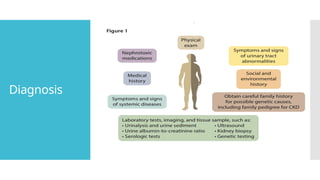
Diagnosis
 Chronic kidney disease (CKD) is defined
as either structural or functional
impairment of the kidney for three or
more months, irrespective of the
cause.
Diagnosis
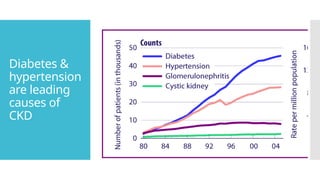
Diabetes &
hypertension
are leading
causes of
CKD
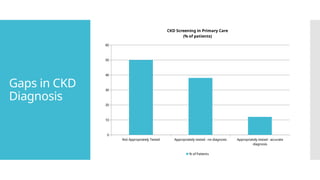
Gaps in CKD
Diagnosis
Not Appropriately Tested Appropriately tested - no diagnosis Appropriately tested - accurate
diagnosis
0
10
20
30
40
50
60
CKD Screening in Primary Care
(% of patients)
% of Patients
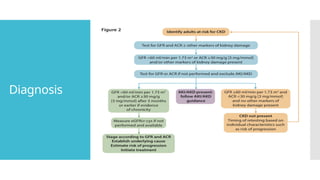
Diagnosis
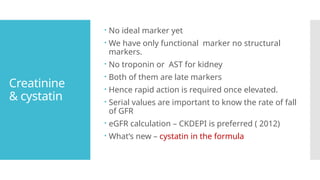
Creatinine
& cystatin
 No ideal marker yet
 We have only functional marker no structural
markers.
 No troponin or AST for kidney
 Both of them are late markers
 Hence rapid action is required once elevated.
 Serial values are important to know the rate of fall
of GFR
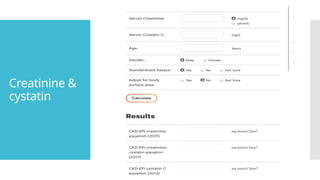
 eGFR calculation – CKDEPI is preferred ( 2012)
 What’s new – cystatin in the formula
Creatinine &
cystatin
Proteinuria/
Albuminuria
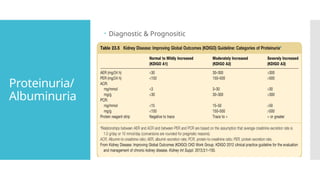
 Diagnostic & Prognositic
 .
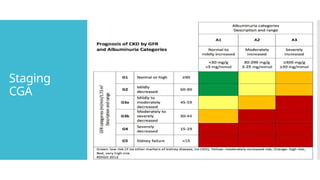
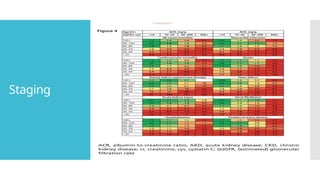
Staging
CGA
Staging
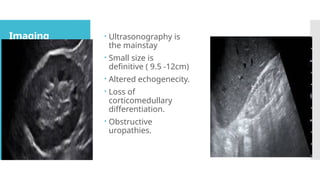
Imaging  Ultrasonography is
the mainstay
 Small size is
definitive ( 9.5 -12cm)
 Altered echogenecity.
 Loss of
corticomedullary
differentiation.
 Obstructive
uropathies.
Managemen
t
Managemen
t
 Treatment of reversible causes of kidney failure
 Preventing or slowing the progression of kidney
disease
 Treatment of the complications of kidney
failure .
 Adjusting drug doses when appropriate for the
level of estimated glomerular filtration rate
(eGFR).
 Identification and adequate preparation of the
patient in whom kidney replacement therapy
will be required
Reversible
causes of
CKD
 Nephrotoxic drugs
 Urinary tract obstruction
 Treating underlying cause.
 Preventing infections
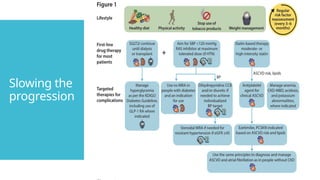
Slowing the
progression
 Life style modifications
 Strict blood pressure and glycemic control
 RAAS inhibitors
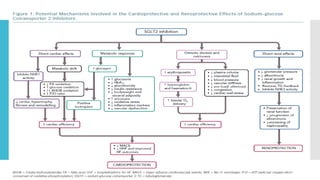
 SGLT2 inhibitors
 No steroid MRA(Finerenone)
Slowing the
progression
Life style
modification
s
 Salt restriction <2.5 gm /day
 Smoking cessation
 weight reduction (ORG)
 Dietary animal protein restriction.
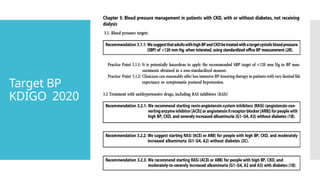
Target BP
KDIGO 2020
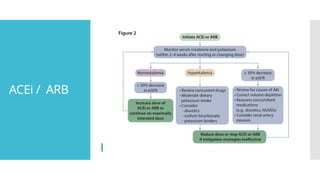
ACEi / ARB
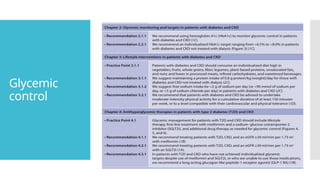
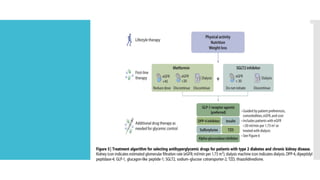
Glycemic
control
SGLT2
inhibitors
The Game
changers
 Decreases blood sugars
 Decreases BP
 Slows progression of CKD
 5th pillar for heart failure treatment
 Reduces hyponatremia
Finerenone
The
Forgotten ‘A’
of RAAS
string
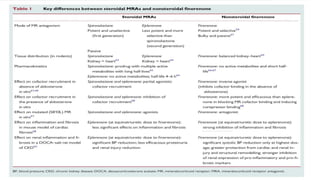
 Finerenone is a non-steroidal third generation Mineralocorticoid
receptor antagonist.
 It has high affinity for the Mineralocorticoid receptor does not bind
to androgen receptor
 It reduces albuminuria
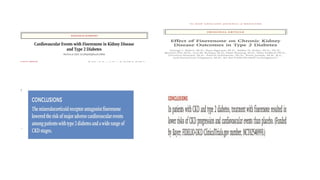
 It improves cardiovascular outcomes and also renal outcomes
 Two major studies FIDELIO DKD and FIGARO DKD have shown
significant improvement with respect to RENAL &
CARDIOVASCULAR outcomes
 There is an increased risk of hyperkalaemia
 Use in combination with SGLT2 inhibitors requires further study
Too early not
just early .
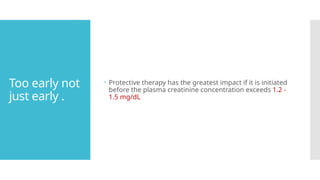
 Protective therapy has the greatest impact if it is initiated
before the plasma creatinine concentration exceeds 1.2 -
1.5 mg/dL
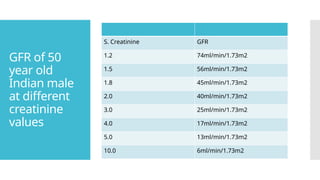
GFR of 50
year old
Indian male
at different
creatinine
values
S. Creatinine GFR
1.2 74ml/min/1.73m2
1.5 56ml/min/1.73m2
1.8 45ml/min/1.73m2
2.0 40ml/min/1.73m2
3.0 25ml/min/1.73m2
4.0 17ml/min/1.73m2
5.0 13ml/min/1.73m2
10.0 6ml/min/1.73m2
Complication
s
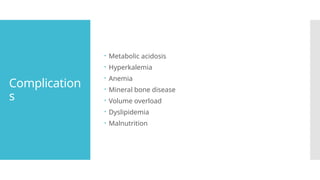
 Metabolic acidosis
 Hyperkalemia
 Anemia
 Mineral bone disease
 Volume overload
 Dyslipidemia
 Malnutrition
Complication
s
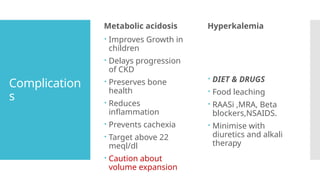
Metabolic acidosis
 Improves Growth in
children
 Delays progression
of CKD
 Preserves bone
health
 Reduces
inflammation
 Prevents cachexia
 Target above 22
meql/dl
 Caution about
volume expansion
Hyperkalemia
 DIET & DRUGS
 Food leaching
 RAASi ,MRA, Beta
blockers,NSAIDS.
 Minimise with
diuretics and alkali
therapy
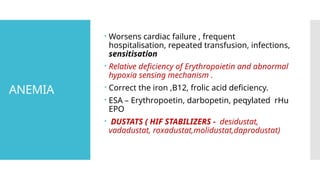
ANEMIA
 Worsens cardiac failure , frequent
hospitalisation, repeated transfusion, infections,
sensitisation
 Relative deficiency of Erythropoietin and abnormal
hypoxia sensing mechanism .
 Correct the iron ,B12, frolic acid deficiency.
 ESA – Erythropoetin, darbopetin, peqylated rHu
EPO
 DUSTATS ( HIF STABILIZERS - desidustat,
vadadustat, roxadustat,molidustat,daprodustat)
CKD MBD
 Triard
 Osteodystrophy, vascular calicification , high
phosphate ,low calcium, high
pth(paratharmone).
 Spectrum – a Dynamic bone disease to renal
osteodystrophy
 Treatment - Correct vit D deficiency,
hypocalcemia , hyperphosphatemia ( dietary
restriction, oral phosphate binders, calcitriol,
calcimmetics)
Dyslipidemia
 Mainly hypertriglycerdemia with total
cholesterol being normal.
 Screen all patients with CKD
 In DM, Nephrotic syndrome , metabolic
syndrome may have elevated cholesterol ,
treatment is with statins and ezetimibe.
 Secondary prevention is similar to non CKD
patients
 Primary prevention-
1. All patients with GFR <60ml/min
2. Patients with CKD and GFR >60ml/min and
age>50yrs or other risk factors.
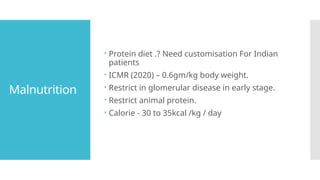
Malnutrition
 Protein diet .? Need customisation For Indian
patients
 ICMR (2020) – 0.6gm/kg body weight.
 Restrict in glomerular disease in early stage.
 Restrict animal protein.
 Calorie - 30 to 35kcal /kg / day
Infection and
vaccination
 Higher risk of infections compared to general
population
 Vaccination :
 Influenza – annual.
 Hepatitis B – 4 doses ( double dose)
 Pneumococcal ( prevenar 13 & pneumovac 23)
Medications
in CKD
 CKD patients at high risk for drug-related adverse events
 •Several classes of drugs renally eliminated
 •Consider kidney function and current eGFR (not just SCr)
when prescribing meds
 •Minimize pill burden as much as possible
 •Remind CKD patients to avoid NSAIDs
 •No Dual RAAS blockade
 •Any med with >30% renal clearance probably needs dose
adjustment for CKD
 •No bisphosphonates for eGFR <30
 •Avoid GAD for eGFR <30
Referral to
Nephrologist
s
When
 GFR < 30 ml/min/1.73m2.
 Earlier in whom GFR is falling rapidly and with
albuminuric CKD
 Rapid fall - >5ml/min/1.73m2/ year .
Why
 To Plan and counsel about renal replacement therapy
 Access(vascular & peritoneal Dialysis)
 To counsel about renal transplantation
Referral to
Nephrologist
s
 late referral is associated with a significantly
increased risk of all-cause mortality.
 Early referral enables discussion of the
preferred mode of kidney replacement therapy
to suit the patient's lifestyle.
 Helps in timely placement of a permanent
dialysis access.
 Patients treated by nephrologists were
significantly less likely to have required a
temporary venous catheter for the first dialysis
(36 versus 89 percent).
Most
common
cause of
death
 1. Cardiovascular.
 2. Infections.
 3. Access failure.
Kidney
replacement
therapy
 Hemodialysis ( incentre / home )
 Peritoneal dialysis ( intermittent/ continuous)
 Kidney transplantation – treatment of choice,
as it improves quality of life and reduces
mortality.
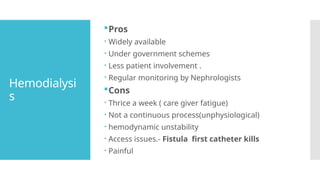
Hemodialysi
s
Pros
 Widely available
 Under government schemes
 Less patient involvement .
 Regular monitoring by Nephrologists
Cons
 Thrice a week ( care giver fatigue)
 Not a continuous process(unphysiological)
 hemodynamic unstability
 Access issues.- Fistula first catheter kills
 Painful
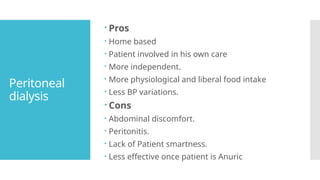
Peritoneal
dialysis
 Pros
 Home based
 Patient involved in his own care
 More independent.
 More physiological and liberal food intake
 Less BP variations.
 Cons
 Abdominal discomfort.
 Peritonitis.
 Lack of Patient smartness.
 Less effective once patient is Anuric
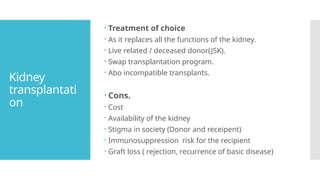
Kidney
transplantati
on
 Treatment of choice
 As it replaces all the functions of the kidney.
 Live related / deceased donor(JSK).
 Swap transplantation program.
 Abo incompatible transplants.
 Cons.
 Cost
 Availability of the kidney
 Stigma in society (Donor and receipent)
 Immunosuppression risk for the recipient
 Graft loss ( rejection, recurrence of basic disease)
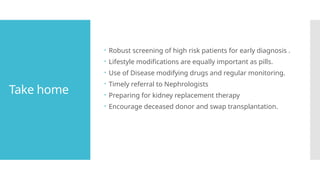
Take home
 Robust screening of high risk patients for early diagnosis .
 Lifestyle modifications are equally important as pills.
 Use of Disease modifying drugs and regular monitoring.
 Timely referral to Nephrologists
 Preparing for kidney replacement therapy
 Encourage deceased donor and swap transplantation.
Thank you
Management of CKD basic to current update.pptx

Management of CKD basic to current update.pptx

  • 1.
    Management of CKD BASICS TOCURRENT UPDATES Dr Shashikanth M DM Nephrology Assistant professor VIMS Bellary
  • 2.
    Content  Introduction  Magnitudeof the problem  Diagnosis  Management • Summary
  • 3.
    Introduction  CKD isa worldwide public health problem, both for the number of patients and cost involved.  With growing age of the population prevelence is increasing.  Lack of knowledge to screen early and also to manage them rightly increasing morbidity and mortality among CKD patients.
  • 4.
    Magnitude of the burden • Thereported prevalence of CKD in different regions of India ranges from <1% to 17%(ISN 2018). • Over 50% of patients with advanced CKD are first seen when the eGFR is <15 ml/min per 1.73 m2 . • This sobering number highlights the need for robust screening programs for those at risk for CKD
  • 5.
    Diagnosis  Chronic kidneydisease (CKD) is defined as either structural or functional impairment of the kidney for three or more months, irrespective of the cause.
  • 6.
  • 7.
  • 8.
    Gaps in CKD Diagnosis NotAppropriately Tested Appropriately tested - no diagnosis Appropriately tested - accurate diagnosis 0 10 20 30 40 50 60 CKD Screening in Primary Care (% of patients) % of Patients
  • 9.
  • 10.
    Creatinine & cystatin  Noideal marker yet  We have only functional marker no structural markers.  No troponin or AST for kidney  Both of them are late markers  Hence rapid action is required once elevated.  Serial values are important to know the rate of fall of GFR  eGFR calculation – CKDEPI is preferred ( 2012)  What’s new – cystatin in the formula
  • 11.
  • 12.
  • 13.
  • 14.
  • 15.
    Imaging  Ultrasonographyis the mainstay  Small size is definitive ( 9.5 -12cm)  Altered echogenecity.  Loss of corticomedullary differentiation.  Obstructive uropathies.
  • 16.
  • 17.
    Managemen t  Treatment ofreversible causes of kidney failure  Preventing or slowing the progression of kidney disease  Treatment of the complications of kidney failure .  Adjusting drug doses when appropriate for the level of estimated glomerular filtration rate (eGFR).  Identification and adequate preparation of the patient in whom kidney replacement therapy will be required
  • 18.
    Reversible causes of CKD  Nephrotoxicdrugs  Urinary tract obstruction  Treating underlying cause.  Preventing infections
  • 19.
    Slowing the progression  Lifestyle modifications  Strict blood pressure and glycemic control  RAAS inhibitors  SGLT2 inhibitors  No steroid MRA(Finerenone)
  • 20.
  • 21.
    Life style modification s  Saltrestriction <2.5 gm /day  Smoking cessation  weight reduction (ORG)  Dietary animal protein restriction.
  • 22.
  • 23.
  • 24.
  • 26.
    SGLT2 inhibitors The Game changers  Decreasesblood sugars  Decreases BP  Slows progression of CKD  5th pillar for heart failure treatment  Reduces hyponatremia
  • 28.
    Finerenone The Forgotten ‘A’ of RAAS string Finerenone is a non-steroidal third generation Mineralocorticoid receptor antagonist.  It has high affinity for the Mineralocorticoid receptor does not bind to androgen receptor  It reduces albuminuria  It improves cardiovascular outcomes and also renal outcomes  Two major studies FIDELIO DKD and FIGARO DKD have shown significant improvement with respect to RENAL & CARDIOVASCULAR outcomes  There is an increased risk of hyperkalaemia  Use in combination with SGLT2 inhibitors requires further study
  • 31.
    Too early not justearly .  Protective therapy has the greatest impact if it is initiated before the plasma creatinine concentration exceeds 1.2 - 1.5 mg/dL
  • 32.
    GFR of 50 yearold Indian male at different creatinine values S. Creatinine GFR 1.2 74ml/min/1.73m2 1.5 56ml/min/1.73m2 1.8 45ml/min/1.73m2 2.0 40ml/min/1.73m2 3.0 25ml/min/1.73m2 4.0 17ml/min/1.73m2 5.0 13ml/min/1.73m2 10.0 6ml/min/1.73m2
  • 33.
    Complication s  Metabolic acidosis Hyperkalemia  Anemia  Mineral bone disease  Volume overload  Dyslipidemia  Malnutrition
  • 34.
    Complication s Metabolic acidosis  ImprovesGrowth in children  Delays progression of CKD  Preserves bone health  Reduces inflammation  Prevents cachexia  Target above 22 meql/dl  Caution about volume expansion Hyperkalemia  DIET & DRUGS  Food leaching  RAASi ,MRA, Beta blockers,NSAIDS.  Minimise with diuretics and alkali therapy
  • 35.
    ANEMIA  Worsens cardiacfailure , frequent hospitalisation, repeated transfusion, infections, sensitisation  Relative deficiency of Erythropoietin and abnormal hypoxia sensing mechanism .  Correct the iron ,B12, frolic acid deficiency.  ESA – Erythropoetin, darbopetin, peqylated rHu EPO  DUSTATS ( HIF STABILIZERS - desidustat, vadadustat, roxadustat,molidustat,daprodustat)
  • 36.
    CKD MBD  Triard Osteodystrophy, vascular calicification , high phosphate ,low calcium, high pth(paratharmone).  Spectrum – a Dynamic bone disease to renal osteodystrophy  Treatment - Correct vit D deficiency, hypocalcemia , hyperphosphatemia ( dietary restriction, oral phosphate binders, calcitriol, calcimmetics)
  • 37.
    Dyslipidemia  Mainly hypertriglycerdemiawith total cholesterol being normal.  Screen all patients with CKD  In DM, Nephrotic syndrome , metabolic syndrome may have elevated cholesterol , treatment is with statins and ezetimibe.  Secondary prevention is similar to non CKD patients  Primary prevention- 1. All patients with GFR <60ml/min 2. Patients with CKD and GFR >60ml/min and age>50yrs or other risk factors.
  • 38.
    Malnutrition  Protein diet.? Need customisation For Indian patients  ICMR (2020) – 0.6gm/kg body weight.  Restrict in glomerular disease in early stage.  Restrict animal protein.  Calorie - 30 to 35kcal /kg / day
  • 39.
    Infection and vaccination  Higherrisk of infections compared to general population  Vaccination :  Influenza – annual.  Hepatitis B – 4 doses ( double dose)  Pneumococcal ( prevenar 13 & pneumovac 23)
  • 40.
    Medications in CKD  CKDpatients at high risk for drug-related adverse events  •Several classes of drugs renally eliminated  •Consider kidney function and current eGFR (not just SCr) when prescribing meds  •Minimize pill burden as much as possible  •Remind CKD patients to avoid NSAIDs  •No Dual RAAS blockade  •Any med with >30% renal clearance probably needs dose adjustment for CKD  •No bisphosphonates for eGFR <30  •Avoid GAD for eGFR <30
  • 41.
    Referral to Nephrologist s When  GFR< 30 ml/min/1.73m2.  Earlier in whom GFR is falling rapidly and with albuminuric CKD  Rapid fall - >5ml/min/1.73m2/ year . Why  To Plan and counsel about renal replacement therapy  Access(vascular & peritoneal Dialysis)  To counsel about renal transplantation
  • 42.
    Referral to Nephrologist s  latereferral is associated with a significantly increased risk of all-cause mortality.  Early referral enables discussion of the preferred mode of kidney replacement therapy to suit the patient's lifestyle.  Helps in timely placement of a permanent dialysis access.  Patients treated by nephrologists were significantly less likely to have required a temporary venous catheter for the first dialysis (36 versus 89 percent).
  • 43.
    Most common cause of death  1.Cardiovascular.  2. Infections.  3. Access failure.
  • 44.
    Kidney replacement therapy  Hemodialysis (incentre / home )  Peritoneal dialysis ( intermittent/ continuous)  Kidney transplantation – treatment of choice, as it improves quality of life and reduces mortality.
  • 45.
    Hemodialysi s Pros  Widely available Under government schemes  Less patient involvement .  Regular monitoring by Nephrologists Cons  Thrice a week ( care giver fatigue)  Not a continuous process(unphysiological)  hemodynamic unstability  Access issues.- Fistula first catheter kills  Painful
  • 46.
    Peritoneal dialysis  Pros  Homebased  Patient involved in his own care  More independent.  More physiological and liberal food intake  Less BP variations.  Cons  Abdominal discomfort.  Peritonitis.  Lack of Patient smartness.  Less effective once patient is Anuric
  • 47.
    Kidney transplantati on  Treatment ofchoice  As it replaces all the functions of the kidney.  Live related / deceased donor(JSK).  Swap transplantation program.  Abo incompatible transplants.  Cons.  Cost  Availability of the kidney  Stigma in society (Donor and receipent)  Immunosuppression risk for the recipient  Graft loss ( rejection, recurrence of basic disease)
  • 48.
    Take home  Robustscreening of high risk patients for early diagnosis .  Lifestyle modifications are equally important as pills.  Use of Disease modifying drugs and regular monitoring.  Timely referral to Nephrologists  Preparing for kidney replacement therapy  Encourage deceased donor and swap transplantation.
  • 49.

Editor's Notes

  • #4 Increases risk for all-cause mortality, CV mortality, kidney failure (ESRD), and other adverse outcomes.
  • #10 Use of cystatin c along with creatnine strengthens the association between the eGFR and risk of death. Muscle mass All nucleated cells ( obesity smoking crp ) Epidemiology collaboration equation
  • #18 Heart failure Liver failure Haematological diseases HBV HCV Glomerular disease
  • #21 Hyperfiltration injury Nephron numbers are fixed
  • #26 RAASi Diuretics MRA Beta blockers
  • #37 Cheese, milk products, egg Red meat, beans nuts oats soft drinks
  • #48 BP control erythropoesis, bone health