CJUS 702
Activity 4 Instructions
Complete the required reading and presentations in the Reading
& Study folder of Module/Week 8. Then write a paper which
addresses what you believe are the most important issues facing
the juvenile justice system today and how does this affect the
system in the future? What are some ways that the juvenile
justice system be revitalized?
In order to have the possibility of receiving full points, you
must complete your answer entirely.
This includes 4 fully developed pages include correct usage of
APA format, your Christian world view, and relevant in-text
support for both. The title-page, abstract, and reference page(s)
are not included in the page count requirement. See the activity
rubric for additional clarification.
Textbooks
Steven M. Cox, Jennifer M. Allen, Robert D. Hanser and John J.
Conrad. Juvenile Justice A Guide to Theory, Policy and
Practice. 9th ed. Sage Publications, 2018. ISBN:
9781506349008.
Francine T. Sherman and Francine H. Jacobs. Juvenile Justice
Advancing Research, Policy and Practice. 1st ed. John Wiley
and Sons, Inc., 2011. ISBN: 9780470497043
Unacceptable Needs Improvement Competent Exemplary
Examine organizational risks in the current workplace or
another organization.
0 (0.00%)
Did not submit or incompletely examined organizational risks
in the current workplace or another organization.
23.625 (15.75%)
Partially examined organizational risks in the current
workplace or another organization.
26.775 (17.85%)
Satisfactorily examined organizational risks in the current
workplace or another organization.
31.5 (21.00%)
Thoroughly examined organizational risks in the current
workplace or another organization.
Examine technical risks in the current workplace or
another organization.
0 (0.00%)
Did not submit or incompletely examined technical risks in
the current workplace or another organization.
23.625 (15.75%)
Partially examined technical risks in the current workplace or
another organization.
26.775 (17.85%)
Satisfactorily examined technical risks in the current
workplace or another organization.
31.5 (21.00%)
Thoroughly examined technical risks in the current workplace
or another organization.
Examine resource risks in the current workplace or
another organization.
0 (0.00%)
Did not submit or incompletely examined resource risks in
the current workplace or another organization.
23.625 (15.75%)
Partially examined resource risks in the current workplace or
another organization.
26.775 (17.85%)
Satisfactorily examined resource risks in the current
workplace or another organization.
31.5 (21.00%)
Thoroughly examined resource risks in the current workplace
or another organization.
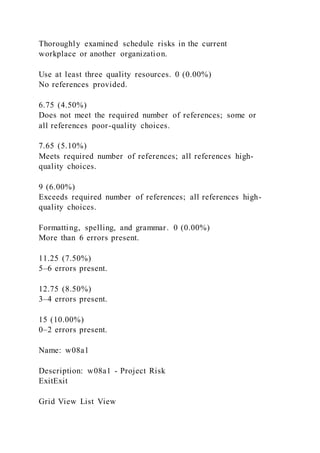
Examine schedule risks in the current workplace or
another organization.
0 (0.00%)
Did not submit or incompletely examined schedule risks in
the current workplace or another organization.
23.625 (15.75%)
Partially examined schedule risks in the current workplace or
another organization.
26.775 (17.85%)
Satisfactorily examined schedule risks in the current
workplace or another organization.
31.5 (21.00%)
Thoroughly examined schedule risks in the current
workplace or another organization.
Use at least three quality resources. 0 (0.00%)
No references provided.
6.75 (4.50%)
Does not meet the required number of references; some or
all references poor-quality choices.
7.65 (5.10%)
Meets required number of references; all references high-
quality choices.
9 (6.00%)
Exceeds required number of references; all references high-
quality choices.
Formatting, spelling, and grammar. 0 (0.00%)
More than 6 errors present.
11.25 (7.50%)
5–6 errors present.
12.75 (8.50%)
3–4 errors present.
15 (10.00%)
0–2 errors present.
Name: w08a1
Description: w08a1 - Project Risk
ExitExit
Grid View List View
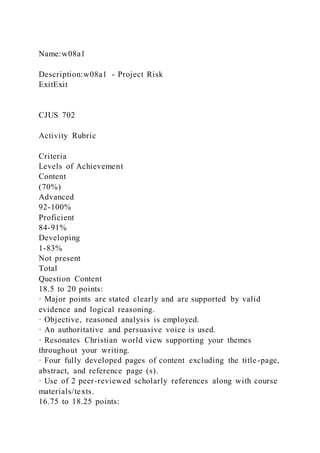
Name:w08a1
Description:w08a1 - Project Risk
ExitExit
CJUS 702
Activity Rubric
Criteria
Levels of Achievement
Content
(70%)
Advanced
92-100%
Proficient
84-91%
Developing
1-83%
Not present
Total
Question Content
18.5 to 20 points:
· Major points are stated clearly and are supported by valid
evidence and logical reasoning.
· Objective, reasoned analysis is employed.
· An authoritative and persuasive voice is used.
· Resonates Christian world view supporting your themes
throughout your writing.
· Four fully developed pages of content excluding the title-page,
abstract, and reference page (s).
· Use of 2 peer-reviewed scholarly references along with course
materials/texts.
16.75 to 18.25 points:
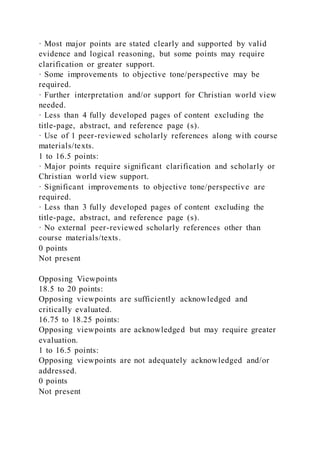
· Most major points are stated clearly and supported by valid
evidence and logical reasoning, but some points may require
clarification or greater support.
· Some improvements to objective tone/perspective may be
required.
· Further interpretation and/or support for Christian world view
needed.
· Less than 4 fully developed pages of content excluding the
title-page, abstract, and reference page (s).
· Use of 1 peer-reviewed scholarly references along with course
materials/texts.
1 to 16.5 points:
· Major points require significant clarification and scholarly or
Christian world view support.
· Significant improvements to objective tone/perspective are
required.
· Less than 3 fully developed pages of content excluding the
title-page, abstract, and reference page (s).
· No external peer-reviewed scholarly references other than
course materials/texts.
0 points
Not present
Opposing Viewpoints
18.5 to 20 points:
Opposing viewpoints are sufficiently acknowledged and
critically evaluated.
16.75 to 18.25 points:
Opposing viewpoints are acknowledged but may require greater
evaluation.
1 to 16.5 points:
Opposing viewpoints are not adequately acknowledged and/or
addressed.
0 points
Not present
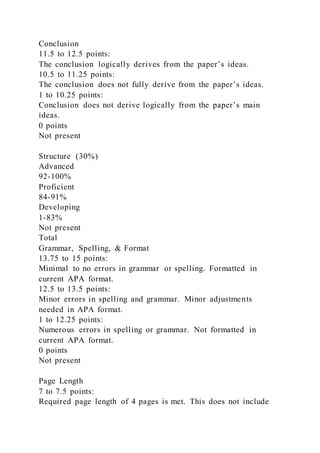
Conclusion
11.5 to 12.5 points:
The conclusion logically derives from the paper’s ideas.
10.5 to 11.25 points:
The conclusion does not fully derive from the paper’s ideas.
1 to 10.25 points:
Conclusion does not derive logically from the paper’s main
ideas.
0 points
Not present
Structure (30%)
Advanced
92-100%
Proficient
84-91%
Developing
1-83%
Not present
Total
Grammar, Spelling, & Format
13.75 to 15 points:
Minimal to no errors in grammar or spelling. Formatted in
current APA format.
12.5 to 13.5 points:
Minor errors in spelling and grammar. Minor adjustments
needed in APA format.
1 to 12.25 points:
Numerous errors in spelling or grammar. Not formatted in
current APA format.
0 points
Not present
Page Length
7 to 7.5 points:
Required page length of 4 pages is met. This does not include
title-page, abstract, nor reference page(s).
6.25 to 6.75 points:
Required page length was not met or exceeded required page
length of 1 page. This does not include title-page, abstract, nor
reference page(s).
1 to 6 points:
Page length may be significantly shorter or longer than the
requirement by 2 or more pages.
0 points
Not present
Professor Comments:
Total:
/75

Cjus 702 activity 4 instructionscomplete the required reading

  • 1.
    CJUS 702 Activity 4Instructions Complete the required reading and presentations in the Reading & Study folder of Module/Week 8. Then write a paper which addresses what you believe are the most important issues facing the juvenile justice system today and how does this affect the system in the future? What are some ways that the juvenile justice system be revitalized? In order to have the possibility of receiving full points, you must complete your answer entirely. This includes 4 fully developed pages include correct usage of APA format, your Christian world view, and relevant in-text support for both. The title-page, abstract, and reference page(s) are not included in the page count requirement. See the activity rubric for additional clarification. Textbooks Steven M. Cox, Jennifer M. Allen, Robert D. Hanser and John J. Conrad. Juvenile Justice A Guide to Theory, Policy and Practice. 9th ed. Sage Publications, 2018. ISBN: 9781506349008. Francine T. Sherman and Francine H. Jacobs. Juvenile Justice Advancing Research, Policy and Practice. 1st ed. John Wiley and Sons, Inc., 2011. ISBN: 9780470497043 Unacceptable Needs Improvement Competent Exemplary Examine organizational risks in the current workplace or
  • 2.
    another organization. 0 (0.00%) Didnot submit or incompletely examined organizational risks in the current workplace or another organization. 23.625 (15.75%) Partially examined organizational risks in the current workplace or another organization. 26.775 (17.85%) Satisfactorily examined organizational risks in the current workplace or another organization. 31.5 (21.00%) Thoroughly examined organizational risks in the current workplace or another organization. Examine technical risks in the current workplace or another organization. 0 (0.00%) Did not submit or incompletely examined technical risks in the current workplace or another organization. 23.625 (15.75%) Partially examined technical risks in the current workplace or another organization. 26.775 (17.85%) Satisfactorily examined technical risks in the current workplace or another organization. 31.5 (21.00%) Thoroughly examined technical risks in the current workplace or another organization.
  • 3.
    Examine resource risksin the current workplace or another organization. 0 (0.00%) Did not submit or incompletely examined resource risks in the current workplace or another organization. 23.625 (15.75%) Partially examined resource risks in the current workplace or another organization. 26.775 (17.85%) Satisfactorily examined resource risks in the current workplace or another organization. 31.5 (21.00%) Thoroughly examined resource risks in the current workplace or another organization. Examine schedule risks in the current workplace or another organization. 0 (0.00%) Did not submit or incompletely examined schedule risks in the current workplace or another organization. 23.625 (15.75%) Partially examined schedule risks in the current workplace or another organization. 26.775 (17.85%) Satisfactorily examined schedule risks in the current workplace or another organization. 31.5 (21.00%)
  • 4.
    Thoroughly examined schedulerisks in the current workplace or another organization. Use at least three quality resources. 0 (0.00%) No references provided. 6.75 (4.50%) Does not meet the required number of references; some or all references poor-quality choices. 7.65 (5.10%) Meets required number of references; all references high- quality choices. 9 (6.00%) Exceeds required number of references; all references high- quality choices. Formatting, spelling, and grammar. 0 (0.00%) More than 6 errors present. 11.25 (7.50%) 5–6 errors present. 12.75 (8.50%) 3–4 errors present. 15 (10.00%) 0–2 errors present. Name: w08a1 Description: w08a1 - Project Risk ExitExit Grid View List View
  • 5.
    Name:w08a1 Description:w08a1 - ProjectRisk ExitExit CJUS 702 Activity Rubric Criteria Levels of Achievement Content (70%) Advanced 92-100% Proficient 84-91% Developing 1-83% Not present Total Question Content 18.5 to 20 points: · Major points are stated clearly and are supported by valid evidence and logical reasoning. · Objective, reasoned analysis is employed. · An authoritative and persuasive voice is used. · Resonates Christian world view supporting your themes throughout your writing. · Four fully developed pages of content excluding the title-page, abstract, and reference page (s). · Use of 2 peer-reviewed scholarly references along with course materials/texts. 16.75 to 18.25 points:
  • 6.
    · Most majorpoints are stated clearly and supported by valid evidence and logical reasoning, but some points may require clarification or greater support. · Some improvements to objective tone/perspective may be required. · Further interpretation and/or support for Christian world view needed. · Less than 4 fully developed pages of content excluding the title-page, abstract, and reference page (s). · Use of 1 peer-reviewed scholarly references along with course materials/texts. 1 to 16.5 points: · Major points require significant clarification and scholarly or Christian world view support. · Significant improvements to objective tone/perspective are required. · Less than 3 fully developed pages of content excluding the title-page, abstract, and reference page (s). · No external peer-reviewed scholarly references other than course materials/texts. 0 points Not present Opposing Viewpoints 18.5 to 20 points: Opposing viewpoints are sufficiently acknowledged and critically evaluated. 16.75 to 18.25 points: Opposing viewpoints are acknowledged but may require greater evaluation. 1 to 16.5 points: Opposing viewpoints are not adequately acknowledged and/or addressed. 0 points Not present
  • 7.
    Conclusion 11.5 to 12.5points: The conclusion logically derives from the paper’s ideas. 10.5 to 11.25 points: The conclusion does not fully derive from the paper’s ideas. 1 to 10.25 points: Conclusion does not derive logically from the paper’s main ideas. 0 points Not present Structure (30%) Advanced 92-100% Proficient 84-91% Developing 1-83% Not present Total Grammar, Spelling, & Format 13.75 to 15 points: Minimal to no errors in grammar or spelling. Formatted in current APA format. 12.5 to 13.5 points: Minor errors in spelling and grammar. Minor adjustments needed in APA format. 1 to 12.25 points: Numerous errors in spelling or grammar. Not formatted in current APA format. 0 points Not present Page Length 7 to 7.5 points: Required page length of 4 pages is met. This does not include
  • 8.
    title-page, abstract, norreference page(s). 6.25 to 6.75 points: Required page length was not met or exceeded required page length of 1 page. This does not include title-page, abstract, nor reference page(s). 1 to 6 points: Page length may be significantly shorter or longer than the requirement by 2 or more pages. 0 points Not present Professor Comments: Total: /75