YOUR ORGANIZATION NAME
CITIZENSHIP
CITIZENSHIP
- is a membership in a political
community which is personal and more
or less permanent in character where he
enjoys the exercise of political rights
above civil privileges provided by law
NATIONALITY
- encompasses all those who
render allegiance to the State,
be it a citizen or otherwise.
ALIENS
is a foreigner who temporarily resides in
another country or one who passes
through another border. It receives
limited protection over his person and
property.
Classification of Aliens
1. Resident alien. A foreigner residing in
the jurisdiction of another State, and to
some extent, his rights and property are
protected.
2. Non-resident alien. Refers to the citizen
of the State as provided in Art IV, Sec 1.
Refugees
- are stateless persons who have fled their
home State for shelter and asylum in
another State. They deliberately withdraw
their citizenship and denounce allegiance to
the State and laws.
Doctrines of citizenship
a. Jus sanguinis- the citizenship of a child is
determined by blood relationship. This is
the doctrine the Philippines apply in
determining one’s membership to the
political society.
b. Jus soli/jus loci- the citizenship of a
child is determined by the place of birth.
Modes of acquiring citizenship:
1. By birth. This is called the involuntary method.
Citizenship is acquired through blood relationship to the
parents.
Natural Born Citizens (Sec. 2, Art. IV)
1. Citizens of the Philippines from birth without having to
perform any act to acquire or perfect their Philippine
citizenship;
2. Those born before January 17, 1973 of Filipino mothers,
who elect Philippine citizenship upon reaching the age of
majority
2. By naturalization. This is called the
voluntary method of acquiring citizenship
through naturalization process.
Naturalization, it means the act of formally
adopting a foreigner into the political body of
the State, and clothing him with the rights
and privileges of citizenship.
Three ways of acquiring naturalization process
a. Act of court. This suggests that citizenship
may be granted to an applicant pursuant to
the judgment of the court. Regional Trial
Court has the jurisdiction
b. Direct act of Congress. The legislative
normally promulgates an act directly
bestowing citizenship on an alien applicant.
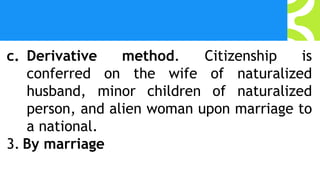
c. Derivative method. Citizenship is
conferred on the wife of naturalized
husband, minor children of naturalized
person, and alien woman upon marriage to
a national.
3. By marriage
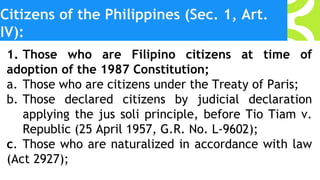
Citizens of the Philippines (Sec. 1, Art.
IV):
1. Those who are Filipino citizens at time of
adoption of the 1987 Constitution;
a. Those who are citizens under the Treaty of Paris;
b. Those declared citizens by judicial declaration
applying the jus soli principle, before Tio Tiam v.
Republic (25 April 1957, G.R. No. L-9602);
c. Those who are naturalized in accordance with law
(Act 2927);
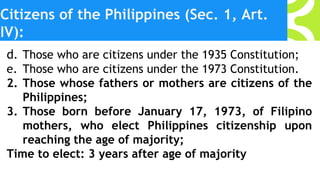
Citizens of the Philippines (Sec. 1, Art.
IV):
d. Those who are citizens under the 1935 Constitution;
e. Those who are citizens under the 1973 Constitution.
2. Those whose fathers or mothers are citizens of the
Philippines;
3. Those born before January 17, 1973, of Filipino
mothers, who elect Philippines citizenship upon
reaching the age of majority;
Time to elect: 3 years after age of majority
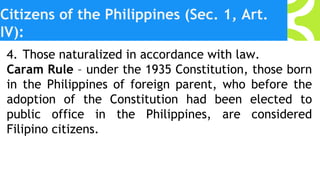
Citizens of the Philippines (Sec. 1, Art.
IV):
4. Those naturalized in accordance with law.
Caram Rule – under the 1935 Constitution, those born
in the Philippines of foreign parent, who before the
adoption of the Constitution had been elected to
public office in the Philippines, are considered
Filipino citizens.
Effects of Naturalization :
1.ON THE WIFE. It vests citizenship on wife who
might herself be lawfully naturalized; She need not
prove her qualifications but only that she is not
disqualified.
2. ON THE MINOR CHILDREN
(i) If born in the Philippines – automatically becomes
a citizen;If born abroad
Effects of Naturalization :
1.ON THE WIFE. It vests citizenship on wife who
might herself be lawfully naturalized; She need not
prove her qualifications but only that she is not
disqualified.
2. ON THE MINOR CHILDREN
(i) If born in the Philippines – automatically becomes
a citizen;If born abroad
Effects of Naturalization :
If born before the naturalization of the father
(ia). residing in RP at the time of naturalization –
automatically becomes citizen;
(ib). if not residing in RP at the time of
naturalization – considered citizen only during
minority, unless begins to reside permanently in
the Philippines;
Effects of Naturalization :
(ii). If born outside the Philippines after
parents’ naturalization considered Filipino,
provided registered as such before any Philippines
consulate within 1 year after attaining majority
age and takes oath of allegiance.
Doctrine of Indelible Allegiance – an
individual may be compelled to retain his original
nationality notwithstanding that he has already
renounced or forfeited it under the laws of the
second state whose nationality he has acquired.
LOSS OF PHILIPPINE CITIZENSHIP: :
1.Naturalization in a foreign country;
2. Express renunciation of citizenship (expatriation);
– The mere application or possession of an alien
certificate of registration does not amount to
renunciation
3. Subscribing to an oath of allegiance to
constitution or laws of foreign upon attaining of 21
years of age;
Read and analyze the song and answer the
following questions below. : :
Ako’y Mabuting Pilipino By: Noel Cabangon
Ako'y isang mabuting Pilipino
Minamahal ko ang bayan ko
Tinutupad ko ang aking mga tungkulin Sinusunod ko ang
kanyang mga alituntunin Tumatawid ako sa tamang
tawiran
Sumasakay ako sa tamang sakayan
Pumipila at 'di nakikipag-unahan
Read and analyze the song and answer the
following questions below. : :
At 'di ako pasiga-siga sa lansangan
Bumababa't nagsasakay ako sa tamang sakayan
'Di nakahambalang parang walang pakiaalam
Pinagbibigyan kong mga tumatawid sa kalsada
Humihinto ako 'pag ang ilaw ay pula
'Pagkat ako'y isang mabuting Pilipino
Minamahal ko ang bayan ko
Tinutupad ko ang aking mga tungkulin
Sinusunod ko ang kanyang mga alituntunin
Read and analyze the song and answer the
following questions below. : :
'Di ako nagongotong o nagbibigay ng lagay Ticket
lamang ang tinatanggap kong ibinibigay
Ako'y nakatayo doon mismo sa kanto
At 'di nagtatago sa ilalim ng puno 'Di ako nagkakalat ng
basura sa…
Guide Questions:
1. What is the message of the song?
2. Based on the song, what are the
characteristics of a good citizen?
3. Do you possess these characteristics?
Explain and give examples/situations.

Citizenship.pptx

  • 1.
  • 2.
    CITIZENSHIP - is amembership in a political community which is personal and more or less permanent in character where he enjoys the exercise of political rights above civil privileges provided by law
  • 3.
    NATIONALITY - encompasses allthose who render allegiance to the State, be it a citizen or otherwise.
  • 4.
    ALIENS is a foreignerwho temporarily resides in another country or one who passes through another border. It receives limited protection over his person and property.
  • 5.
    Classification of Aliens 1.Resident alien. A foreigner residing in the jurisdiction of another State, and to some extent, his rights and property are protected. 2. Non-resident alien. Refers to the citizen of the State as provided in Art IV, Sec 1.
  • 6.
    Refugees - are statelesspersons who have fled their home State for shelter and asylum in another State. They deliberately withdraw their citizenship and denounce allegiance to the State and laws.
  • 7.
    Doctrines of citizenship a.Jus sanguinis- the citizenship of a child is determined by blood relationship. This is the doctrine the Philippines apply in determining one’s membership to the political society. b. Jus soli/jus loci- the citizenship of a child is determined by the place of birth.
  • 8.
    Modes of acquiringcitizenship: 1. By birth. This is called the involuntary method. Citizenship is acquired through blood relationship to the parents. Natural Born Citizens (Sec. 2, Art. IV) 1. Citizens of the Philippines from birth without having to perform any act to acquire or perfect their Philippine citizenship; 2. Those born before January 17, 1973 of Filipino mothers, who elect Philippine citizenship upon reaching the age of majority
  • 9.
    2. By naturalization.This is called the voluntary method of acquiring citizenship through naturalization process. Naturalization, it means the act of formally adopting a foreigner into the political body of the State, and clothing him with the rights and privileges of citizenship.
  • 10.
    Three ways ofacquiring naturalization process a. Act of court. This suggests that citizenship may be granted to an applicant pursuant to the judgment of the court. Regional Trial Court has the jurisdiction b. Direct act of Congress. The legislative normally promulgates an act directly bestowing citizenship on an alien applicant.
  • 11.
    c. Derivative method.Citizenship is conferred on the wife of naturalized husband, minor children of naturalized person, and alien woman upon marriage to a national. 3. By marriage
  • 12.
    Citizens of thePhilippines (Sec. 1, Art. IV): 1. Those who are Filipino citizens at time of adoption of the 1987 Constitution; a. Those who are citizens under the Treaty of Paris; b. Those declared citizens by judicial declaration applying the jus soli principle, before Tio Tiam v. Republic (25 April 1957, G.R. No. L-9602); c. Those who are naturalized in accordance with law (Act 2927);
  • 13.
    Citizens of thePhilippines (Sec. 1, Art. IV): d. Those who are citizens under the 1935 Constitution; e. Those who are citizens under the 1973 Constitution. 2. Those whose fathers or mothers are citizens of the Philippines; 3. Those born before January 17, 1973, of Filipino mothers, who elect Philippines citizenship upon reaching the age of majority; Time to elect: 3 years after age of majority
  • 14.
    Citizens of thePhilippines (Sec. 1, Art. IV): 4. Those naturalized in accordance with law. Caram Rule – under the 1935 Constitution, those born in the Philippines of foreign parent, who before the adoption of the Constitution had been elected to public office in the Philippines, are considered Filipino citizens.
  • 15.
    Effects of Naturalization: 1.ON THE WIFE. It vests citizenship on wife who might herself be lawfully naturalized; She need not prove her qualifications but only that she is not disqualified. 2. ON THE MINOR CHILDREN (i) If born in the Philippines – automatically becomes a citizen;If born abroad
  • 16.
    Effects of Naturalization: 1.ON THE WIFE. It vests citizenship on wife who might herself be lawfully naturalized; She need not prove her qualifications but only that she is not disqualified. 2. ON THE MINOR CHILDREN (i) If born in the Philippines – automatically becomes a citizen;If born abroad
  • 17.
    Effects of Naturalization: If born before the naturalization of the father (ia). residing in RP at the time of naturalization – automatically becomes citizen; (ib). if not residing in RP at the time of naturalization – considered citizen only during minority, unless begins to reside permanently in the Philippines;
  • 18.
    Effects of Naturalization: (ii). If born outside the Philippines after parents’ naturalization considered Filipino, provided registered as such before any Philippines consulate within 1 year after attaining majority age and takes oath of allegiance.
  • 19.
    Doctrine of IndelibleAllegiance – an individual may be compelled to retain his original nationality notwithstanding that he has already renounced or forfeited it under the laws of the second state whose nationality he has acquired.
  • 20.
    LOSS OF PHILIPPINECITIZENSHIP: : 1.Naturalization in a foreign country; 2. Express renunciation of citizenship (expatriation); – The mere application or possession of an alien certificate of registration does not amount to renunciation 3. Subscribing to an oath of allegiance to constitution or laws of foreign upon attaining of 21 years of age;
  • 21.
    Read and analyzethe song and answer the following questions below. : : Ako’y Mabuting Pilipino By: Noel Cabangon Ako'y isang mabuting Pilipino Minamahal ko ang bayan ko Tinutupad ko ang aking mga tungkulin Sinusunod ko ang kanyang mga alituntunin Tumatawid ako sa tamang tawiran Sumasakay ako sa tamang sakayan Pumipila at 'di nakikipag-unahan
  • 22.
    Read and analyzethe song and answer the following questions below. : : At 'di ako pasiga-siga sa lansangan Bumababa't nagsasakay ako sa tamang sakayan 'Di nakahambalang parang walang pakiaalam Pinagbibigyan kong mga tumatawid sa kalsada Humihinto ako 'pag ang ilaw ay pula 'Pagkat ako'y isang mabuting Pilipino Minamahal ko ang bayan ko Tinutupad ko ang aking mga tungkulin Sinusunod ko ang kanyang mga alituntunin
  • 23.
    Read and analyzethe song and answer the following questions below. : : 'Di ako nagongotong o nagbibigay ng lagay Ticket lamang ang tinatanggap kong ibinibigay Ako'y nakatayo doon mismo sa kanto At 'di nagtatago sa ilalim ng puno 'Di ako nagkakalat ng basura sa…
  • 24.
    Guide Questions: 1. Whatis the message of the song? 2. Based on the song, what are the characteristics of a good citizen? 3. Do you possess these characteristics? Explain and give examples/situations.