Mathias Klang - @klangable – mklang@sju.edu 
Cities & Suburbs
Urban population in 2005 world map
Excerpt: Hans Rosling: Religions and babies 
http://www.ted.com/talks/hans_rosling_religions_and_babies
Urban settlements 
appeared around 
3,000 B.C. in 
ancient 
Mesopotamia, 
Egypt, and the 
Indus Valley
Grow, Store, Transport Surplus
In 1800, only 3% of the world's 
population lived in cities, a 
figure that rose to 47% by the 
end of the twentieth century. 
In 1950, there were 83 cities 
with populations exceeding 
one million; by 2007, this 
number had risen to 468. 
Megacities
Power and Organization 
The City: By Whom and for Whom?
Theocritus’ bucolics in 3rd century 
bc
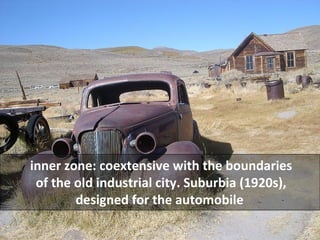
inner zone: coextensive with the boundaries 
of the old industrial city. Suburbia (1920s), 
designed for the automobile
Creating Suburbia: Moses et al
William J. Levitt – creator of suburbia
Levitt & Sons’ 26-step assembly line building method. 
Construction workers moved from house to house 
performing one task. Levitt's workers to produce a 
finished house every 16 minutes.
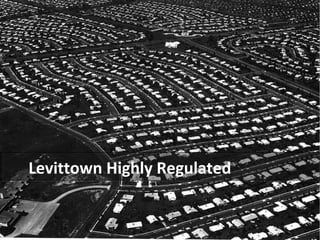
Levittown Highly Regulated
“For a man who owns his home acquires with it a 
new dignity… He begins to take pride in what is his 
own, and pride in conserving and improving it for 
his children. He becomes a more steadfast and 
concerned citizen of his community. He becomes 
more self-confident and self-reliant. The mere act 
of becoming a homeowner transforms him. It gives 
him roots, a sense of belonging, a true stake in his 
community and well being.” 
Sen. Charles Percy (1966)
What’s with the lawn?
Philly, a recent survey of renters conducted by the 
city found unexpected levels of social engagement. 
Planners were surprised by how many renters 
knew their neighbors, participated in 
neighborhood events and helped maintain the 
physical environment through volunteer work. 
Salon Magazine
Rental as norm
The “suburban experiment,” as he calls it, has been a fiscal failure. On top of the 
issues of low-density tax collection, sprawling development is more expensive to 
build. Roads are wider and require more paving. Water and sewage service costs are 
higher. It costs more to maintain emergency services since more fire stations and 
police stations are needed per capita to keep response times down. Children need to 
be bused farther distances to school. 
Charles Marohn
The End of the Suburbs: Leigh Gallagher
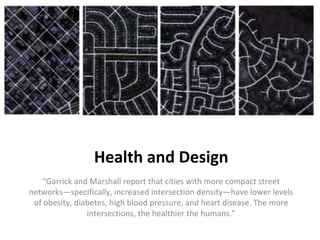
Health and Design 
“Garrick and Marshall report that cities with more compact street 
networks—specifically, increased intersection density—have lower levels 
of obesity, diabetes, high blood pressure, and heart disease. The more 
intersections, the healthier the humans.”
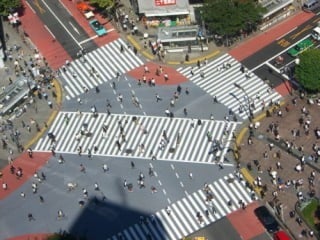
The city and it’s users
Unpleasant design
Private Public Space
Private Public Space: Control
Genpei Akasegawa 
Thomassons
Desire Paths
Mathias Klang 
www.klangable.com 
Image & licensing info in the notes 
section of slides. 
Images at www.flickr.com (or 
specifically stated). 
This ppt licensed: 
Creative Commons BY-NC-SA 
Download presentation 
www.slideshare.net/klang

Cities, Suburbs & Design

  • 1.
    Mathias Klang -@klangable – mklang@sju.edu Cities & Suburbs
  • 2.
    Urban population in2005 world map
  • 3.
    Excerpt: Hans Rosling:Religions and babies http://www.ted.com/talks/hans_rosling_religions_and_babies
  • 4.
    Urban settlements appearedaround 3,000 B.C. in ancient Mesopotamia, Egypt, and the Indus Valley
  • 5.
  • 6.
    In 1800, only3% of the world's population lived in cities, a figure that rose to 47% by the end of the twentieth century. In 1950, there were 83 cities with populations exceeding one million; by 2007, this number had risen to 468. Megacities
  • 7.
    Power and Organization The City: By Whom and for Whom?
  • 8.
  • 9.
    inner zone: coextensivewith the boundaries of the old industrial city. Suburbia (1920s), designed for the automobile
  • 10.
  • 11.
    William J. Levitt– creator of suburbia
  • 12.
    Levitt & Sons’26-step assembly line building method. Construction workers moved from house to house performing one task. Levitt's workers to produce a finished house every 16 minutes.
  • 13.
  • 14.
    “For a manwho owns his home acquires with it a new dignity… He begins to take pride in what is his own, and pride in conserving and improving it for his children. He becomes a more steadfast and concerned citizen of his community. He becomes more self-confident and self-reliant. The mere act of becoming a homeowner transforms him. It gives him roots, a sense of belonging, a true stake in his community and well being.” Sen. Charles Percy (1966)
  • 15.
  • 16.
    Philly, a recentsurvey of renters conducted by the city found unexpected levels of social engagement. Planners were surprised by how many renters knew their neighbors, participated in neighborhood events and helped maintain the physical environment through volunteer work. Salon Magazine
  • 17.
  • 18.
    The “suburban experiment,”as he calls it, has been a fiscal failure. On top of the issues of low-density tax collection, sprawling development is more expensive to build. Roads are wider and require more paving. Water and sewage service costs are higher. It costs more to maintain emergency services since more fire stations and police stations are needed per capita to keep response times down. Children need to be bused farther distances to school. Charles Marohn
  • 19.
    The End ofthe Suburbs: Leigh Gallagher
  • 20.
    Health and Design “Garrick and Marshall report that cities with more compact street networks—specifically, increased intersection density—have lower levels of obesity, diabetes, high blood pressure, and heart disease. The more intersections, the healthier the humans.”
  • 21.
    The city andit’s users
  • 22.
  • 24.
  • 25.
  • 27.
  • 28.
  • 30.
    Mathias Klang www.klangable.com Image & licensing info in the notes section of slides. Images at www.flickr.com (or specifically stated). This ppt licensed: Creative Commons BY-NC-SA Download presentation www.slideshare.net/klang

Editor's Notes

  • #2 Two canals - Venice by MorBCN CC BY NC SA
  • #3 Urban population in 2005 world map CC BY-SA 3.0 Sbw01f - Own work by uploader, data obtained from the UN Human Development Report
  • #5 Skater by Matteo Angelino CC BY NC
  • #6 Hanjin San Francisco in Panama canal by pete CC BY
  • #7 Principal Agglomerations of the World". Citypopulation.de. Retrieved 2010-09-01 – Cited in Wikipedia article Megacities http://en.wikipedia.org/wiki/Megacity/
  • #8 Urban Love - Antennas to Heaven by Collin Key CC BY NC SA
  • #9 Theocritus (Greek: Θεόκριτος, Theokritos; fl. c. 270 BC), the creator of ancient Greek bucolic poetry, flourished in the 3rd century BC. http://en.wikipedia.org/wiki/Theocritus Faroe _ sheep from polandeze cc by nc
  • #10 IMGP5933 by Colin CC BY
  • #11 Suburbia by Daniel Lobo CC BY
  • #12 Construction of the homes commenced in 1952 and when completed in 1958, 17,311 homes were built. San Jose California aerial view south CC BY-SA 3.0view terms Robert Campbell - U.S. Army Corps of Engineers Digital Visual Library Image page Image description page Digital Visual Library home page
  • #13 LEGOSimpsons10 by Bill Toenjes CC BY NC ND
  • #14 Levitt & Sons would not sell homes to African Americans. Levitt did not consider himself to be a racist, considering housing and racial relations entirely separate matters. However, this did not prevent a European-American family from reselling a home to an African-American family, and Levittown's first black couple, William and Daisy Myers, bought a home in the Dogwood Hollow section in 1957. http://en.wikipedia.org/wiki/Levittown,_Pennsylvania No hanging laundry out to dry on Sunday No Fences Levittown PA Public Domain.
  • #15 America is so over homeownership: Why the shift to a renting economy might actually be a good thing. Salon Magazine, Sunday, Aug 31, 2014 http://www.salon.com/2014/08/31/america_is_so_over_homeownership_why_the_shift_to_a_renting_economy_might_actually_be_a_good_thing/ Private Property, no trespassing by The Hamster Factor CC BY NC ND
  • #16 mowing by Steve Mishos CC BY NC SA
  • #17 America is so over homeownership: Why the shift to a renting economy might actually be a good thing. Salon Magazine, Sunday, Aug 31, 2014 http://www.salon.com/2014/08/31/america_is_so_over_homeownership_why_the_shift_to_a_renting_economy_might_actually_be_a_good_thing/ lantern by Wrote CC by nc
  • #18 Rental Shoes by Rachel Gardner CC BY NC ND
  • #19 The Suburbs Will Die: One Man’s Fight to Fix the American Dream http://time.com/3031079/suburbs-will-die-sprawl/ Fail by Thomas Hawk CC BY NC
  • #20 https://www.youtube.com/watch?v=VqresNtpegw
  • #21 James Hamblin, “Do We Look Fat in These Suburbs?” The Atlantic Aug 13, 2014 http://www.theatlantic.com/health/archive/2014/08/blame-the-city/375888/
  • #22 Large Crowd Exits Train, Park Street by Almond Dhukka CC BY NC ND
  • #23 excroissance urbaine anti-SDF by survival group CC BY NC ND
  • #24 Chris Hadfield, who is commander of Expedition 35 on the International Space Station, published the image on social media with the caption: "Berlin at night. Amazingly, I think the light bulbs still show the East/West division from orbit." Nearly a fifth of the street lights in the German capital are gas-powered, yielding a softer illumination. City authorities plan to replace these lights with electric lamps to reduce energy consumption.
  • #25 Property of the Hess Estate by Isaac Hsieh CC BY NC SA In 1910, nearly 300 buildings were condemned and demolished by the city to widen the streets and construct new subway lines. David Hess battled the city to keep the Voorhis, his 5-story apartment building. He resisted eminent domain laws for years, but was ultimately forced to give up his property.  By 1914, the 500-square-inch concrete triangle was all that remained of Hess' property. As if his loss wasn't bad enough, the city asked him to donate the tiny portion of concrete to use as part of the public sidewalk. Out of spite, Hess refused the offer. On July 27, 1922, he had the triangle covered with mosaic tiles, displaying the statement, “Property of the Hess Estate Which Has Never Been Dedicated For Public Purposes.” Although the triangular mosaic is walked all over by pedestrians, it serves as a constant reminder that Hess was not easily conquered. Hess' Triangle sits on the ground outside of a cigar shop on the corner of Christopher and 7th Avenue, just a bit larger than a generously-sized pizza slice. Village Cigars bought the triangle in 1938 for $1,000. http://www.atlasobscura.com/places/hess-triangle
  • #26 You Are Not Allowed To Take Photos... from Troy Holden cc by nc sa
  • #27 Edith Macefield, 1921-2008. in 2006 she turned down US$1 million to sell her home to make way for a commercial development in the Ballard neighborhood of Seattle. http://en.wikipedia.org/wiki/Edith_Macefield Edith's house by Markus Kolb CC BY NC SA
  • #28 Nowhere steps by Wrote CC BY NC “Thomasson” was actually coined by Japanese artist Genpei Akasegawa. Back in 1972, Akasegawa came across a lone staircase that went up and then back down but had no door at the top. But then he noticed something even stranger: the railing had recently been fixed. Gary Thomasson Was the object at hand completely and utterly useless? Was it being maintained? http://www.6sqft.com/thomassons-those-peculiar-architectural-relics-that-serve-no-purpose/
  • #29 desire path by wetwebwork cc by A desire path (also known as a desire line, social trail, goat track or bootleg trail) can be a path created as a consequence of foot or bicycle traffic. The path usually represents the shortest or most easily navigated route between an origin and destination. The width of the path and its erosion are indicators of the amount of use the path receives. Desire paths emerge as shortcuts where constructed ways take a circuitous route, or have gaps, or are lacking entirely. http://en.wikipedia.org/wiki/Desire_path