Africa’s
Artificial Intelligence
Initiative
Outline
Rest of the world
Impediments
Addressing impediments
Cirrus overview
Cirrus FOUNDRY overview
Cirrus FOUNDRY Fund overview
Example application
Going forward
Rest of the world
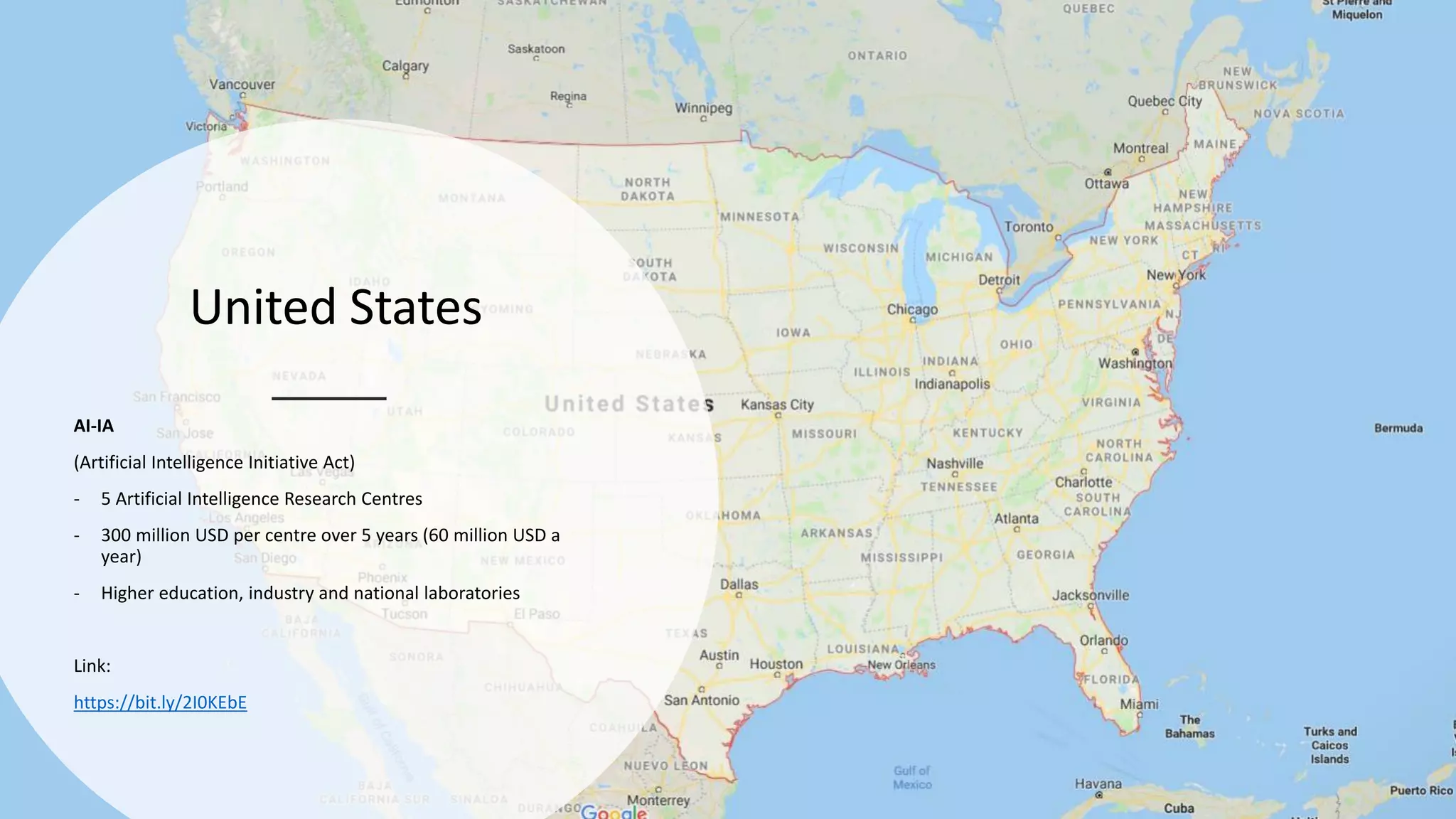
United States
AI-IA
(Artificial Intelligence Initiative Act)
- 5 Artificial Intelligence Research Centres
- 300 million USD per centre over 5 years (60 million USD a
year)
- Higher education, industry and national laboratories
Link:
https://bit.ly/2I0KEbE
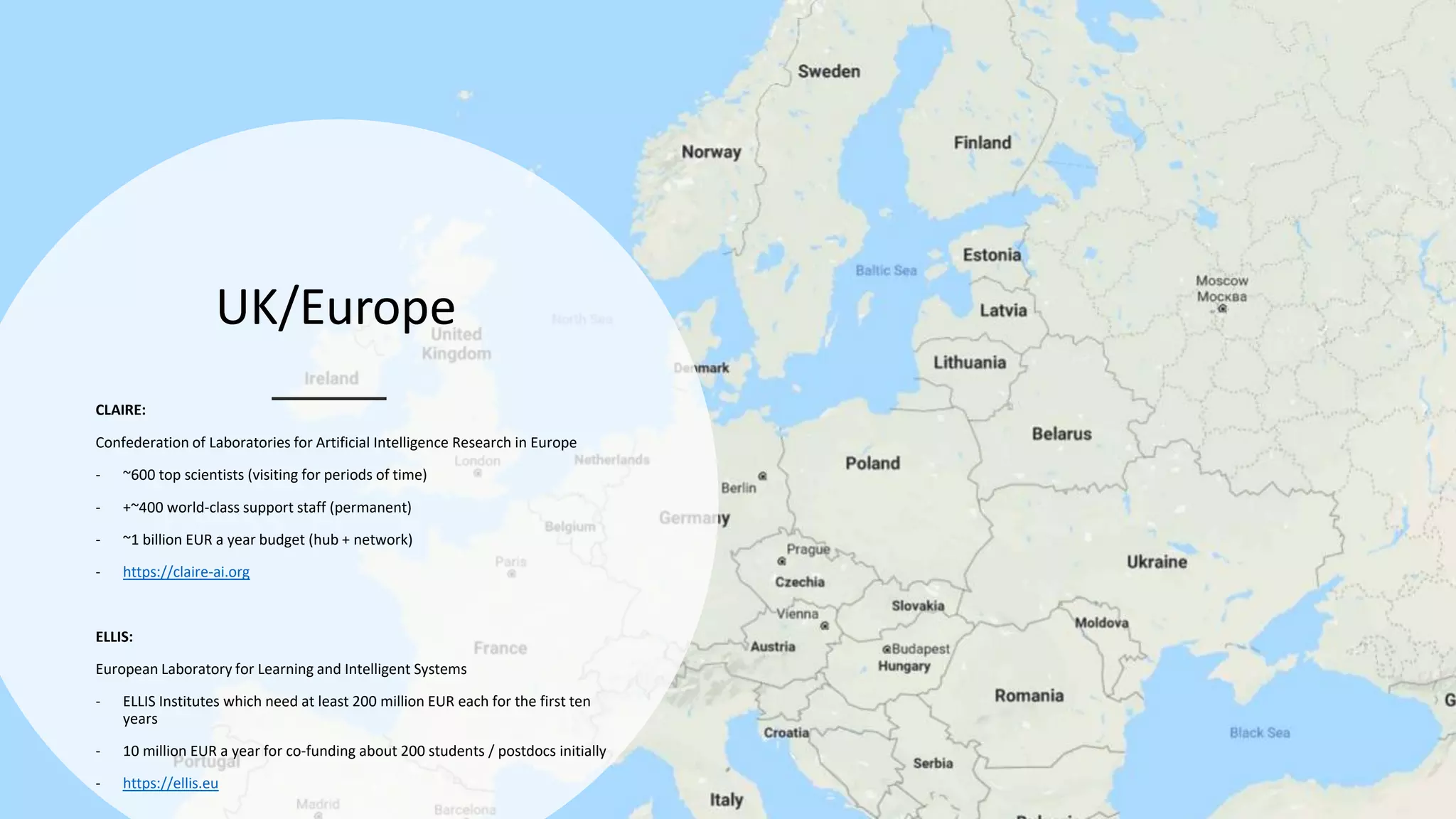
UK/Europe
CLAIRE:
Confederation of Laboratories for Artificial Intelligence Research in Europe
- ~600 top scientists (visiting for periods of time)
- +~400 world-class support staff (permanent)
- ~1 billion EUR a year budget (hub + network)
- https://claire-ai.org
ELLIS:
European Laboratory for Learning and Intelligent Systems
- ELLIS Institutes which need at least 200 million EUR each for the first ten
years
- 10 million EUR a year for co-funding about 200 students / postdocs initially
- https://ellis.eu
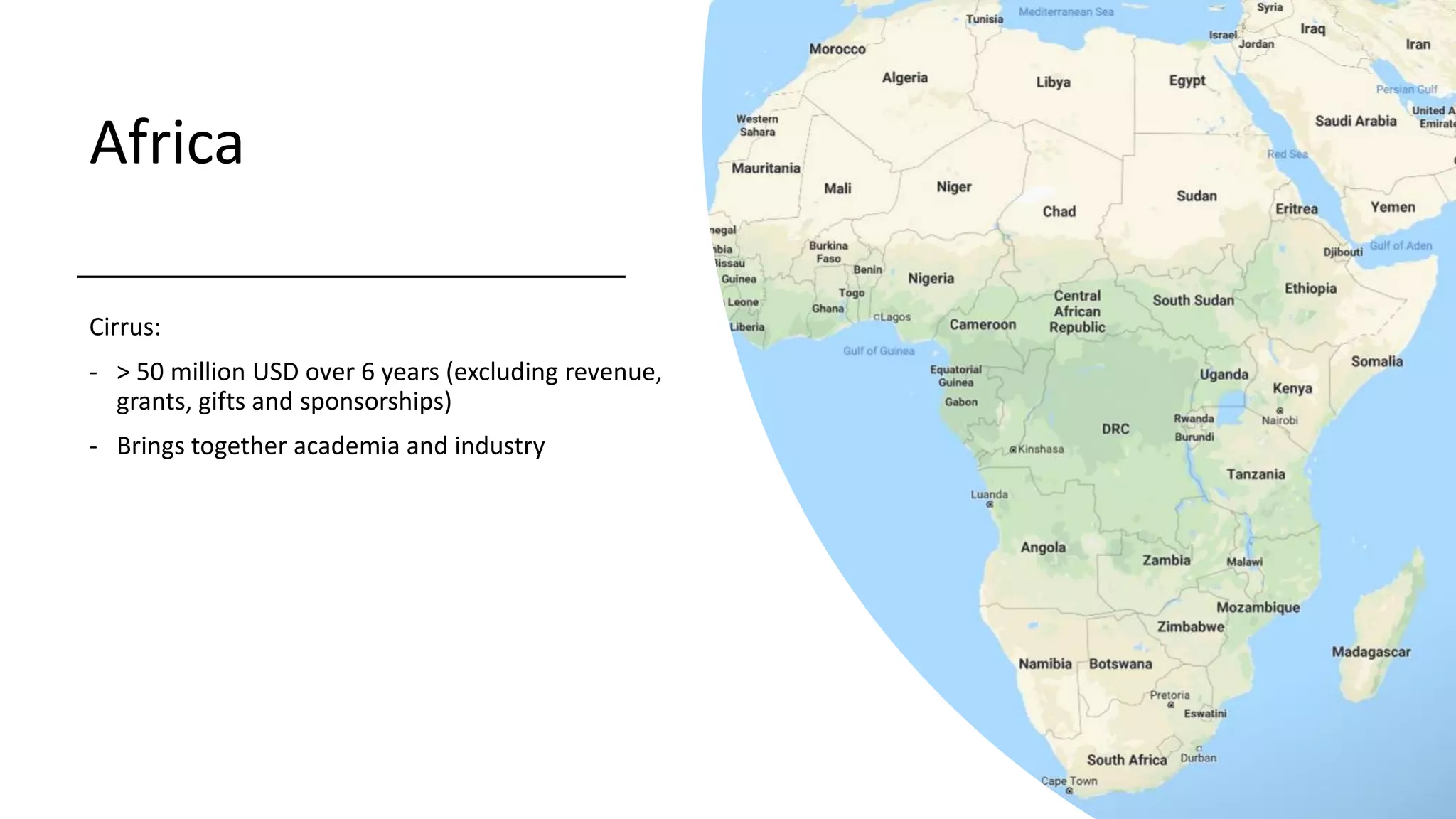
Africa
Cirrus:
- > 50 million USD over 6 years (excluding revenue,
grants, gifts and sponsorships)
- Brings together academia and industry
Impediments
Technical Debt
“If you are anything like me, 99 percent of the time you
will be in a situation where your code is not working…”
– Jeremy Howard, Fast.ai
https://dawn.cs.stanford.edu/assets/dawn-overview.pdf
https://xkcd.com/1319/
“The biggest lesson that can be read from 70 years of
AI research is that general methods that leverage
computation are ultimately the most effective, and by
a large margin.”
The Bitter Lesson
Rich Sutton
March 13, 2019
http://www.incompleteideas.net/IncIdeas/BitterLesson.html
A New Golden Age for Computer Architecture
John L. Hennessy, David A. Patterson
February, 2019
https://cacm.acm.org/magazines/2019/2/234352-a-new-golden-age-for-computer-architecture/fulltext
Compute Infrastructure and Engineering
The twilight of Moore’s Law and the impact of computing resources on the performance of AI
applications requires optimal hardware and software deployment
Energy
Since 2012, the amount of compute used in the largest AI
training runs has been increasing exponentially with a 3.5
month doubling time (by comparison, Moore’s Law had an 18
month doubling period).
Dario Amodei and Danny Hernandez
https://openai.com/blog/ai-and-compute
The total energy cost of producing a model increases linearly
with each of three variables:
- the size of its training data set
- the number of hyperparameter experiments
- the cost of executing the model on a single example.
https://arxiv.org/abs/1907.10597
The amount of compute used to train deep learning
models has increased 300,000x in 6 years.
https://openai.com/blog/ai-and-compute
Data Infrastructure and Engineering
https://wallpaperstock.net
Addressing impediments
Bring together the necessary specialised expertise
Distinct tones symbolize the distinct possible tasks for an individual or team to perform. A. Separating distinct types of tasks, specialists can address more conditions
than one individual; the numbers add. What is shown is that two specialists can do twice as many tasks as one. For example, if each one can do 10,000 tasks,
together they can do 20,000. B. Teams can address an even more diverse set of conditions because the numbers multiply. For a two member team it would be
10,000 x 10,000 = 100,000,000.
Teams
http://necsi.edu/research/overview/why-teams
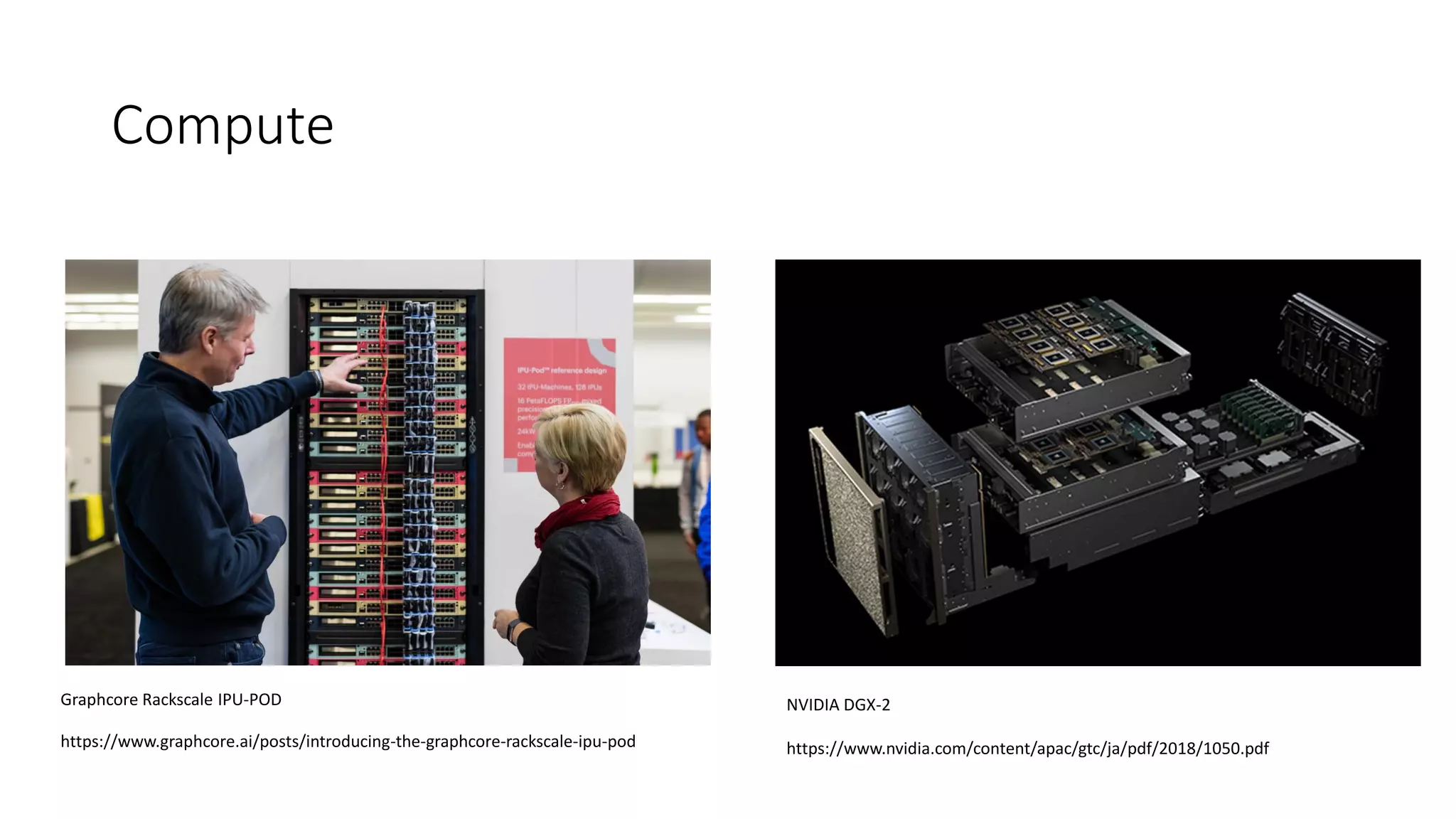
Graphcore Rackscale IPU-POD
https://www.graphcore.ai/posts/introducing-the-graphcore-rackscale-ipu-pod
NVIDIA DGX-2
https://www.nvidia.com/content/apac/gtc/ja/pdf/2018/1050.pdf
Compute
Data Management Platform
Conventional ML workflow and data silos. MLdp system architecture showing control plane and data plane and hybrid
storage model.
https://dl.acm.org/citation.cfm?doid=3299869.3314050
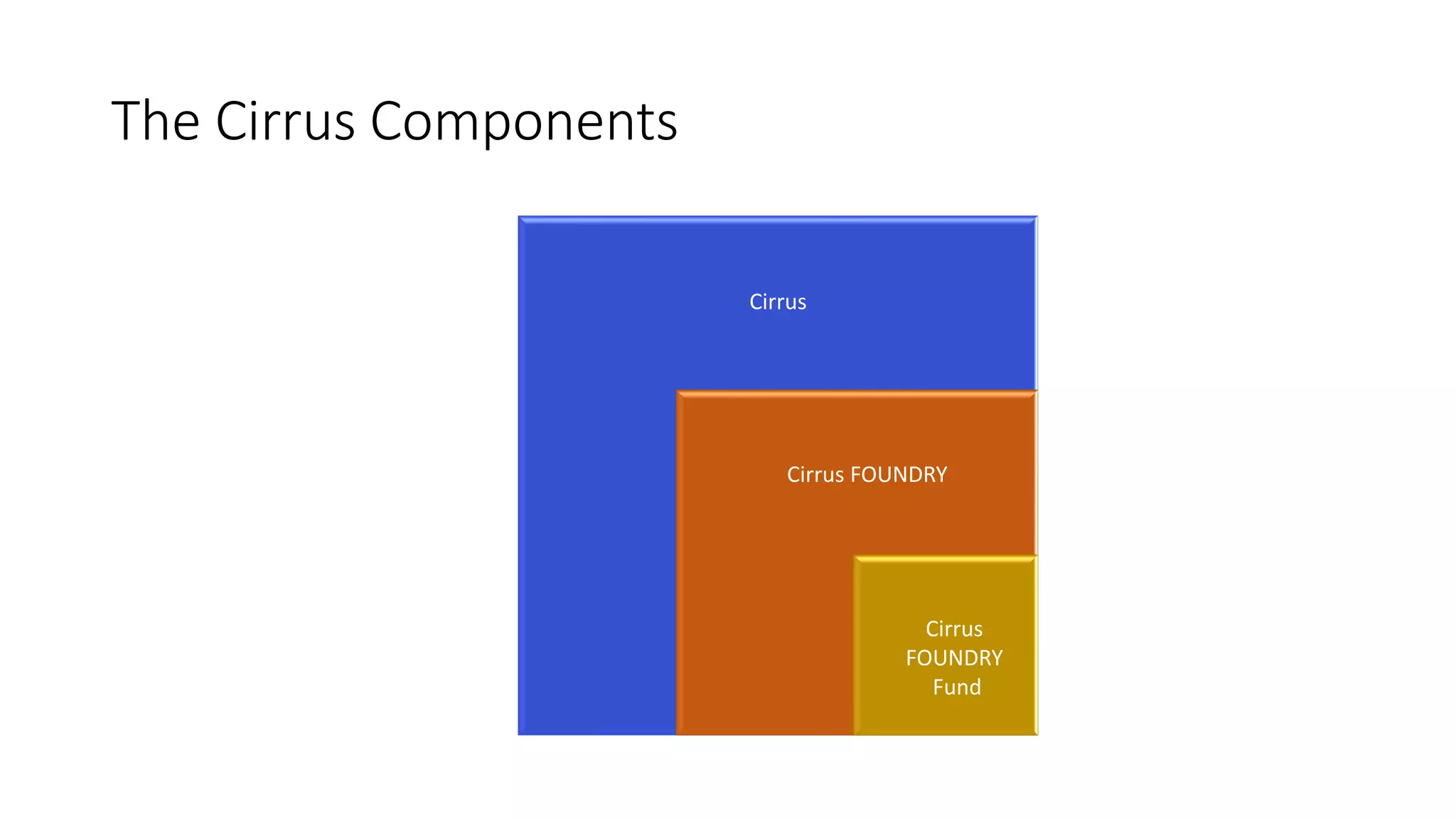
The Cirrus Components
Cirrus
Cirrus FOUNDRY
Cirrus
FOUNDRY
Fund
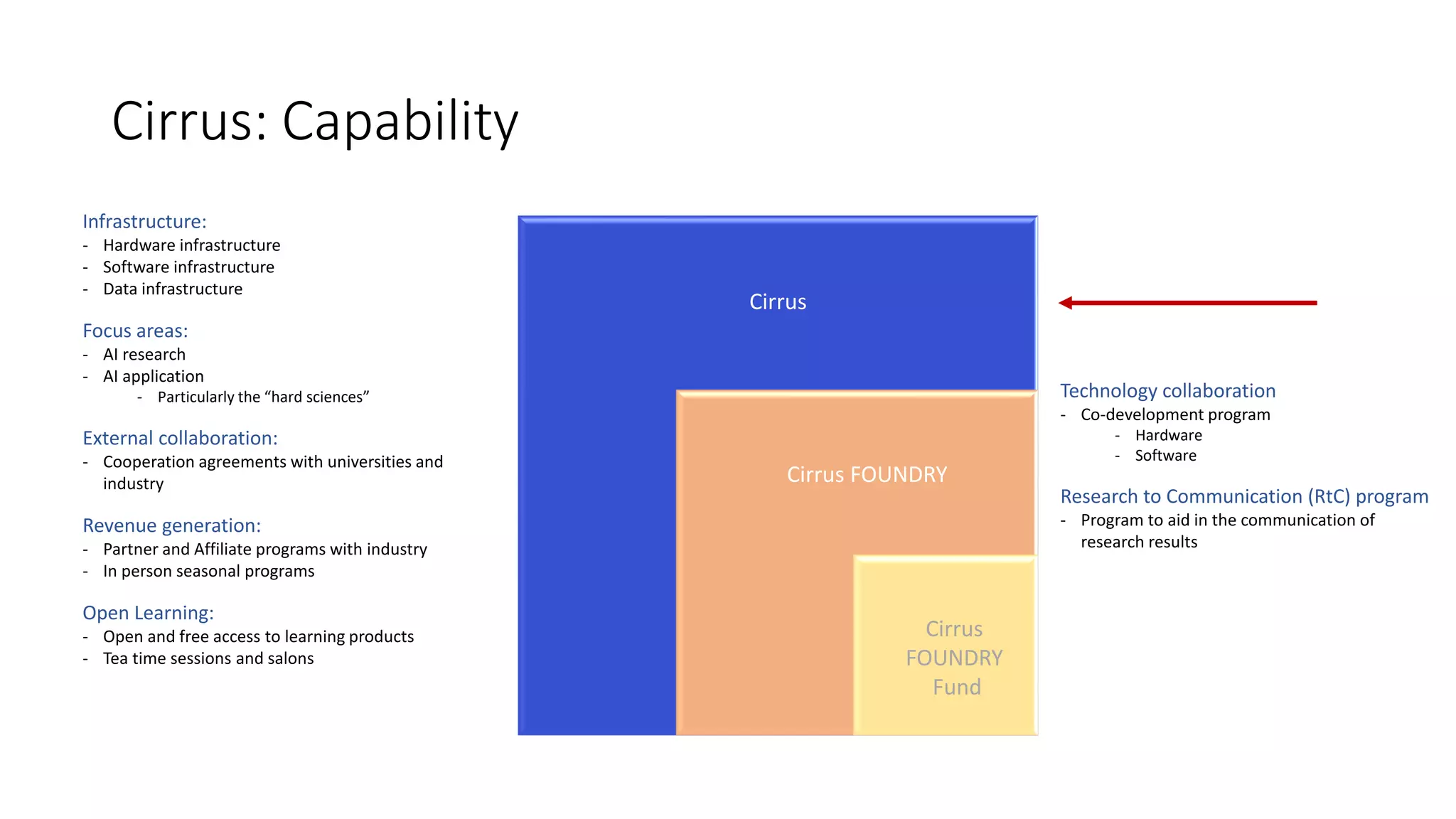
Cirrus: Capability
Cirrus
Cirrus FOUNDRY
Cirrus
FOUNDRY
Fund
Infrastructure:
- Hardware infrastructure
- Software infrastructure
- Data infrastructure
Focus areas:
- AI research
- AI application
- Particularly the “hard sciences”
External collaboration:
- Cooperation agreements with universities and
industry
Revenue generation:
- Partner and Affiliate programs with industry
- In person seasonal programs
Open Learning:
- Open and free access to learning products
- Tea time sessions and salons
Technology collaboration
- Co-development program
- Hardware
- Software
Research to Communication (RtC) program
- Program to aid in the communication of
research results
Cirrus: Resources
Cirrus
Cirrus FOUNDRY
Cirrus
FOUNDRY
Fund
Engineering and research core:
- Hardware engineers
- Software engineers
- Data engineers
- Machine learning engineers
Academically Speaking
https://www.thetimes.co.uk/article/is-the-new-dyson-institute-
the-answer-to-the-university-funding-crisis-55qcdblhs
Cirrus: Resources
Cirrus
Cirrus FOUNDRY
Cirrus
FOUNDRY
Fund
Engineering and research core:
- Hardware engineers
- Software engineers
- Data engineers
- Machine learning engineers
Cirrus Residency program:
- 12 month program
- Open to undergrad, masters and PhD
- Paid program
Cirrus PhD internship program:
- 5 month program
- PhD’s in their penultimate or final year of study
- Paid program
Cirrus Postdoc program:
- Minimum 12 months
- PhD’s
- Paid program
Cirrus Assistantship program:
- Duration varies
- Primarily masters and PhD’s
- Paid program
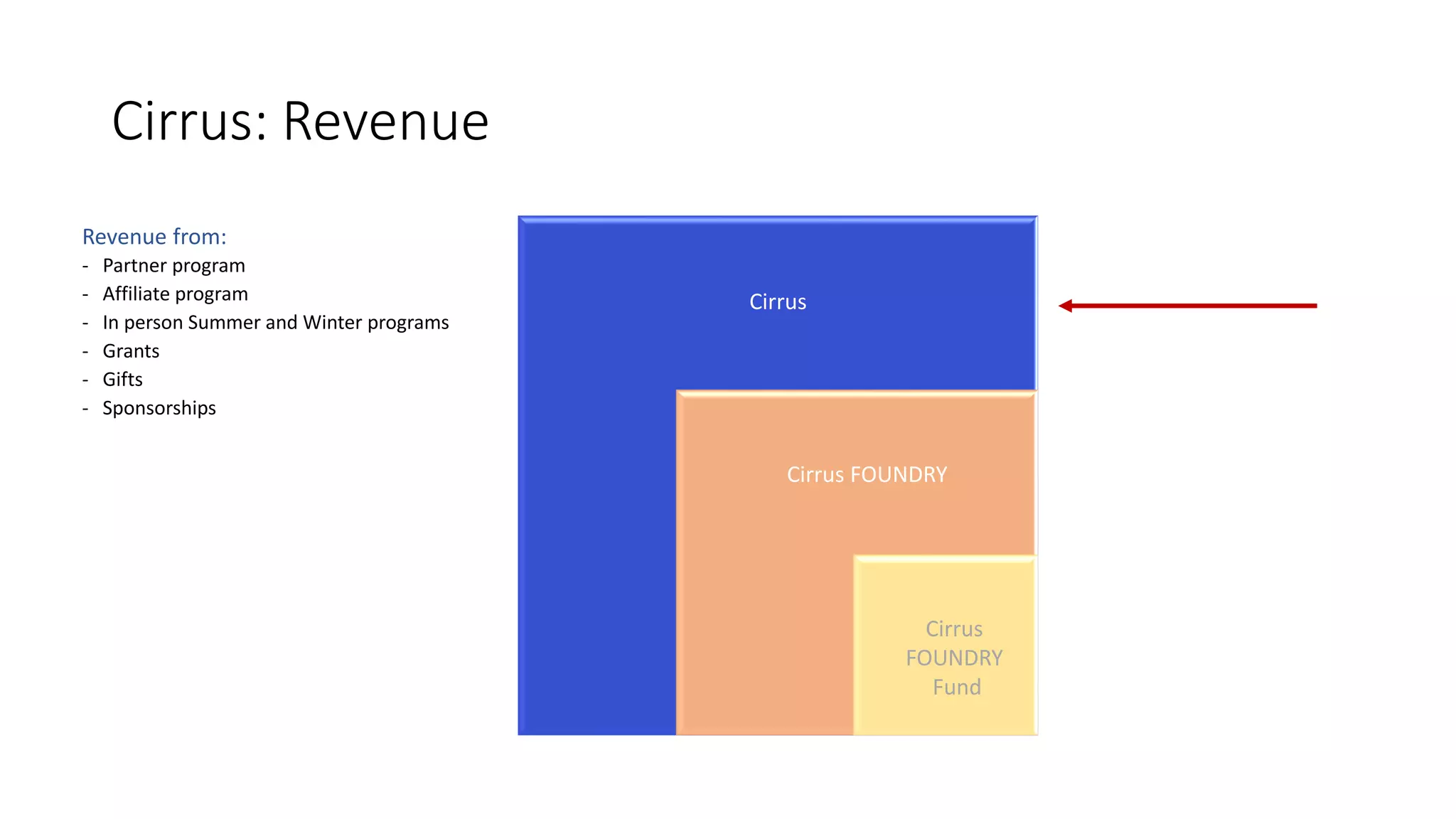
Cirrus: Revenue
Cirrus
Cirrus FOUNDRY
Cirrus
FOUNDRY
Fund
Revenue from:
- Partner program
- Affiliate program
- In person Summer and Winter programs
- Grants
- Gifts
- Sponsorships
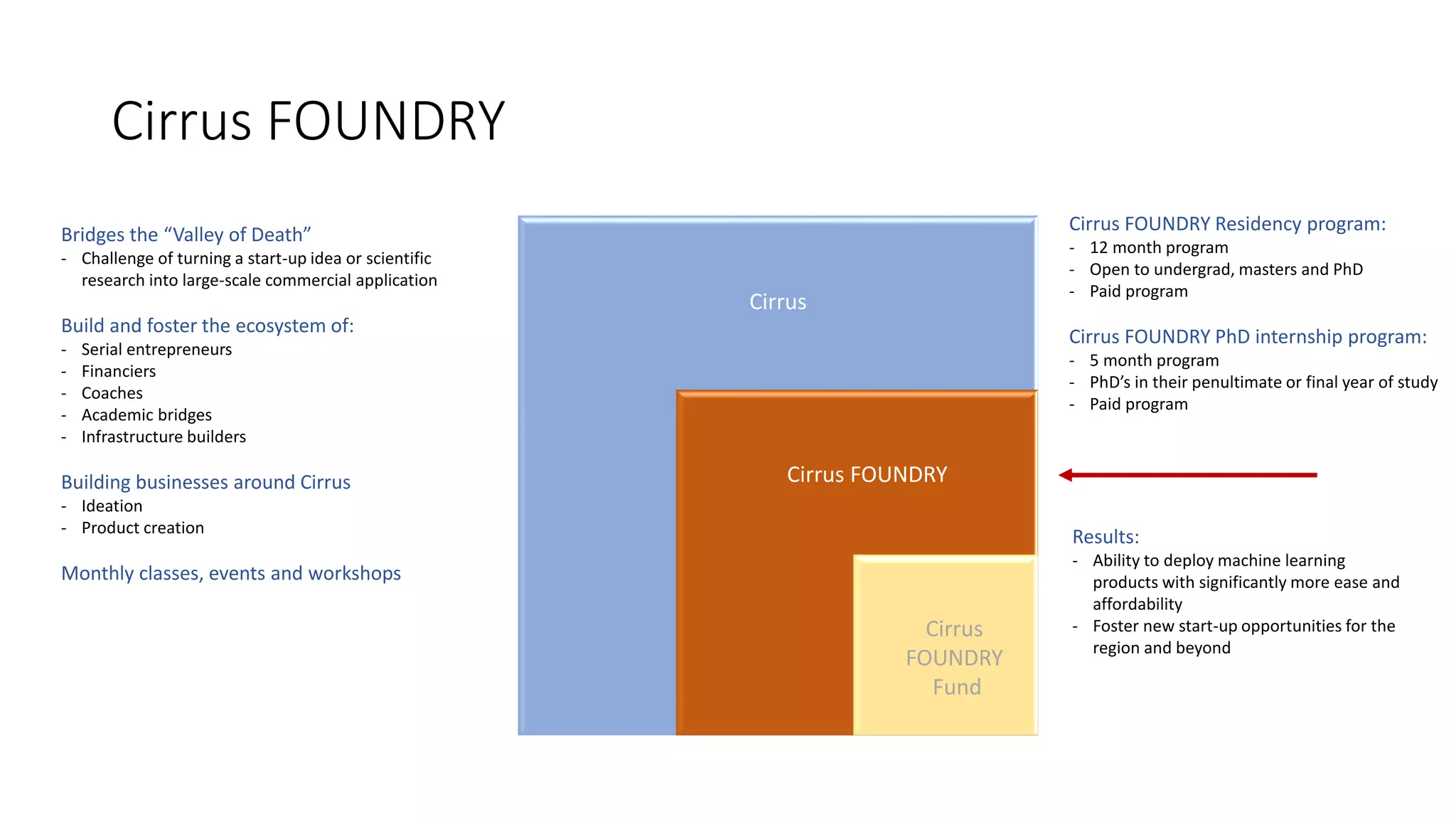
Cirrus FOUNDRY
Cirrus
Cirrus FOUNDRY
Cirrus
FOUNDRY
Fund
Bridges the “Valley of Death”
- Challenge of turning a start-up idea or scientific
research into large-scale commercial application
Build and foster the ecosystem of:
- Serial entrepreneurs
- Financiers
- Coaches
- Academic bridges
- Infrastructure builders
Building businesses around Cirrus
- Ideation
- Product creation
Monthly classes, events and workshops
Cirrus FOUNDRY Residency program:
- 12 month program
- Open to undergrad, masters and PhD
- Paid program
Cirrus FOUNDRY PhD internship program:
- 5 month program
- PhD’s in their penultimate or final year of study
- Paid program
Results:
- Ability to deploy machine learning
products with significantly more ease and
affordability
- Foster new start-up opportunities for the
region and beyond
Cirrus FOUNDRY: Revenue
Cirrus
Cirrus FOUNDRY
Cirrus
FOUNDRY
Fund
Revenue options
- Successful exits of start-up business
- Run the product as a revenue generating
project
- Sell the code/IP without spinning it out
Opportunity to generate a return on the
investment and sustain the FOUNDRY fund
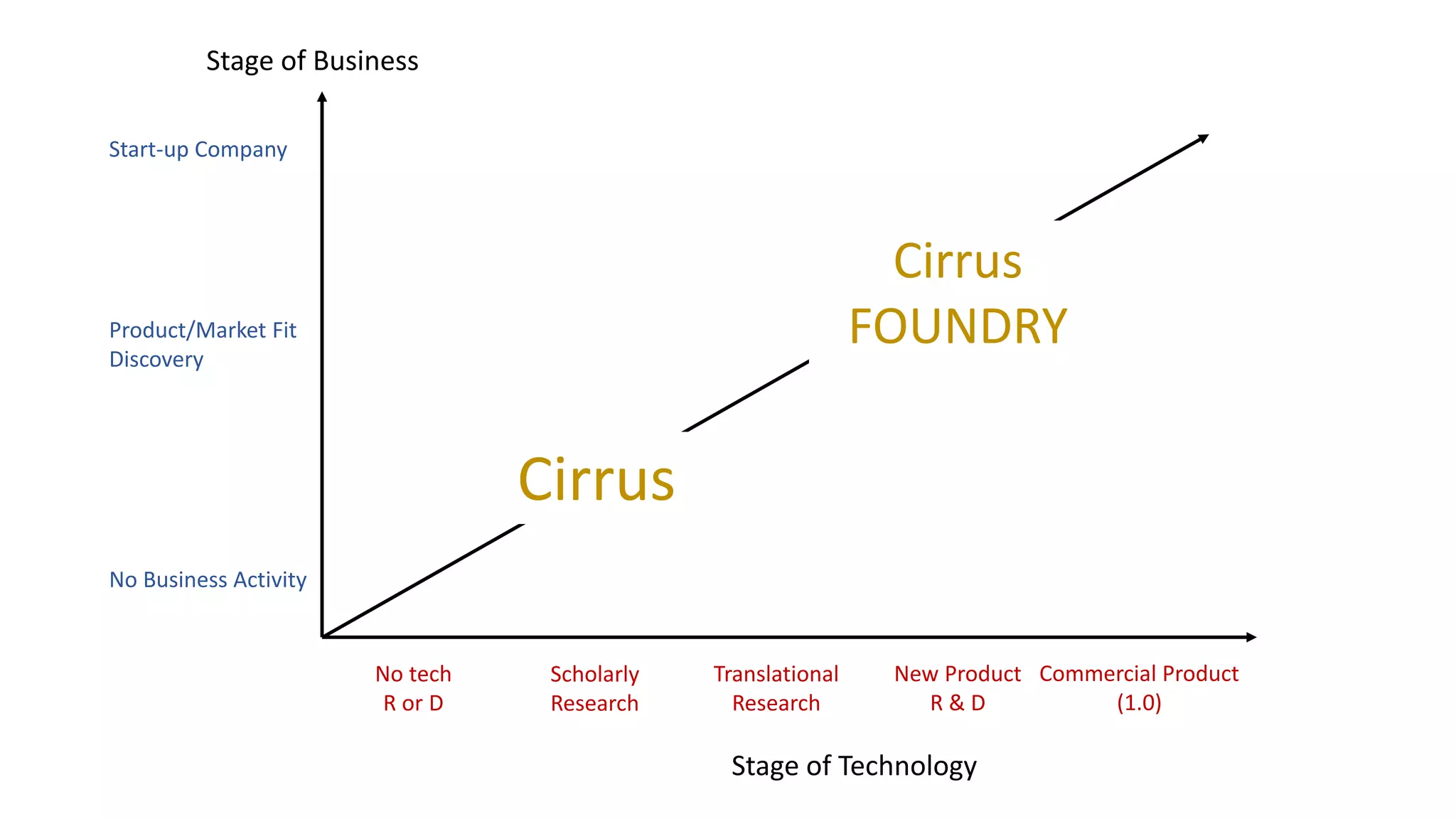
Stage of Business
Stage of Technology
Start-up Company
Product/Market Fit
Discovery
No Business Activity
No tech
R or D
Scholarly
Research
Translational
Research
New Product
R & D
Commercial Product
(1.0)
Cirrus
Cirrus
FOUNDRY
Where The Money Goes
2017 Early Stage Venture Deals
Online/Software Other Life Sciences Physical Sciences
Online/Software
81%
Other
7%
Physical Sciences
3%
Life Sciences
9%
www.pitchbook.com
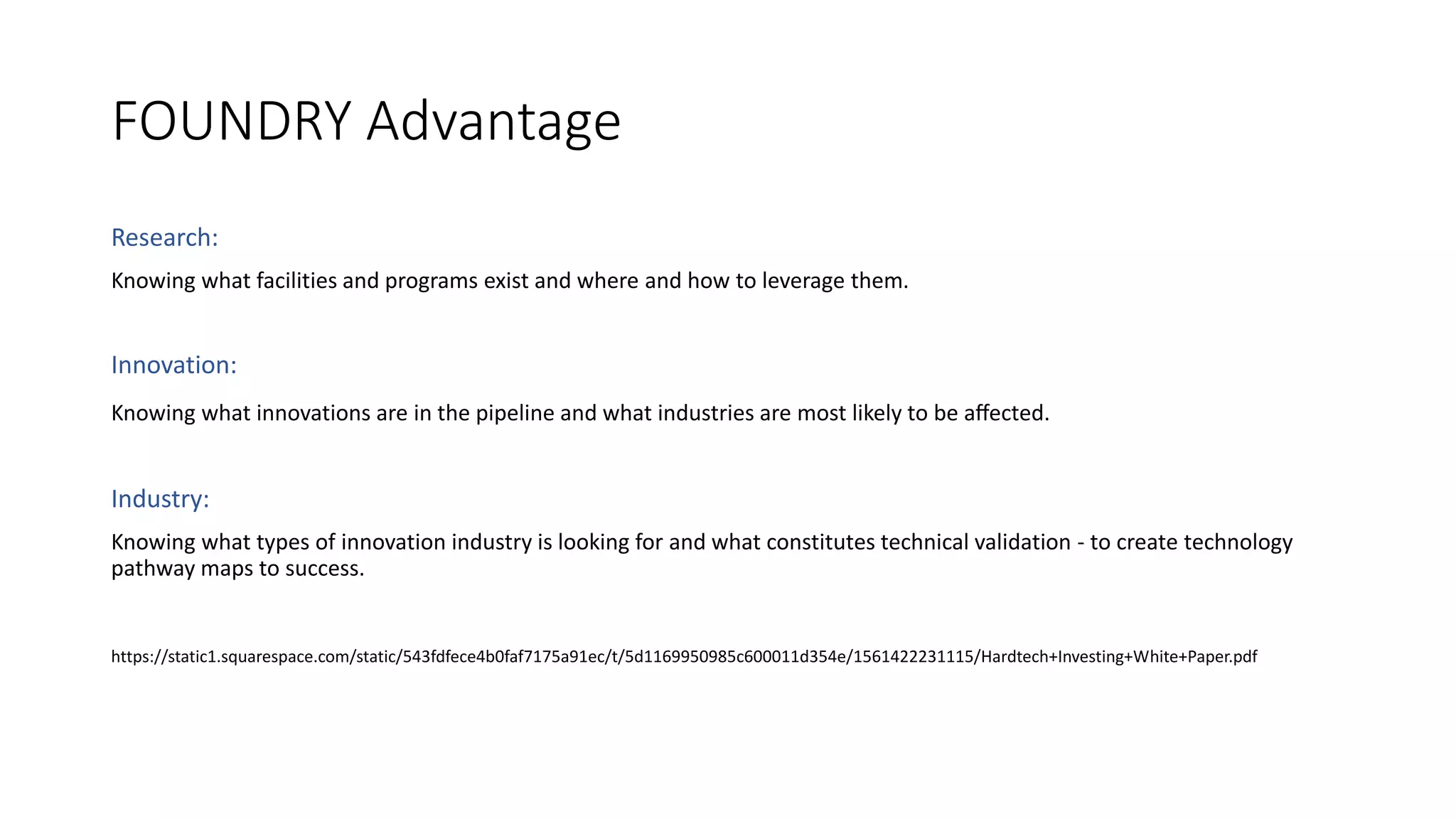
FOUNDRY Advantage
Research:
Knowing what facilities and programs exist and where and how to leverage them.
Innovation:
Knowing what innovations are in the pipeline and what industries are most likely to be affected.
Industry:
Knowing what types of innovation industry is looking for and what constitutes technical validation - to create technology
pathway maps to success.
https://static1.squarespace.com/static/543fdfece4b0faf7175a91ec/t/5d1169950985c600011d354e/1561422231115/Hardtech+Investing+White+Paper.pdf
Cirrus FOUNDRY Fund
Cirrus FOUNDRY Fund
Cirrus
Cirrus FOUNDRY
Cirrus
FOUNDRY
Fund
Cirrus FOUNDRY FUND
- Provides the Cirrus FOUNDRY with the capital to
support the start-up portfolio
- ~ R100 million in capital
- No management fees
- No performance fees
Assists the Cirrus FOUNDRY to:
- Maximise its ownership stake in the start-up
company
- Maximise the valuation of the start-up
Ensures the Cirrus FOUNDRY start-ups:
- Are not wholly dependent on outside capital
- Increases the short term success of the start-up
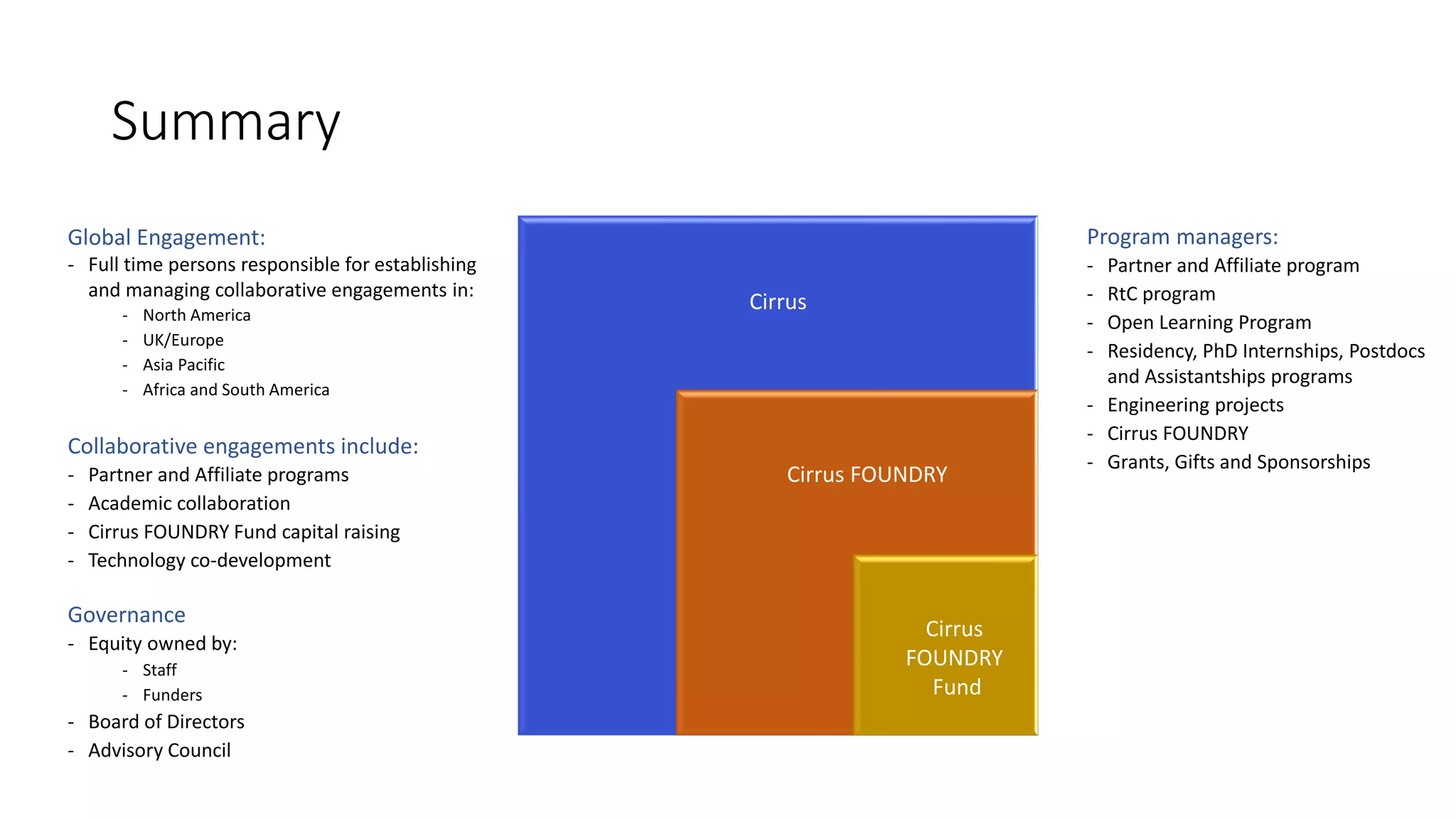
Summary
Cirrus
Cirrus FOUNDRY
Cirrus
FOUNDRY
Fund
Global Engagement:
- Full time persons responsible for establishing
and managing collaborative engagements in:
- North America
- UK/Europe
- Asia Pacific
- Africa and South America
Collaborative engagements include:
- Partner and Affiliate programs
- Academic collaboration
- Cirrus FOUNDRY Fund capital raising
- Technology co-development
Governance
- Equity owned by:
- Staff
- Funders
- Board of Directors
- Advisory Council
Program managers:
- Partner and Affiliate program
- RtC program
- Open Learning Program
- Residency, PhD Internships, Postdocs
and Assistantships programs
- Engineering projects
- Cirrus FOUNDRY
- Grants, Gifts and Sponsorships
Example Application
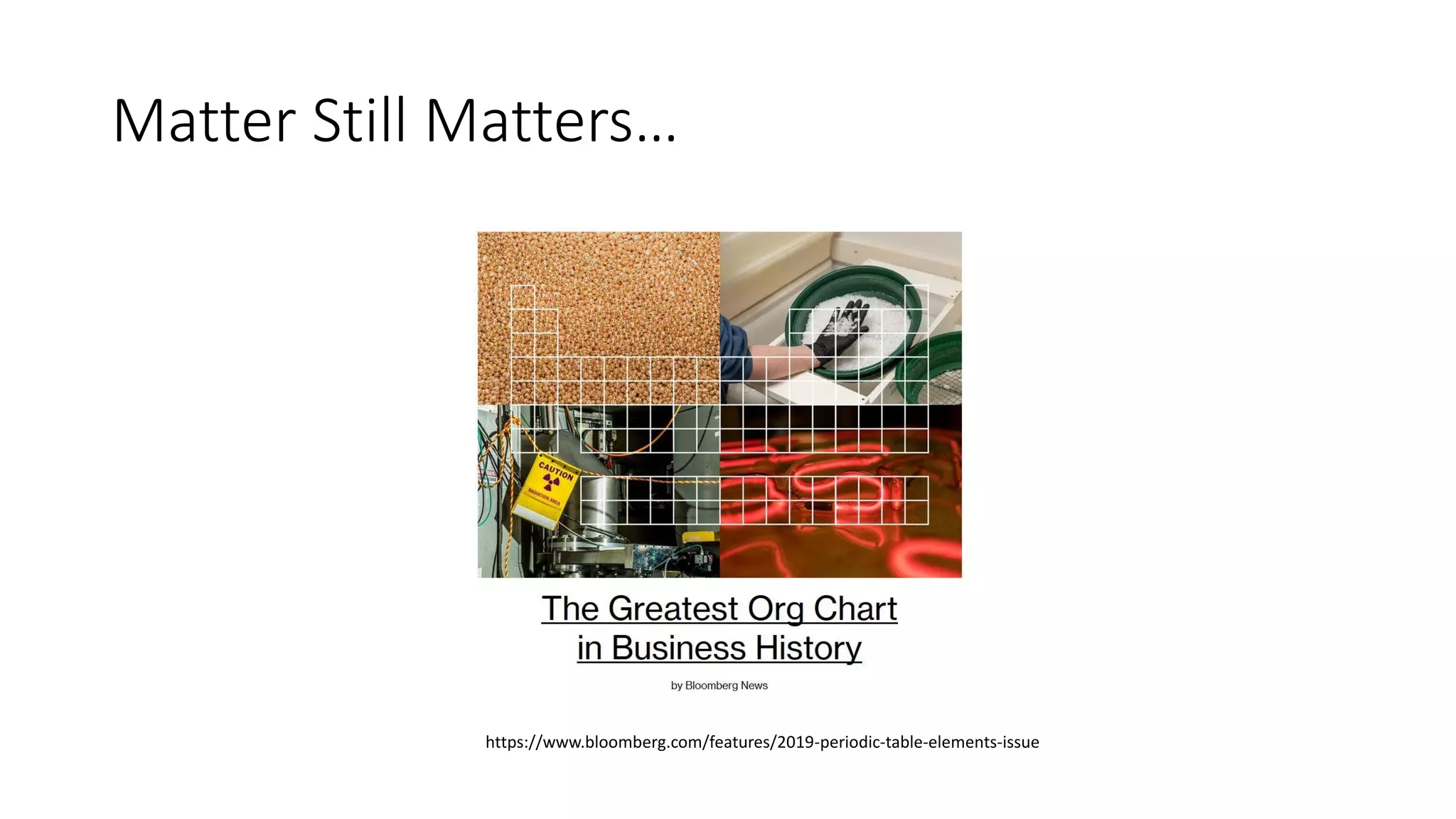
Matter Still Matters…
https://www.bloomberg.com/features/2019-periodic-table-elements-issue
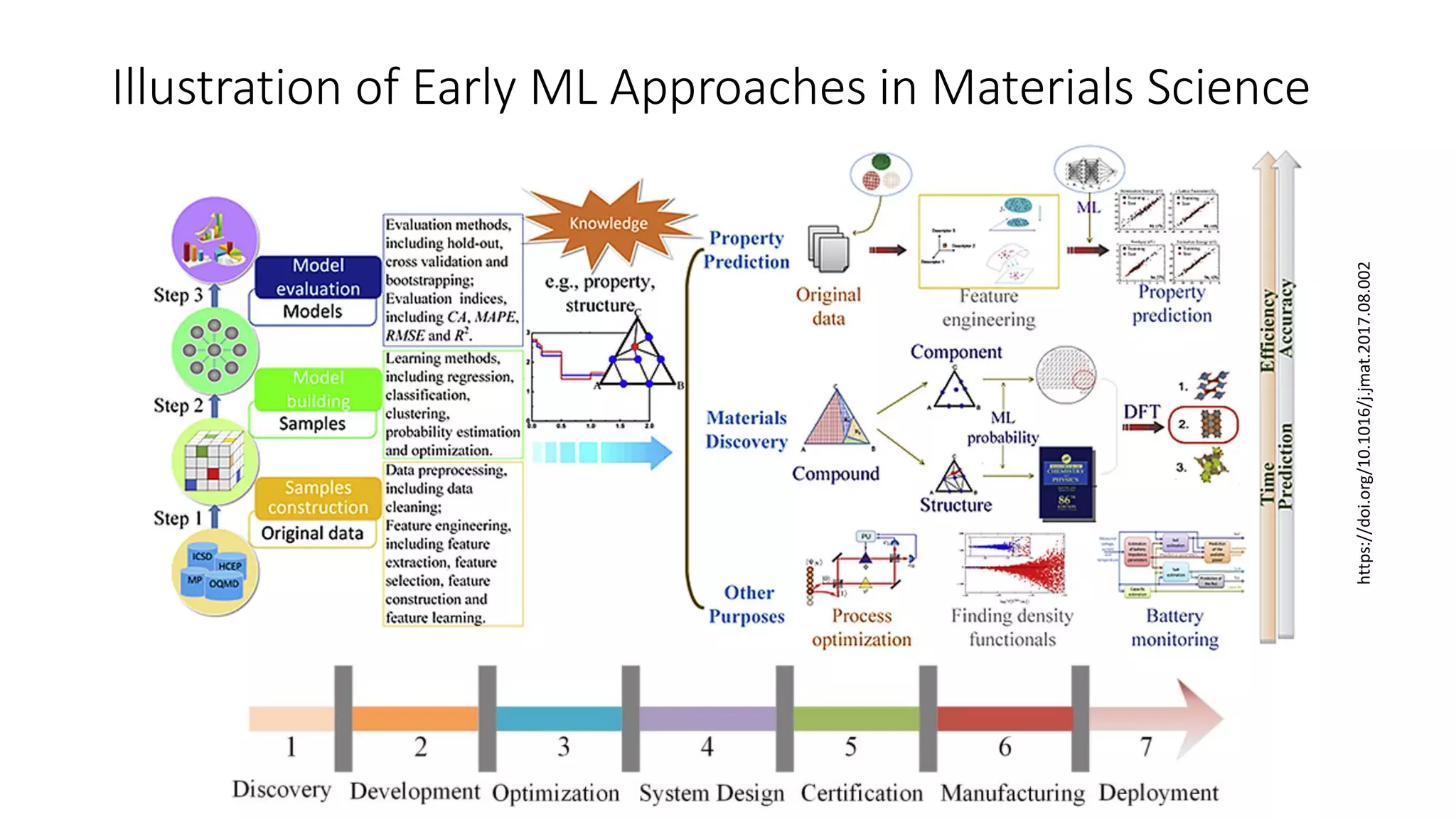
Illustration of Early ML Approaches in Materials Science
https://doi.org/10.1016/j.jmat.2017.08.002
Machine Learning Matters in Matter…
- Structure determination and imaging
- Drug design, drug screening, chemical and fuels production, discovery of new scientifically designed materials.
- ML is already being applied to a large suite of scientific techniques such as:
- phase identification via the ICSD database
- Rietveld refinement, and
- pair distribution function analysis [1] of total scattering experiments
- Density functional theory [2]
- Modelling of new chemically relevant systems
- Materials discovery and design
- Energy storage, space-age materials, environmental solutions
- Automating synchrotron data-analysis [3]
- Detectors in synchrotrons generate 9 Gbps each (over 100 detectors running simultaneously)
- Simulation and prediction of properties of materials [4]
- Massive savings on hit-and-miss type R&D
- Processing of research papers in experimental materials science to extract structural data on huge classes of novel materials[5]
- Extraction of rules from known manufacturing processes to guide synthesis of materials, fuels, drugs
[1]
Using a machine learning approach to determine the space group of a structure from the atomic pair
distribution function (PDF)
Chia-Hao Liu, Yunzhe Tao, Daniel Hsu, Qiang Du, Simon J.L. Billinge
https://arxiv.org/abs/1902.00594
[2]
A density functional theory parameterised neural network model of zirconia
Chen Wang, Akshay Tharval, John R. Kitchin
https://doi.org/10.1080/08927022.2017.1420185
Deep Learning and Density Functional Theory
Kevin Ryczko, David Strubbe, Isaac Tamblyn
https://arxiv.org/abs/1811.08928
[3]
Automated Data Analysis Strategy for Synchrotron Experiments
Lifen Yan
http://www.imedpub.com/articles/automated-data-analysis-strategy-for-synchrotron-experiments.pdf
Researchers get most comprehensive view yet of lithium-ion battery electrode damage
https://www6.slac.stanford.edu/news/2019-06-03-researchers-get-most-comprehensive-view-yet-
lithium-ion-battery-electrode-damage
[4]
Scientists Use Artificial Intelligence To Discover New Materials
https://www.forbes.com/sites/meriameberboucha/2018/04/22/scientists-use-artificial-
intelligence-to-discover-new-materials/#1b0b6cf138c4
New Lithium-Rich Battery Could Last Much Longer
https://www.mccormick.northwestern.edu/news/articles/2018/01/new-lithium-rich-battery-
could-last-much-longer.html
Generative models for fast simulation
Sofia Vallecorsa
https://indico.cern.ch/event/567550/papers/2656673/files/5841-
SofiaVallecorsa_Plenary.pdf
Accelerated discovery of metallic glasses through iteration of machine learning and high-
throughput experiments
Fang Ren, Logan Ward, Travis Williams, Kevin J. Laws, Christopher Wolverton, Jason Hattrick-
Simpers, and Apurva Mehta
https://www.ncbi.nlm.nih.gov/pmc/articles/PMC5898831
[5]
With little training, machine-learning algorithms can uncover hidden scientific knowledge
https://techxplore.com/news/2019-07-machine-learning-algorithms-uncover-hidden-
scientific.html
Collaboration
DeepMind: AlphaFold: Using AI for scientific discovery
https://deepmind.com/blog/alphafold
Google AI: Healthcare and biosciences
https://ai.google/healthcare
Toyota Research Institute (TRI): Researchers Use AI to Accurately Predict the Useful Life of Batteries
https://www.tri.global/news/researchers-use-ai-to-accurately-predict-the-usefu-2019-3-25
Machine learning collaborations accelerate materials discovery:
https://physicsworld.com/a/machine-learning-collaborations-accelerate-materials-discovery
Where We Are Headed
AI and Robotics in the Lab: Accelerating Materials Discovery
https://events.technologyreview.com/video/watch/jill-becker-accelerating-materials-discovery
Jill Becker, Kebotix
Going Forward
Get in touch
- Contact details on the website
www.CirrusAI.net
Letters of support
- Individuals
- Research groups
- CoE’s
- Institutes
- Universities
- Corporations
Cooperation Agreement
- Announcements coming soon
Slide 3:
NASA. (1969). Apollo 11 mission image - earth view over Africa, the Mediterranean and the Middle East. [image]. Retrieved from
https://www.flickr.com/photos/nasacommons/5052744618
Slide 8:
Stanford Dawn. (2017). Hidden technical debt in machine learning systems. [figure]. Retrieved from Dawn: infrastructure for usable machine learning. [pdf].
Retrieved from https://dawn.cs.stanford.edu/assets/dawn-overview.pdf
Slide 9:
Hennessy, J. Patterson, D. (2019). A new golden age for computer architecture. [figure]. Retrieved from Communications of the ACM, Vol. 62 No. 2, Pages 48-60.
Retrieved from https://cacm.acm.org/magazines/2019/2/234352-a-new-golden-age-for-computer-architecture/fulltext
Sutton, R. (2019). The bitter lesson. [blog]. Retrieved from http://www.incompleteideas.net/IncIdeas/BitterLesson.html
Slide 10:
Amodei, D. Hernandez, D. (2019). AI and compute. [blog]. Retrieved from https://openai.com/blog/ai-and-compute
Schwartz, R. Dodge, J. Smith, N. Etzioni, O. (2019). Green AI. [pdf]. Retrieved from https://arxiv.org/abs/1907.10597
Slide 13:
Bar-Yam, Y. (2017). Fig. 2. [figure]. Retrieved from NECSI. (2017). Why teams?. [webpage]. Retrieved from http://necsi.edu/research/overview/why-teams
Reference
Slide 14:
Graphcore. (2018). Graphcore Rackscale IPU-POD. [image]. Retrieved from Introducing the Graphcore Rackscale IPU pod. [webpage]. Retrieved from
https://www.graphcore.ai/posts/introducing-the-graphcore-rackscale-ipu-pod
NVIDIA. (2019). NVIDIA DGX-2. [image]. Retrieved from NVIDIA DGX-2 APAC. [pdf]. Retrieved from https://www.nvidia.com/content/apac/gtc/ja/pdf/2018/1050.pdf
Slide 15:
Agrawal, P. et al. (2019). Data platform for machine learning. [pdf]. Retrieved from International Conference on Management of Data (SIGMOD ’19). Retrieved from
https://dl.acm.org/citation.cfm?doid=3299869.3314050
Slide 20:
The Times. (2019). Is the new dyson institute the answer to the university funding crisis. {webpage]. Retrieved from https://www.thetimes.co.uk/article/is-the-new-
dyson-institute-the-answer-to-the-university-funding-crisis-55qcdblhs
Slide 26:
Adapted from:
UC Berkeley. (2018). UCB I&E Ecosystem: Tech Stage vs Biz Stage. [image]. Retrieved from Lab to Market. [pdf]. Retrieved from
https://bpep.berkeley.edu/sites/default/files/shared/docs/BPEP_Idea_TO_MARKET.pdf
Slide 27:
U.S. Department of Energy. (2019). 2017 Early Stage Venture Deals. [image]. Retrieved from A New Mechanism to Fund Hardtech Innovation. [pdf[. Retrieved from
https://static1.squarespace.com/static/543fdfece4b0faf7175a91ec/t/5d1169950985c600011d354e/1561422231115/Hardtech+Investing+White+Paper.pdf
Reference
Slide 28
U.S. Department of Energy. (2019). A New Mechanism to Fund Hardtech Innovation. [pdf[. Retrieved from
https://static1.squarespace.com/static/543fdfece4b0faf7175a91ec/t/5d1169950985c600011d354e/1561422231115/Hardtech+Investing+White+Paper.pdf
Slide 34:
Liu, Y. Zhao, T. Ju, W. Shi, S. (2017). Graphical abstract. [figure]. Retrieved from Materials discovery and design using machine learning. [webpage]. Retrieved from
https://www.sciencedirect.com/science/article/pii/S2352847817300515?via%3Dihub#undfig1
Reference

Cirrus: Africa's AI initiative

  • 1.
  • 2.
    Outline Rest of theworld Impediments Addressing impediments Cirrus overview Cirrus FOUNDRY overview Cirrus FOUNDRY Fund overview Example application Going forward
  • 3.
  • 4.
    United States AI-IA (Artificial IntelligenceInitiative Act) - 5 Artificial Intelligence Research Centres - 300 million USD per centre over 5 years (60 million USD a year) - Higher education, industry and national laboratories Link: https://bit.ly/2I0KEbE
  • 5.
    UK/Europe CLAIRE: Confederation of Laboratoriesfor Artificial Intelligence Research in Europe - ~600 top scientists (visiting for periods of time) - +~400 world-class support staff (permanent) - ~1 billion EUR a year budget (hub + network) - https://claire-ai.org ELLIS: European Laboratory for Learning and Intelligent Systems - ELLIS Institutes which need at least 200 million EUR each for the first ten years - 10 million EUR a year for co-funding about 200 students / postdocs initially - https://ellis.eu
  • 6.
    Africa Cirrus: - > 50million USD over 6 years (excluding revenue, grants, gifts and sponsorships) - Brings together academia and industry
  • 7.
  • 8.
    Technical Debt “If youare anything like me, 99 percent of the time you will be in a situation where your code is not working…” – Jeremy Howard, Fast.ai https://dawn.cs.stanford.edu/assets/dawn-overview.pdf https://xkcd.com/1319/
  • 9.
    “The biggest lessonthat can be read from 70 years of AI research is that general methods that leverage computation are ultimately the most effective, and by a large margin.” The Bitter Lesson Rich Sutton March 13, 2019 http://www.incompleteideas.net/IncIdeas/BitterLesson.html A New Golden Age for Computer Architecture John L. Hennessy, David A. Patterson February, 2019 https://cacm.acm.org/magazines/2019/2/234352-a-new-golden-age-for-computer-architecture/fulltext Compute Infrastructure and Engineering The twilight of Moore’s Law and the impact of computing resources on the performance of AI applications requires optimal hardware and software deployment
  • 10.
    Energy Since 2012, theamount of compute used in the largest AI training runs has been increasing exponentially with a 3.5 month doubling time (by comparison, Moore’s Law had an 18 month doubling period). Dario Amodei and Danny Hernandez https://openai.com/blog/ai-and-compute The total energy cost of producing a model increases linearly with each of three variables: - the size of its training data set - the number of hyperparameter experiments - the cost of executing the model on a single example. https://arxiv.org/abs/1907.10597 The amount of compute used to train deep learning models has increased 300,000x in 6 years. https://openai.com/blog/ai-and-compute
  • 11.
    Data Infrastructure andEngineering https://wallpaperstock.net
  • 12.
  • 13.
    Bring together thenecessary specialised expertise Distinct tones symbolize the distinct possible tasks for an individual or team to perform. A. Separating distinct types of tasks, specialists can address more conditions than one individual; the numbers add. What is shown is that two specialists can do twice as many tasks as one. For example, if each one can do 10,000 tasks, together they can do 20,000. B. Teams can address an even more diverse set of conditions because the numbers multiply. For a two member team it would be 10,000 x 10,000 = 100,000,000. Teams http://necsi.edu/research/overview/why-teams
  • 14.
    Graphcore Rackscale IPU-POD https://www.graphcore.ai/posts/introducing-the-graphcore-rackscale-ipu-pod NVIDIADGX-2 https://www.nvidia.com/content/apac/gtc/ja/pdf/2018/1050.pdf Compute
  • 15.
    Data Management Platform ConventionalML workflow and data silos. MLdp system architecture showing control plane and data plane and hybrid storage model. https://dl.acm.org/citation.cfm?doid=3299869.3314050
  • 17.
    The Cirrus Components Cirrus CirrusFOUNDRY Cirrus FOUNDRY Fund
  • 18.
    Cirrus: Capability Cirrus Cirrus FOUNDRY Cirrus FOUNDRY Fund Infrastructure: -Hardware infrastructure - Software infrastructure - Data infrastructure Focus areas: - AI research - AI application - Particularly the “hard sciences” External collaboration: - Cooperation agreements with universities and industry Revenue generation: - Partner and Affiliate programs with industry - In person seasonal programs Open Learning: - Open and free access to learning products - Tea time sessions and salons Technology collaboration - Co-development program - Hardware - Software Research to Communication (RtC) program - Program to aid in the communication of research results
  • 19.
    Cirrus: Resources Cirrus Cirrus FOUNDRY Cirrus FOUNDRY Fund Engineeringand research core: - Hardware engineers - Software engineers - Data engineers - Machine learning engineers
  • 20.
  • 21.
    Cirrus: Resources Cirrus Cirrus FOUNDRY Cirrus FOUNDRY Fund Engineeringand research core: - Hardware engineers - Software engineers - Data engineers - Machine learning engineers Cirrus Residency program: - 12 month program - Open to undergrad, masters and PhD - Paid program Cirrus PhD internship program: - 5 month program - PhD’s in their penultimate or final year of study - Paid program Cirrus Postdoc program: - Minimum 12 months - PhD’s - Paid program Cirrus Assistantship program: - Duration varies - Primarily masters and PhD’s - Paid program
  • 22.
    Cirrus: Revenue Cirrus Cirrus FOUNDRY Cirrus FOUNDRY Fund Revenuefrom: - Partner program - Affiliate program - In person Summer and Winter programs - Grants - Gifts - Sponsorships
  • 24.
    Cirrus FOUNDRY Cirrus Cirrus FOUNDRY Cirrus FOUNDRY Fund Bridgesthe “Valley of Death” - Challenge of turning a start-up idea or scientific research into large-scale commercial application Build and foster the ecosystem of: - Serial entrepreneurs - Financiers - Coaches - Academic bridges - Infrastructure builders Building businesses around Cirrus - Ideation - Product creation Monthly classes, events and workshops Cirrus FOUNDRY Residency program: - 12 month program - Open to undergrad, masters and PhD - Paid program Cirrus FOUNDRY PhD internship program: - 5 month program - PhD’s in their penultimate or final year of study - Paid program Results: - Ability to deploy machine learning products with significantly more ease and affordability - Foster new start-up opportunities for the region and beyond
  • 25.
    Cirrus FOUNDRY: Revenue Cirrus CirrusFOUNDRY Cirrus FOUNDRY Fund Revenue options - Successful exits of start-up business - Run the product as a revenue generating project - Sell the code/IP without spinning it out Opportunity to generate a return on the investment and sustain the FOUNDRY fund
  • 26.
    Stage of Business Stageof Technology Start-up Company Product/Market Fit Discovery No Business Activity No tech R or D Scholarly Research Translational Research New Product R & D Commercial Product (1.0) Cirrus Cirrus FOUNDRY
  • 27.
    Where The MoneyGoes 2017 Early Stage Venture Deals Online/Software Other Life Sciences Physical Sciences Online/Software 81% Other 7% Physical Sciences 3% Life Sciences 9% www.pitchbook.com
  • 28.
    FOUNDRY Advantage Research: Knowing whatfacilities and programs exist and where and how to leverage them. Innovation: Knowing what innovations are in the pipeline and what industries are most likely to be affected. Industry: Knowing what types of innovation industry is looking for and what constitutes technical validation - to create technology pathway maps to success. https://static1.squarespace.com/static/543fdfece4b0faf7175a91ec/t/5d1169950985c600011d354e/1561422231115/Hardtech+Investing+White+Paper.pdf
  • 29.
  • 30.
    Cirrus FOUNDRY Fund Cirrus CirrusFOUNDRY Cirrus FOUNDRY Fund Cirrus FOUNDRY FUND - Provides the Cirrus FOUNDRY with the capital to support the start-up portfolio - ~ R100 million in capital - No management fees - No performance fees Assists the Cirrus FOUNDRY to: - Maximise its ownership stake in the start-up company - Maximise the valuation of the start-up Ensures the Cirrus FOUNDRY start-ups: - Are not wholly dependent on outside capital - Increases the short term success of the start-up
  • 31.
    Summary Cirrus Cirrus FOUNDRY Cirrus FOUNDRY Fund Global Engagement: -Full time persons responsible for establishing and managing collaborative engagements in: - North America - UK/Europe - Asia Pacific - Africa and South America Collaborative engagements include: - Partner and Affiliate programs - Academic collaboration - Cirrus FOUNDRY Fund capital raising - Technology co-development Governance - Equity owned by: - Staff - Funders - Board of Directors - Advisory Council Program managers: - Partner and Affiliate program - RtC program - Open Learning Program - Residency, PhD Internships, Postdocs and Assistantships programs - Engineering projects - Cirrus FOUNDRY - Grants, Gifts and Sponsorships
  • 32.
  • 33.
  • 34.
    Illustration of EarlyML Approaches in Materials Science https://doi.org/10.1016/j.jmat.2017.08.002
  • 35.
    Machine Learning Mattersin Matter… - Structure determination and imaging - Drug design, drug screening, chemical and fuels production, discovery of new scientifically designed materials. - ML is already being applied to a large suite of scientific techniques such as: - phase identification via the ICSD database - Rietveld refinement, and - pair distribution function analysis [1] of total scattering experiments - Density functional theory [2] - Modelling of new chemically relevant systems - Materials discovery and design - Energy storage, space-age materials, environmental solutions - Automating synchrotron data-analysis [3] - Detectors in synchrotrons generate 9 Gbps each (over 100 detectors running simultaneously) - Simulation and prediction of properties of materials [4] - Massive savings on hit-and-miss type R&D - Processing of research papers in experimental materials science to extract structural data on huge classes of novel materials[5] - Extraction of rules from known manufacturing processes to guide synthesis of materials, fuels, drugs
  • 36.
    [1] Using a machinelearning approach to determine the space group of a structure from the atomic pair distribution function (PDF) Chia-Hao Liu, Yunzhe Tao, Daniel Hsu, Qiang Du, Simon J.L. Billinge https://arxiv.org/abs/1902.00594 [2] A density functional theory parameterised neural network model of zirconia Chen Wang, Akshay Tharval, John R. Kitchin https://doi.org/10.1080/08927022.2017.1420185 Deep Learning and Density Functional Theory Kevin Ryczko, David Strubbe, Isaac Tamblyn https://arxiv.org/abs/1811.08928 [3] Automated Data Analysis Strategy for Synchrotron Experiments Lifen Yan http://www.imedpub.com/articles/automated-data-analysis-strategy-for-synchrotron-experiments.pdf Researchers get most comprehensive view yet of lithium-ion battery electrode damage https://www6.slac.stanford.edu/news/2019-06-03-researchers-get-most-comprehensive-view-yet- lithium-ion-battery-electrode-damage [4] Scientists Use Artificial Intelligence To Discover New Materials https://www.forbes.com/sites/meriameberboucha/2018/04/22/scientists-use-artificial- intelligence-to-discover-new-materials/#1b0b6cf138c4 New Lithium-Rich Battery Could Last Much Longer https://www.mccormick.northwestern.edu/news/articles/2018/01/new-lithium-rich-battery- could-last-much-longer.html Generative models for fast simulation Sofia Vallecorsa https://indico.cern.ch/event/567550/papers/2656673/files/5841- SofiaVallecorsa_Plenary.pdf Accelerated discovery of metallic glasses through iteration of machine learning and high- throughput experiments Fang Ren, Logan Ward, Travis Williams, Kevin J. Laws, Christopher Wolverton, Jason Hattrick- Simpers, and Apurva Mehta https://www.ncbi.nlm.nih.gov/pmc/articles/PMC5898831 [5] With little training, machine-learning algorithms can uncover hidden scientific knowledge https://techxplore.com/news/2019-07-machine-learning-algorithms-uncover-hidden- scientific.html
  • 37.
    Collaboration DeepMind: AlphaFold: UsingAI for scientific discovery https://deepmind.com/blog/alphafold Google AI: Healthcare and biosciences https://ai.google/healthcare Toyota Research Institute (TRI): Researchers Use AI to Accurately Predict the Useful Life of Batteries https://www.tri.global/news/researchers-use-ai-to-accurately-predict-the-usefu-2019-3-25 Machine learning collaborations accelerate materials discovery: https://physicsworld.com/a/machine-learning-collaborations-accelerate-materials-discovery
  • 38.
    Where We AreHeaded AI and Robotics in the Lab: Accelerating Materials Discovery https://events.technologyreview.com/video/watch/jill-becker-accelerating-materials-discovery Jill Becker, Kebotix
  • 39.
    Going Forward Get intouch - Contact details on the website www.CirrusAI.net Letters of support - Individuals - Research groups - CoE’s - Institutes - Universities - Corporations Cooperation Agreement - Announcements coming soon
  • 41.
    Slide 3: NASA. (1969).Apollo 11 mission image - earth view over Africa, the Mediterranean and the Middle East. [image]. Retrieved from https://www.flickr.com/photos/nasacommons/5052744618 Slide 8: Stanford Dawn. (2017). Hidden technical debt in machine learning systems. [figure]. Retrieved from Dawn: infrastructure for usable machine learning. [pdf]. Retrieved from https://dawn.cs.stanford.edu/assets/dawn-overview.pdf Slide 9: Hennessy, J. Patterson, D. (2019). A new golden age for computer architecture. [figure]. Retrieved from Communications of the ACM, Vol. 62 No. 2, Pages 48-60. Retrieved from https://cacm.acm.org/magazines/2019/2/234352-a-new-golden-age-for-computer-architecture/fulltext Sutton, R. (2019). The bitter lesson. [blog]. Retrieved from http://www.incompleteideas.net/IncIdeas/BitterLesson.html Slide 10: Amodei, D. Hernandez, D. (2019). AI and compute. [blog]. Retrieved from https://openai.com/blog/ai-and-compute Schwartz, R. Dodge, J. Smith, N. Etzioni, O. (2019). Green AI. [pdf]. Retrieved from https://arxiv.org/abs/1907.10597 Slide 13: Bar-Yam, Y. (2017). Fig. 2. [figure]. Retrieved from NECSI. (2017). Why teams?. [webpage]. Retrieved from http://necsi.edu/research/overview/why-teams Reference
  • 42.
    Slide 14: Graphcore. (2018).Graphcore Rackscale IPU-POD. [image]. Retrieved from Introducing the Graphcore Rackscale IPU pod. [webpage]. Retrieved from https://www.graphcore.ai/posts/introducing-the-graphcore-rackscale-ipu-pod NVIDIA. (2019). NVIDIA DGX-2. [image]. Retrieved from NVIDIA DGX-2 APAC. [pdf]. Retrieved from https://www.nvidia.com/content/apac/gtc/ja/pdf/2018/1050.pdf Slide 15: Agrawal, P. et al. (2019). Data platform for machine learning. [pdf]. Retrieved from International Conference on Management of Data (SIGMOD ’19). Retrieved from https://dl.acm.org/citation.cfm?doid=3299869.3314050 Slide 20: The Times. (2019). Is the new dyson institute the answer to the university funding crisis. {webpage]. Retrieved from https://www.thetimes.co.uk/article/is-the-new- dyson-institute-the-answer-to-the-university-funding-crisis-55qcdblhs Slide 26: Adapted from: UC Berkeley. (2018). UCB I&E Ecosystem: Tech Stage vs Biz Stage. [image]. Retrieved from Lab to Market. [pdf]. Retrieved from https://bpep.berkeley.edu/sites/default/files/shared/docs/BPEP_Idea_TO_MARKET.pdf Slide 27: U.S. Department of Energy. (2019). 2017 Early Stage Venture Deals. [image]. Retrieved from A New Mechanism to Fund Hardtech Innovation. [pdf[. Retrieved from https://static1.squarespace.com/static/543fdfece4b0faf7175a91ec/t/5d1169950985c600011d354e/1561422231115/Hardtech+Investing+White+Paper.pdf Reference
  • 43.
    Slide 28 U.S. Departmentof Energy. (2019). A New Mechanism to Fund Hardtech Innovation. [pdf[. Retrieved from https://static1.squarespace.com/static/543fdfece4b0faf7175a91ec/t/5d1169950985c600011d354e/1561422231115/Hardtech+Investing+White+Paper.pdf Slide 34: Liu, Y. Zhao, T. Ju, W. Shi, S. (2017). Graphical abstract. [figure]. Retrieved from Materials discovery and design using machine learning. [webpage]. Retrieved from https://www.sciencedirect.com/science/article/pii/S2352847817300515?via%3Dihub#undfig1 Reference