CIRCULATORY RESPONSES
TO EXERCISE
Dr.Rabia Iqbal
• one of the major challenges to homeostasis
posed by exercise is the increased muscular
demand for oxygen.
• during heavy exercise the demand may be
fifteen to twenty-five times greater than at
rest.
• the primary purpose of the cardiorespiratory
system is to deliver adequate amounts of
oxygen and remove wastes from body
tissue.
• in addition the circulatory system transports
nutrients and aids in temperature regulation.
• respiratory system and circulatory system
both work together as a unit called coupled
unit.
• to meet the increased demand of a muscle
during exercise ,two major adjustments of
the blood flow must be made
• 1.an increased cardiac output
• 2. and redistribution of blood flow from
inactive organs to active skeletal muscles
• however while the needs of muscle being
met ,other tissues such as brain ,cannot
be denied blood flow.this is accomplished
by maintaining blood pressure ,the driving
force of the blood .
ORGANIZATION OF THE
CIRCULATORY SYSTEM
•THE human circulatory system is a closed
loop that circulates blood to all body tissues
•circulation of blood requires the action of a
muscular pump, the heart , that creates the
“pressure head”needed to move blood
through the system.
• heart arteries arterioles capallaries
vein venules
(a) structure of heart
•4 chambers
•2 pumps( right and left).... separated by
interventicular septum.
•four one way valves....
1.right Av valve( tricuspid)
2.left AV walve( bicuspid)
3. pulmonary semilunar valve
4. aortic semilunar valve
(b) pulmonary and systemic circuit
• pulmonary circuit
• systemic circuit.
fig.
HEART
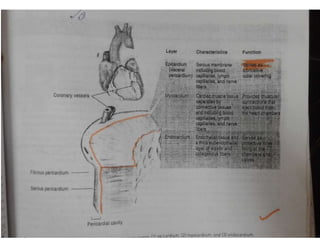
•1. mayocardium:
wall of the heart,composed of 3 layers
1. epicardium... outer most layer
2.myocardium... middle muscular layer
3. endocardium.. inner most layer
blood supply....right and left coronary
arteries.(branches of aorta)
and coronary veins(drains blood into
coronary sinus and ultimately right atrium)
fig
•heart attack or MI:
minor
major
•exercise training can provide protection
against tissue damage during a heart attack.
cardiac vs skeletal muscle
• heart muscle differ from cardiac muscle in
several ways.
cardiac cycle
•the contraction phase of the cardiac cycle is
called systole and the relaxation period is called
diastole.
•average resting heart rate is 75.
–total cardiac cycle lasts for 0.8 sec. 0.5 sec spent in diastole and
0.3 sec dedicated to systole.
•the pacemaker of the heart is SA node
.
PRESSURE CHANGES DURING
CARDIAC CYCLE
• blood pressure is the force exerted by blood against the arterial walls and is
determined by how much blood pumped and the resistance to blood flow.
• measured by: sphygmomanometer
• normal adult bp= 120/80mmhg
• in female slightly lower = 110/70mmhg
• systolic bp= is the pressure generated as blood is ejected from the heart
during ventricular systole
• diastolic pressure: during relaxation of ventricles ,filling occur and pressure
decreases whic is represented as diastolic
• pulse pressure: difference b/w systolic and diastolic
• the average blood pressure during a cardiac cycle is called mean arterial
blood pressure.
• mean arterial bp= DBP+0.33(pulse pressure)
• this formula cannot be used during exercise
because it is based on the timing of the
cardiac cycle at rest.
• 70% blood entering the atria during diastole
flows directly into ventricles before
contraction of atria, later on contraction of
atria rest of 30% is pushed in to ventricles.
• HYPERTENSION: raised bp
• bp above 140/90 is indicator of HTN
• classification of HTN:
• 1. primary or essential HTN: (90% cases,
unknown cause)
• 2. secondary HTN: due to another disease
• Complicationz of HTN:
• left ventricular hypertrophy
• heart failure
• arteriosclerosis
• heart attacks
• kidney damage
• stroke
•Blood pressure can be increased by one or
all of the following factors:
a. increase in blood volume.
b. increase in heart rate.
c. increased blood viscosity
d. increase in stroke volume
e. increased peripheral resistance.
factors influencing arterial blood
pressure
•mean arterial blood pressure is determined
by two factors
•1. cardiac out put
•2.total vascular resistance
•mean arterial blood pressure=cardiac
output x total vasculr resistance.
fig
how bp is regulated?
• acute(short term ) regulation of bp is
achieved by the sympathetic nervous
system.
• long term regulation of blood is primarily a
function of the kidneys.kidneys regulate bp
by controlling blood volume.
baroreceptors
( in carotid artery and aorta)
cardiovascular control center
(brainstem)
dec sympathetic or inc sympathetic
activity
• dec sympathetic or inc. parasympathetic activity lower bp
• inc. sympathetic or dec. parasympathetic activity
increases bp
ELECTRICAL ACTIVITY OF
HEART
• recording of electrical activity of heart is
known as ECG.
• p wave= contraction of atria(depolarization
of atrium
• Q-R= depolarization of ventricles
• R-S-T= repolarization of ventricles
complete
• end of T wave= again depolarization
begins
CARDIAC OUTPUT
• Cardiac output is the product of heart rate
and stroke volume. (amount of blood
pumped per heart beat)
• Q= HR X SV
• during exercise in the upright position (e.g.
running, cycling etc) the increase in cardiac
output is due to an increase in both HR and
SV.
• The gender differences in SV and cardiac
output are due to difference in body sizes of
men and women.
(a)regulation of heart rate
• during exercise ,the quantity of blood
pumped by the heart must change in
accordance with the elevated skeletal m/s
oxygen demand .
• because the SA node controls heart
rate.,changes in heart rate often involve
factors that influence the SA node.
• the two most prominent factors that
influence HR are the parasympthetic and
sympathetic nervous system.
• the parasympathetic fibers arises from
neurons in cvs center in medulla oblongata
and make up a portion of vagus nerve.
• on reaching heart these fibers make contact
with both SA and AV nodes.
• when stimulated nerve endings release
acetylcholine.which causes decrease in
activity of both nodes resulting in dec. heart
rate
• even at rest vagus nerve carry impulses to
SA and AV nodes. this is called
parasympathetic tone.
• inc. parasympathetic activity ..... dec. HR
and vice versa
• endings of sympathetic nerves release
norepinephrine upon stimulation, which act
on beta receptors in heart and causes an
inc. in both HR and force of contraction of
cardiac m/s.
another regulatory reflex
•regulatory reflex involves receptors in right
atrium of heart . inc. in rt. atrial pressure
signals the cvs control center in brain that an
increase in venous return has occured.
•hence to prevent a backup of blood in the
systemic venous sytem inc. cardiac output is
required,
•so cvs control system responed by sending
sympathetic accelerator to heart.which
increases HR
•increase in body temperature increases HR and
vice versa.
(b)REGULATION OF STROKE VOLUME:
•stroke vol. is regulated by
•1. end-diastolic vol. (pre-load).. direct relation
•2. aortic bp(after-load)...offer resistance to
ejection of blood
•3. strength of ventricular contraction( controlled by
epinephrine and nor-epinephrine and direct
sympthetic stimulation of heart.)
• FRANK STARLING LAW:
• the strength of ventricular contraction
increased with an enlargement of EDV(
end diastolic volume) i.e . stretch of the
ventricles.
fig
REGULATION OF VENOUS
RETURN
• increased venous return increases stroke
vol.
• three principle mechanism responsible for
increassing venous return during exercise
are:
• 1. vasoconstriction(reduced vol capacity of
veins)
• 2. muscle pump(m/s contractions)
• 3. pulmonary pump( rythmic breathing)
•during sustained contractions(isometrics)
,the muscle pump cannot operate.and
venous return is reduced.
HEMODYNAMICS
• TO understand the physical regulation of
blood flow to tissues,it is necessary to
appreciate the inter-relationships b/w
pressure, flow and resistance.the studies
of these factors and the physical principles
of blood flow is called hemodynamics.
PHYSICAL CHARACTERISTICS
OF BLOOD
•TWO principal components:
cells and plasma
•plasma is the watery portion of the blood
that contain numerous ions ,proteins and
hormones
•cells that make up blood are RBCs, white
blood cells and platelets.
•RBC contain Hb for oxygen transport
• platelets play an important role in blood
clotting
• and white blood cells are important in
prevention of infectionz.
• the percentage of the blood that is
composed of the cells is called
hematocrit. that is 42% of the blood
• for male it is 42%
• for females it is 38%
• values may vary among individuals
•blood is more viscous than water.
relationship among pressure
resistance and flow
• blood flow through vascular system is
directly proportinal to the pressure
difference at the two ends of the system
and inversely proportional to the
resistance
• BLOOD FLOW= PRESSURE/RESISTANCE
• THe most important factor determining
resistance to blood flow is the radius of the blood
vessel the relationship b/w vessel radius ,vessel
length ,blood viscosity and flow is:
RESISTANCE=length x viscosity/ radius4
• the greatest resistance to blood flow is
offered in arterioles.
pressure changes
changes in oxygen delivery to
muscle during exercise
•during intense exercise ,the metabolic need
for oxygen in skeletal m/s increases many
times over the resting value.
•to meet this rise there must be increase in
blood flow towards contracting muscles.
•which is accomplished via two
mechanisms:
1.increased cardiac output
2. redistribution of blood flow from inactive
organs to the working m/s
1. change in cardiac output during
exercise
• cardiac output increases during exercise in
direct proportion to the metabolic rate
required to perform the exercise task.
• relationship b/w cardiac output and
maximaum oxygen uptake is linear
• increase in cardiac output during exercise
in the upright position is achieved by an
increase in both stroke volume and heart
rate.
• in untrained or moderate trained subjects ,
stroke volume does not increase beyond a
workload of 40% to 50% vo2 max ,therefore at
work rates greater than 40% to 50% vo 2 max
,the rise of cardiac output in these individuals is
achieved by increase in heart rate alone.
• cardiac output tends to decrease in a linear
fashion in both men and women after 30 years
of age.this is primaruly due to a decrease in
maximal heart rate with age,
•decrease in heart rate with age can be
estimated by the following formula:
Max HR= 220-age (years)
this is only an estimate the actual values are
20 beats/ min higher or lower.
changes in arterial-mixed venous
oxygen content during exercise
•there is an increase in a-v O2 diff due to an
increase in amount of oxygen taken up and
used for oxidative production of ATP BY
skeletal m/s.
•FICKS LAW:
•the relationship b/w cardiac output (Q) ,
a-v O2 diff and oxygen uptake (VO2) is
given by fick's equation
VO2 = Q x ( a-v O2 diff)
• simply stated , the Fick's equation says
that VO2 is equal to the product of cardiac
output and a-v O2 diff.
• increase in either cardiac output or a-v O2
diff would elevate VO2.
2. redistribution of blood flow
during exercise
• to meet the increased oxygen demand of
m/s during exercise increse blood supply
to m/s
• and decrease blood supply to inactive
organs i.e GIT ,kidney liver
• the increase in skeletal m/s blood flow and
decrease in splanchnic blood
flow(pertaining to viscera) change as a
linear function of % vo2 max.
•at rest, approximately 15 to 20 % of total cardiac
output is directed towards skeletal m/s
•during maximal exercise 80 TO 85% of total
cardiac output is directed towards skeletal
m/s(necessary to meet huge oxygen demand)
•during heavy exercise percentage of total cardiac
output that goes to the brain is reduced compared
to that during rest.
•However the absolute blood flow that reaching
the brain is slightly increased above resting values,
this is due to elevated cardiac output during
exxercise.
• although percentage of total cardiac output
that reaches myocardium is the same
duing maximal exercise as it is at rest,
the total coronary blood flow is increased
due to increase in cardiac out put during
heavy exercise.
fig
regulation of local blood flow during
exercise
•regulation of m/s blood flow during exercise
primarily is regulated by local factores(called
autoregulation)
•autoregulation refers to intrinsic control of
blood flow by change in local metabolites
(e.g oxygen tension, pH, potassium
adenosine, and nitric oxide ) areound
arterioles.
• the local changes work together to cause
vasodilation of arterioles feeding the
contracting skeletal m/s.
• vasodilation reduces the vascular
resistance therefore increases blood flow.
• blood flow rises 15 to 20 times the resting
value.
• further arteriole vasodilation is combined
with recruitment of capallaries in skeletal
m/s.
• at rest only 5 to 10% of the capallaries in
skeletal m/s are open at any one time,
however, during intense exercise almost all
the capallaries in contracting m/s are open.
• level of vasodilation is regulated by the
metabolic need of the m/s.
• i.e. intensity of exercise and no. of motor units
recruited determine the over all need for blood
flow to the m/s.
• vascular resistance decreases in m/s but
increases in other tissues and viscera bcoz of
sympathetic output to these viscera,regulated
by cvs center in brain,which causes
vasoconstriction of vessels in viscera during
exercise and decrease blood flow. only 20 to 30
% decrease of resting value
circulatory responses to
exercise
•the change in HR and BP that occur during
exercise reflects
-the type and intensity of exercise performed
,
-duration of exercise and the environmental
conditions under which the work was
performed.
• for example; HR and BP at any given
oxygen uptake are higher during arm work
when compared to leg work
• further exercise in hot/humid environment
results in higher HR when compared to the
same exercise in cool environment.
(a) EMOTIONAL INFLUENCE
• submaximal exercise in emothinally
charged( filled with strong feeling or
tension) atmosphere results in higher HR
and BP. when compared to same work in a
psychologically neutral environment,
• this elevation is mediated by an increase
in sympathetic nervous system activity.
(b) TRANSITION FROM REST TO
EXERCISE
•At begining... rapid increase in HR,sv and Q
( within the first sec after muscular
contraction)
•if the work rate is constant and below
lactate threshold(quantitative point at which
an action is triggered) , a steady state
plateau in the HR, SV, and Q is reached
within two to three min
* * plateau( stable level in something that
varies)
fig
(c) RECOVERY FROM EXERCISE
• recovery from short-term low intensity
exercise is rapid
• recovery from long-term exercise is much
slower
(c) INCREMENTAL EXERCISE
• cardiac output and heart rate reaches
plateau at 100% vo2 max.... represents
maximum ceiling of oxygen to the
exercising m/s
• increase in cardiac output during
incremental exercise is achieved via dec.
in vascular resistance and an increase in
mean arterial blood pressure, due to
increase in systolic bp coz diastolic fairly
remains constant during incremental
exercise.
• the increase workload on heart during
exercise is estimated by double product.
• double product also known as rate-
pressure product, computed as:
• double product= HR x SBP
• practical application: this measure can be
used as a guideline to prescribe exercise
for patients with coronary artery blockage.
(d) ARM vs LEG EXERCISES
(e) INTERMITTENT EXERCISE
• interval training( discontinous exercise)
• during interval recovery can occur
• but in hot/humid environment and high
intensity exercise complete recovery can
not occur
(f) PROLONGED EXERCISE
• cardiac out put is maintained throughout
the duration of exercise
• sv declines (dehydration due to prolonged
duration, dec. plasma vol.)
• but HR increases
• the increase in heart rate that occurs
during prolonged exercises is called
cardiovascular drift.
REGULATION OF
CARDIOVASCULAR
ADJUSTMENTS TO EXERCISE
• cvs adjustments at beginning are rapid
• within one second after commencement of
m/s contraction there is withdrawl of vagal
outflow to heart
• which is followed by an increase in
sympathetic stimulation of heart...> inc.
cardiac output ...> inc. blood flow
• what is the signal to turn on the cvs at onset of
execise??
• central command theory
• CENTRAL COMMAND refers to a motor signal
developed within the brain.this theory argues
that the initial cvs changes at the beginning of
dynamic exercise (e.g cycle ergometer) are due
to centrally generated cardiovascular motor
signals,which set the general pattern of
cardiovascular response.
• however it is believed that cardiovascular
activity can be and is modified by heart
mechanoreceptor,muscle chemoreceptors,
m/s mechanoreceptor and baroreceptors
located in carotid and aortic arch.
• fine tunning of the cvs response to a given
exercise test is accomplished via a series
of feedback loops from m/s
chemoreceptors , m/s mechanoreceptors
and arterial baroreceptors.
• exercise pressor reflex;
• M/S chemoreceptors are sensitive to
increase in m/s metabolites (e.g.
potassium,lactic acid etc) and send msgs
to higher brain centers to “fine-tune” the
cardiovascular response to exercise. this
type of peripheral feed-back to the cvs
control center in medulla oblongata has
been termed exercise pressor reflex.
THE END

Circulatory responses to exercise

  • 1.
  • 2.
    • one ofthe major challenges to homeostasis posed by exercise is the increased muscular demand for oxygen. • during heavy exercise the demand may be fifteen to twenty-five times greater than at rest. • the primary purpose of the cardiorespiratory system is to deliver adequate amounts of oxygen and remove wastes from body tissue. • in addition the circulatory system transports nutrients and aids in temperature regulation. • respiratory system and circulatory system both work together as a unit called coupled unit.
  • 3.
    • to meetthe increased demand of a muscle during exercise ,two major adjustments of the blood flow must be made • 1.an increased cardiac output • 2. and redistribution of blood flow from inactive organs to active skeletal muscles
  • 4.
    • however whilethe needs of muscle being met ,other tissues such as brain ,cannot be denied blood flow.this is accomplished by maintaining blood pressure ,the driving force of the blood .
  • 5.
    ORGANIZATION OF THE CIRCULATORYSYSTEM •THE human circulatory system is a closed loop that circulates blood to all body tissues •circulation of blood requires the action of a muscular pump, the heart , that creates the “pressure head”needed to move blood through the system. • heart arteries arterioles capallaries vein venules
  • 6.
    (a) structure ofheart •4 chambers •2 pumps( right and left).... separated by interventicular septum. •four one way valves.... 1.right Av valve( tricuspid) 2.left AV walve( bicuspid) 3. pulmonary semilunar valve 4. aortic semilunar valve
  • 8.
    (b) pulmonary andsystemic circuit • pulmonary circuit • systemic circuit.
  • 9.
  • 10.
    HEART •1. mayocardium: wall ofthe heart,composed of 3 layers 1. epicardium... outer most layer 2.myocardium... middle muscular layer 3. endocardium.. inner most layer blood supply....right and left coronary arteries.(branches of aorta) and coronary veins(drains blood into coronary sinus and ultimately right atrium)
  • 11.
  • 12.
    •heart attack orMI: minor major •exercise training can provide protection against tissue damage during a heart attack.
  • 13.
    cardiac vs skeletalmuscle • heart muscle differ from cardiac muscle in several ways.
  • 15.
    cardiac cycle •the contractionphase of the cardiac cycle is called systole and the relaxation period is called diastole. •average resting heart rate is 75. –total cardiac cycle lasts for 0.8 sec. 0.5 sec spent in diastole and 0.3 sec dedicated to systole. •the pacemaker of the heart is SA node .
  • 16.
    PRESSURE CHANGES DURING CARDIACCYCLE • blood pressure is the force exerted by blood against the arterial walls and is determined by how much blood pumped and the resistance to blood flow. • measured by: sphygmomanometer • normal adult bp= 120/80mmhg • in female slightly lower = 110/70mmhg • systolic bp= is the pressure generated as blood is ejected from the heart during ventricular systole • diastolic pressure: during relaxation of ventricles ,filling occur and pressure decreases whic is represented as diastolic • pulse pressure: difference b/w systolic and diastolic • the average blood pressure during a cardiac cycle is called mean arterial blood pressure. • mean arterial bp= DBP+0.33(pulse pressure)
  • 18.
    • this formulacannot be used during exercise because it is based on the timing of the cardiac cycle at rest. • 70% blood entering the atria during diastole flows directly into ventricles before contraction of atria, later on contraction of atria rest of 30% is pushed in to ventricles. • HYPERTENSION: raised bp • bp above 140/90 is indicator of HTN • classification of HTN: • 1. primary or essential HTN: (90% cases, unknown cause) • 2. secondary HTN: due to another disease
  • 19.
    • Complicationz ofHTN: • left ventricular hypertrophy • heart failure • arteriosclerosis • heart attacks • kidney damage • stroke
  • 20.
    •Blood pressure canbe increased by one or all of the following factors: a. increase in blood volume. b. increase in heart rate. c. increased blood viscosity d. increase in stroke volume e. increased peripheral resistance.
  • 21.
    factors influencing arterialblood pressure •mean arterial blood pressure is determined by two factors •1. cardiac out put •2.total vascular resistance •mean arterial blood pressure=cardiac output x total vasculr resistance.
  • 22.
  • 23.
    how bp isregulated? • acute(short term ) regulation of bp is achieved by the sympathetic nervous system. • long term regulation of blood is primarily a function of the kidneys.kidneys regulate bp by controlling blood volume.
  • 24.
    baroreceptors ( in carotidartery and aorta) cardiovascular control center (brainstem) dec sympathetic or inc sympathetic activity • dec sympathetic or inc. parasympathetic activity lower bp • inc. sympathetic or dec. parasympathetic activity increases bp
  • 25.
  • 27.
    • recording ofelectrical activity of heart is known as ECG. • p wave= contraction of atria(depolarization of atrium • Q-R= depolarization of ventricles • R-S-T= repolarization of ventricles complete • end of T wave= again depolarization begins
  • 28.
    CARDIAC OUTPUT • Cardiacoutput is the product of heart rate and stroke volume. (amount of blood pumped per heart beat) • Q= HR X SV • during exercise in the upright position (e.g. running, cycling etc) the increase in cardiac output is due to an increase in both HR and SV. • The gender differences in SV and cardiac output are due to difference in body sizes of men and women.
  • 29.
    (a)regulation of heartrate • during exercise ,the quantity of blood pumped by the heart must change in accordance with the elevated skeletal m/s oxygen demand . • because the SA node controls heart rate.,changes in heart rate often involve factors that influence the SA node. • the two most prominent factors that influence HR are the parasympthetic and sympathetic nervous system.
  • 30.
    • the parasympatheticfibers arises from neurons in cvs center in medulla oblongata and make up a portion of vagus nerve. • on reaching heart these fibers make contact with both SA and AV nodes. • when stimulated nerve endings release acetylcholine.which causes decrease in activity of both nodes resulting in dec. heart rate • even at rest vagus nerve carry impulses to SA and AV nodes. this is called parasympathetic tone. • inc. parasympathetic activity ..... dec. HR and vice versa
  • 31.
    • endings ofsympathetic nerves release norepinephrine upon stimulation, which act on beta receptors in heart and causes an inc. in both HR and force of contraction of cardiac m/s.
  • 32.
    another regulatory reflex •regulatoryreflex involves receptors in right atrium of heart . inc. in rt. atrial pressure signals the cvs control center in brain that an increase in venous return has occured. •hence to prevent a backup of blood in the systemic venous sytem inc. cardiac output is required, •so cvs control system responed by sending sympathetic accelerator to heart.which increases HR
  • 33.
    •increase in bodytemperature increases HR and vice versa. (b)REGULATION OF STROKE VOLUME: •stroke vol. is regulated by •1. end-diastolic vol. (pre-load).. direct relation •2. aortic bp(after-load)...offer resistance to ejection of blood •3. strength of ventricular contraction( controlled by epinephrine and nor-epinephrine and direct sympthetic stimulation of heart.)
  • 34.
    • FRANK STARLINGLAW: • the strength of ventricular contraction increased with an enlargement of EDV( end diastolic volume) i.e . stretch of the ventricles.
  • 35.
  • 36.
    REGULATION OF VENOUS RETURN •increased venous return increases stroke vol. • three principle mechanism responsible for increassing venous return during exercise are: • 1. vasoconstriction(reduced vol capacity of veins) • 2. muscle pump(m/s contractions) • 3. pulmonary pump( rythmic breathing)
  • 37.
    •during sustained contractions(isometrics) ,themuscle pump cannot operate.and venous return is reduced.
  • 39.
    HEMODYNAMICS • TO understandthe physical regulation of blood flow to tissues,it is necessary to appreciate the inter-relationships b/w pressure, flow and resistance.the studies of these factors and the physical principles of blood flow is called hemodynamics.
  • 40.
    PHYSICAL CHARACTERISTICS OF BLOOD •TWOprincipal components: cells and plasma •plasma is the watery portion of the blood that contain numerous ions ,proteins and hormones •cells that make up blood are RBCs, white blood cells and platelets. •RBC contain Hb for oxygen transport
  • 41.
    • platelets playan important role in blood clotting • and white blood cells are important in prevention of infectionz. • the percentage of the blood that is composed of the cells is called hematocrit. that is 42% of the blood • for male it is 42% • for females it is 38% • values may vary among individuals
  • 42.
    •blood is moreviscous than water.
  • 44.
    relationship among pressure resistanceand flow • blood flow through vascular system is directly proportinal to the pressure difference at the two ends of the system and inversely proportional to the resistance • BLOOD FLOW= PRESSURE/RESISTANCE • THe most important factor determining resistance to blood flow is the radius of the blood vessel the relationship b/w vessel radius ,vessel length ,blood viscosity and flow is:
  • 45.
    RESISTANCE=length x viscosity/radius4 • the greatest resistance to blood flow is offered in arterioles.
  • 46.
  • 48.
    changes in oxygendelivery to muscle during exercise •during intense exercise ,the metabolic need for oxygen in skeletal m/s increases many times over the resting value. •to meet this rise there must be increase in blood flow towards contracting muscles. •which is accomplished via two mechanisms: 1.increased cardiac output 2. redistribution of blood flow from inactive organs to the working m/s
  • 49.
    1. change incardiac output during exercise • cardiac output increases during exercise in direct proportion to the metabolic rate required to perform the exercise task. • relationship b/w cardiac output and maximaum oxygen uptake is linear • increase in cardiac output during exercise in the upright position is achieved by an increase in both stroke volume and heart rate.
  • 50.
    • in untrainedor moderate trained subjects , stroke volume does not increase beyond a workload of 40% to 50% vo2 max ,therefore at work rates greater than 40% to 50% vo 2 max ,the rise of cardiac output in these individuals is achieved by increase in heart rate alone. • cardiac output tends to decrease in a linear fashion in both men and women after 30 years of age.this is primaruly due to a decrease in maximal heart rate with age,
  • 51.
    •decrease in heartrate with age can be estimated by the following formula: Max HR= 220-age (years) this is only an estimate the actual values are 20 beats/ min higher or lower.
  • 52.
    changes in arterial-mixedvenous oxygen content during exercise •there is an increase in a-v O2 diff due to an increase in amount of oxygen taken up and used for oxidative production of ATP BY skeletal m/s. •FICKS LAW: •the relationship b/w cardiac output (Q) , a-v O2 diff and oxygen uptake (VO2) is given by fick's equation VO2 = Q x ( a-v O2 diff)
  • 53.
    • simply stated, the Fick's equation says that VO2 is equal to the product of cardiac output and a-v O2 diff. • increase in either cardiac output or a-v O2 diff would elevate VO2.
  • 54.
    2. redistribution ofblood flow during exercise • to meet the increased oxygen demand of m/s during exercise increse blood supply to m/s • and decrease blood supply to inactive organs i.e GIT ,kidney liver • the increase in skeletal m/s blood flow and decrease in splanchnic blood flow(pertaining to viscera) change as a linear function of % vo2 max.
  • 55.
    •at rest, approximately15 to 20 % of total cardiac output is directed towards skeletal m/s •during maximal exercise 80 TO 85% of total cardiac output is directed towards skeletal m/s(necessary to meet huge oxygen demand) •during heavy exercise percentage of total cardiac output that goes to the brain is reduced compared to that during rest. •However the absolute blood flow that reaching the brain is slightly increased above resting values, this is due to elevated cardiac output during exxercise.
  • 56.
    • although percentageof total cardiac output that reaches myocardium is the same duing maximal exercise as it is at rest, the total coronary blood flow is increased due to increase in cardiac out put during heavy exercise.
  • 57.
  • 58.
    regulation of localblood flow during exercise •regulation of m/s blood flow during exercise primarily is regulated by local factores(called autoregulation) •autoregulation refers to intrinsic control of blood flow by change in local metabolites (e.g oxygen tension, pH, potassium adenosine, and nitric oxide ) areound arterioles.
  • 59.
    • the localchanges work together to cause vasodilation of arterioles feeding the contracting skeletal m/s. • vasodilation reduces the vascular resistance therefore increases blood flow. • blood flow rises 15 to 20 times the resting value. • further arteriole vasodilation is combined with recruitment of capallaries in skeletal m/s. • at rest only 5 to 10% of the capallaries in skeletal m/s are open at any one time, however, during intense exercise almost all the capallaries in contracting m/s are open.
  • 60.
    • level ofvasodilation is regulated by the metabolic need of the m/s. • i.e. intensity of exercise and no. of motor units recruited determine the over all need for blood flow to the m/s. • vascular resistance decreases in m/s but increases in other tissues and viscera bcoz of sympathetic output to these viscera,regulated by cvs center in brain,which causes vasoconstriction of vessels in viscera during exercise and decrease blood flow. only 20 to 30 % decrease of resting value
  • 61.
    circulatory responses to exercise •thechange in HR and BP that occur during exercise reflects -the type and intensity of exercise performed , -duration of exercise and the environmental conditions under which the work was performed.
  • 62.
    • for example;HR and BP at any given oxygen uptake are higher during arm work when compared to leg work • further exercise in hot/humid environment results in higher HR when compared to the same exercise in cool environment.
  • 63.
    (a) EMOTIONAL INFLUENCE •submaximal exercise in emothinally charged( filled with strong feeling or tension) atmosphere results in higher HR and BP. when compared to same work in a psychologically neutral environment, • this elevation is mediated by an increase in sympathetic nervous system activity.
  • 64.
    (b) TRANSITION FROMREST TO EXERCISE •At begining... rapid increase in HR,sv and Q ( within the first sec after muscular contraction) •if the work rate is constant and below lactate threshold(quantitative point at which an action is triggered) , a steady state plateau in the HR, SV, and Q is reached within two to three min * * plateau( stable level in something that varies)
  • 65.
  • 66.
    (c) RECOVERY FROMEXERCISE • recovery from short-term low intensity exercise is rapid • recovery from long-term exercise is much slower
  • 67.
    (c) INCREMENTAL EXERCISE •cardiac output and heart rate reaches plateau at 100% vo2 max.... represents maximum ceiling of oxygen to the exercising m/s • increase in cardiac output during incremental exercise is achieved via dec. in vascular resistance and an increase in mean arterial blood pressure, due to increase in systolic bp coz diastolic fairly remains constant during incremental exercise.
  • 68.
    • the increaseworkload on heart during exercise is estimated by double product. • double product also known as rate- pressure product, computed as: • double product= HR x SBP • practical application: this measure can be used as a guideline to prescribe exercise for patients with coronary artery blockage.
  • 69.
    (d) ARM vsLEG EXERCISES
  • 70.
    (e) INTERMITTENT EXERCISE •interval training( discontinous exercise) • during interval recovery can occur • but in hot/humid environment and high intensity exercise complete recovery can not occur
  • 71.
    (f) PROLONGED EXERCISE •cardiac out put is maintained throughout the duration of exercise • sv declines (dehydration due to prolonged duration, dec. plasma vol.) • but HR increases • the increase in heart rate that occurs during prolonged exercises is called cardiovascular drift.
  • 73.
    REGULATION OF CARDIOVASCULAR ADJUSTMENTS TOEXERCISE • cvs adjustments at beginning are rapid • within one second after commencement of m/s contraction there is withdrawl of vagal outflow to heart • which is followed by an increase in sympathetic stimulation of heart...> inc. cardiac output ...> inc. blood flow
  • 74.
    • what isthe signal to turn on the cvs at onset of execise?? • central command theory • CENTRAL COMMAND refers to a motor signal developed within the brain.this theory argues that the initial cvs changes at the beginning of dynamic exercise (e.g cycle ergometer) are due to centrally generated cardiovascular motor signals,which set the general pattern of cardiovascular response.
  • 75.
    • however itis believed that cardiovascular activity can be and is modified by heart mechanoreceptor,muscle chemoreceptors, m/s mechanoreceptor and baroreceptors located in carotid and aortic arch. • fine tunning of the cvs response to a given exercise test is accomplished via a series of feedback loops from m/s chemoreceptors , m/s mechanoreceptors and arterial baroreceptors.
  • 76.
    • exercise pressorreflex; • M/S chemoreceptors are sensitive to increase in m/s metabolites (e.g. potassium,lactic acid etc) and send msgs to higher brain centers to “fine-tune” the cardiovascular response to exercise. this type of peripheral feed-back to the cvs control center in medulla oblongata has been termed exercise pressor reflex.
  • 78.