e334
Myocardial Infarction: More
Complex Than Plumbing
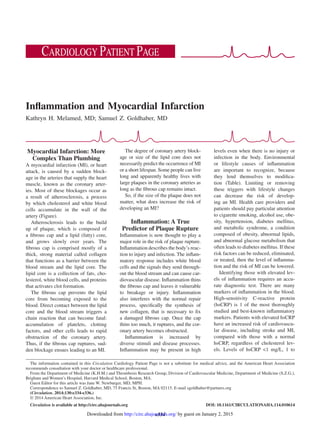
A myocardial infarction (MI), or heart
attack, is caused by a sudden block-
age in the arteries that supply the heart
muscle, known as the coronary arter-
ies. Most of these blockages occur as
a result of atherosclerosis, a process
by which cholesterol and white blood
cells accumulate in the wall of the
artery (Figure).
Atherosclerosis leads to the build
up of plaque, which is composed of
a fibrous cap and a lipid (fatty) core,
and grows slowly over years. The
fibrous cap is comprised mostly of a
thick, strong material called collagen
that functions as a barrier between the
blood stream and the lipid core. The
lipid core is a collection of fats, cho-
lesterol, white blood cells, and proteins
that activates clot formation.
The fibrous cap prevents the lipid
core from becoming exposed to the
blood. Direct contact between the lipid
core and the blood stream triggers a
chain reaction that can become fatal:
accumulation of platelets, clotting
factors, and other cells leads to rapid
obstruction of the coronary artery.
Thus, if the fibrous cap ruptures, sud-
den blockage ensues leading to an MI.
The degree of coronary artery block-
age or size of the lipid core does not
necessarily predict the occurrence of MI
or a short lifespan. Some people can live
long and apparently healthy lives with
large plaques in the coronary arteries as
long as the fibrous cap remains intact.
So, if the size of the plaque does not
matter, what does increase the risk of
developing an MI?
Inflammation: A True
Predictor of Plaque Rupture
Inflammation is now thought to play a
major role in the risk of plaque rupture.
Inflammation describes the body’s reac-
tion to injury and infection. The inflam-
matory response includes white blood
cells and the signals they send through-
out the blood stream and can cause car-
diovascular disease. Inflammation thins
the fibrous cap and leaves it vulnerable
to breakage or injury. Inflammation
also interferes with the normal repair
process, specifically the synthesis of
new collagen, that is necessary to fix
a damaged fibrous cap. Once the cap
thins too much, it ruptures, and the cor-
onary artery becomes obstructed.
Inflammation is increased by
diverse stimuli and disease processes.
Inflammation may be present in high
levels even when there is no injury or
infection in the body. Environmental
or lifestyle causes of inflammation
are important to recognize, because
they lend themselves to modifica-
tion (Table). Limiting or removing
these triggers with lifestyle changes
can decrease the risk of develop-
ing an MI. Health care providers and
patients should pay particular attention
to cigarette smoking, alcohol use, obe-
sity, hypertension, diabetes mellitus,
and metabolic syndrome, a condition
composed of obesity, abnormal lipids,
and abnormal glucose metabolism that
often leads to diabetes mellitus. If these
risk factors can be reduced, eliminated,
or treated, then the level of inflamma-
tion and the risk of MI can be lowered.
Identifying those with elevated lev-
els of inflammation requires an accu-
rate diagnostic test. There are many
markers of inflammation in the blood.
High-sensitivity C-reactive protein
(hsCRP) is 1 of the most thoroughly
studied and best-known inflammatory
markers. Patients with elevated hsCRP
have an increased risk of cardiovascu-
lar disease, including stroke and MI,
compared with those with a normal
hsCRP, regardless of cholesterol lev-
els. Levels of hsCRP <1 mg/L, 1 to
(Circulation. 2014;130:e334-e336.)
© 2014 American Heart Association, Inc.
Circulation is available at http://circ.ahajournals.org DOI: 10.1161/CIRCULATIONAHA.114.010614
The information contained in this Circulation Cardiology Patient Page is not a substitute for medical advice, and the American Heart Association
recommends consultation with your doctor or healthcare professional.
From the Department of Medicine (K.H.M.) and Thrombosis Research Group, Division of Cardiovascular Medicine, Department of Medicine (S.Z.G.),
Brigham and Women’s Hospital, Harvard Medical School, Boston, MA.
Guest Editor for this article was Jane W. Newburger, MD, MPH.
Correspondence to Samuel Z. Goldhaber, MD, 75 Francis St, Boston, MA 02115. E-mail sgoldhaber@partners.org
Inflammation and Myocardial Infarction
Kathryn H. Melamed, MD; Samuel Z. Goldhaber, MD
Cardiology Patient Page
by guest on January 2, 2015http://circ.ahajournals.org/Downloaded from
Melamed and Goldhaber   Inflammation and Myocardial Infarction   e335
3 mg/L, and 3 mg/L indicate lower,
average, and higher relative risks for
future cardiovascular events, respec-
tively. It is important to make sure
that the units are mg/L, not mg/dL. If
your CRP test is reported as mg/dL,
then you did not have the correct test
performed.
Statins, a class of medications used
to lower cholesterol levels, help prevent
MI. They decrease levels of bad cho-
lesterol, called low-density lipoprotein,
but also decrease hsCRP. Statins are
thus 2-for-1 medications that combine
lipid-lowering and anti-inflammatory
mechanisms, making them especially
important for preventing cardiovascu-
lar disease.
One major study, the Justification
for the Use of Statins in Prevention:
an Intervention Trial Evaluating
Rosuvastatin (JUPITER), investi-
gated the anti-inflammatory property
of statins. The investigators enrolled
almost 18 000 apparently normal sub-
jects who had normal lipid profiles
but high hsCRP levels. These patients
would not ordinarily have qualified
for statin therapy because they already
had low levels of cholesterol. However,
they were at significantly increased
cardiac risk, because they had elevated
levels of hsCRP. The JUPITER results
showed that a statin medication called
rosuvastatin, when compared with
placebo, lowered hsCRP levels and
reduced cardiovascular events such as
MI and stroke by nearly 50% and the
overall risk of death by 20%. Because
both hsCRP and cholesterol levels
were reduced with this medication, it
is uncertain whether the inflamma-
tion-lowering or cholesterol-lowering
effect was primarily responsible for the
markedly lower rate of MI, stroke, and
cardiovascular death.
Additional evidence for the poten-
tial cardiovascular benefits of anti-
inflammatory medications comes
from observational studies of patients
with rheumatoid arthritis and psoriatic
arthritis. These studies compared those
taking low dose methotrexate (LDM),
an anti-inflammatory medication, with
those who were not. Patients with
inflammatory disorders such as rheu-
matoid arthritis are at increased cardiac
risk. However, the results suggested
that these same patients who took
LDM had lower rates of heart attack
and stroke compared with those who
did not take LDM. These observations
require further study.
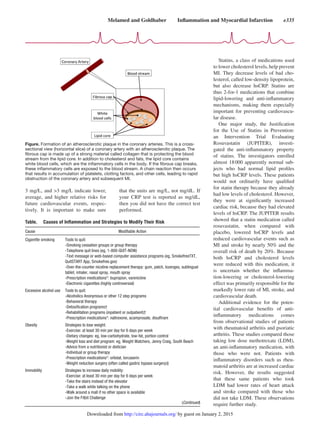
Figure. Formation of an atherosclerotic plaque in the coronary arteries. This is a cross-
sectional view (horizontal slice) of a coronary artery with an atherosclerotic plaque. The
fibrous cap is made up of a strong material called collagen that is protecting the blood
stream from the lipid core. In addition to cholesterol and fats, the lipid core contains
white blood cells, which are the inflammatory cells in the body. If the fibrous cap breaks,
these inflammatory cells are exposed to the blood stream. A chain reaction then occurs
that results in accumulation of platelets, clotting factors, and other cells, leading to rapid
obstruction of the coronary artery and subsequent MI.
Table.  Causes of Inflammation and Strategies to Modify Their Risk
Cause Modifiable Action
Cigarette smoking Tools to quit:
-Smoking cessation groups or group therapy
-Telephone quit lines (eg, 1-800-QUIT-NOW)
-Text message or web-based computer assistance programs (eg, SmokefreeTXT,
QuitSTART App, Smokefree.gov)
-Over-the-counter nicotine replacement therapy: gum, patch, lozenges, sublingual
tablet, inhaler, nasal spray, mouth spray
-Prescription medications*: bupropion, varenicline
-Electronic cigarettes (highly controversial)
Excessive alcohol use Tools to quit:
-Alcoholics Anonymous or other 12 step programs
-Behavioral therapy
-Detoxification programs†
-Rehabilitation programs (inpatient or outpatient)†
-Prescription medications*: naltrexone, acamprosate, disulfiram
Obesity Strategies to lose weight:
-Exercise: at least 30 min per day for 6 days per week
-Dietary changes: eg, low-carbohydrate, low-fat, portion control
-Weight loss and diet program: eg, Weight Watchers, Jenny Craig, South Beach
-Advice from a nutritionist or dietician
-Individual or group therapy
-Prescription medications*: orlistat, lorcaserin
-Weight reduction surgery (often called gastric bypass surgery)‡
Immobility Strategies to increase daily mobility:
-Exercise: at least 30 min per day for 6 days per week
-Take the stairs instead of the elevator
-Take a walk while talking on the phone
-Walk around a mall if no other space is available
-Join the Fitbit Challenge
(Continued)
by guest on January 2, 2015http://circ.ahajournals.org/Downloaded from
e336  Circulation  December 9/16, 2014
Ongoing Research:
Do Anti-Inflammatory
Medications Prevent MI?
Whether reducing inflammation alone
will lower vascular event rates is a major
public health question. The National
Heart, Lung, and Blood Institute is spon-
soring a 7000-patient randomized trial
called the Cardiovascular Inflammation
Reduction Trial (CIRT). The study is
enrolling patients in the United States
and Canada at 300 centers to determine
whether patients without arthritis but
with known coronary disease might also
benefit from LDM. CIRT is designed
to test whether lowering inflammation
can prevent MI and other cardiovascular
events, such as stroke.
The study tests the effects of treat-
ing cardiovascular inflammation by
using LDM, a safe and effective anti-
inflammatory medication that does not
reduce cholesterol or decrease blood
pressure. LDM is a generic drug that
has been widely used to treat arthritis
for 40 years and has been taken safely
by hundreds of thousands of adults.
CIRT is currently enrolling adults who
within the past 5 years have had an MI
or were diagnosed with coronary artery
disease in 1 coronary artery. Patients
must also have either diabetes mellitus
or metabolic syndrome, 2 conditions
with a high inflammatory state. For more
information about the study, visit the trial
website at www.theCIRT.org.
Additional Resources
Libby P. Mechanisms of acute coro-
nary syndromes and their implica-
tions for therapy. N Engl J Med.
2013;368:2004–2013.
Ridker PM, Danielson E, Fonseca
FA, Genest J, Gotto AM Jr, Kastelein
JJ, Koenig W, Libby P, Lorenzatti AJ,
MacFadyen JG, Nordestgaard BG,
Shepherd J, Willerson JT, Glynn RJ;
JUPITER Study Group. Rosuvastatin
to prevent vascular events in men and
womenwithelevatedC-reactiveprotein.
N Engl J Med. 2008;359:2195–2207.
Everett BM, Pradhan AD, Solomon
DH, Paynter N, Macfadyen J,
Zaharris E, Gupta M, Clearfield
M, Libby P, Hasan AA, Glynn RJ,
Ridker PM. Rationale and design
of the Cardiovascular Inflammation
Reduction Trial: a test of the inflamma-
tory hypothesis of atherothrombosis.
Am Heart J. 2013;166:199–207.e15.
Cardiovascular Inflammation
Reduction Trial website. www.the-
CIRT.org.
North American Thrombosis Forum
website. www.NATFonline.org.
American Heart Association website.
www.heart.org.
Disclosures
Dr Goldhaber reports the following dis-
closures: Research grants: BMS, Daiichi
Sankyo, BTG, NHLBI, Thrombosis
Research Institute (London, UK);
Consultant: Ariad, Bayer, Boehringer
Ingelheim, BMS, Daiichi Sankyo, Janssen,
Merck, Pfizer, Portola. Dr Melamed reports
no conflicts.
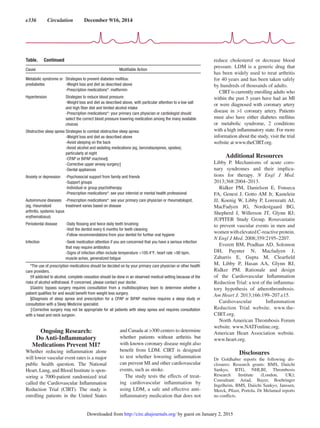
Metabolic syndrome or
prediabetes
Strategies to prevent diabetes mellitus:
-Weight loss and diet as described above
-Prescription medications*: metformin
Hypertension Strategies to reduce blood pressure:
-Weight loss and diet as described above, with particular attention to a low salt
and high fiber diet and limited alcohol intake
-Prescription medications*: your primary care physician or cardiologist should
select the correct blood pressure lowering medication among the many available
choices
Obstructive sleep apnea Strategies to combat obstructive sleep apnea:
-Weight loss and diet as described above
-Avoid sleeping on the back
-Avoid alcohol and sedating medications (eg, benzodiazepines, opiates),
particularly at night
-CPAP or BiPAP machine§
-Corrective upper airway surgery║
-Dental appliances
Anxiety or depression -Psychosocial support from family and friends
-Support groups
-Individual or group psychotherapy
-Prescription medications*: see your internist or mental health professional
Autoimmune diseases
(eg, rheumatoid
arthritis, systemic lupus
erythematosus)
-Prescription medications*: see your primary care physician or rheumatologist,
treatment varies based on disease
Periodontal disease -Daily flossing and twice daily teeth brushing
-Visit the dentist every 6 months for teeth cleaning
-Follow recommendations from your dentist for further oral hygiene
Infection -Seek medication attention if you are concerned that you have a serious infection
that may require antibiotics
-Signs of infection often include temperature 100.4°F, heart rate 90 bpm,
muscle aches, generalized fatigue
*The use of prescription medications should be decided on by your primary care physician or other health
care providers.
†If addicted to alcohol, complete cessation should be done in an observed medical setting because of the
risks of alcohol withdrawal. If concerned, please contact your doctor.
‡Gastric bypass surgery requires consultation from a multidisciplinary team to determine whether a
patient qualifies for and would benefit from weight loss surgery.
§Diagnosis of sleep apnea and prescription for a CPAP or BiPAP machine requires a sleep study or
consultation with a Sleep Medicine specialist.
║Corrective surgery may not be appropriate for all patients with sleep apnea and requires consultation
with a head and neck surgeon.
Table.  Continued
Cause Modifiable Action
by guest on January 2, 2015http://circ.ahajournals.org/Downloaded from
Kathryn H. Melamed and Samuel Z. Goldhaber
Inflammation and Myocardial Infarction
Print ISSN: 0009-7322. Online ISSN: 1524-4539
Copyright © 2014 American Heart Association, Inc. All rights reserved.
is published by the American Heart Association, 7272 Greenville Avenue, Dallas, TX 75231Circulation
doi: 10.1161/CIRCULATIONAHA.114.010614
2014;130:e334-e336Circulation.
http://circ.ahajournals.org/content/130/24/e334
World Wide Web at:
The online version of this article, along with updated information and services, is located on the
http://circ.ahajournals.org//subscriptions/
is online at:CirculationInformation about subscribing toSubscriptions:
http://www.lww.com/reprints
Information about reprints can be found online at:Reprints:
document.Permissions and Rights Question and Answerthis process is available in the
click Request Permissions in the middle column of the Web page under Services. Further information about
Office. Once the online version of the published article for which permission is being requested is located,
can be obtained via RightsLink, a service of the Copyright Clearance Center, not the EditorialCirculationin
Requests for permissions to reproduce figures, tables, or portions of articles originally publishedPermissions:
by guest on January 2, 2015http://circ.ahajournals.org/Downloaded from

Circulation 2014-melamed-e334-6

  • 1.
    e334 Myocardial Infarction: More ComplexThan Plumbing A myocardial infarction (MI), or heart attack, is caused by a sudden block- age in the arteries that supply the heart muscle, known as the coronary arter- ies. Most of these blockages occur as a result of atherosclerosis, a process by which cholesterol and white blood cells accumulate in the wall of the artery (Figure). Atherosclerosis leads to the build up of plaque, which is composed of a fibrous cap and a lipid (fatty) core, and grows slowly over years. The fibrous cap is comprised mostly of a thick, strong material called collagen that functions as a barrier between the blood stream and the lipid core. The lipid core is a collection of fats, cho- lesterol, white blood cells, and proteins that activates clot formation. The fibrous cap prevents the lipid core from becoming exposed to the blood. Direct contact between the lipid core and the blood stream triggers a chain reaction that can become fatal: accumulation of platelets, clotting factors, and other cells leads to rapid obstruction of the coronary artery. Thus, if the fibrous cap ruptures, sud- den blockage ensues leading to an MI. The degree of coronary artery block- age or size of the lipid core does not necessarily predict the occurrence of MI or a short lifespan. Some people can live long and apparently healthy lives with large plaques in the coronary arteries as long as the fibrous cap remains intact. So, if the size of the plaque does not matter, what does increase the risk of developing an MI? Inflammation: A True Predictor of Plaque Rupture Inflammation is now thought to play a major role in the risk of plaque rupture. Inflammation describes the body’s reac- tion to injury and infection. The inflam- matory response includes white blood cells and the signals they send through- out the blood stream and can cause car- diovascular disease. Inflammation thins the fibrous cap and leaves it vulnerable to breakage or injury. Inflammation also interferes with the normal repair process, specifically the synthesis of new collagen, that is necessary to fix a damaged fibrous cap. Once the cap thins too much, it ruptures, and the cor- onary artery becomes obstructed. Inflammation is increased by diverse stimuli and disease processes. Inflammation may be present in high levels even when there is no injury or infection in the body. Environmental or lifestyle causes of inflammation are important to recognize, because they lend themselves to modifica- tion (Table). Limiting or removing these triggers with lifestyle changes can decrease the risk of develop- ing an MI. Health care providers and patients should pay particular attention to cigarette smoking, alcohol use, obe- sity, hypertension, diabetes mellitus, and metabolic syndrome, a condition composed of obesity, abnormal lipids, and abnormal glucose metabolism that often leads to diabetes mellitus. If these risk factors can be reduced, eliminated, or treated, then the level of inflamma- tion and the risk of MI can be lowered. Identifying those with elevated lev- els of inflammation requires an accu- rate diagnostic test. There are many markers of inflammation in the blood. High-sensitivity C-reactive protein (hsCRP) is 1 of the most thoroughly studied and best-known inflammatory markers. Patients with elevated hsCRP have an increased risk of cardiovascu- lar disease, including stroke and MI, compared with those with a normal hsCRP, regardless of cholesterol lev- els. Levels of hsCRP <1 mg/L, 1 to (Circulation. 2014;130:e334-e336.) © 2014 American Heart Association, Inc. Circulation is available at http://circ.ahajournals.org DOI: 10.1161/CIRCULATIONAHA.114.010614 The information contained in this Circulation Cardiology Patient Page is not a substitute for medical advice, and the American Heart Association recommends consultation with your doctor or healthcare professional. From the Department of Medicine (K.H.M.) and Thrombosis Research Group, Division of Cardiovascular Medicine, Department of Medicine (S.Z.G.), Brigham and Women’s Hospital, Harvard Medical School, Boston, MA. Guest Editor for this article was Jane W. Newburger, MD, MPH. Correspondence to Samuel Z. Goldhaber, MD, 75 Francis St, Boston, MA 02115. E-mail sgoldhaber@partners.org Inflammation and Myocardial Infarction Kathryn H. Melamed, MD; Samuel Z. Goldhaber, MD Cardiology Patient Page by guest on January 2, 2015http://circ.ahajournals.org/Downloaded from
  • 2.
    Melamed and Goldhaber  Inflammation and Myocardial Infarction   e335 3 mg/L, and 3 mg/L indicate lower, average, and higher relative risks for future cardiovascular events, respec- tively. It is important to make sure that the units are mg/L, not mg/dL. If your CRP test is reported as mg/dL, then you did not have the correct test performed. Statins, a class of medications used to lower cholesterol levels, help prevent MI. They decrease levels of bad cho- lesterol, called low-density lipoprotein, but also decrease hsCRP. Statins are thus 2-for-1 medications that combine lipid-lowering and anti-inflammatory mechanisms, making them especially important for preventing cardiovascu- lar disease. One major study, the Justification for the Use of Statins in Prevention: an Intervention Trial Evaluating Rosuvastatin (JUPITER), investi- gated the anti-inflammatory property of statins. The investigators enrolled almost 18 000 apparently normal sub- jects who had normal lipid profiles but high hsCRP levels. These patients would not ordinarily have qualified for statin therapy because they already had low levels of cholesterol. However, they were at significantly increased cardiac risk, because they had elevated levels of hsCRP. The JUPITER results showed that a statin medication called rosuvastatin, when compared with placebo, lowered hsCRP levels and reduced cardiovascular events such as MI and stroke by nearly 50% and the overall risk of death by 20%. Because both hsCRP and cholesterol levels were reduced with this medication, it is uncertain whether the inflamma- tion-lowering or cholesterol-lowering effect was primarily responsible for the markedly lower rate of MI, stroke, and cardiovascular death. Additional evidence for the poten- tial cardiovascular benefits of anti- inflammatory medications comes from observational studies of patients with rheumatoid arthritis and psoriatic arthritis. These studies compared those taking low dose methotrexate (LDM), an anti-inflammatory medication, with those who were not. Patients with inflammatory disorders such as rheu- matoid arthritis are at increased cardiac risk. However, the results suggested that these same patients who took LDM had lower rates of heart attack and stroke compared with those who did not take LDM. These observations require further study. Figure. Formation of an atherosclerotic plaque in the coronary arteries. This is a cross- sectional view (horizontal slice) of a coronary artery with an atherosclerotic plaque. The fibrous cap is made up of a strong material called collagen that is protecting the blood stream from the lipid core. In addition to cholesterol and fats, the lipid core contains white blood cells, which are the inflammatory cells in the body. If the fibrous cap breaks, these inflammatory cells are exposed to the blood stream. A chain reaction then occurs that results in accumulation of platelets, clotting factors, and other cells, leading to rapid obstruction of the coronary artery and subsequent MI. Table.  Causes of Inflammation and Strategies to Modify Their Risk Cause Modifiable Action Cigarette smoking Tools to quit: -Smoking cessation groups or group therapy -Telephone quit lines (eg, 1-800-QUIT-NOW) -Text message or web-based computer assistance programs (eg, SmokefreeTXT, QuitSTART App, Smokefree.gov) -Over-the-counter nicotine replacement therapy: gum, patch, lozenges, sublingual tablet, inhaler, nasal spray, mouth spray -Prescription medications*: bupropion, varenicline -Electronic cigarettes (highly controversial) Excessive alcohol use Tools to quit: -Alcoholics Anonymous or other 12 step programs -Behavioral therapy -Detoxification programs† -Rehabilitation programs (inpatient or outpatient)† -Prescription medications*: naltrexone, acamprosate, disulfiram Obesity Strategies to lose weight: -Exercise: at least 30 min per day for 6 days per week -Dietary changes: eg, low-carbohydrate, low-fat, portion control -Weight loss and diet program: eg, Weight Watchers, Jenny Craig, South Beach -Advice from a nutritionist or dietician -Individual or group therapy -Prescription medications*: orlistat, lorcaserin -Weight reduction surgery (often called gastric bypass surgery)‡ Immobility Strategies to increase daily mobility: -Exercise: at least 30 min per day for 6 days per week -Take the stairs instead of the elevator -Take a walk while talking on the phone -Walk around a mall if no other space is available -Join the Fitbit Challenge (Continued) by guest on January 2, 2015http://circ.ahajournals.org/Downloaded from
  • 3.
    e336  Circulation  December 9/16, 2014 OngoingResearch: Do Anti-Inflammatory Medications Prevent MI? Whether reducing inflammation alone will lower vascular event rates is a major public health question. The National Heart, Lung, and Blood Institute is spon- soring a 7000-patient randomized trial called the Cardiovascular Inflammation Reduction Trial (CIRT). The study is enrolling patients in the United States and Canada at 300 centers to determine whether patients without arthritis but with known coronary disease might also benefit from LDM. CIRT is designed to test whether lowering inflammation can prevent MI and other cardiovascular events, such as stroke. The study tests the effects of treat- ing cardiovascular inflammation by using LDM, a safe and effective anti- inflammatory medication that does not reduce cholesterol or decrease blood pressure. LDM is a generic drug that has been widely used to treat arthritis for 40 years and has been taken safely by hundreds of thousands of adults. CIRT is currently enrolling adults who within the past 5 years have had an MI or were diagnosed with coronary artery disease in 1 coronary artery. Patients must also have either diabetes mellitus or metabolic syndrome, 2 conditions with a high inflammatory state. For more information about the study, visit the trial website at www.theCIRT.org. Additional Resources Libby P. Mechanisms of acute coro- nary syndromes and their implica- tions for therapy. N Engl J Med. 2013;368:2004–2013. Ridker PM, Danielson E, Fonseca FA, Genest J, Gotto AM Jr, Kastelein JJ, Koenig W, Libby P, Lorenzatti AJ, MacFadyen JG, Nordestgaard BG, Shepherd J, Willerson JT, Glynn RJ; JUPITER Study Group. Rosuvastatin to prevent vascular events in men and womenwithelevatedC-reactiveprotein. N Engl J Med. 2008;359:2195–2207. Everett BM, Pradhan AD, Solomon DH, Paynter N, Macfadyen J, Zaharris E, Gupta M, Clearfield M, Libby P, Hasan AA, Glynn RJ, Ridker PM. Rationale and design of the Cardiovascular Inflammation Reduction Trial: a test of the inflamma- tory hypothesis of atherothrombosis. Am Heart J. 2013;166:199–207.e15. Cardiovascular Inflammation Reduction Trial website. www.the- CIRT.org. North American Thrombosis Forum website. www.NATFonline.org. American Heart Association website. www.heart.org. Disclosures Dr Goldhaber reports the following dis- closures: Research grants: BMS, Daiichi Sankyo, BTG, NHLBI, Thrombosis Research Institute (London, UK); Consultant: Ariad, Bayer, Boehringer Ingelheim, BMS, Daiichi Sankyo, Janssen, Merck, Pfizer, Portola. Dr Melamed reports no conflicts. Metabolic syndrome or prediabetes Strategies to prevent diabetes mellitus: -Weight loss and diet as described above -Prescription medications*: metformin Hypertension Strategies to reduce blood pressure: -Weight loss and diet as described above, with particular attention to a low salt and high fiber diet and limited alcohol intake -Prescription medications*: your primary care physician or cardiologist should select the correct blood pressure lowering medication among the many available choices Obstructive sleep apnea Strategies to combat obstructive sleep apnea: -Weight loss and diet as described above -Avoid sleeping on the back -Avoid alcohol and sedating medications (eg, benzodiazepines, opiates), particularly at night -CPAP or BiPAP machine§ -Corrective upper airway surgery║ -Dental appliances Anxiety or depression -Psychosocial support from family and friends -Support groups -Individual or group psychotherapy -Prescription medications*: see your internist or mental health professional Autoimmune diseases (eg, rheumatoid arthritis, systemic lupus erythematosus) -Prescription medications*: see your primary care physician or rheumatologist, treatment varies based on disease Periodontal disease -Daily flossing and twice daily teeth brushing -Visit the dentist every 6 months for teeth cleaning -Follow recommendations from your dentist for further oral hygiene Infection -Seek medication attention if you are concerned that you have a serious infection that may require antibiotics -Signs of infection often include temperature 100.4°F, heart rate 90 bpm, muscle aches, generalized fatigue *The use of prescription medications should be decided on by your primary care physician or other health care providers. †If addicted to alcohol, complete cessation should be done in an observed medical setting because of the risks of alcohol withdrawal. If concerned, please contact your doctor. ‡Gastric bypass surgery requires consultation from a multidisciplinary team to determine whether a patient qualifies for and would benefit from weight loss surgery. §Diagnosis of sleep apnea and prescription for a CPAP or BiPAP machine requires a sleep study or consultation with a Sleep Medicine specialist. ║Corrective surgery may not be appropriate for all patients with sleep apnea and requires consultation with a head and neck surgeon. Table.  Continued Cause Modifiable Action by guest on January 2, 2015http://circ.ahajournals.org/Downloaded from
  • 4.
    Kathryn H. Melamedand Samuel Z. Goldhaber Inflammation and Myocardial Infarction Print ISSN: 0009-7322. Online ISSN: 1524-4539 Copyright © 2014 American Heart Association, Inc. All rights reserved. is published by the American Heart Association, 7272 Greenville Avenue, Dallas, TX 75231Circulation doi: 10.1161/CIRCULATIONAHA.114.010614 2014;130:e334-e336Circulation. http://circ.ahajournals.org/content/130/24/e334 World Wide Web at: The online version of this article, along with updated information and services, is located on the http://circ.ahajournals.org//subscriptions/ is online at:CirculationInformation about subscribing toSubscriptions: http://www.lww.com/reprints Information about reprints can be found online at:Reprints: document.Permissions and Rights Question and Answerthis process is available in the click Request Permissions in the middle column of the Web page under Services. Further information about Office. Once the online version of the published article for which permission is being requested is located, can be obtained via RightsLink, a service of the Copyright Clearance Center, not the EditorialCirculationin Requests for permissions to reproduce figures, tables, or portions of articles originally publishedPermissions: by guest on January 2, 2015http://circ.ahajournals.org/Downloaded from