Electric Circuit
What's a circuit?
• A circuit is a closed loop through which electrons can
travel. In the circuit, electrical energy is supplied by a
power source, such as a battery. No electrons will move
unless the circuit is complete, that is, it makes a full circle
back to the electrical source.
The Four Essential Parts of an Electric Circuit
A. Source- Provide the electrical pressure in the circuit
Ex. Battery and AC outlet
B. Conducting path- Brings the electricity towards load
ex. Wires
C. Controling devices/ Switch- Controls the flow of
electricity, depending upon the discretion of the operator.
D. Load- Converts electricity to other form of energy.
Ex. Electric motor, Light bulb, television, refrigerator, etc
Types of Electric Circuits
Series Circuit
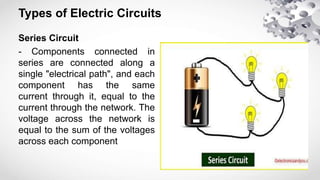
- Components connected in
series are connected along a
single "electrical path", and each
component has the same
current through it, equal to the
current through the network. The
voltage across the network is
equal to the sum of the voltages
across each component
Parallel Circuit
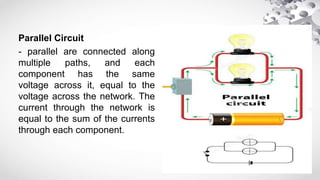
- parallel are connected along
multiple paths, and each
component has the same
voltage across it, equal to the
voltage across the network. The
current through the network is
equal to the sum of the currents
through each component.
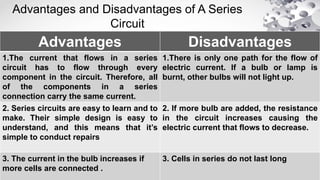
Advantages and Disadvantages of A Series
Circuit
Advantages Disadvantages
1.The current that flows in a series
circuit has to flow through every
component in the circuit. Therefore, all
of the components in a series
connection carry the same current.
1.There is only one path for the flow of
electric current. If a bulb or lamp is
burnt, other bulbs will not light up.
2. Series circuits are easy to learn and to
make. Their simple design is easy to
understand, and this means that it’s
simple to conduct repairs
2. If more bulb are added, the resistance
in the circuit increases causing the
electric current that flows to decrease.
3. The current in the bulb increases if
more cells are connected .
3. Cells in series do not last long
Advantages and Disadvantages of A Parallel
Circuit
Advantages Disadvantages
1.If one of the bulb is burnt the other
bulbs continues to shine
1.The voltage does not increase or
decrease if cells of the same type are
connected in parallel.
2. It becomes easy to connect or
disconnect a new element without
affecting the working of other elements.
2. The electric current in the circuit is
the same even though more cells are
connected in parallel.
3. Each bulb receives the same voltage
that is supplied by the electric source.
3. It requires the use of lot of wires.
The Four Basic Physical
Quantities in Electricity
Voltage (V, in volts - V) is the electrical force responsible
for making electrical charge move.
Current (I, in amperes - A) is the "rate" that current is
flowing through the circuit or the number of electrons
moving through the wire.
Resistance (R, in ohms) is a measure of how much a
component opposes the movement of the current through it.
Watts are a measurement of power, describing the rate at
which electricity is being used at a specific moment.
Evaluation
Instructions: On a 1/2 sheet of paper answer the following
questions. Write the letters of your answers only.
1.It is the electrical force responsible for making electrical
charge move.
A.Volts B. Ampere C. Ohms D. Watts
2.It is a measure of how much a component opposes the
movement of the current through it.
A.Volts B. Ampere C. Ohms D. Watts
3. It is a measurement of power, describing the rate at
which electricity is being used at a specific moment.
A.Volts B. Ampere C. Ohms D. Watts
4.It is the "rate" that current is flowing through the circuit or
the number of electrons moving through the wire.
A.Volts B. Ampere C. Ohms D. Watts
5.It is a closed loop through which electrons can travel.
A.Circuit B. Wire C. Parallel D. Series
6.It is the path that the electricity flows through towards the
load.
A. Wire B. Bulb C. Battery D. Switch
7-8 Name at least 2 advantages of series circuit
9-10 Name at least 2 disadvantages of parallel circuit
Assignment
• Instructions: Using the PhET simulator, construct your
own electric circuit in both forms, the parallel and series
circuit. The link for the simulator will be posted on Google
Classroom. Take a screenshot of your output and upload
it to Google Classroom.
THANK YOU FOR LISTENING!!!!

Circuits - Copy.pptx

  • 1.
  • 2.
    What's a circuit? •A circuit is a closed loop through which electrons can travel. In the circuit, electrical energy is supplied by a power source, such as a battery. No electrons will move unless the circuit is complete, that is, it makes a full circle back to the electrical source.
  • 3.
    The Four EssentialParts of an Electric Circuit A. Source- Provide the electrical pressure in the circuit Ex. Battery and AC outlet B. Conducting path- Brings the electricity towards load ex. Wires C. Controling devices/ Switch- Controls the flow of electricity, depending upon the discretion of the operator. D. Load- Converts electricity to other form of energy. Ex. Electric motor, Light bulb, television, refrigerator, etc
  • 4.
    Types of ElectricCircuits Series Circuit - Components connected in series are connected along a single "electrical path", and each component has the same current through it, equal to the current through the network. The voltage across the network is equal to the sum of the voltages across each component
  • 5.
    Parallel Circuit - parallelare connected along multiple paths, and each component has the same voltage across it, equal to the voltage across the network. The current through the network is equal to the sum of the currents through each component.
  • 6.
    Advantages and Disadvantagesof A Series Circuit Advantages Disadvantages 1.The current that flows in a series circuit has to flow through every component in the circuit. Therefore, all of the components in a series connection carry the same current. 1.There is only one path for the flow of electric current. If a bulb or lamp is burnt, other bulbs will not light up. 2. Series circuits are easy to learn and to make. Their simple design is easy to understand, and this means that it’s simple to conduct repairs 2. If more bulb are added, the resistance in the circuit increases causing the electric current that flows to decrease. 3. The current in the bulb increases if more cells are connected . 3. Cells in series do not last long
  • 7.
    Advantages and Disadvantagesof A Parallel Circuit Advantages Disadvantages 1.If one of the bulb is burnt the other bulbs continues to shine 1.The voltage does not increase or decrease if cells of the same type are connected in parallel. 2. It becomes easy to connect or disconnect a new element without affecting the working of other elements. 2. The electric current in the circuit is the same even though more cells are connected in parallel. 3. Each bulb receives the same voltage that is supplied by the electric source. 3. It requires the use of lot of wires.
  • 8.
    The Four BasicPhysical Quantities in Electricity Voltage (V, in volts - V) is the electrical force responsible for making electrical charge move. Current (I, in amperes - A) is the "rate" that current is flowing through the circuit or the number of electrons moving through the wire. Resistance (R, in ohms) is a measure of how much a component opposes the movement of the current through it. Watts are a measurement of power, describing the rate at which electricity is being used at a specific moment.
  • 9.
    Evaluation Instructions: On a1/2 sheet of paper answer the following questions. Write the letters of your answers only. 1.It is the electrical force responsible for making electrical charge move. A.Volts B. Ampere C. Ohms D. Watts 2.It is a measure of how much a component opposes the movement of the current through it. A.Volts B. Ampere C. Ohms D. Watts
  • 10.
    3. It isa measurement of power, describing the rate at which electricity is being used at a specific moment. A.Volts B. Ampere C. Ohms D. Watts 4.It is the "rate" that current is flowing through the circuit or the number of electrons moving through the wire. A.Volts B. Ampere C. Ohms D. Watts
  • 11.
    5.It is aclosed loop through which electrons can travel. A.Circuit B. Wire C. Parallel D. Series 6.It is the path that the electricity flows through towards the load. A. Wire B. Bulb C. Battery D. Switch 7-8 Name at least 2 advantages of series circuit 9-10 Name at least 2 disadvantages of parallel circuit
  • 12.
    Assignment • Instructions: Usingthe PhET simulator, construct your own electric circuit in both forms, the parallel and series circuit. The link for the simulator will be posted on Google Classroom. Take a screenshot of your output and upload it to Google Classroom.
  • 13.
    THANK YOU FORLISTENING!!!!