


“ Circuit Riders” A Model for Successful  NGO Technical Assistance
Background The Need - Changing market conditions – market failing most NGOs Non-profit organizations lagging in effectiveness Groups struggling Technology offers new solutions to old problems 1996 TCN “Capacity Survey” What the survey sought to measure Technology seen as adjunct; not critical to program mission
Background Survey Highlights Little formal recognition of technology Few internal training or support resources Overburdened or conflicted “systems” staff Little or no management support No lack of technology but a lack of expertise Organizations had the technology, but didn’t know how to use it
Background The Pioneers - 1995 - W.A. Jones/TCN  One year LEV/ZEV project 1996 - Brainerd/Bullitt  OneNorthWest  1996 - Rockefeller Technology Project Ongoing Project 1998 - Multiple ongoing “rider” projects Artswire to DC Works 1999 – Over 50 official “riders”  2000 …
The Model What is circuit riding? Issue or project focused Cross-organizational Foundation “authorized” Foundation subsidized or funded  Limited scope
The Model What is a Circuit Rider? Teacher Evangelist Researcher Facilitator Mechanic What they are not Computer geek Temporary help
What Does a Circuit Rider Do? Demonstrates  power of technology to leadership Assesses  the group’s technology capacity  Develops  strategy Implements  technology to advance the group’s objective Promotes  collaboration between groups using technology & service providers
The Results Budget Total budget of $120,000 for 1.5 years (including travel) Fifty organizations Three-four days a piece Impacts 100% Internet email 100% listserv participation Wide variety of problems solved
Lessons Start off with a bang Provide a small funding budget Start focused, stay focused Few are using what they have  Few are using what they have effectively Management makes it or breaks it
Lessons Riders need their independence Every Lone Ranger needs a Tonto Backroom support LEV/ZEV succeeded due to TCN’s support Resources & expertise to draw on LEV/ZEV succeeded to to WAJ’s support
What the Groups Say: Biggest Barrier is Understanding Lack of Knowledge cited more than equipment Want someone to come to them Best if a disinterested ally Should be from non- profit community Has to translate “tech speak”  Focus on solving real  problems
The Future Current Rider Projects 50 riders on the range Annual Circuit Rider Roundup Sponsored by RBF, Surdna, Microsoft, Mott, Packard Development of Circuit Rider regional centers Baltimore / Washington DC Development of a circuit rider ranch? The National Strategy for Nonprofit Technology…
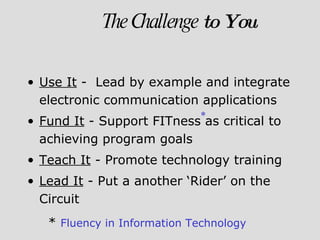
Use It  -  Lead by example and integrate electronic communication applications Fund It  - Support FITness as critical to achieving program goals Teach It  - Promote technology training Lead It  - Put a another ‘Rider’ on the Circuit The Challenge  to You *  Fluency in Information Technology *
 

Circuit Riders - Original Summary WAJones - Circa 2000

  • 1.
  • 2.
    “ Circuit Riders”A Model for Successful NGO Technical Assistance
  • 3.
    Background The Need- Changing market conditions – market failing most NGOs Non-profit organizations lagging in effectiveness Groups struggling Technology offers new solutions to old problems 1996 TCN “Capacity Survey” What the survey sought to measure Technology seen as adjunct; not critical to program mission
  • 4.
    Background Survey HighlightsLittle formal recognition of technology Few internal training or support resources Overburdened or conflicted “systems” staff Little or no management support No lack of technology but a lack of expertise Organizations had the technology, but didn’t know how to use it
  • 5.
    Background The Pioneers- 1995 - W.A. Jones/TCN One year LEV/ZEV project 1996 - Brainerd/Bullitt OneNorthWest 1996 - Rockefeller Technology Project Ongoing Project 1998 - Multiple ongoing “rider” projects Artswire to DC Works 1999 – Over 50 official “riders” 2000 …
  • 6.
    The Model Whatis circuit riding? Issue or project focused Cross-organizational Foundation “authorized” Foundation subsidized or funded Limited scope
  • 7.
    The Model Whatis a Circuit Rider? Teacher Evangelist Researcher Facilitator Mechanic What they are not Computer geek Temporary help
  • 8.
    What Does aCircuit Rider Do? Demonstrates power of technology to leadership Assesses the group’s technology capacity Develops strategy Implements technology to advance the group’s objective Promotes collaboration between groups using technology & service providers
  • 9.
    The Results BudgetTotal budget of $120,000 for 1.5 years (including travel) Fifty organizations Three-four days a piece Impacts 100% Internet email 100% listserv participation Wide variety of problems solved
  • 10.
    Lessons Start offwith a bang Provide a small funding budget Start focused, stay focused Few are using what they have Few are using what they have effectively Management makes it or breaks it
  • 11.
    Lessons Riders needtheir independence Every Lone Ranger needs a Tonto Backroom support LEV/ZEV succeeded due to TCN’s support Resources & expertise to draw on LEV/ZEV succeeded to to WAJ’s support
  • 12.
    What the GroupsSay: Biggest Barrier is Understanding Lack of Knowledge cited more than equipment Want someone to come to them Best if a disinterested ally Should be from non- profit community Has to translate “tech speak” Focus on solving real problems
  • 13.
    The Future CurrentRider Projects 50 riders on the range Annual Circuit Rider Roundup Sponsored by RBF, Surdna, Microsoft, Mott, Packard Development of Circuit Rider regional centers Baltimore / Washington DC Development of a circuit rider ranch? The National Strategy for Nonprofit Technology…
  • 14.
    Use It - Lead by example and integrate electronic communication applications Fund It - Support FITness as critical to achieving program goals Teach It - Promote technology training Lead It - Put a another ‘Rider’ on the Circuit The Challenge to You * Fluency in Information Technology *
  • 15.