Reinforcing the bridge between researchers
and global citizens by means of Open
Knowledge culture
On the Social Impact of Wikipedia
Miquel Duran, Fernando Blasc, Sílva Simon, Pep Anton Vieta, Josep
Duran
Càtdra de Cultura Científica i Comunicació Digital
Universitat de Girona
@miquelduran – usuari:quelet
#sis2016 Barcelona, 27/6/2016
This PPT: http://goo.gl/JQfBrN
Micro CV
University professor. Research in
Quantum Chemistry. Digital Science
Communication, Magic and Science,
MOOCs, TEDx events, Open Knowledge
http://miquelduran.net
@miquelduran aka @quelet
Wikipedia: user:quelet
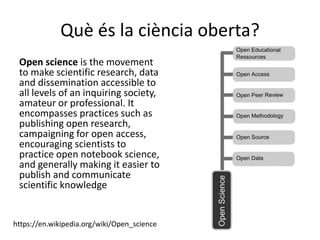
What is Open Science?
Open science is the movement
to make scientific research, data
and dissemination accessible to
all levels of an inquiring society,
amateur or professional. It
encompasses practices such as
publishing open research,
campaigning for open access,
encouraging scientists to
practice open notebook science,
and generally making it easier to
publish and communicate
scientific knowledge
https://en.wikipedia.org/wiki/Open_science
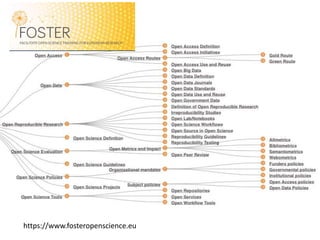
https://www.fosteropenscience.eu
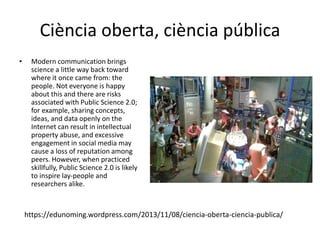
Public Engagement with Open Science
Sharing concepts, ideas, and data
openly on the Internet can result
in intellectual property abuse,
and excessive engagement in
social media may cause a loss of
reputation among peers.
However, when practiced
skillfully, Public Science 2.0 is
likely to inspire lay-people and
researchers alike.
https://edunoming.wordpress.com/2013/11/08/ciencia-oberta-ciencia-publica/
Flipping Chemistry Classrooms
C&EN 25/3/2013
NYT & MOOCs (20/4/13)
2012: The Year of the MOOC
• Open Educational Resources
• Learning path
• Interaction between participants
• Annotations
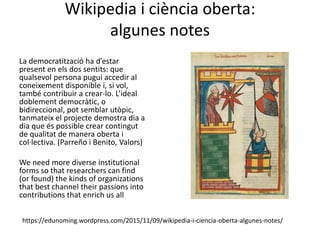
Wikipedia and open knowledge:
another form of communication
We need more diverse
institutional forms so
that researchers can find
(or found) the kinds of
organizations that best
channel their passions
into contributions that
enrich us all
https://edunoming.wordpress.com/2015/11/09/wikipedia-i-ciencia-oberta-algunes-notes/
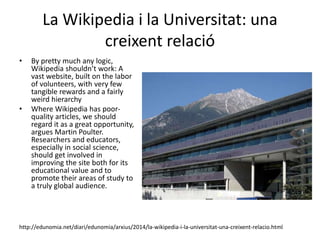
Wikipedia and University: an
increasing relationship
Where Wikipedia has poor-
quality articles, we should
regard it as a great opportunity.
Researchers and educators,
especially in social science,
should get involved in
improving the site both for
- its educational value and
- to promote their areas of
study to a truly global
audience.
http://edunomia.net/diari/edunomia/arxius/2014/la-wikipedia-i-la-universitat-una-creixent-relacio.html
Science, Scientists and Wikipedia: an
enticing subject in a complex world
• Multlinguism needs
energy, time and
sometimes money.
• Writing science entries
in Wikipedia needs
energy and time: one
must write accurately
and the task is endless
• Both should be handled
in a low-cost way
http://edunomia.net/diari/edunomia/arxius/2015/ciencia-cientifics-i-wikipedia-un-tema-engrescador-en-un-mon-complex.html
Where is Wikipedia along the Gartner Cycle?
http://www.gartner.com/newsroom/id/3114217
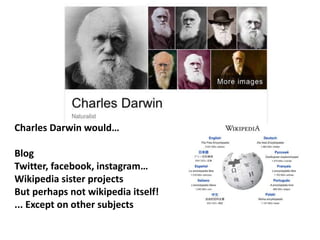
Charles Darwin would…
Blog
Twitter, facebook, instagram…
Wikipedia sister projects
But perhaps not wikipedia itself!
... Except on other subjects
Wikipedia…
• Is an encyclopaedia, not a journal where to
publish original research or a magazine to
publish opinion (that’s what blog are for,
aren’t they?)
• Content must provide proper references
• The concept of “our Wikipedia page” does not
exist
How can we use Wikipedia to impact Society?
• Scientists:
– Fer servir llicències Creative Commons/coneixement obert
– Conèixer i fer servir projectes associats a Wikipedia
– Curar contingut, recerca de la integració
– Crear entrades de nivell menys elevat
• Non Scientists:
– Llegir i criticar la dificultat de les entrades
– Crear contingut planer per a altres no científics
– Traduir
– Incrementar la cultura científica (+formació)
• Prolific Wikipedia contributors & editors:
– Ampliar la base d’editors, seguir conscienciant
– Contribuir al canvi a les universitats, a l’educació
A few clues about OK & W
• Open Knowledge does not mean
Understanding by All
• Sometimes (or often) it is better that someone
outside the actual field of knowledge provides
dissemination (e.g., Martin Gadner & math)
• Entries should have a general-public level
• Schools should be able to edit Wikipedia
and/or curate open content – a new
competence of citizens
• Scientits, university students, scholars,
curious-minded people... Everyone is key to
disseminate open knowledge
• Wikipedia is currently one of the key aspects
of freedom
• Do not say “there’s an error” – correct it!
A few clues about OK & W
Wikpedia and Science
• Indeed multilingualism generates challenges,
and scientific concepts cause an even more
challenging task. Actually Sciene in wikipedia
has a heterogeneous level and the amount of
entries is much lower that in other fields of
knowledge.
•
Wikpedia and Science
• Wikipedia and Open Knowledge allow anyone
to access available knowledge, but also allow
anyone to communicate it. This is doubly
democratic idealism, indeed. We need more
diverse institutional forms so that researchers
can find (or found) the kinds of organizations
that best channel their passions into
contributions that enrich us all
Wikpedia and Science
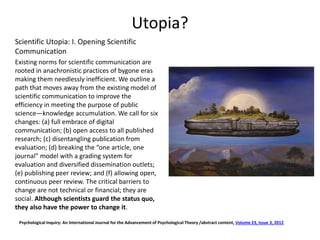
• Scientists still face critical barriers to change,
which are not technical or financial; they are
social. Although scientists guard the status
quo, they also have the power to change it.
On the social impact of Open
Knowledge
• Knowledge economy has been too restricted
so far to a particular part of the population.
Open Courses, Open Educational Resources,
Wikipedia, and similar tools empower the
underdeveloped and underprivileged parts of
the Society.
On the social impact of Open
Knowledge
• Fast access to the Internet is becoming
ubiquous, and mobile phones are becoming
more affordable. Furthermore, video creation
and consumption has reached a wide level of
simplicity. However, clever use of technology
and Internet access is still dividing social
groups – if not widening.
•
On the social impact of Open
Knowledge
• Provinding new opportunities and building
bridges betwen citizens and educators (at all
levels, including continued education) is likely
to close the digital divide. Research and
innovation in Open Knowledge seems to
contribute to reinforce those bridges.
•
On the social impact of Open
Knowledge
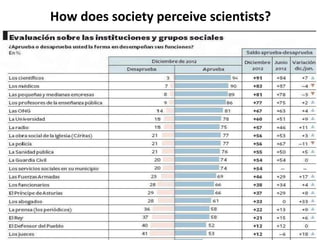
• Scientists, scholars and universitites lead the
rankings of public perception, and people
trust them. It is their duty to pursue an
improvement using the tools provided by the
Internet, so their advances, their creation of
knowledge and their mastery of academic
fields be used effectively by anyone, anytime,
anywhere.
SO
There are many reasons to communicate science openly in the Net, they are
APPEALING
Communicating openly Science means having the right attitude, rather than having the
suitable resources.
WHY DON’T YOU
Publish n open-access journals, start a blog, open a twitter account or set up
instragram photostream - And edit Wikipeida
AND
Tackle an idea, talk about an event, deal with a moment in history, criticize science in
newspapers and media, curate content
AND PLEASE SHARE
This talk
Key ideas to (tweet and to) take away
• The most exciting phrase to hear in science, the one that heralds
new discoveries, is not 'Eureka!' (I found it!) but 'That's funny ...‘
(Isaasc Asimov) (also “Oh My God!, as noted by Nobel Prize S
Glashow)
• Education is not a preparation for life. Education is life itself
• Open Knowledge is the Future. Be part of it!
• Presentation CC-BY-SA at http://slideshare.net/quelgir
• Thanks for your attention!

Ciencia i Viquipèdia.

  • 1.
    Reinforcing the bridgebetween researchers and global citizens by means of Open Knowledge culture On the Social Impact of Wikipedia Miquel Duran, Fernando Blasc, Sílva Simon, Pep Anton Vieta, Josep Duran Càtdra de Cultura Científica i Comunicació Digital Universitat de Girona @miquelduran – usuari:quelet #sis2016 Barcelona, 27/6/2016 This PPT: http://goo.gl/JQfBrN
  • 2.
    Micro CV University professor.Research in Quantum Chemistry. Digital Science Communication, Magic and Science, MOOCs, TEDx events, Open Knowledge http://miquelduran.net @miquelduran aka @quelet Wikipedia: user:quelet
  • 3.
    What is OpenScience? Open science is the movement to make scientific research, data and dissemination accessible to all levels of an inquiring society, amateur or professional. It encompasses practices such as publishing open research, campaigning for open access, encouraging scientists to practice open notebook science, and generally making it easier to publish and communicate scientific knowledge https://en.wikipedia.org/wiki/Open_science
  • 4.
  • 5.
    Public Engagement withOpen Science Sharing concepts, ideas, and data openly on the Internet can result in intellectual property abuse, and excessive engagement in social media may cause a loss of reputation among peers. However, when practiced skillfully, Public Science 2.0 is likely to inspire lay-people and researchers alike. https://edunoming.wordpress.com/2013/11/08/ciencia-oberta-ciencia-publica/
  • 6.
  • 7.
    NYT & MOOCs(20/4/13) 2012: The Year of the MOOC • Open Educational Resources • Learning path • Interaction between participants • Annotations
  • 8.
    Wikipedia and openknowledge: another form of communication We need more diverse institutional forms so that researchers can find (or found) the kinds of organizations that best channel their passions into contributions that enrich us all https://edunoming.wordpress.com/2015/11/09/wikipedia-i-ciencia-oberta-algunes-notes/
  • 9.
    Wikipedia and University:an increasing relationship Where Wikipedia has poor- quality articles, we should regard it as a great opportunity. Researchers and educators, especially in social science, should get involved in improving the site both for - its educational value and - to promote their areas of study to a truly global audience. http://edunomia.net/diari/edunomia/arxius/2014/la-wikipedia-i-la-universitat-una-creixent-relacio.html
  • 10.
    Science, Scientists andWikipedia: an enticing subject in a complex world • Multlinguism needs energy, time and sometimes money. • Writing science entries in Wikipedia needs energy and time: one must write accurately and the task is endless • Both should be handled in a low-cost way http://edunomia.net/diari/edunomia/arxius/2015/ciencia-cientifics-i-wikipedia-un-tema-engrescador-en-un-mon-complex.html
  • 11.
    Where is Wikipediaalong the Gartner Cycle?
  • 12.
  • 13.
    Charles Darwin would… Blog Twitter,facebook, instagram… Wikipedia sister projects But perhaps not wikipedia itself! ... Except on other subjects
  • 14.
    Wikipedia… • Is anencyclopaedia, not a journal where to publish original research or a magazine to publish opinion (that’s what blog are for, aren’t they?) • Content must provide proper references • The concept of “our Wikipedia page” does not exist
  • 15.
    How can weuse Wikipedia to impact Society? • Scientists: – Fer servir llicències Creative Commons/coneixement obert – Conèixer i fer servir projectes associats a Wikipedia – Curar contingut, recerca de la integració – Crear entrades de nivell menys elevat • Non Scientists: – Llegir i criticar la dificultat de les entrades – Crear contingut planer per a altres no científics – Traduir – Incrementar la cultura científica (+formació) • Prolific Wikipedia contributors & editors: – Ampliar la base d’editors, seguir conscienciant – Contribuir al canvi a les universitats, a l’educació
  • 16.
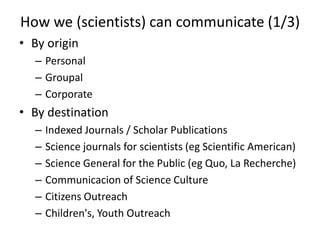
    A few cluesabout OK & W • Open Knowledge does not mean Understanding by All • Sometimes (or often) it is better that someone outside the actual field of knowledge provides dissemination (e.g., Martin Gadner & math) • Entries should have a general-public level
  • 17.
    • Schools shouldbe able to edit Wikipedia and/or curate open content – a new competence of citizens • Scientits, university students, scholars, curious-minded people... Everyone is key to disseminate open knowledge • Wikipedia is currently one of the key aspects of freedom • Do not say “there’s an error” – correct it! A few clues about OK & W
  • 18.
    Wikpedia and Science •Indeed multilingualism generates challenges, and scientific concepts cause an even more challenging task. Actually Sciene in wikipedia has a heterogeneous level and the amount of entries is much lower that in other fields of knowledge. •
  • 19.
    Wikpedia and Science •Wikipedia and Open Knowledge allow anyone to access available knowledge, but also allow anyone to communicate it. This is doubly democratic idealism, indeed. We need more diverse institutional forms so that researchers can find (or found) the kinds of organizations that best channel their passions into contributions that enrich us all
  • 20.
    Wikpedia and Science •Scientists still face critical barriers to change, which are not technical or financial; they are social. Although scientists guard the status quo, they also have the power to change it.
  • 21.
    On the socialimpact of Open Knowledge • Knowledge economy has been too restricted so far to a particular part of the population. Open Courses, Open Educational Resources, Wikipedia, and similar tools empower the underdeveloped and underprivileged parts of the Society.
  • 22.
    On the socialimpact of Open Knowledge • Fast access to the Internet is becoming ubiquous, and mobile phones are becoming more affordable. Furthermore, video creation and consumption has reached a wide level of simplicity. However, clever use of technology and Internet access is still dividing social groups – if not widening. •
  • 23.
    On the socialimpact of Open Knowledge • Provinding new opportunities and building bridges betwen citizens and educators (at all levels, including continued education) is likely to close the digital divide. Research and innovation in Open Knowledge seems to contribute to reinforce those bridges. •
  • 24.
    On the socialimpact of Open Knowledge • Scientists, scholars and universitites lead the rankings of public perception, and people trust them. It is their duty to pursue an improvement using the tools provided by the Internet, so their advances, their creation of knowledge and their mastery of academic fields be used effectively by anyone, anytime, anywhere.
  • 25.
    SO There are manyreasons to communicate science openly in the Net, they are APPEALING Communicating openly Science means having the right attitude, rather than having the suitable resources. WHY DON’T YOU Publish n open-access journals, start a blog, open a twitter account or set up instragram photostream - And edit Wikipeida AND Tackle an idea, talk about an event, deal with a moment in history, criticize science in newspapers and media, curate content AND PLEASE SHARE This talk
  • 26.
    Key ideas to(tweet and to) take away • The most exciting phrase to hear in science, the one that heralds new discoveries, is not 'Eureka!' (I found it!) but 'That's funny ...‘ (Isaasc Asimov) (also “Oh My God!, as noted by Nobel Prize S Glashow) • Education is not a preparation for life. Education is life itself • Open Knowledge is the Future. Be part of it! • Presentation CC-BY-SA at http://slideshare.net/quelgir • Thanks for your attention!