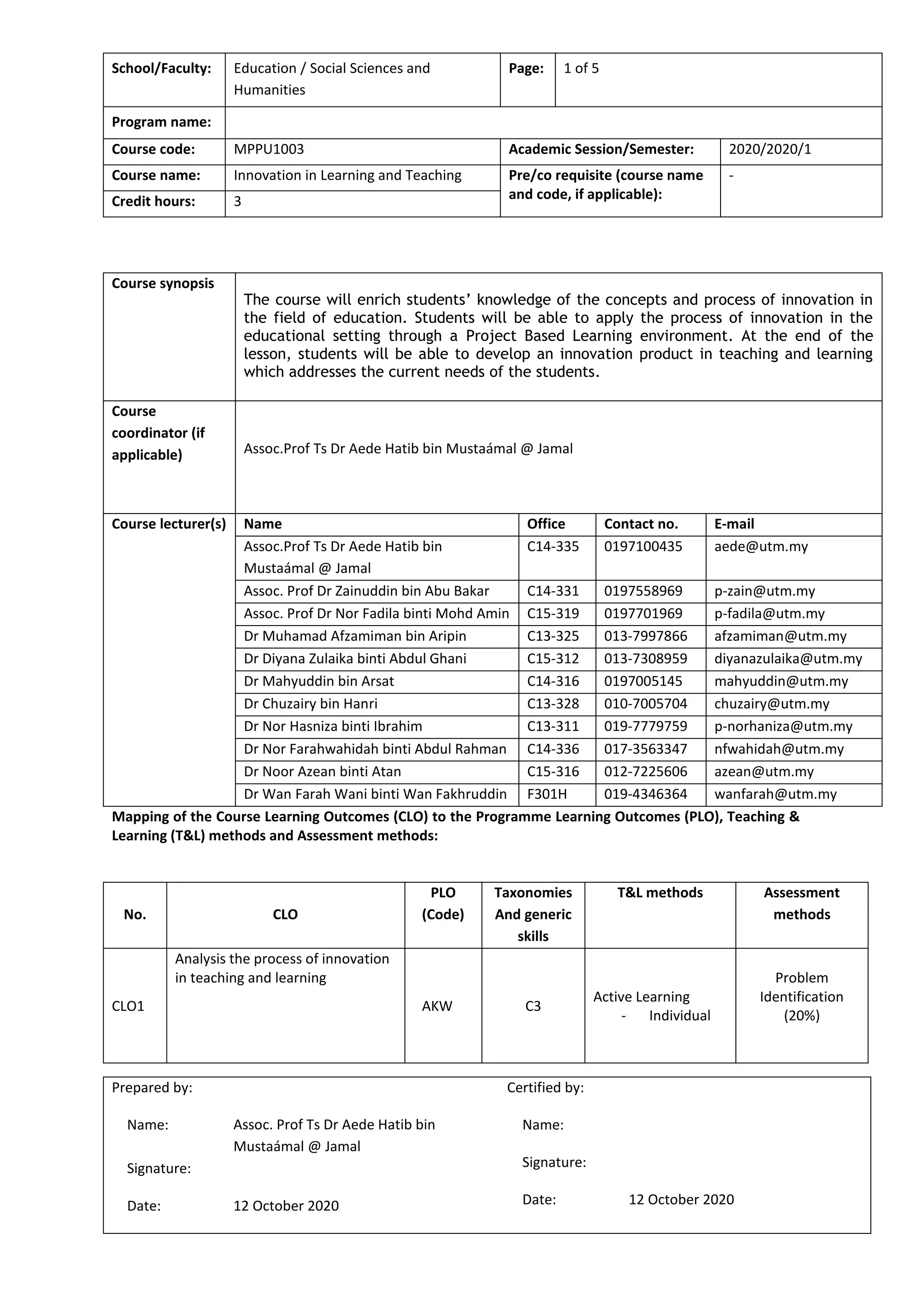
School/Faculty: Education / Social Sciences and
Humanities
Page: 1 of 5
Program name:
Course code: MPPU1003 Academic Session/Semester: 2020/2020/1
Course name: Innovation in Learning and Teaching Pre/co requisite (course name
and code, if applicable):
-
Credit hours: 3
Prepared by:
Name: Assoc. Prof Ts Dr Aede Hatib bin
Mustaámal @ Jamal
Signature:
Date: 12 October 2020
Certified by:
Name:
Signature:
Date: 12 October 2020
Mapping of the Course Learning Outcomes (CLO) to the Programme Learning Outcomes (PLO), Teaching &
Learning (T&L) methods and Assessment methods:
No. CLO
PLO
(Code)
Taxonomies
And generic
skills
T&L methods Assessment
methods
CLO1
Analysis the process of innovation
in teaching and learning
AKW C3
Active Learning
- Individual
Problem
Identification
(20%)
Course synopsis
The course will enrich students’ knowledge of the concepts and process of innovation in
the field of education. Students will be able to apply the process of innovation in the
educational setting through a Project Based Learning environment. At the end of the
lesson, students will be able to develop an innovation product in teaching and learning
which addresses the current needs of the students.
Course
coordinator (if
applicable) Assoc.Prof Ts Dr Aede Hatib bin Mustaámal @ Jamal
Course lecturer(s) Name Office Contact no. E-mail
Assoc.Prof Ts Dr Aede Hatib bin
Mustaámal @ Jamal
C14-335 0197100435 aede@utm.my
Assoc. Prof Dr Zainuddin bin Abu Bakar C14-331 0197558969 p-zain@utm.my
Assoc. Prof Dr Nor Fadila binti Mohd Amin C15-319 0197701969 p-fadila@utm.my
Dr Muhamad Afzamiman bin Aripin C13-325 013-7997866 afzamiman@utm.my
Dr Diyana Zulaika binti Abdul Ghani C15-312 013-7308959 diyanazulaika@utm.my
Dr Mahyuddin bin Arsat C14-316 0197005145 mahyuddin@utm.my
Dr Chuzairy bin Hanri C13-328 010-7005704 chuzairy@utm.my
Dr Nor Hasniza binti Ibrahim C13-311 019-7779759 p-norhaniza@utm.my
Dr Nor Farahwahidah binti Abdul Rahman C14-336 017-3563347 nfwahidah@utm.my
Dr Noor Azean binti Atan C15-316 012-7225606 azean@utm.my
Dr Wan Farah Wani binti Wan Fakhruddin F301H 019-4346364 wanfarah@utm.my
COURSE INFORMATION
School/Faculty: Education / Social Sciences and
Humanities
Page: 2 of 5
Program name:
Course code: MPPU1003 Academic Session/Semester: 2020/2020/1
Course name: Innovation in Learning and Teaching Pre/co requisite (course name
and code, if applicable):
-
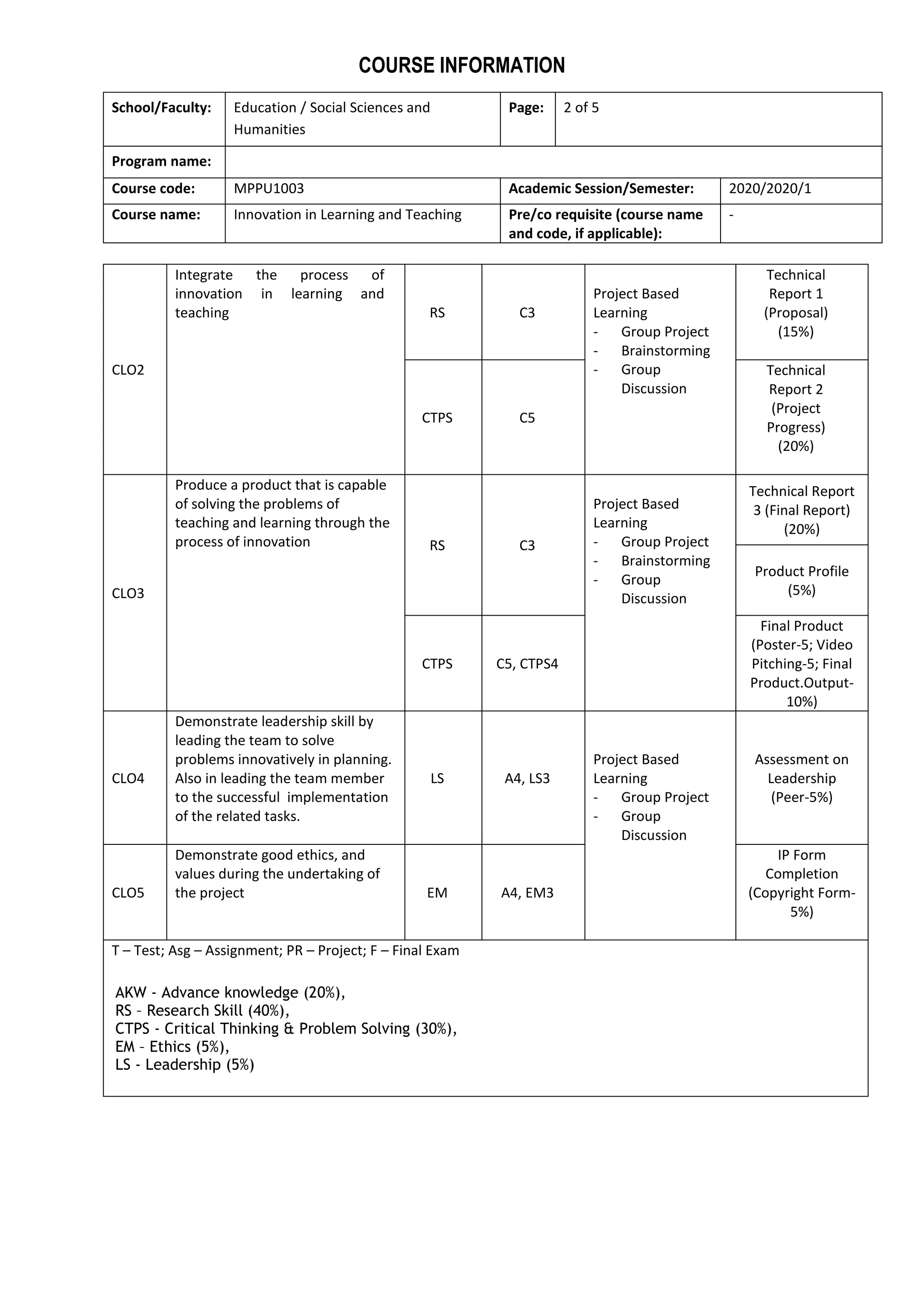
CLO2
Integrate the process of
innovation in learning and
teaching RS C3
Project Based
Learning
- Group Project
- Brainstorming
- Group
Discussion
Technical
Report 1
(Proposal)
(15%)
CTPS C5
Technical
Report 2
(Project
Progress)
(20%)
CLO3
Produce a product that is capable
of solving the problems of
teaching and learning through the
process of innovation RS C3
Project Based
Learning
- Group Project
- Brainstorming
- Group
Discussion
Technical Report
3 (Final Report)
(20%)
Product Profile
(5%)
CTPS C5, CTPS4
Final Product
(Poster-5; Video
Pitching-5; Final
Product.Output-
10%)
CLO4
Demonstrate leadership skill by
leading the team to solve
problems innovatively in planning.
Also in leading the team member
to the successful implementation
of the related tasks.
LS A4, LS3
Project Based
Learning
- Group Project
- Group
Discussion
Assessment on
Leadership
(Peer-5%)
CLO5
Demonstrate good ethics, and
values during the undertaking of
the project EM A4, EM3
IP Form
Completion
(Copyright Form-
5%)
T – Test; Asg – Assignment; PR – Project; F – Final Exam
AKW - Advance knowledge (20%),
RS – Research Skill (40%),
CTPS - Critical Thinking & Problem Solving (30%),
EM – Ethics (5%),
LS - Leadership (5%)
COURSE INFORMATION
School/Faculty: Education / Social Sciences and
Humanities
Page: 3 of 5
Program name:
Course code: MPPU1003 Academic Session/Semester: 2020/2020/1
Course name: Innovation in Learning and Teaching Pre/co requisite (course name
and code, if applicable):
-
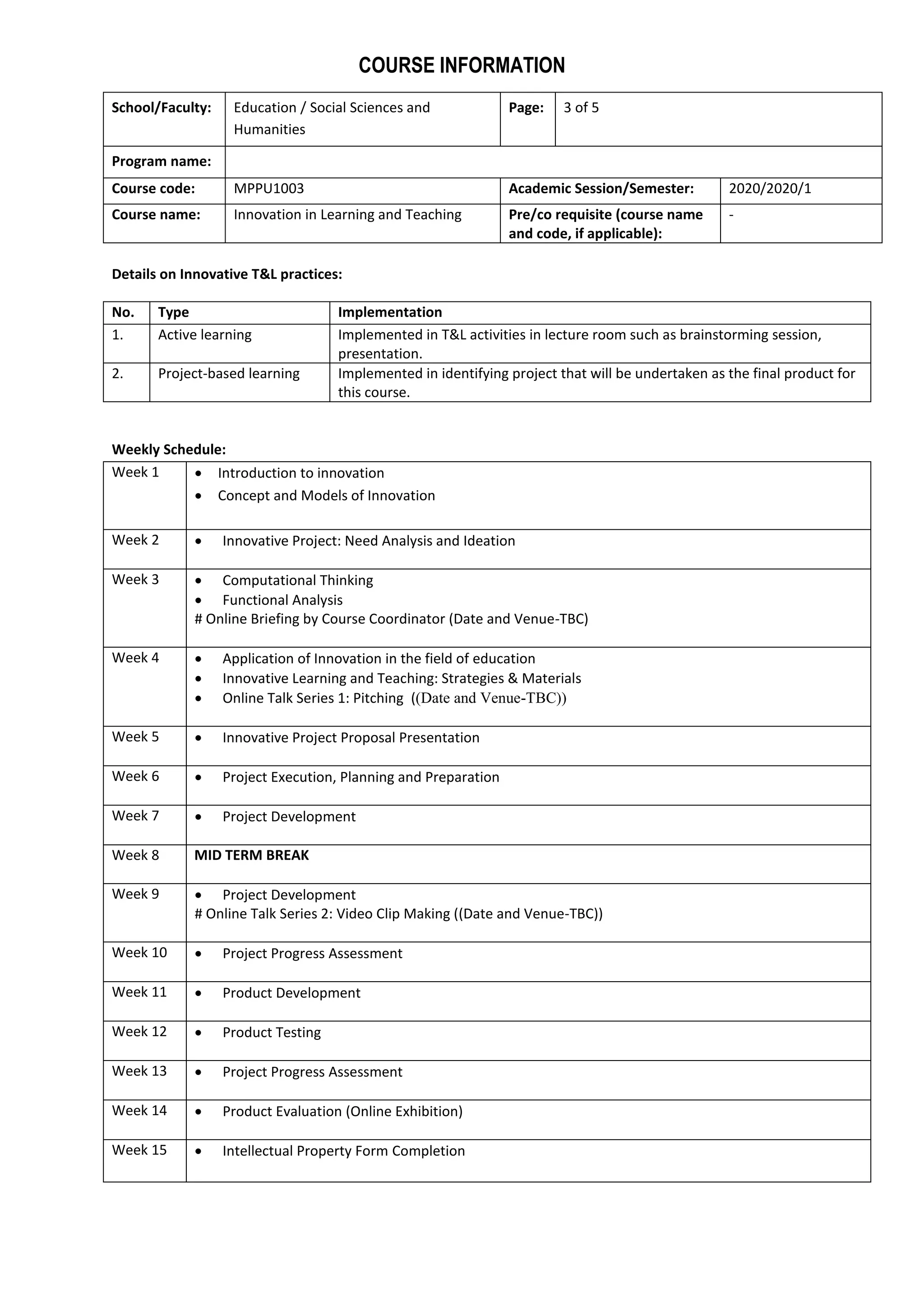
Details on Innovative T&L practices:
No. Type Implementation
1. Active learning Implemented in T&L activities in lecture room such as brainstorming session,
presentation.
2. Project-based learning Implemented in identifying project that will be undertaken as the final product for
this course.
Weekly Schedule:
Week 1  Introduction to innovation
 Concept and Models of Innovation
Week 2  Innovative Project: Need Analysis and Ideation
Week 3  Computational Thinking
 Functional Analysis
# Online Briefing by Course Coordinator (Date and Venue-TBC)
Week 4  Application of Innovation in the field of education
 Innovative Learning and Teaching: Strategies & Materials
 Online Talk Series 1: Pitching ((Date and Venue-TBC))
Week 5  Innovative Project Proposal Presentation
Week 6  Project Execution, Planning and Preparation
Week 7  Project Development
Week 8 MID TERM BREAK
Week 9  Project Development
# Online Talk Series 2: Video Clip Making ((Date and Venue-TBC))
Week 10  Project Progress Assessment
Week 11  Product Development
Week 12  Product Testing
Week 13  Project Progress Assessment
Week 14  Product Evaluation (Online Exhibition)
Week 15  Intellectual Property Form Completion
COURSE INFORMATION
School/Faculty: Education / Social Sciences and
Humanities
Page: 4 of 5
Program name:
Course code: MPPU1003 Academic Session/Semester: 2020/2020/1
Course name: Innovation in Learning and Teaching Pre/co requisite (course name
and code, if applicable):
-
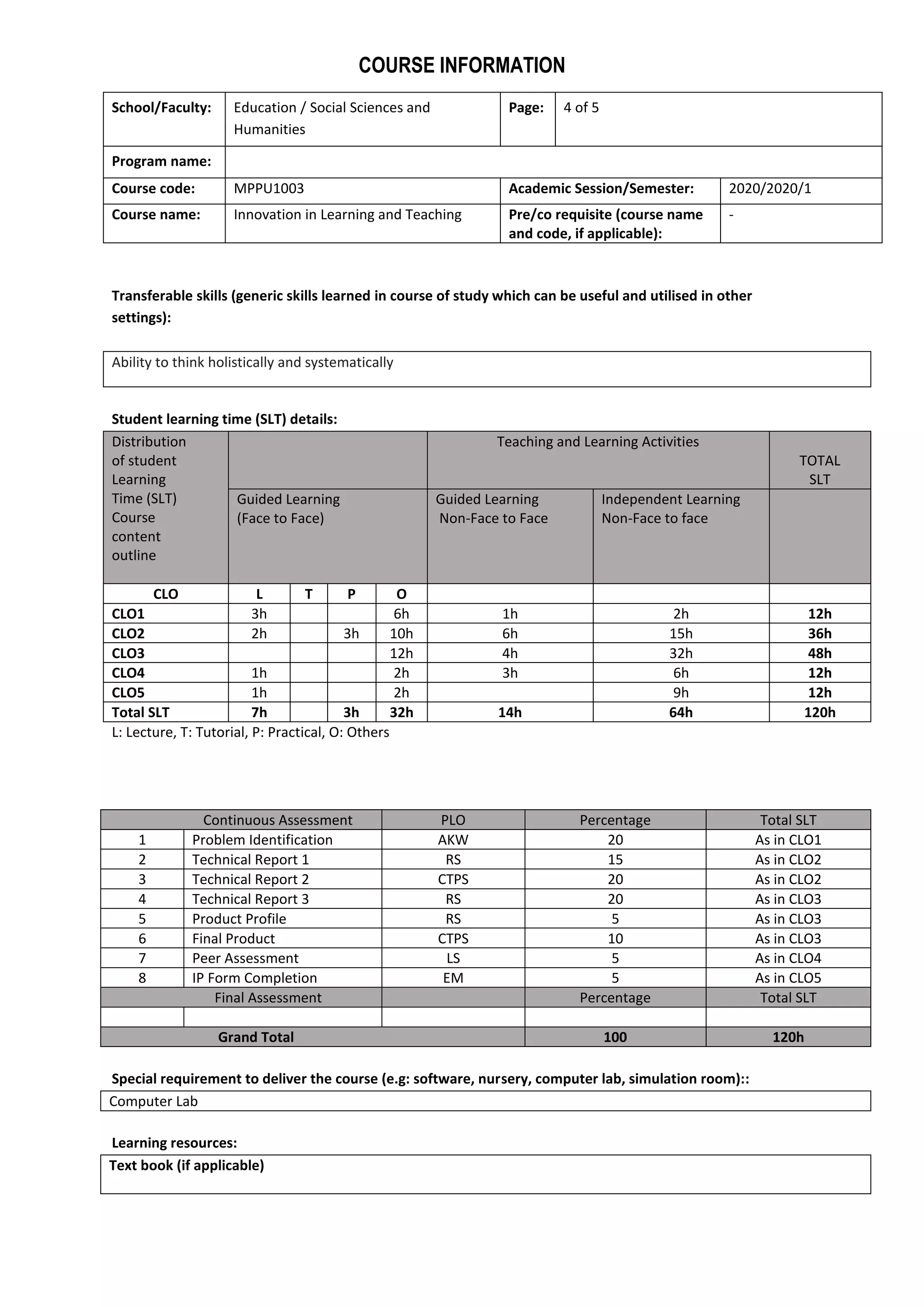
Transferable skills (generic skills learned in course of study which can be useful and utilised in other
settings):
Ability to think holistically and systematically
Student learning time (SLT) details:
Distribution
of student
Learning
Time (SLT)
Course
content
outline
Teaching and Learning Activities
TOTAL
SLT
Guided Learning
(Face to Face)
Guided Learning
Non-Face to Face
Independent Learning
Non-Face to face
CLO L T P O
CLO1 3h 6h 1h 2h 12h
CLO2 2h 3h 10h 6h 15h 36h
CLO3 12h 4h 32h 48h
CLO4 1h 2h 3h 6h 12h
CLO5 1h 2h 9h 12h
Total SLT 7h 3h 32h 14h 64h 120h
L: Lecture, T: Tutorial, P: Practical, O: Others
Continuous Assessment PLO Percentage Total SLT
1 Problem Identification AKW 20 As in CLO1
2 Technical Report 1 RS 15 As in CLO2
3 Technical Report 2 CTPS 20 As in CLO2
4 Technical Report 3 RS 20 As in CLO3
5 Product Profile RS 5 As in CLO3
6 Final Product CTPS 10 As in CLO3
7 Peer Assessment LS 5 As in CLO4
8 IP Form Completion EM 5 As in CLO5
Final Assessment Percentage Total SLT
Grand Total 100 120h
Special requirement to deliver the course (e.g: software, nursery, computer lab, simulation room)::
Computer Lab
Learning resources:
Text book (if applicable)
COURSE INFORMATION
School/Faculty: Education / Social Sciences and
Humanities
Page: 5 of 5
Program name:
Course code: MPPU1003 Academic Session/Semester: 2020/2020/1
Course name: Innovation in Learning and Teaching Pre/co requisite (course name
and code, if applicable):
-
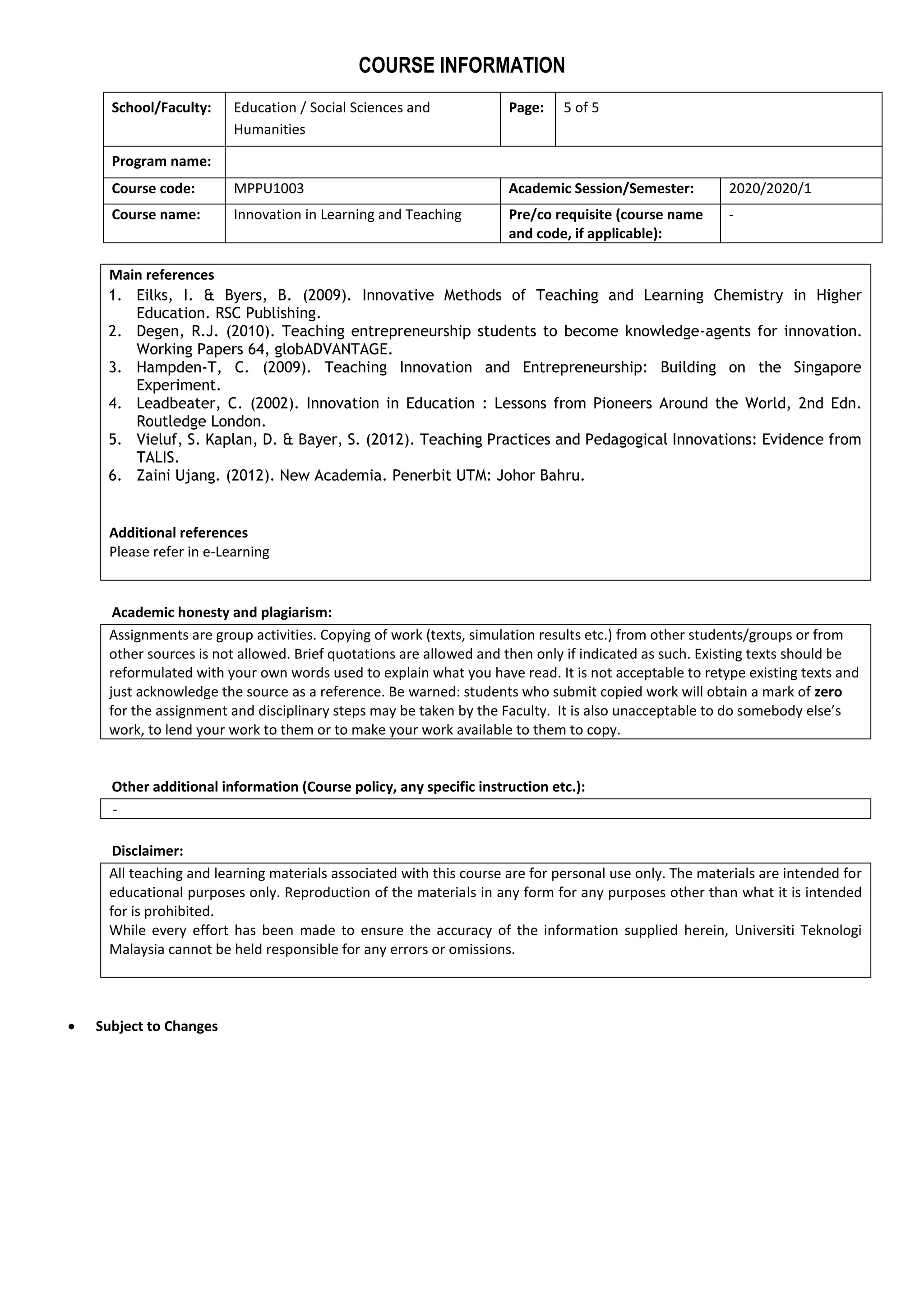
Main references
1. Eilks, I. & Byers, B. (2009). Innovative Methods of Teaching and Learning Chemistry in Higher
Education. RSC Publishing.
2. Degen, R.J. (2010). Teaching entrepreneurship students to become knowledge-agents for innovation.
Working Papers 64, globADVANTAGE.
3. Hampden-T, C. (2009). Teaching Innovation and Entrepreneurship: Building on the Singapore
Experiment.
4. Leadbeater, C. (2002). Innovation in Education : Lessons from Pioneers Around the World, 2nd Edn.
Routledge London.
5. Vieluf, S. Kaplan, D. & Bayer, S. (2012). Teaching Practices and Pedagogical Innovations: Evidence from
TALIS.
6. Zaini Ujang. (2012). New Academia. Penerbit UTM: Johor Bahru.
Additional references
Please refer in e-Learning
Academic honesty and plagiarism:
Assignments are group activities. Copying of work (texts, simulation results etc.) from other students/groups or from
other sources is not allowed. Brief quotations are allowed and then only if indicated as such. Existing texts should be
reformulated with your own words used to explain what you have read. It is not acceptable to retype existing texts and
just acknowledge the source as a reference. Be warned: students who submit copied work will obtain a mark of zero
for the assignment and disciplinary steps may be taken by the Faculty. It is also unacceptable to do somebody else’s
work, to lend your work to them or to make your work available to them to copy.
Other additional information (Course policy, any specific instruction etc.):
-
Disclaimer:
All teaching and learning materials associated with this course are for personal use only. The materials are intended for
educational purposes only. Reproduction of the materials in any form for any purposes other than what it is intended
for is prohibited.
While every effort has been made to ensure the accuracy of the information supplied herein, Universiti Teknologi
Malaysia cannot be held responsible for any errors or omissions.
 Subject to Changes

CI MPPU1003 20202021-01 08.10.20 Student reference.pdf

  • 1.
    School/Faculty: Education /Social Sciences and Humanities Page: 1 of 5 Program name: Course code: MPPU1003 Academic Session/Semester: 2020/2020/1 Course name: Innovation in Learning and Teaching Pre/co requisite (course name and code, if applicable): - Credit hours: 3 Prepared by: Name: Assoc. Prof Ts Dr Aede Hatib bin Mustaámal @ Jamal Signature: Date: 12 October 2020 Certified by: Name: Signature: Date: 12 October 2020 Mapping of the Course Learning Outcomes (CLO) to the Programme Learning Outcomes (PLO), Teaching & Learning (T&L) methods and Assessment methods: No. CLO PLO (Code) Taxonomies And generic skills T&L methods Assessment methods CLO1 Analysis the process of innovation in teaching and learning AKW C3 Active Learning - Individual Problem Identification (20%) Course synopsis The course will enrich students’ knowledge of the concepts and process of innovation in the field of education. Students will be able to apply the process of innovation in the educational setting through a Project Based Learning environment. At the end of the lesson, students will be able to develop an innovation product in teaching and learning which addresses the current needs of the students. Course coordinator (if applicable) Assoc.Prof Ts Dr Aede Hatib bin Mustaámal @ Jamal Course lecturer(s) Name Office Contact no. E-mail Assoc.Prof Ts Dr Aede Hatib bin Mustaámal @ Jamal C14-335 0197100435 aede@utm.my Assoc. Prof Dr Zainuddin bin Abu Bakar C14-331 0197558969 p-zain@utm.my Assoc. Prof Dr Nor Fadila binti Mohd Amin C15-319 0197701969 p-fadila@utm.my Dr Muhamad Afzamiman bin Aripin C13-325 013-7997866 afzamiman@utm.my Dr Diyana Zulaika binti Abdul Ghani C15-312 013-7308959 diyanazulaika@utm.my Dr Mahyuddin bin Arsat C14-316 0197005145 mahyuddin@utm.my Dr Chuzairy bin Hanri C13-328 010-7005704 chuzairy@utm.my Dr Nor Hasniza binti Ibrahim C13-311 019-7779759 p-norhaniza@utm.my Dr Nor Farahwahidah binti Abdul Rahman C14-336 017-3563347 nfwahidah@utm.my Dr Noor Azean binti Atan C15-316 012-7225606 azean@utm.my Dr Wan Farah Wani binti Wan Fakhruddin F301H 019-4346364 wanfarah@utm.my
  • 2.
    COURSE INFORMATION School/Faculty: Education/ Social Sciences and Humanities Page: 2 of 5 Program name: Course code: MPPU1003 Academic Session/Semester: 2020/2020/1 Course name: Innovation in Learning and Teaching Pre/co requisite (course name and code, if applicable): - CLO2 Integrate the process of innovation in learning and teaching RS C3 Project Based Learning - Group Project - Brainstorming - Group Discussion Technical Report 1 (Proposal) (15%) CTPS C5 Technical Report 2 (Project Progress) (20%) CLO3 Produce a product that is capable of solving the problems of teaching and learning through the process of innovation RS C3 Project Based Learning - Group Project - Brainstorming - Group Discussion Technical Report 3 (Final Report) (20%) Product Profile (5%) CTPS C5, CTPS4 Final Product (Poster-5; Video Pitching-5; Final Product.Output- 10%) CLO4 Demonstrate leadership skill by leading the team to solve problems innovatively in planning. Also in leading the team member to the successful implementation of the related tasks. LS A4, LS3 Project Based Learning - Group Project - Group Discussion Assessment on Leadership (Peer-5%) CLO5 Demonstrate good ethics, and values during the undertaking of the project EM A4, EM3 IP Form Completion (Copyright Form- 5%) T – Test; Asg – Assignment; PR – Project; F – Final Exam AKW - Advance knowledge (20%), RS – Research Skill (40%), CTPS - Critical Thinking & Problem Solving (30%), EM – Ethics (5%), LS - Leadership (5%)
  • 3.
    COURSE INFORMATION School/Faculty: Education/ Social Sciences and Humanities Page: 3 of 5 Program name: Course code: MPPU1003 Academic Session/Semester: 2020/2020/1 Course name: Innovation in Learning and Teaching Pre/co requisite (course name and code, if applicable): - Details on Innovative T&L practices: No. Type Implementation 1. Active learning Implemented in T&L activities in lecture room such as brainstorming session, presentation. 2. Project-based learning Implemented in identifying project that will be undertaken as the final product for this course. Weekly Schedule: Week 1  Introduction to innovation  Concept and Models of Innovation Week 2  Innovative Project: Need Analysis and Ideation Week 3  Computational Thinking  Functional Analysis # Online Briefing by Course Coordinator (Date and Venue-TBC) Week 4  Application of Innovation in the field of education  Innovative Learning and Teaching: Strategies & Materials  Online Talk Series 1: Pitching ((Date and Venue-TBC)) Week 5  Innovative Project Proposal Presentation Week 6  Project Execution, Planning and Preparation Week 7  Project Development Week 8 MID TERM BREAK Week 9  Project Development # Online Talk Series 2: Video Clip Making ((Date and Venue-TBC)) Week 10  Project Progress Assessment Week 11  Product Development Week 12  Product Testing Week 13  Project Progress Assessment Week 14  Product Evaluation (Online Exhibition) Week 15  Intellectual Property Form Completion
  • 4.
    COURSE INFORMATION School/Faculty: Education/ Social Sciences and Humanities Page: 4 of 5 Program name: Course code: MPPU1003 Academic Session/Semester: 2020/2020/1 Course name: Innovation in Learning and Teaching Pre/co requisite (course name and code, if applicable): - Transferable skills (generic skills learned in course of study which can be useful and utilised in other settings): Ability to think holistically and systematically Student learning time (SLT) details: Distribution of student Learning Time (SLT) Course content outline Teaching and Learning Activities TOTAL SLT Guided Learning (Face to Face) Guided Learning Non-Face to Face Independent Learning Non-Face to face CLO L T P O CLO1 3h 6h 1h 2h 12h CLO2 2h 3h 10h 6h 15h 36h CLO3 12h 4h 32h 48h CLO4 1h 2h 3h 6h 12h CLO5 1h 2h 9h 12h Total SLT 7h 3h 32h 14h 64h 120h L: Lecture, T: Tutorial, P: Practical, O: Others Continuous Assessment PLO Percentage Total SLT 1 Problem Identification AKW 20 As in CLO1 2 Technical Report 1 RS 15 As in CLO2 3 Technical Report 2 CTPS 20 As in CLO2 4 Technical Report 3 RS 20 As in CLO3 5 Product Profile RS 5 As in CLO3 6 Final Product CTPS 10 As in CLO3 7 Peer Assessment LS 5 As in CLO4 8 IP Form Completion EM 5 As in CLO5 Final Assessment Percentage Total SLT Grand Total 100 120h Special requirement to deliver the course (e.g: software, nursery, computer lab, simulation room):: Computer Lab Learning resources: Text book (if applicable)
  • 5.
    COURSE INFORMATION School/Faculty: Education/ Social Sciences and Humanities Page: 5 of 5 Program name: Course code: MPPU1003 Academic Session/Semester: 2020/2020/1 Course name: Innovation in Learning and Teaching Pre/co requisite (course name and code, if applicable): - Main references 1. Eilks, I. & Byers, B. (2009). Innovative Methods of Teaching and Learning Chemistry in Higher Education. RSC Publishing. 2. Degen, R.J. (2010). Teaching entrepreneurship students to become knowledge-agents for innovation. Working Papers 64, globADVANTAGE. 3. Hampden-T, C. (2009). Teaching Innovation and Entrepreneurship: Building on the Singapore Experiment. 4. Leadbeater, C. (2002). Innovation in Education : Lessons from Pioneers Around the World, 2nd Edn. Routledge London. 5. Vieluf, S. Kaplan, D. & Bayer, S. (2012). Teaching Practices and Pedagogical Innovations: Evidence from TALIS. 6. Zaini Ujang. (2012). New Academia. Penerbit UTM: Johor Bahru. Additional references Please refer in e-Learning Academic honesty and plagiarism: Assignments are group activities. Copying of work (texts, simulation results etc.) from other students/groups or from other sources is not allowed. Brief quotations are allowed and then only if indicated as such. Existing texts should be reformulated with your own words used to explain what you have read. It is not acceptable to retype existing texts and just acknowledge the source as a reference. Be warned: students who submit copied work will obtain a mark of zero for the assignment and disciplinary steps may be taken by the Faculty. It is also unacceptable to do somebody else’s work, to lend your work to them or to make your work available to them to copy. Other additional information (Course policy, any specific instruction etc.): - Disclaimer: All teaching and learning materials associated with this course are for personal use only. The materials are intended for educational purposes only. Reproduction of the materials in any form for any purposes other than what it is intended for is prohibited. While every effort has been made to ensure the accuracy of the information supplied herein, Universiti Teknologi Malaysia cannot be held responsible for any errors or omissions.  Subject to Changes