Church Turing Thesis
Prepared by : Sharma Hemant
hemantbeast@gmail.com
Turing Machine
🠶 Alan Turing has created Turing Machine Model. This model has computing of
general purpose computer.
🠶 The Turing Machine is a collection of following components:
M = (Q, ∑, Г, δ, q0, Δ or B, F)
1. Q is a finite set of states.
2. Г is finite set of external symbols.
3. ∑ is a finite set of input symbols.
4. Δ or b or B Є Г is a blank symbol majorly used as end marker for input.
5. δ is a transition or a mapping function.
Turing Machine
🠶 A Turing Machine (TM) is a theoretical symbol manipulating device.
🠶 A TM can simulate any computer algorithm (this is a simple formation of
what came to be known as the Church-Turing Thesis, a version of Church’s
Thesis)
🠶 The combination of the current symbol and the state determines what
the device does next.
🠶 TMs are useful for simulating and understanding how computer CPUs
work.
Church Turing Thesis
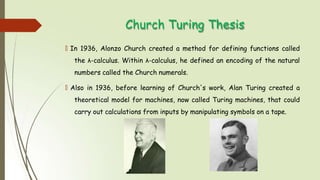
🠶 In 1936, Alonzo Church created a method for defining functions called
the λ-calculus. Within λ-calculus, he defined an encoding of the natural
numbers called the Church numerals.
🠶 Also in 1936, before learning of Church's work, Alan Turing created a
theoretical model for machines, now called Turing machines, that could
carry out calculations from inputs by manipulating symbols on a tape.
Church Turing Thesis
🠶 A Turing machine is an abstract representation of a computing device.
🠶 It is more like a computer hardware than a computer software.
🠶 LCMs [Logical Computing Machines: Turing’s expression for Turing
machines] were first proposed by Alan Turing, in an attempt to give a
mathematically precise definition of "algorithm" or "mechanical
procedure".
Church Turing Thesis
🠶 The Church-Turing thesis concerns an effective or mechanical method
in logic and mathematics.
🠶 A method, M, is called ‘effective’ or ‘mechanical’ just in case:
 M is set out in terms of a finite number of exact instructions (each
instruction being expressed by means of a finite number of symbols);
 M will, if carried out without error, always produce the desired result
in a finite number of steps;
Church Turing Thesis
 M can (in practice or in principle) be carried out by a human being
unaided by any machinery except for paper and pencil;
 M demands no insight or ingenuity on the part of the human being
carrying it out.
🠶 They gave an hypothesis which means proposing certain facts.
🠶 The Church’s hypothesis or Church’s turing thesis can be stated as:
Church Turing Thesis
🠶 The assumption that the intuitive notion of computable functions can
be identified with partial recursive functions.
🠶 This statement was first formulated by Alonzo Church in the 1930s
and is usually referred to as Church’s thesis, or the Church-Turing
thesis.
🠶 However, this hypothesis cannot be proved.
Church Turing Thesis
🠶 The computability of recursive functions is based on following
assumptions:
1. Each elementary function is computable.
2. Let f be the computable function & g be the another function which
can be obtained by applying the elementary operation to f, then g
becomes a computable function.
3. Any function becomes computable if it is obtained by rule 1 & 2.
Example
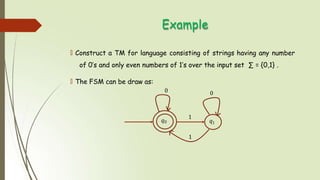
🠶 Construct a TM for language consisting of strings having any number
of 0’s and only even numbers of 1’s over the input set ∑ = {0,1} .
🠶 The FSM can be draw as:
𝑞0 𝑞1
0 0
1
1
Example
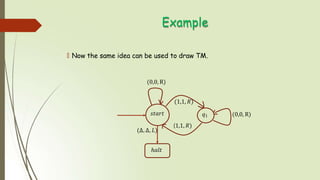
🠶 Now the same idea can be used to draw TM.
𝑞1 (0,0, R)
(0,0, R)
(1,1, 𝑅)
𝑠𝑡𝑎𝑟𝑡
(Δ, Δ, 𝐿)
(1,1, 𝑅)
ℎ𝑎𝑙𝑡
Example
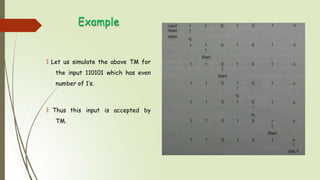
🠶 Let us simulate the above TM for
the input 110101 which has even
number of 1’s.
🠶 Thus this input is accepted by
TM.
churchturingthesis-160906170827.pptx

churchturingthesis-160906170827.pptx

  • 1.
    Church Turing Thesis Preparedby : Sharma Hemant hemantbeast@gmail.com
  • 2.
    Turing Machine 🠶 AlanTuring has created Turing Machine Model. This model has computing of general purpose computer. 🠶 The Turing Machine is a collection of following components: M = (Q, ∑, Г, δ, q0, Δ or B, F) 1. Q is a finite set of states. 2. Г is finite set of external symbols. 3. ∑ is a finite set of input symbols. 4. Δ or b or B Є Г is a blank symbol majorly used as end marker for input. 5. δ is a transition or a mapping function.
  • 3.
    Turing Machine 🠶 ATuring Machine (TM) is a theoretical symbol manipulating device. 🠶 A TM can simulate any computer algorithm (this is a simple formation of what came to be known as the Church-Turing Thesis, a version of Church’s Thesis) 🠶 The combination of the current symbol and the state determines what the device does next. 🠶 TMs are useful for simulating and understanding how computer CPUs work.
  • 4.
    Church Turing Thesis 🠶In 1936, Alonzo Church created a method for defining functions called the λ-calculus. Within λ-calculus, he defined an encoding of the natural numbers called the Church numerals. 🠶 Also in 1936, before learning of Church's work, Alan Turing created a theoretical model for machines, now called Turing machines, that could carry out calculations from inputs by manipulating symbols on a tape.
  • 5.
    Church Turing Thesis 🠶A Turing machine is an abstract representation of a computing device. 🠶 It is more like a computer hardware than a computer software. 🠶 LCMs [Logical Computing Machines: Turing’s expression for Turing machines] were first proposed by Alan Turing, in an attempt to give a mathematically precise definition of "algorithm" or "mechanical procedure".
  • 6.
    Church Turing Thesis 🠶The Church-Turing thesis concerns an effective or mechanical method in logic and mathematics. 🠶 A method, M, is called ‘effective’ or ‘mechanical’ just in case:  M is set out in terms of a finite number of exact instructions (each instruction being expressed by means of a finite number of symbols);  M will, if carried out without error, always produce the desired result in a finite number of steps;
  • 7.
    Church Turing Thesis M can (in practice or in principle) be carried out by a human being unaided by any machinery except for paper and pencil;  M demands no insight or ingenuity on the part of the human being carrying it out. 🠶 They gave an hypothesis which means proposing certain facts. 🠶 The Church’s hypothesis or Church’s turing thesis can be stated as:
  • 8.
    Church Turing Thesis 🠶The assumption that the intuitive notion of computable functions can be identified with partial recursive functions. 🠶 This statement was first formulated by Alonzo Church in the 1930s and is usually referred to as Church’s thesis, or the Church-Turing thesis. 🠶 However, this hypothesis cannot be proved.
  • 9.
    Church Turing Thesis 🠶The computability of recursive functions is based on following assumptions: 1. Each elementary function is computable. 2. Let f be the computable function & g be the another function which can be obtained by applying the elementary operation to f, then g becomes a computable function. 3. Any function becomes computable if it is obtained by rule 1 & 2.
  • 10.
    Example 🠶 Construct aTM for language consisting of strings having any number of 0’s and only even numbers of 1’s over the input set ∑ = {0,1} . 🠶 The FSM can be draw as: 𝑞0 𝑞1 0 0 1 1
  • 11.
    Example 🠶 Now thesame idea can be used to draw TM. 𝑞1 (0,0, R) (0,0, R) (1,1, 𝑅) 𝑠𝑡𝑎𝑟𝑡 (Δ, Δ, 𝐿) (1,1, 𝑅) ℎ𝑎𝑙𝑡
  • 12.
    Example 🠶 Let ussimulate the above TM for the input 110101 which has even number of 1’s. 🠶 Thus this input is accepted by TM.