Churches, Monasteries, Theaters
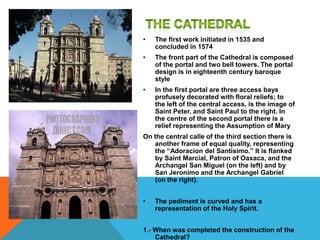
THE CATHEDRALThe first work initiated in 1535 and concluded in 1574
The front part of the Cathedral is composed of the portal and two bell towers. The portal design is in eighteenth century baroque style
In the first portal are three access bays profusely decorated with floral reliefs; to the left of the central access, is the image of Saint Peter, and Saint Paul to the right. In the centre of the second portal there is a relief representing the Assumption of MaryOn the central calle of the third section there is another frame of equal quality, representing the “Adoracion del Santisimo.” It is flanked by Saint Marcial, Patron of Oaxaca, and the Archangel San Miguel (on the left) and by San Jeronimo and the Archangel Gabriel (on the right).The pediment is curved and has a representation of the Holy Spirit.1.- When was completed the construction of the Cathedral?
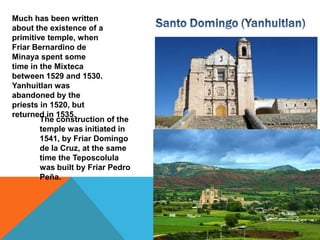
Much has been written about the existence of a primitive temple, when Friar Bernardino de Minaya spent some time in the Mixteca between 1529 and 1530. Yanhuitlan was abandoned by the priests in 1520, but returned in 1535. Santo Domingo (Yanhuitlan)The construction of the temple was initiated in 1541, by Friar Domingo de la Cruz, at the same time the Teposcolula was built by Friar Pedro Peña.
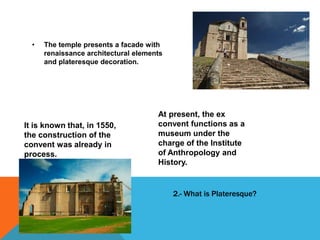
The temple presents a facade with renaissance architectural elements and plateresque decoration. At present, the ex convent functions as a museum under the charge of the Institute of Anthropology and History.It is known that, in 1550, the construction of the convent was already in process. 2.- WhatisPlateresque?
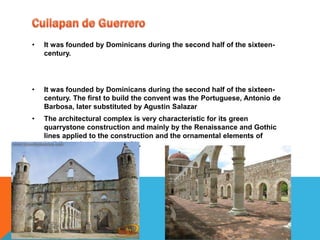
Cuilapan de Guerrero It was founded by Dominicans during the second half of the sixteen-century.
It was founded by Dominicans during the second half of the sixteen-century. The first to build the convent was the Portuguese, Antonio de Barbosa, later substituted by Agustin Salazar
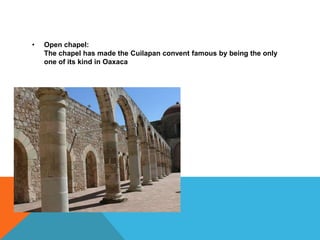
The architectural complex is very characteristic for its green quarrystone construction and mainly by the Renaissance and Gothic lines applied to the construction and the ornamental elements of buildings that form part of it.Open chapel:The chapel has made the Cuilapan convent famous by being the only one of its kind in OaxacaSanto Domingo de Guzmán
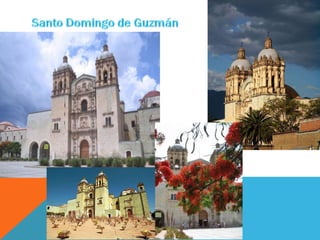
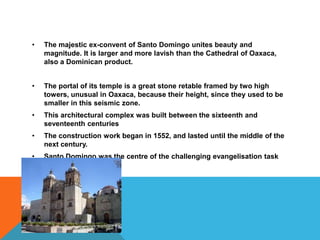
The majestic ex-convent of Santo Domingo unites beauty and magnitude. It is larger and more lavish than the Cathedral of Oaxaca, also a Dominican product.
The portal of its temple is a great stone retable framed by two high towers, unusual in Oaxaca, because their height, since they used to be smaller in this seismic zone.
This architectural complex was built between the sixteenth and seventeenth centuries
The construction work began in 1552, and lasted until the middle of the next century.
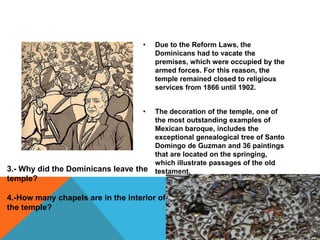
Santo Domingo was the centre of the challenging evangelisation task throughout the state. Due to the Reform Laws, the Dominicans had to vacate the premises, which were occupied by the armed forces. For this reason, the temple remained closed to religious services from 1866 until 1902.
The decoration of the temple, one of the most outstanding examples of Mexican baroque, includes the exceptional genealogical tree of Santo Domingo de Guzman and 36 paintings that are located on the springing, which illustrate passages of the old testament.3.- WhydidtheDominicansleavethe temple?4.-How manychapels are in the interior of the temple?
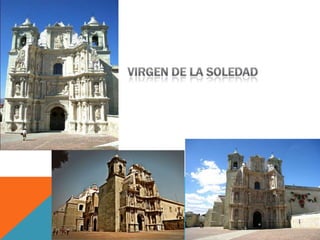
Virgen de la soledad
The temple’s construction, the present Basilica, was begun in 1682
It was finished in 1689, and consecrated in 1697 by Bishop Isidro Sariñana y Cuenca, the same year the convent was included.
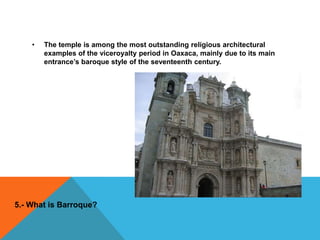
It is an elegant temple, notable for its sumptuous stone portal in the shape of a folding screen, richly carved in various stones
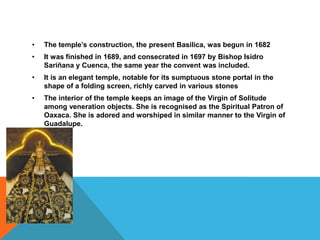
The interior of the temple keeps an image of the Virgin of Solitude among veneration objects. She is recognised as the Spiritual Patron of Oaxaca. She is adored and worshiped in similar manner to the Virgin of Guadalupe.The temple is among the most outstanding religious architectural examples of the viceroyalty period in Oaxaca, mainly due to its main entrance’s baroque style of the seventeenth century. 5.- WhatisBarroque?

Churches, monasteries, theaters

  • 1.
  • 2.
    THE CATHEDRALThe firstwork initiated in 1535 and concluded in 1574
  • 3.
    The front partof the Cathedral is composed of the portal and two bell towers. The portal design is in eighteenth century baroque style
  • 4.
    In the firstportal are three access bays profusely decorated with floral reliefs; to the left of the central access, is the image of Saint Peter, and Saint Paul to the right. In the centre of the second portal there is a relief representing the Assumption of MaryOn the central calle of the third section there is another frame of equal quality, representing the “Adoracion del Santisimo.” It is flanked by Saint Marcial, Patron of Oaxaca, and the Archangel San Miguel (on the left) and by San Jeronimo and the Archangel Gabriel (on the right).The pediment is curved and has a representation of the Holy Spirit.1.- When was completed the construction of the Cathedral?
  • 5.
    Much has beenwritten about the existence of a primitive temple, when Friar Bernardino de Minaya spent some time in the Mixteca between 1529 and 1530. Yanhuitlan was abandoned by the priests in 1520, but returned in 1535. Santo Domingo (Yanhuitlan)The construction of the temple was initiated in 1541, by Friar Domingo de la Cruz, at the same time the Teposcolula was built by Friar Pedro Peña.
  • 6.
    The temple presentsa facade with renaissance architectural elements and plateresque decoration. At present, the ex convent functions as a museum under the charge of the Institute of Anthropology and History.It is known that, in 1550, the construction of the convent was already in process. 2.- WhatisPlateresque?
  • 7.
    Cuilapan de GuerreroIt was founded by Dominicans during the second half of the sixteen-century.
  • 8.
    It was foundedby Dominicans during the second half of the sixteen-century. The first to build the convent was the Portuguese, Antonio de Barbosa, later substituted by Agustin Salazar
  • 9.
    The architectural complexis very characteristic for its green quarrystone construction and mainly by the Renaissance and Gothic lines applied to the construction and the ornamental elements of buildings that form part of it.Open chapel:The chapel has made the Cuilapan convent famous by being the only one of its kind in OaxacaSanto Domingo de Guzmán
  • 10.
    The majestic ex-conventof Santo Domingo unites beauty and magnitude. It is larger and more lavish than the Cathedral of Oaxaca, also a Dominican product.
  • 11.
    The portal ofits temple is a great stone retable framed by two high towers, unusual in Oaxaca, because their height, since they used to be smaller in this seismic zone.
  • 12.
    This architectural complexwas built between the sixteenth and seventeenth centuries
  • 13.
    The construction workbegan in 1552, and lasted until the middle of the next century.
  • 14.
    Santo Domingo wasthe centre of the challenging evangelisation task throughout the state. Due to the Reform Laws, the Dominicans had to vacate the premises, which were occupied by the armed forces. For this reason, the temple remained closed to religious services from 1866 until 1902.
  • 15.
    The decoration ofthe temple, one of the most outstanding examples of Mexican baroque, includes the exceptional genealogical tree of Santo Domingo de Guzman and 36 paintings that are located on the springing, which illustrate passages of the old testament.3.- WhydidtheDominicansleavethe temple?4.-How manychapels are in the interior of the temple?
  • 16.
  • 17.
    The temple’s construction,the present Basilica, was begun in 1682
  • 18.
    It was finishedin 1689, and consecrated in 1697 by Bishop Isidro Sariñana y Cuenca, the same year the convent was included.
  • 19.
    It is anelegant temple, notable for its sumptuous stone portal in the shape of a folding screen, richly carved in various stones
  • 20.
    The interior ofthe temple keeps an image of the Virgin of Solitude among veneration objects. She is recognised as the Spiritual Patron of Oaxaca. She is adored and worshiped in similar manner to the Virgin of Guadalupe.The temple is among the most outstanding religious architectural examples of the viceroyalty period in Oaxaca, mainly due to its main entrance’s baroque style of the seventeenth century. 5.- WhatisBarroque?