Chrysler In Trouble
CASE STUDY
A Quick Brief


Chrysler's future may be uncertain, but its past is full of notable moments



Since Chrysler’s start in the early 1900s, they have held a substantial amount of
respect and leverage within the automobile industry.



After a long journey in the automotive industry passing by highlights of failure
and others of success they encountered a tricky financial situation



Chrysler fighting for survival and got tangled in bad strategies and abrupt
changes in management strategic decisions and other external factors.



There is much to the story, starting from their merger with Dailmer-Benz.


1934: The company introduces the Airflow,
the

first

aerodynamically

designed

production automobile. Despite praise for its
bold design, it is a commercial flop.



1938-41: Chrysler enjoys four straight years as
the world's No. 2 automaker, behind General
Motors.




1940: Walter Chrysler dies.

1942-45: With auto production shut down for
World War II, Chrysler plants produce Sherman
tanks and other military vehicles.


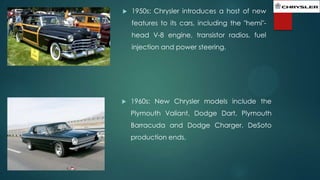
1950s: Chrysler introduces a host of new
features to its cars, including the "hemi"head V-8 engine, transistor radios, fuel
injection and power steering.



1960s: New Chrysler models include the
Plymouth Valiant, Dodge Dart, Plymouth
Barracuda and Dodge Charger. DeSoto
production ends.


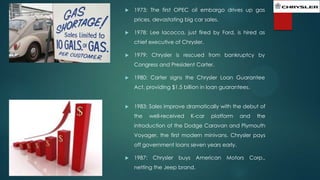
1973: The first OPEC oil embargo drives up gas
prices, devastating big car sales.



1978: Lee Iacocca, just fired by Ford, is hired as
chief executive of Chrysler.



1979: Chrysler is rescued from bankruptcy by
Congress and President Carter.



1980: Carter signs the Chrysler Loan Guarantee
Act, providing $1.5 billion in loan guarantees.



1983: Sales improve dramatically with the debut of

the

well-received

K-car

platform

and

the

introduction of the Dodge Caravan and Plymouth
Voyager, the first modern minivans. Chrysler pays
off government loans seven years early.


1987:

Chrysler

buys

netting the Jeep brand.

American

Motors

Corp.,
Daimler-Benz Merger


In 1998, German automaker Daimler-Benz purchased Chrysler for $36 billion in

what was then regarded as one of the largest industrial mergers ever.


But the potential global powerhouse turned out to be a disappointment.
Cultural differences immediately caused a rift between the two companies.



Daimler, famous for luxury brands and affluent customers, didn't understand the
price-conscious concerns of the U.S. automaker. And worried that sharing
Mercedes components would undermine its brand



the German company broke its parts-sharing agreement with Chrysler, which
was just beginning to suffer from the current U.S. auto crisis.
Financial
Crisis


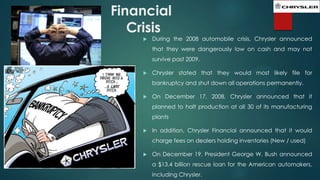
During the 2008 automobile crisis, Chrysler announced
that they were dangerously low on cash and may not
survive past 2009.



Chrysler stated that they would most likely file for
bankruptcy and shut down all operations permanently.



On December 17, 2008, Chrysler announced that it
planned to halt production at all 30 of its manufacturing

plants


In addition, Chrysler Financial announced that it would
charge fees on dealers holding inventories (New / used)



On December 19, President George W. Bush announced
a $13.4 billion rescue loan for the American automakers,
including Chrysler.
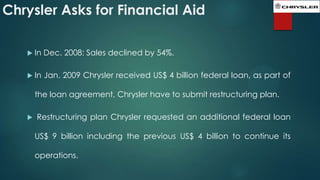
Chrysler Asks for Financial Aid
 In

Dec. 2008: Sales declined by 54%.

 In

Jan. 2009 Chrysler received US$ 4 billion federal loan, as part of

the loan agreement, Chrysler have to submit restructuring plan.


Restructuring plan Chrysler requested an additional federal loan
US$ 9 billion including the previous US$ 4 billion to continue its
operations.
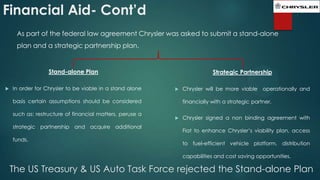
Financial Aid- Cont’d
As part of the federal law agreement Chrysler was asked to submit a stand-alone
plan and a strategic partnership plan.

Stand-alone Plan


In order for Chrysler to be viable in a stand alone

Strategic Partnership


basis certain assumptions should be considered
such as: restructure of financial matters, peruse a
strategic partnership and acquire additional
funds.

Chrysler will be more viable operationally and

financially with a strategic partner.


Chrysler signed a non binding agreement with
Fiat to enhance Chrysler’s viability plan, access

to fuel-efficient vehicle platform, distribution
capabilities and cost saving opportunities.

The US Treasury & US Auto Task Force rejected the Stand-alone Plan
Chrysler & Chapter 11


After receiving financial aid in the form of a federal loan of US$4 billion in January 2009,
out of the requested amount of US$7 billion, it had become increasingly difficult for
Chrysler to continue with its operations.



Chrysler asked for another US$2 billion federal loan over and above the US$7 billion loan
it had requested earlier.



The U.S. government made conditions:



Negotiate with UAW, and CAW to reduce costs. – already convinced them to reduce the cost





Establish an alliance with Fiat on or before April 30, 2009. – got the agreement

Restructure its debt - failed to get all its creditors to agree to debt restructuring

The company finally had to file for bankruptcy protection.
Bankruptcy


On April 30, 2009, Chrysler and its 24 wholly-owned U.S. subsidiaries filed for bankruptcy.



The company filed the bankruptcy under Section 363 so that it would be able to emerge
from bankruptcy within 30 to 60 days



As part of the bankruptcy filing, the U.S. Treasury was to give Chrysler a total of US$8
billion in additional aid including up to US$3.3 billion in debtor-in-possession financing and
up to US$4.7 billion in exit financing. Chrysler would have to repay the loan amount

within the next eight years


The new company would retain the Chrysler corporate name and would be run by a
board of nine members including six members appointed by the U.S. government and

three by Fiat


On May 5, 2009, the company’s bankruptcy was approved by the Manhattan
Bankruptcy Court
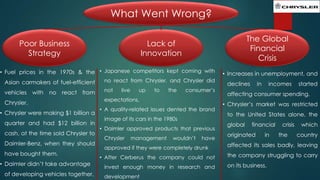
What Went Wrong?
Poor Business
Strategy

The Global
Financial
Crisis

Lack of
Innovation

• Fuel prices in the 1970s & the • Japanese competitors kept coming with
Asian carmakers of fuel-efficient

no react from Chrysler, and Chrysler did

vehicles with no react from

not

Chrysler.

• Chrysler were making $1 billion a
quarter and had $12 billion in
cash, at the time sold Chrysler to

Daimler-Benz, when they should
have bought them.

• Daimler didn’t take advantage
of developing vehicles together.

live

up

to

the

consumer’s

expectations.
• A quality-related issues dented the brand
image of its cars in the 1980s
• Daimler approved products that previous
Chrysler

management

wouldn’t

have

• Increases in unemployment, and
declines

in

incomes

started

affecting consumer spending.
• Chrysler’s market was restricted

to the United States alone, the
global

financial

originated

in

crisis
the

which
country

approved if they were completely drunk

affected its sales badly, leaving

• After Cerberus the company could not

the company struggling to carry

invest enough money in research and
development

on its business.
Fiat-Chrysler Alliance


In order for Chrysler to receive the government loan they had to show a long term viability

plan which included possible mergers.


Fiat needed to find a new market for its cars to balance the declining domestic market.



Fiat would have a strategic partner with operations based in the US.



Fiat would be able to utilize Chrysler’s distribution channels.



Chrysler

needed

fuel

efficient

engine

technology

to

make

smaller

eco-friendly cars.


Chrysler had to find a new CEO (terms of the loan).



Thousands of auto workers in the US would be able to keep their jobs, and 573 new jobs
would be created.
"In addition, production of vehicles for Fiat in North America will allow Chrysler to increase its plant utilization,
helping to preserve and create in excess of 5,000 manufacturing jobs”



Both Fiat and Chrysler would help each other launch new vehicle models in the US.
The Challenges
Is the production of a small car by the new company would be successful in

the United States?
Is the Americans will embrace smaller cars or they buy the Italian small cars?
Is Fiat/Chrysler will find a way to make small cars profitable in North America?
Is the timing of Fiat’s entry into the United States market will be a success
“especially at the time of an economic slowdown”?
Chrysler being jointly owned by different entities such as the U.S.
Government, Canadian Government, Ontario Government, UAW, and Fiat.
The biggest concern now is: Do the different stakeholders have the ability to
make the tough decisions they need to make?
Thank You

Chrysler in Trouble

  • 1.
  • 2.
    A Quick Brief  Chrysler'sfuture may be uncertain, but its past is full of notable moments  Since Chrysler’s start in the early 1900s, they have held a substantial amount of respect and leverage within the automobile industry.  After a long journey in the automotive industry passing by highlights of failure and others of success they encountered a tricky financial situation  Chrysler fighting for survival and got tangled in bad strategies and abrupt changes in management strategic decisions and other external factors.  There is much to the story, starting from their merger with Dailmer-Benz.
  • 3.
     1934: The companyintroduces the Airflow, the first aerodynamically designed production automobile. Despite praise for its bold design, it is a commercial flop.  1938-41: Chrysler enjoys four straight years as the world's No. 2 automaker, behind General Motors.
  • 4.
      1940: Walter Chryslerdies. 1942-45: With auto production shut down for World War II, Chrysler plants produce Sherman tanks and other military vehicles.
  • 5.
     1950s: Chrysler introducesa host of new features to its cars, including the "hemi"head V-8 engine, transistor radios, fuel injection and power steering.  1960s: New Chrysler models include the Plymouth Valiant, Dodge Dart, Plymouth Barracuda and Dodge Charger. DeSoto production ends.
  • 6.
     1973: The firstOPEC oil embargo drives up gas prices, devastating big car sales.  1978: Lee Iacocca, just fired by Ford, is hired as chief executive of Chrysler.  1979: Chrysler is rescued from bankruptcy by Congress and President Carter.  1980: Carter signs the Chrysler Loan Guarantee Act, providing $1.5 billion in loan guarantees.  1983: Sales improve dramatically with the debut of the well-received K-car platform and the introduction of the Dodge Caravan and Plymouth Voyager, the first modern minivans. Chrysler pays off government loans seven years early.  1987: Chrysler buys netting the Jeep brand. American Motors Corp.,
  • 7.
    Daimler-Benz Merger  In 1998,German automaker Daimler-Benz purchased Chrysler for $36 billion in what was then regarded as one of the largest industrial mergers ever.  But the potential global powerhouse turned out to be a disappointment. Cultural differences immediately caused a rift between the two companies.  Daimler, famous for luxury brands and affluent customers, didn't understand the price-conscious concerns of the U.S. automaker. And worried that sharing Mercedes components would undermine its brand  the German company broke its parts-sharing agreement with Chrysler, which was just beginning to suffer from the current U.S. auto crisis.
  • 8.
    Financial Crisis  During the 2008automobile crisis, Chrysler announced that they were dangerously low on cash and may not survive past 2009.  Chrysler stated that they would most likely file for bankruptcy and shut down all operations permanently.  On December 17, 2008, Chrysler announced that it planned to halt production at all 30 of its manufacturing plants  In addition, Chrysler Financial announced that it would charge fees on dealers holding inventories (New / used)  On December 19, President George W. Bush announced a $13.4 billion rescue loan for the American automakers, including Chrysler.
  • 9.
    Chrysler Asks forFinancial Aid  In Dec. 2008: Sales declined by 54%.  In Jan. 2009 Chrysler received US$ 4 billion federal loan, as part of the loan agreement, Chrysler have to submit restructuring plan.  Restructuring plan Chrysler requested an additional federal loan US$ 9 billion including the previous US$ 4 billion to continue its operations.
  • 10.
    Financial Aid- Cont’d Aspart of the federal law agreement Chrysler was asked to submit a stand-alone plan and a strategic partnership plan. Stand-alone Plan  In order for Chrysler to be viable in a stand alone Strategic Partnership  basis certain assumptions should be considered such as: restructure of financial matters, peruse a strategic partnership and acquire additional funds. Chrysler will be more viable operationally and financially with a strategic partner.  Chrysler signed a non binding agreement with Fiat to enhance Chrysler’s viability plan, access to fuel-efficient vehicle platform, distribution capabilities and cost saving opportunities. The US Treasury & US Auto Task Force rejected the Stand-alone Plan
  • 11.
    Chrysler & Chapter11  After receiving financial aid in the form of a federal loan of US$4 billion in January 2009, out of the requested amount of US$7 billion, it had become increasingly difficult for Chrysler to continue with its operations.  Chrysler asked for another US$2 billion federal loan over and above the US$7 billion loan it had requested earlier.  The U.S. government made conditions:   Negotiate with UAW, and CAW to reduce costs. – already convinced them to reduce the cost   Establish an alliance with Fiat on or before April 30, 2009. – got the agreement Restructure its debt - failed to get all its creditors to agree to debt restructuring The company finally had to file for bankruptcy protection.
  • 12.
    Bankruptcy  On April 30,2009, Chrysler and its 24 wholly-owned U.S. subsidiaries filed for bankruptcy.  The company filed the bankruptcy under Section 363 so that it would be able to emerge from bankruptcy within 30 to 60 days  As part of the bankruptcy filing, the U.S. Treasury was to give Chrysler a total of US$8 billion in additional aid including up to US$3.3 billion in debtor-in-possession financing and up to US$4.7 billion in exit financing. Chrysler would have to repay the loan amount within the next eight years  The new company would retain the Chrysler corporate name and would be run by a board of nine members including six members appointed by the U.S. government and three by Fiat  On May 5, 2009, the company’s bankruptcy was approved by the Manhattan Bankruptcy Court
  • 13.
    What Went Wrong? PoorBusiness Strategy The Global Financial Crisis Lack of Innovation • Fuel prices in the 1970s & the • Japanese competitors kept coming with Asian carmakers of fuel-efficient no react from Chrysler, and Chrysler did vehicles with no react from not Chrysler. • Chrysler were making $1 billion a quarter and had $12 billion in cash, at the time sold Chrysler to Daimler-Benz, when they should have bought them. • Daimler didn’t take advantage of developing vehicles together. live up to the consumer’s expectations. • A quality-related issues dented the brand image of its cars in the 1980s • Daimler approved products that previous Chrysler management wouldn’t have • Increases in unemployment, and declines in incomes started affecting consumer spending. • Chrysler’s market was restricted to the United States alone, the global financial originated in crisis the which country approved if they were completely drunk affected its sales badly, leaving • After Cerberus the company could not the company struggling to carry invest enough money in research and development on its business.
  • 14.
    Fiat-Chrysler Alliance  In orderfor Chrysler to receive the government loan they had to show a long term viability plan which included possible mergers.  Fiat needed to find a new market for its cars to balance the declining domestic market.  Fiat would have a strategic partner with operations based in the US.  Fiat would be able to utilize Chrysler’s distribution channels.  Chrysler needed fuel efficient engine technology to make smaller eco-friendly cars.  Chrysler had to find a new CEO (terms of the loan).  Thousands of auto workers in the US would be able to keep their jobs, and 573 new jobs would be created. "In addition, production of vehicles for Fiat in North America will allow Chrysler to increase its plant utilization, helping to preserve and create in excess of 5,000 manufacturing jobs”  Both Fiat and Chrysler would help each other launch new vehicle models in the US.
  • 15.
    The Challenges Is theproduction of a small car by the new company would be successful in the United States? Is the Americans will embrace smaller cars or they buy the Italian small cars? Is Fiat/Chrysler will find a way to make small cars profitable in North America? Is the timing of Fiat’s entry into the United States market will be a success “especially at the time of an economic slowdown”? Chrysler being jointly owned by different entities such as the U.S. Government, Canadian Government, Ontario Government, UAW, and Fiat. The biggest concern now is: Do the different stakeholders have the ability to make the tough decisions they need to make?
  • 16.