A nerve fibre, also called an axon, is a long and slender projection of nerve cells (or neurons) that carry electrical impulses away from the nerve cell body.
A neuron typically has one nerve fibre emanating from its cell body that transmits impulses to other neurons, muscles or glands.
Dysfunctioning of the nerve fibre can cause major acquired and inherited neurological disorders that affect both the central nervous system and the peripheral nervous system.
Physiological Properties of Nerve Fibres
Excitability: The nerve fibres are highly excitable structures that respond to several stimuli and can also generate electrical impulses.
Conductivity: The electrical impulses generated in the nerve fibres are propagated along its entire length and to different neurons, muscles and glands by synaptic connections.
Refractory Period: The nerve fibres can conduct one action potential at once, i.e., the excitability of the fibres is less during conduction and hence a new electrical impulse cannot be generated.
All or None Response: A nerve fiber translates either all of the impulse or none at all. If a stimulus is applied upto a threshold level, an action potential will be generated but increasing the strength of the stimulus will not affect the action potential.
Summation: If a sub-threshold stimulus is applied, it cannot generate an action potential. However, when multiple sub-threshold stimuli are applied in rapid succession, an action potential is generated.
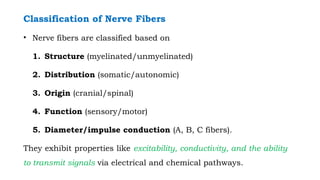
Classification of Nerve Fibers
Nerve fibers are classified based on
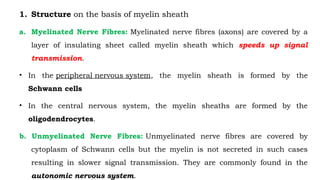
Structure (myelinated/unmyelinated)
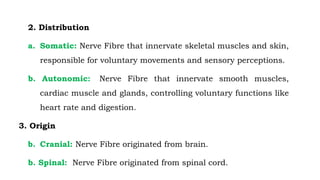
Distribution (somatic/autonomic)
Origin (cranial/spinal)
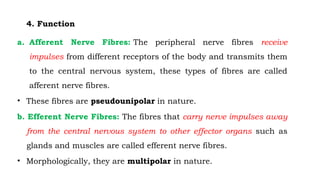
Function (sensory/motor)
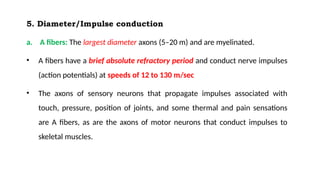
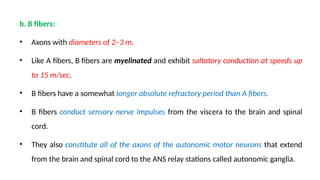
Diameter/impulse conduction (A, B, C fibers).
They exhibit properties like excitability, conductivity, and the ability to transmit signals via electrical and chemical pathways.

 Most read
 Most read
 Most read