CHRISTOPHER ALEXANDER
S U B M I T T E D B Y :
D E E P T H A S U D H A K A R A N
( 0 1 0 )
A R S H I A C H H I B B E R ( 0 2 9 )
S O N A L I S I N G H ( 0 3 9 )
S O O R A J A R O R A ( 0 4 0 )
S U R B H I A G G A R W A L ( 0 4 4 )
INTRODUCING CHRISTOPHER ALEXANDER
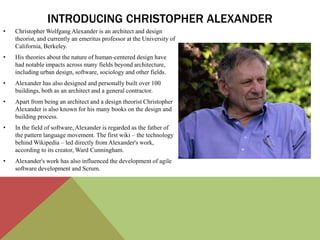
• Christopher Wolfgang Alexander is an architect and design
theorist, and currently an emeritus professor at the University of
California, Berkeley.
• His theories about the nature of human-centered design have
had notable impacts across many fields beyond architecture,
including urban design, software, sociology and other fields.
• Alexander has also designed and personally built over 100
buildings, both as an architect and a general contractor.
• Apart from being an architect and a design theorist Christopher
Alexander is also known for his many books on the design and
building process.
• In the field of software, Alexander is regarded as the father of
the pattern language movement. The first wiki – the technology
behind Wikipedia – led directly from Alexander's work,
according to its creator, Ward Cunningham.
• Alexander's work has also influenced the development of agile
software development and Scrum.
WORKS BY CHRISTOPHER ALEXANDER
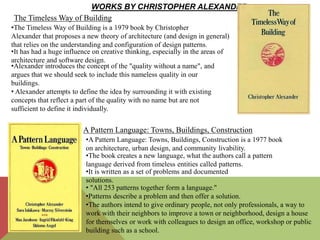
•The Timeless Way of Building is a 1979 book by Christopher
Alexander that proposes a new theory of architecture (and design in general)
that relies on the understanding and configuration of design patterns.
The Timeless Way of Building
•It has had a huge influence on creative thinking, especially in the areas of
architecture and software design.
•Alexander introduces the concept of the "quality without a name", and
argues that we should seek to include this nameless quality in our
buildings.
• Alexander attempts to define the idea by surrounding it with existing
concepts that reflect a part of the quality with no name but are not
sufficient to define it individually.
•A Pattern Language: Towns, Buildings, Construction is a 1977 book
on architecture, urban design, and community livability.
A Pattern Language: Towns, Buildings, Construction
•The book creates a new language, what the authors call a pattern
language derived from timeless entities called patterns.
•It is written as a set of problems and documented
solutions.
• "All 253 patterns together form a language."
•Patterns describe a problem and then offer a solution.
•The authors intend to give ordinary people, not only professionals, a way to
work with their neighbors to improve a town or neighborhood, design a house
for themselves or work with colleagues to design an office, workshop or public
building such as a school.
•The Oregon Experiment is a 1975 book by Christopher Alexander.
• It describes an experimental approach to campus community planning at
the University of Oregon, in Eugene, Oregon which resulted in a theory of
architecture and planning described in the group's later published and better-
known volumes A Pattern Language and The Timeless Way of Building.
The Oregon Experiment
•The book prescribed that "feeling" should be the primary criteria used for
making changes to any place
•Care should be taken to curb the economic and political power of large
monolithic projects.
• Places should be shaped for people, to make them feel more whole, and to
nourish them. And people should be involved in the construction of their
community.
•Notes on the Synthesis of Form is a book by Christopher Alexander about the
process of design, published in 1964.
Notes on the Synthesis of Form
•Alexander defines design as "the process of inventing things which display
new physical order, organization, form, in response to function..."
•By the time it was published, the book was considered "one of the most
important contemporary books about the art of design, what it is, and how to
go about it.
•A City is Not a Tree is a widely cited 1965 essay (later published as a book)
by the architect and design theorist Christopher Alexander, first published in
the journal Architectural Forum, and re-published many times since.
A City is Not a Tree
•It was published in 2015.
•The four books of The Nature of Order redefine architecture for the 21st
century as a field, as a profession, as practice and as social philosophy.
The Nature of Order
•This worldview provides architecture with a new underpinning, describing
procedures of planning, design, and building, as well as attitudes to style, to the
shapes of buildings, and to the forms of urbanization and construction
•There are four books, each one an essay on the topic of living structure, are
connected and interdependent
•The four volumes can be read separately, independently, and in any order.
However, it is together as a whole that they have their greatest impact. For
each book explores comprehensively different aspects of the coherence of
our universe, and brings us at last to being at one with it.
Pattern Language
What is a pattern?
•A pattern is a form of seed. It contains a reflection of current work and
thinking, as well as the vision of a future in which the seeds all have been
successfully cultivated.
•Each pattern is presented using five main parts : title, problem, context,
discussion and solution.
•Additionally they have an introductory graphic that conveys the idea and a
diagram that summarizes the pattern.
Alexander uses ”pattern language” in a specific sense:
•A pattern language is an ordered collection of patterns.
•The pattern is a pattern language combine into a holistic set of patterns that are intended to be
used together.
•In the original book Alexander stated that a pattern language could be developed in any domain.
•Now pattern languages are often a collective work/
•A pattern language is a method of describing good design practices or patterns of useful
organization within a field of expertise. The term was coined by architect Christopher Alexander
and popularized by his book A Pattern Language.
What is Pattern Language?
•The pattern language codifies the interaction of human beings with their environment, and
determines how and where we naturally prefer to walk, sit, sleep, enter and move through a
building, enjoy a room or open space, and feel at ease or not in our garden.
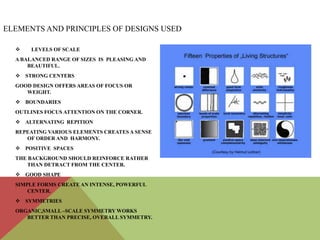
ELEMENTS AND PRINCIPLES OF DESIGNS USED
 LEVELS OF SCALE
A BALANCED RANGE OF SIZES IS PLEASING AND
BEAUTIFUL.
 STRONG CENTERS
GOOD DESIGN OFFERS AREAS OF FOCUS OR
WEIGHT.
 BOUNDARIES
OUTLINES FOCUS ATTENTION ON THE CORNER.
 ALTERNATING REPITION
REPEATING VARIOUS ELEMENTS CREATES A SENSE
OF ORDER AND HARMONY.
 POSITIVE SPACES
THE BACKGROUND SHOULD REINFORCE RATHER
THAN DETRACT FROM THE CENTER.
 GOOD SHAPE
SIMPLE FORMS CREATE AN INTENSE, POWERFUL
CENTER.
 SYMMETRIES
ORGANIC,SMALL –SCALE SYMMETRY WORKS
BETTER THAN PRECISE, OVERALL SYMMETRY.
 DEEP INTERLOCK AND AMBIGUITY
LOOPING , CONNECTED ELEMENTS PROMOTE UNITY AND
GRACE.
 CONTRAST
UNITY IS ACHIEVED WITH VISIBLE OPPOSITIES.
 ROUGHNESS
TEXTURE AND IMPERFECTIONS CONVEY UNIQUENESS
AND LIFE.
 VOIDS
EMPTY SPACES OFFER CALM AND CONTRAST.
 NOT- SEPARATENESS
DESIGNS SHOULD BE CONNECTED AND COMPLEMENTARY
, NOT EGOCENTRIC AND ISOLATED.
 GRADIENT
THE PROPORTIONAL USE OF SPACE AND PATTERN
CREATES HARMONY.
 ECHOES
SIMILARITIES SHOULD REPEAT THROUGHOUT A DESIGN.
 SIMPLICITY AND INNER CALM
USE ONLY ESSENTIALS; AVOID EXTRANEOUS ELEMENTS.
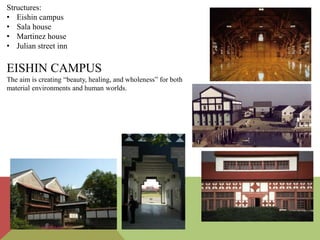
Structures:
• Eishin campus
• Sala house
• Martinez house
• Julian street inn
EISHIN CAMPUS
The aim is creating “beauty, healing, and wholeness” for both
material environments and human worlds.
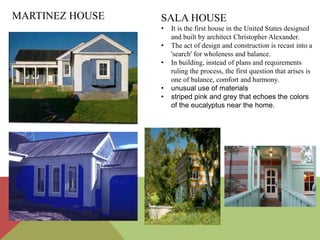
MARTINEZ HOUSE SALA HOUSE
• It is the first house in the United States designed
and built by architect Christopher Alexander.
• The act of design and construction is recast into a
'search' for wholeness and balance.
• In building, instead of plans and requirements
ruling the process, the first question that arises is
one of balance, comfort and harmony.
• unusual use of materials
• striped pink and grey that echoes the colors
of the eucalyptus near the home.
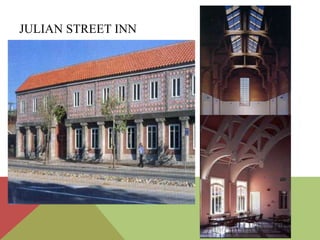
JULIAN STREET INN

CHRISTOPHER ALEXANDER.pptx

  • 1.
    CHRISTOPHER ALEXANDER S UB M I T T E D B Y : D E E P T H A S U D H A K A R A N ( 0 1 0 ) A R S H I A C H H I B B E R ( 0 2 9 ) S O N A L I S I N G H ( 0 3 9 ) S O O R A J A R O R A ( 0 4 0 ) S U R B H I A G G A R W A L ( 0 4 4 )
  • 2.
    INTRODUCING CHRISTOPHER ALEXANDER •Christopher Wolfgang Alexander is an architect and design theorist, and currently an emeritus professor at the University of California, Berkeley. • His theories about the nature of human-centered design have had notable impacts across many fields beyond architecture, including urban design, software, sociology and other fields. • Alexander has also designed and personally built over 100 buildings, both as an architect and a general contractor. • Apart from being an architect and a design theorist Christopher Alexander is also known for his many books on the design and building process. • In the field of software, Alexander is regarded as the father of the pattern language movement. The first wiki – the technology behind Wikipedia – led directly from Alexander's work, according to its creator, Ward Cunningham. • Alexander's work has also influenced the development of agile software development and Scrum.
  • 3.
    WORKS BY CHRISTOPHERALEXANDER •The Timeless Way of Building is a 1979 book by Christopher Alexander that proposes a new theory of architecture (and design in general) that relies on the understanding and configuration of design patterns. The Timeless Way of Building •It has had a huge influence on creative thinking, especially in the areas of architecture and software design. •Alexander introduces the concept of the "quality without a name", and argues that we should seek to include this nameless quality in our buildings. • Alexander attempts to define the idea by surrounding it with existing concepts that reflect a part of the quality with no name but are not sufficient to define it individually. •A Pattern Language: Towns, Buildings, Construction is a 1977 book on architecture, urban design, and community livability. A Pattern Language: Towns, Buildings, Construction •The book creates a new language, what the authors call a pattern language derived from timeless entities called patterns. •It is written as a set of problems and documented solutions. • "All 253 patterns together form a language." •Patterns describe a problem and then offer a solution. •The authors intend to give ordinary people, not only professionals, a way to work with their neighbors to improve a town or neighborhood, design a house for themselves or work with colleagues to design an office, workshop or public building such as a school.
  • 4.
    •The Oregon Experimentis a 1975 book by Christopher Alexander. • It describes an experimental approach to campus community planning at the University of Oregon, in Eugene, Oregon which resulted in a theory of architecture and planning described in the group's later published and better- known volumes A Pattern Language and The Timeless Way of Building. The Oregon Experiment •The book prescribed that "feeling" should be the primary criteria used for making changes to any place •Care should be taken to curb the economic and political power of large monolithic projects. • Places should be shaped for people, to make them feel more whole, and to nourish them. And people should be involved in the construction of their community. •Notes on the Synthesis of Form is a book by Christopher Alexander about the process of design, published in 1964. Notes on the Synthesis of Form •Alexander defines design as "the process of inventing things which display new physical order, organization, form, in response to function..." •By the time it was published, the book was considered "one of the most important contemporary books about the art of design, what it is, and how to go about it.
  • 5.
    •A City isNot a Tree is a widely cited 1965 essay (later published as a book) by the architect and design theorist Christopher Alexander, first published in the journal Architectural Forum, and re-published many times since. A City is Not a Tree •It was published in 2015. •The four books of The Nature of Order redefine architecture for the 21st century as a field, as a profession, as practice and as social philosophy. The Nature of Order •This worldview provides architecture with a new underpinning, describing procedures of planning, design, and building, as well as attitudes to style, to the shapes of buildings, and to the forms of urbanization and construction •There are four books, each one an essay on the topic of living structure, are connected and interdependent •The four volumes can be read separately, independently, and in any order. However, it is together as a whole that they have their greatest impact. For each book explores comprehensively different aspects of the coherence of our universe, and brings us at last to being at one with it.
  • 6.
    Pattern Language What isa pattern? •A pattern is a form of seed. It contains a reflection of current work and thinking, as well as the vision of a future in which the seeds all have been successfully cultivated. •Each pattern is presented using five main parts : title, problem, context, discussion and solution. •Additionally they have an introductory graphic that conveys the idea and a diagram that summarizes the pattern. Alexander uses ”pattern language” in a specific sense: •A pattern language is an ordered collection of patterns. •The pattern is a pattern language combine into a holistic set of patterns that are intended to be used together. •In the original book Alexander stated that a pattern language could be developed in any domain. •Now pattern languages are often a collective work/ •A pattern language is a method of describing good design practices or patterns of useful organization within a field of expertise. The term was coined by architect Christopher Alexander and popularized by his book A Pattern Language. What is Pattern Language? •The pattern language codifies the interaction of human beings with their environment, and determines how and where we naturally prefer to walk, sit, sleep, enter and move through a building, enjoy a room or open space, and feel at ease or not in our garden.
  • 8.
    ELEMENTS AND PRINCIPLESOF DESIGNS USED  LEVELS OF SCALE A BALANCED RANGE OF SIZES IS PLEASING AND BEAUTIFUL.  STRONG CENTERS GOOD DESIGN OFFERS AREAS OF FOCUS OR WEIGHT.  BOUNDARIES OUTLINES FOCUS ATTENTION ON THE CORNER.  ALTERNATING REPITION REPEATING VARIOUS ELEMENTS CREATES A SENSE OF ORDER AND HARMONY.  POSITIVE SPACES THE BACKGROUND SHOULD REINFORCE RATHER THAN DETRACT FROM THE CENTER.  GOOD SHAPE SIMPLE FORMS CREATE AN INTENSE, POWERFUL CENTER.  SYMMETRIES ORGANIC,SMALL –SCALE SYMMETRY WORKS BETTER THAN PRECISE, OVERALL SYMMETRY.
  • 9.
     DEEP INTERLOCKAND AMBIGUITY LOOPING , CONNECTED ELEMENTS PROMOTE UNITY AND GRACE.  CONTRAST UNITY IS ACHIEVED WITH VISIBLE OPPOSITIES.  ROUGHNESS TEXTURE AND IMPERFECTIONS CONVEY UNIQUENESS AND LIFE.  VOIDS EMPTY SPACES OFFER CALM AND CONTRAST.  NOT- SEPARATENESS DESIGNS SHOULD BE CONNECTED AND COMPLEMENTARY , NOT EGOCENTRIC AND ISOLATED.  GRADIENT THE PROPORTIONAL USE OF SPACE AND PATTERN CREATES HARMONY.  ECHOES SIMILARITIES SHOULD REPEAT THROUGHOUT A DESIGN.  SIMPLICITY AND INNER CALM USE ONLY ESSENTIALS; AVOID EXTRANEOUS ELEMENTS.
  • 10.
    Structures: • Eishin campus •Sala house • Martinez house • Julian street inn EISHIN CAMPUS The aim is creating “beauty, healing, and wholeness” for both material environments and human worlds.
  • 11.
    MARTINEZ HOUSE SALAHOUSE • It is the first house in the United States designed and built by architect Christopher Alexander. • The act of design and construction is recast into a 'search' for wholeness and balance. • In building, instead of plans and requirements ruling the process, the first question that arises is one of balance, comfort and harmony. • unusual use of materials • striped pink and grey that echoes the colors of the eucalyptus near the home.
  • 12.