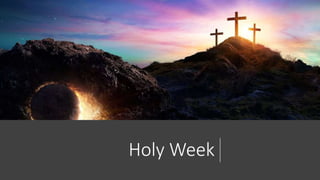
Holy Week
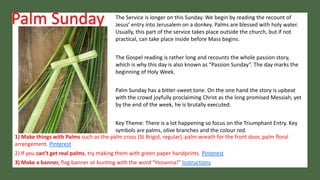
The Service is longer on this Sunday. We begin by reading the recount of
Jesus’ entry into Jerusalem on a donkey. Palms are blessed with holy water.
Usually, this part of the service takes place outside the church, but if not
practical, can take place inside before Mass begins.
The Gospel reading is rather long and recounts the whole passion story,
which is why this day is also known as “Passion Sunday”. The day marks the
beginning of Holy Week.
Palm Sunday has a bitter-sweet tone. On the one hand the story is upbeat
with the crowd joyfully proclaiming Christ as the long promised Messiah, yet
by the end of the week, he is brutally executed.
Key Theme: There is a lot happening so focus on the Triumphant Entry. Key
symbols are palms, olive branches and the colour red.
Palm Sunday
1) Make things with Palms such as the palm cross (St Brigid, regular), palm wreath for the front door, palm floral
arrangement. Pinterest
2) If you can’t get real palms, try making them with green paper handprints. Pinterest
3) Make a banner, flag banner or bunting with the word “Hosanna!” Instructions
Maundy Thursday
There are two Masses on this day.
 In the morning, is the Chrism Mass where the holy oils are
blessed by the Bishop with as many priests as available for
use during the coming year.
 In the evening is the Mass of the Lord’s Supper. This
includes the washing of the feet. The Mass is concluded
by stripping the sanctuary of all decoration (flowers, altar
cloth, banners etc) and by the transfer of the Blessed
Sacrament from the tabernacle to the Altar of Repose,
usually a side altar or chapel. The congregation is
encouraged to ‘keep watch’ with Christ, as Jesus asked the
disciples to keep watch while he prayed in the Garden o
Key Theme:– Agony in the Garden: keeping vigil with
Jesus.
- Servant leadership: washing of feet
1) Last Supper Meal – a handout for families to prepare a meal
that reflects on the Jewish roots of the Mass. Click Here
2) Make unleavened bread. Click Here
3) Set up a garden prayer space with candles, crucifix and other
symbols of the passion (eg crown of thorns, rope, wooden
cross etc). Pray the Sorrowful Mysteries (Rosary) and/or
sing together the Taize song: ‘Stay with Me’ or just sit in
silence.
4) Go on an electronic media fast from Thursday evening
through to sunset on Friday.
There are two ceremonies on this day, the Stations (or Way) of the
Cross, usually at 10am and the Celebration of the Lord’s Passion at 3pm.
1) Stations: There are a variety of traditions for encountering the
Stations of the Cross and there are two approved versions. Most
churches have the traditional 14 stations on the walls of the
church which date back to St Francis of Asissi. Pope John Paul II
instigated the Scriptural Way of the Cross which includes the Agony
in the Garden and an optional 15th one for the Resurrection.
2) Celebration of the Lord’s Passion: This is not a Mass but is a
communion service with the veneration of the Cross where the
people are invited to kiss the feet of Jesus on a crucifix or show
some other sign of reverence. The readings again recount the
passion of Jesus and there is a sombre mood. The service takes
place at 3pm as it is understood that this is the time at which Jesus
died on the cross.
Key Theme: Both services help us to focus on the suffering and death
of Jesus which he undertook out of love for each one of us personally.
– Repentance for our sins. Often, the Sacrament of
Penance (Reconciliation) is also available on this day.
– Sacrificial Love. Cross, crucifix, nails, blood, eclipse, earth
tremors, darkness, colour red.
Activity,
1) Make a cross (sticks with twine
or nails with wire). Reflect on
how each person’s cross
is unique and special. In the
same way, Jesus died for each of
us.
2) Get each person to think about
their sin. Write it down on paper
and nail it to a wooden cross You
could do this before or after
going to Reconciliation.
Holy Saturday The Vigil Mass on Holy Saturday is the peak service of the Church
calendar and has four parts:
1) Service of Light – the church is in darkness, the people gather
around a large fire from which the new Paschal candle is lit. The light
is then spread from person to person until all have a lit candle.
2) Liturgy of the Word – there are nine readings on this night though
some services will use less. They begin with the Creation and retell
the story of redemption. Many churches will employ audio visual
aids for some of these readings.
3) Liturgy of Baptism and Confirmation – this is when new members to
the Church are baptised and confirmed.
4) Liturgy of the Eucharist – the newly baptised members present the
bread and wine in the offertory and make their first communion.
Key Theme: Triumph of good over evil. Symbols include light, fire,
white, praise songs.
Activities,
1) Have a dinner by candlelight.
2) Redecorate the family prayer space with
white or gold.
3) Drape a cross with a white sash or ribbon.
4) Watch a movie recounting the Life of Jesus.
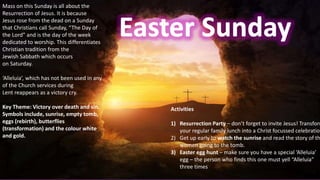
Mass on this Sunday is all about the
Resurrection of Jesus. It is because
Jesus rose from the dead on a Sunday
that Christians call Sunday, “The Day of
the Lord” and is the day of the week
dedicated to worship. This differentiates
Christian tradition from the
Jewish Sabbath which occurs
on Saturday.
‘Alleluia’, which has not been used in any
of the Church services during
Lent reappears as a victory cry.
Key Theme: Victory over death and sin.
Symbols include, sunrise, empty tomb,
eggs (rebirth), butterflies
(transformation) and the colour white
and gold.
Activities
1) Resurrection Party – don’t forget to invite Jesus! Transform
your regular family lunch into a Christ focussed celebration
2) Get up early to watch the sunrise and read the story of th
women going to the tomb.
3) Easter egg hunt – make sure you have a special ‘Alleluia’
egg – the person who finds this one must yell “Alleluia”
three times

Holy Week PPT Explained.pptx

  • 1.
  • 2.
    The Service islonger on this Sunday. We begin by reading the recount of Jesus’ entry into Jerusalem on a donkey. Palms are blessed with holy water. Usually, this part of the service takes place outside the church, but if not practical, can take place inside before Mass begins. The Gospel reading is rather long and recounts the whole passion story, which is why this day is also known as “Passion Sunday”. The day marks the beginning of Holy Week. Palm Sunday has a bitter-sweet tone. On the one hand the story is upbeat with the crowd joyfully proclaiming Christ as the long promised Messiah, yet by the end of the week, he is brutally executed. Key Theme: There is a lot happening so focus on the Triumphant Entry. Key symbols are palms, olive branches and the colour red. Palm Sunday 1) Make things with Palms such as the palm cross (St Brigid, regular), palm wreath for the front door, palm floral arrangement. Pinterest 2) If you can’t get real palms, try making them with green paper handprints. Pinterest 3) Make a banner, flag banner or bunting with the word “Hosanna!” Instructions
  • 3.
    Maundy Thursday There aretwo Masses on this day.  In the morning, is the Chrism Mass where the holy oils are blessed by the Bishop with as many priests as available for use during the coming year.  In the evening is the Mass of the Lord’s Supper. This includes the washing of the feet. The Mass is concluded by stripping the sanctuary of all decoration (flowers, altar cloth, banners etc) and by the transfer of the Blessed Sacrament from the tabernacle to the Altar of Repose, usually a side altar or chapel. The congregation is encouraged to ‘keep watch’ with Christ, as Jesus asked the disciples to keep watch while he prayed in the Garden o Key Theme:– Agony in the Garden: keeping vigil with Jesus. - Servant leadership: washing of feet 1) Last Supper Meal – a handout for families to prepare a meal that reflects on the Jewish roots of the Mass. Click Here 2) Make unleavened bread. Click Here 3) Set up a garden prayer space with candles, crucifix and other symbols of the passion (eg crown of thorns, rope, wooden cross etc). Pray the Sorrowful Mysteries (Rosary) and/or sing together the Taize song: ‘Stay with Me’ or just sit in silence. 4) Go on an electronic media fast from Thursday evening through to sunset on Friday.
  • 4.
    There are twoceremonies on this day, the Stations (or Way) of the Cross, usually at 10am and the Celebration of the Lord’s Passion at 3pm. 1) Stations: There are a variety of traditions for encountering the Stations of the Cross and there are two approved versions. Most churches have the traditional 14 stations on the walls of the church which date back to St Francis of Asissi. Pope John Paul II instigated the Scriptural Way of the Cross which includes the Agony in the Garden and an optional 15th one for the Resurrection. 2) Celebration of the Lord’s Passion: This is not a Mass but is a communion service with the veneration of the Cross where the people are invited to kiss the feet of Jesus on a crucifix or show some other sign of reverence. The readings again recount the passion of Jesus and there is a sombre mood. The service takes place at 3pm as it is understood that this is the time at which Jesus died on the cross. Key Theme: Both services help us to focus on the suffering and death of Jesus which he undertook out of love for each one of us personally. – Repentance for our sins. Often, the Sacrament of Penance (Reconciliation) is also available on this day. – Sacrificial Love. Cross, crucifix, nails, blood, eclipse, earth tremors, darkness, colour red. Activity, 1) Make a cross (sticks with twine or nails with wire). Reflect on how each person’s cross is unique and special. In the same way, Jesus died for each of us. 2) Get each person to think about their sin. Write it down on paper and nail it to a wooden cross You could do this before or after going to Reconciliation.
  • 5.
    Holy Saturday TheVigil Mass on Holy Saturday is the peak service of the Church calendar and has four parts: 1) Service of Light – the church is in darkness, the people gather around a large fire from which the new Paschal candle is lit. The light is then spread from person to person until all have a lit candle. 2) Liturgy of the Word – there are nine readings on this night though some services will use less. They begin with the Creation and retell the story of redemption. Many churches will employ audio visual aids for some of these readings. 3) Liturgy of Baptism and Confirmation – this is when new members to the Church are baptised and confirmed. 4) Liturgy of the Eucharist – the newly baptised members present the bread and wine in the offertory and make their first communion. Key Theme: Triumph of good over evil. Symbols include light, fire, white, praise songs. Activities, 1) Have a dinner by candlelight. 2) Redecorate the family prayer space with white or gold. 3) Drape a cross with a white sash or ribbon. 4) Watch a movie recounting the Life of Jesus.
  • 6.
    Mass on thisSunday is all about the Resurrection of Jesus. It is because Jesus rose from the dead on a Sunday that Christians call Sunday, “The Day of the Lord” and is the day of the week dedicated to worship. This differentiates Christian tradition from the Jewish Sabbath which occurs on Saturday. ‘Alleluia’, which has not been used in any of the Church services during Lent reappears as a victory cry. Key Theme: Victory over death and sin. Symbols include, sunrise, empty tomb, eggs (rebirth), butterflies (transformation) and the colour white and gold. Activities 1) Resurrection Party – don’t forget to invite Jesus! Transform your regular family lunch into a Christ focussed celebration 2) Get up early to watch the sunrise and read the story of th women going to the tomb. 3) Easter egg hunt – make sure you have a special ‘Alleluia’ egg – the person who finds this one must yell “Alleluia” three times