CHAMPS:
PBIS in the
Classroom
(17) Develop systematic,
consistent strategies for
correcting behavior
errors
STOIC
 Structure the environment
 Teach behaviors and expectations
 Observe
 Systematic supervision
 Use data to make decisions
 Interact positively
 Correct Fluently
Chapter 9: Correcting
 Task 1: Adjusting the Basic
Management Plan (classroom and/or
individual student)
 Task 2: Analyze and Adjust Strategies for
Building Positive Relationships with
students
 Task 3: Developing a Function-Based
Intervention
Continuum of supports – DATA DRIVEN
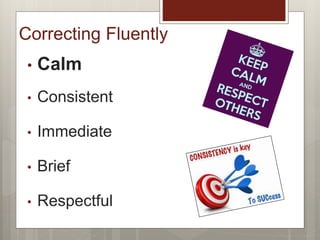
Correcting Fluently
• Calm
• Consistent
• Immediate
• Brief
• Respectful
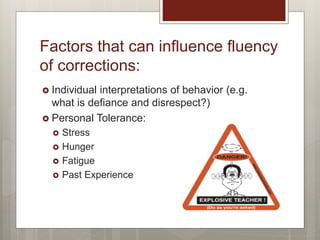
Factors that can influence fluency
of corrections:
 Individual interpretations of behavior (e.g.
what is defiance and disrespect?)
 Personal Tolerance:
 Stress
 Hunger
 Fatigue
 Past Experience
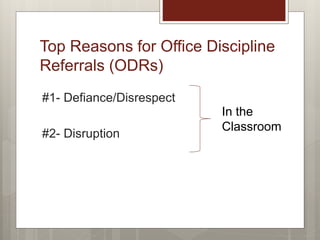
Top Reasons for Office Discipline
Referrals (ODRs)
#1- Defiance/Disrespect
#2- Disruption
In the
Classroom
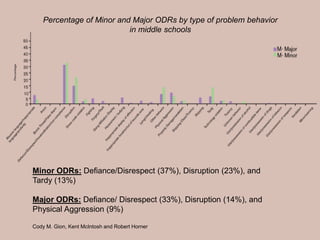
Percentage of Minor and Major ODRs by type of problem behavior
in middle schools
Minor ODRs: Defiance/Disrespect (37%), Disruption (23%), and
Tardy (13%)
Major ODRs: Defiance/ Disrespect (33%), Disruption (14%), and
Physical Aggression (9%)
Cody M. Gion, Kent McIntosh and Robert Horner
Webster’s Definition:
de·fi·ance
noun di-ˈfī-ən(t)s, dē- : a refusal to obey
something or someone : the act of defying
someone or something
SWIS Definition:
Defiance/disrespect/insubordination/non-
compliance
Refusal to follow directions, talking back and/or
socially rude interactions.
What is defiance?
What is defiance?
 Cultural differences can be interpreted as
defiance
 Dr. McIntyre www.behavioradvisor.com
 “Look at me when I am talking to you!” In many
Asian, black and Hispanic homes, children are
taught to lower their eyes when being
disciplined as a sign of respect and submission
 Many culturally diverse children smile when
being disciplined, not to express defiance, but
rather due to anxiety, appeasement attempts or
confusion (Henkin & Nguyen, 1981; Nine-Curt,
1976).
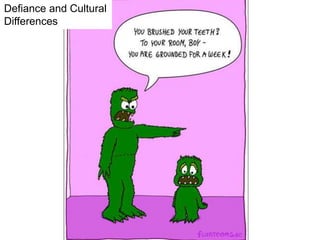
Defiance and Cultural
Differences

Chp. 9 task 1 slides

  • 1.
    CHAMPS: PBIS in the Classroom (17)Develop systematic, consistent strategies for correcting behavior errors
  • 2.
    STOIC  Structure theenvironment  Teach behaviors and expectations  Observe  Systematic supervision  Use data to make decisions  Interact positively  Correct Fluently
  • 3.
    Chapter 9: Correcting Task 1: Adjusting the Basic Management Plan (classroom and/or individual student)  Task 2: Analyze and Adjust Strategies for Building Positive Relationships with students  Task 3: Developing a Function-Based Intervention Continuum of supports – DATA DRIVEN
  • 4.
    Correcting Fluently • Calm •Consistent • Immediate • Brief • Respectful
  • 5.
    Factors that caninfluence fluency of corrections:  Individual interpretations of behavior (e.g. what is defiance and disrespect?)  Personal Tolerance:  Stress  Hunger  Fatigue  Past Experience
  • 6.
    Top Reasons forOffice Discipline Referrals (ODRs) #1- Defiance/Disrespect #2- Disruption In the Classroom
  • 7.
    Percentage of Minorand Major ODRs by type of problem behavior in middle schools Minor ODRs: Defiance/Disrespect (37%), Disruption (23%), and Tardy (13%) Major ODRs: Defiance/ Disrespect (33%), Disruption (14%), and Physical Aggression (9%) Cody M. Gion, Kent McIntosh and Robert Horner
  • 8.
    Webster’s Definition: de·fi·ance noun di-ˈfī-ən(t)s,dē- : a refusal to obey something or someone : the act of defying someone or something SWIS Definition: Defiance/disrespect/insubordination/non- compliance Refusal to follow directions, talking back and/or socially rude interactions. What is defiance?
  • 9.
    What is defiance? Cultural differences can be interpreted as defiance  Dr. McIntyre www.behavioradvisor.com  “Look at me when I am talking to you!” In many Asian, black and Hispanic homes, children are taught to lower their eyes when being disciplined as a sign of respect and submission  Many culturally diverse children smile when being disciplined, not to express defiance, but rather due to anxiety, appeasement attempts or confusion (Henkin & Nguyen, 1981; Nine-Curt, 1976).
  • 10.

Editor's Notes

  • #3 Essential Elements of SW anc CW PBIS
  • #4 How do we correct behavior errors? Focus on the 3 tasks in Chapter 9 and go a little deeper than the book. Things not in the book will be in your packet and we’ll point those things out to you.
  • #5 Fluently – least amount of interruption to the flow of your instruction Reacting emotionally can impact all of these things, but especially inconsistency. On a bad day we may overreact, but on a good day, we may underreact. For example, your class is focused and working and that one student who hums when he works doesn’t really bother you right now so you ignore it. The next day your class is a little louder, your lesson didn’t go as planned, things are more chaotic, and you tell the student if he doesn’t stop humming you’re going to have to send him out. OR you consistently let your 4th period students come in late to class after lunch and don’t really acknowledge it, but that one day you had a rough class before, you decide you’re going to lock them all out and not let them in. Emotions are impacting the way you respond, which leads to inconsistency and could reinforce the behavior errors. “I know I have to be on time for Schrumpfs class because she’ll keep me after if I’m late, but I know I can be late to Russells class because she doesn’t keep track of tardies. MODEL the behavior we expect to see: teacher is late, but marks kids tardy. Teacher yelling at her kids in the hallway for being loud in the hallway. Pencil Tapper, humming
  • #8 The school-level ODR Data consisted of 3,092 schools from ten different states (i.e., CO, FL, IL, MD, MI, MN, NC, NY, OH, OR). The data set consisted of 2,124 elementary (K-5), 630 middle (6-8), and 338 high (9-12) schools. The referral data consisted of 4,407,677 total ODRs. There were 1,940,686 elementary (K-5), 1,574,311 middle (6- 8), and 892, 680 high school (9-12) ODRs.