1 © Experian 19/09/2019
Sip and Solve
Choosing the right model:
custom or generic
Featuring:
Marsha Silverman
Lead Analytic Consultant
Experian Commercial Decision Sciences
2 © Experian Sip and Solve: Choosing the right model
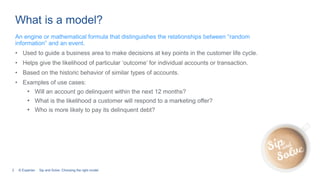
What is a model?
An engine or mathematical formula that distinguishes the relationships between “random
information” and an event.
• Used to guide a business area to make decisions at key points in the customer life cycle.
• Helps give the likelihood of particular ‘outcome’ for individual accounts or transaction.
• Based on the historic behavior of similar types of accounts.
• Examples of use cases:
• Will an account go delinquent within the next 12 months?
• What is the likelihood a customer will respond to a marketing offer?
• Who is more likely to pay its delinquent debt?
3 © Experian
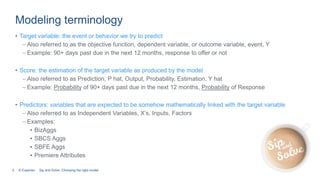
Modeling terminology
• Target variable: the event or behavior we try to predict
– Also referred to as the objective function, dependent variable, or outcome variable, event, Y
– Example: 90+ days past due in the next 12 months, response to offer or not
• Score: the estimation of the target variable as produced by the model
– Also referred to as Prediction, P hat, Output, Probability, Estimation, Y hat
– Example: Probability of 90+ days past due in the next 12 months, Probability of Response
• Predictors: variables that are expected to be somehow mathematically linked with the target variable
– Also referred to as Independent Variables, X’s, Inputs, Factors
– Examples:
▪ BizAggs
▪ SBCS Aggs
▪ SBFE Aggs
▪ Premiere Attributes
Sip and Solve: Choosing the right model
4 © Experian
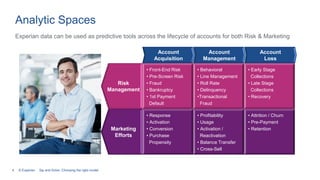
Analytic Spaces
Account
Acquisition
Account
Management
Account
Loss
• Front-End Risk
• Pre-Screen Risk
• Fraud
• Bankruptcy
• 1st Payment
Default
• Behavioral
• Line Management
• Roll Rate
• Delinquency
•Transactional
Fraud
• Early Stage
Collections
• Late Stage
Collections
• Recovery
• Response
• Activation
• Conversion
• Purchase
Propensity
• Profitability
• Usage
• Activation /
Reactivation
• Balance Transfer
• Cross-Sell
• Attrition / Churn
• Pre-Payment
• Retention
Risk
Management
Marketing
Efforts
Experian data can be used as predictive tools across the lifecycle of accounts for both Risk & Marketing
Sip and Solve: Choosing the right model
5 © Experian
Custom or generic model?
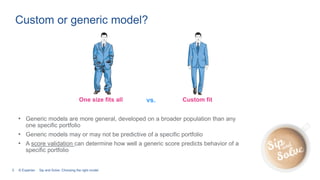
• Generic models are more general, developed on a broader population than any
one specific portfolio
• Generic models may or may not be predictive of a specific portfolio
• A score validation can determine how well a generic score predicts behavior of a
specific portfolio
One size fits all Custom fitvs.
Sip and Solve: Choosing the right model
6 © Experian
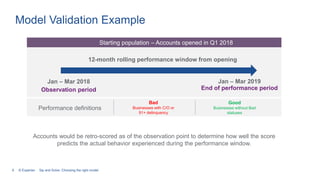
Model Validation Example
Starting population – Accounts opened in Q1 2018
Jan – Mar 2018
Observation period
Jan – Mar 2019
12-month rolling performance window from opening
Performance definitions
Bad
Businesses with C/O or
91+ delinquency
Good
Businesses without Bad
statuses
End of performance period
Accounts would be retro-scored as of the observation point to determine how well the score
predicts the actual behavior experienced during the performance window.
Sip and Solve: Choosing the right model
7 © Experian
How do we know if a model “works”?
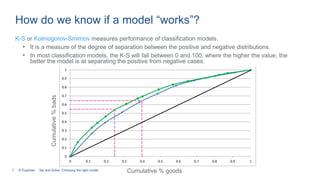
K-S or Kolmogorov-Smirnov measures performance of classification models.
• It is a measure of the degree of separation between the positive and negative distributions.
• In most classification models, the K-S will fall between 0 and 100, where the higher the value, the
better the model is at separating the positive from negative cases.
Cumulative%bads
Cumulative % goods
0
0.1
0.2
0.3
0.4
0.5
0.6
0.7
0.8
0.9
1
0 0.1 0.2 0.3 0.4 0.5 0.6 0.7 0.8 0.9 1
Sip and Solve: Choosing the right model
8 © Experian
How do we know if a score “works”? - Odds Chart
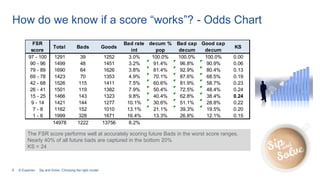
The FSR score performs well at accurately scoring future Bads in the worst score ranges.
Nearly 40% of all future bads are captured in the bottom 20%
KS = 24
FSR
score
Total Bads Goods
Bad rate
int
decum %
pop
Bad cap
decum
Good cap
decum
KS
97 - 100 1291 39 1252 3.0% 100.0% 100.0% 100.0% 0.00
90 - 96 1499 48 1451 3.2% 91.4% 96.8% 90.9% 0.06
79 - 89 1690 64 1626 3.8% 81.4% 92.9% 80.4% 0.13
69 - 78 1423 70 1353 4.9% 70.1% 87.6% 68.5% 0.19
42 - 68 1526 115 1411 7.5% 60.6% 81.9% 58.7% 0.23
26 - 41 1501 119 1382 7.9% 50.4% 72.5% 48.4% 0.24
15 - 25 1466 143 1323 9.8% 40.4% 62.8% 38.4% 0.24
9 - 14 1421 144 1277 10.1% 30.6% 51.1% 28.8% 0.22
7 - 8 1162 152 1010 13.1% 21.1% 39.3% 19.5% 0.20
1 - 6 1999 328 1671 16.4% 13.3% 26.8% 12.1% 0.15
14978 1222 13756 8.2%
Sip and Solve: Choosing the right model
9 © Experian
Financial Stability Risk validation
maximizing profit
Maximum net profit of $2,988,655 is at FSR of 9+
This is $390k over the total population ($2,988,655 - $2,598,563)
For one year of applicants, the net profit gain is $1,170,000
[$390k * 3]
Profit can be further increased by assessing deposits for those
applicants scoring below 9
FSR
score
Total Bads Goods
Bad rate
int
decum %
pop
97 - 100 1291 39 1252 3.0% 100.0%
90 - 96 1499 48 1451 3.2% 91.4%
79 - 89 1690 64 1626 3.8% 81.4%
69 - 78 1423 70 1353 4.9% 70.1%
42 - 68 1526 115 1411 7.5% 60.6%
26 - 41 1501 119 1382 7.9% 50.4%
15 - 25 1466 143 1323 9.8% 40.4%
9 - 14 1421 144 1277 10.1% 30.6%
7 - 8 1162 152 1010 13.1% 21.1%
1 - 6 1999 328 1671 16.4% 13.3%
14978 1222 13756 8.2%
profit margin on goods 15%
co rate 20%
Total good
balance
Total bad
balance
CO balance
Annual
profit est
Est loss
Net profit
cum.
3,174,489$ 148,235$ 10,025$ 493,962$ 39,672$ 454,290$
3,892,563$ 237,564$ 38,541$ 612,392$ 86,054$ 980,628$
4,005,358$ 241,308$ 40,530$ 629,761$ 88,792$ 1,521,597$
4,812,652$ 342,173$ 48,532$ 762,959$ 116,967$ 2,167,589$
3,491,868$ 1,018,134$ 142,930$ 645,956$ 346,557$ 2,466,988$
3,402,776$ 1,267,648$ 212,735$ 662,534$ 466,265$ 2,663,258$
3,307,563$ 1,110,626$ 178,008$ 629,410$ 400,133$ 2,892,534$
2,885,293$ 1,526,637$ 214,542$ 615,990$ 519,869$ 2,988,655$
2,322,419$ 1,790,791$ 233,032$ 563,258$ 591,190$ 2,960,723$
4,171,432$ 4,451,173$ 631,781$ 1,159,856$ 1,522,016$ 2,598,563$
35,466,413$ 12,134,289$ 1,750,656$ 6,776,077$
Sip and Solve: Choosing the right model
10 © Experian 19/09/2019
Thank you!
Have questions or want to learn more about choosing the right model?
• Chat with us: bit.ly/sip-solve-chat
Upcoming Sip and Solves -
• Join the list to stay in the loop: bit.ly/sip-and-solve

Choosing The Right Credit Decisioning Model

  • 1.
    1 © Experian19/09/2019 Sip and Solve Choosing the right model: custom or generic Featuring: Marsha Silverman Lead Analytic Consultant Experian Commercial Decision Sciences
  • 2.
    2 © ExperianSip and Solve: Choosing the right model What is a model? An engine or mathematical formula that distinguishes the relationships between “random information” and an event. • Used to guide a business area to make decisions at key points in the customer life cycle. • Helps give the likelihood of particular ‘outcome’ for individual accounts or transaction. • Based on the historic behavior of similar types of accounts. • Examples of use cases: • Will an account go delinquent within the next 12 months? • What is the likelihood a customer will respond to a marketing offer? • Who is more likely to pay its delinquent debt?
  • 3.
    3 © Experian Modelingterminology • Target variable: the event or behavior we try to predict – Also referred to as the objective function, dependent variable, or outcome variable, event, Y – Example: 90+ days past due in the next 12 months, response to offer or not • Score: the estimation of the target variable as produced by the model – Also referred to as Prediction, P hat, Output, Probability, Estimation, Y hat – Example: Probability of 90+ days past due in the next 12 months, Probability of Response • Predictors: variables that are expected to be somehow mathematically linked with the target variable – Also referred to as Independent Variables, X’s, Inputs, Factors – Examples: ▪ BizAggs ▪ SBCS Aggs ▪ SBFE Aggs ▪ Premiere Attributes Sip and Solve: Choosing the right model
  • 4.
    4 © Experian AnalyticSpaces Account Acquisition Account Management Account Loss • Front-End Risk • Pre-Screen Risk • Fraud • Bankruptcy • 1st Payment Default • Behavioral • Line Management • Roll Rate • Delinquency •Transactional Fraud • Early Stage Collections • Late Stage Collections • Recovery • Response • Activation • Conversion • Purchase Propensity • Profitability • Usage • Activation / Reactivation • Balance Transfer • Cross-Sell • Attrition / Churn • Pre-Payment • Retention Risk Management Marketing Efforts Experian data can be used as predictive tools across the lifecycle of accounts for both Risk & Marketing Sip and Solve: Choosing the right model
  • 5.
    5 © Experian Customor generic model? • Generic models are more general, developed on a broader population than any one specific portfolio • Generic models may or may not be predictive of a specific portfolio • A score validation can determine how well a generic score predicts behavior of a specific portfolio One size fits all Custom fitvs. Sip and Solve: Choosing the right model
  • 6.
    6 © Experian ModelValidation Example Starting population – Accounts opened in Q1 2018 Jan – Mar 2018 Observation period Jan – Mar 2019 12-month rolling performance window from opening Performance definitions Bad Businesses with C/O or 91+ delinquency Good Businesses without Bad statuses End of performance period Accounts would be retro-scored as of the observation point to determine how well the score predicts the actual behavior experienced during the performance window. Sip and Solve: Choosing the right model
  • 7.
    7 © Experian Howdo we know if a model “works”? K-S or Kolmogorov-Smirnov measures performance of classification models. • It is a measure of the degree of separation between the positive and negative distributions. • In most classification models, the K-S will fall between 0 and 100, where the higher the value, the better the model is at separating the positive from negative cases. Cumulative%bads Cumulative % goods 0 0.1 0.2 0.3 0.4 0.5 0.6 0.7 0.8 0.9 1 0 0.1 0.2 0.3 0.4 0.5 0.6 0.7 0.8 0.9 1 Sip and Solve: Choosing the right model
  • 8.
    8 © Experian Howdo we know if a score “works”? - Odds Chart The FSR score performs well at accurately scoring future Bads in the worst score ranges. Nearly 40% of all future bads are captured in the bottom 20% KS = 24 FSR score Total Bads Goods Bad rate int decum % pop Bad cap decum Good cap decum KS 97 - 100 1291 39 1252 3.0% 100.0% 100.0% 100.0% 0.00 90 - 96 1499 48 1451 3.2% 91.4% 96.8% 90.9% 0.06 79 - 89 1690 64 1626 3.8% 81.4% 92.9% 80.4% 0.13 69 - 78 1423 70 1353 4.9% 70.1% 87.6% 68.5% 0.19 42 - 68 1526 115 1411 7.5% 60.6% 81.9% 58.7% 0.23 26 - 41 1501 119 1382 7.9% 50.4% 72.5% 48.4% 0.24 15 - 25 1466 143 1323 9.8% 40.4% 62.8% 38.4% 0.24 9 - 14 1421 144 1277 10.1% 30.6% 51.1% 28.8% 0.22 7 - 8 1162 152 1010 13.1% 21.1% 39.3% 19.5% 0.20 1 - 6 1999 328 1671 16.4% 13.3% 26.8% 12.1% 0.15 14978 1222 13756 8.2% Sip and Solve: Choosing the right model
  • 9.
    9 © Experian FinancialStability Risk validation maximizing profit Maximum net profit of $2,988,655 is at FSR of 9+ This is $390k over the total population ($2,988,655 - $2,598,563) For one year of applicants, the net profit gain is $1,170,000 [$390k * 3] Profit can be further increased by assessing deposits for those applicants scoring below 9 FSR score Total Bads Goods Bad rate int decum % pop 97 - 100 1291 39 1252 3.0% 100.0% 90 - 96 1499 48 1451 3.2% 91.4% 79 - 89 1690 64 1626 3.8% 81.4% 69 - 78 1423 70 1353 4.9% 70.1% 42 - 68 1526 115 1411 7.5% 60.6% 26 - 41 1501 119 1382 7.9% 50.4% 15 - 25 1466 143 1323 9.8% 40.4% 9 - 14 1421 144 1277 10.1% 30.6% 7 - 8 1162 152 1010 13.1% 21.1% 1 - 6 1999 328 1671 16.4% 13.3% 14978 1222 13756 8.2% profit margin on goods 15% co rate 20% Total good balance Total bad balance CO balance Annual profit est Est loss Net profit cum. 3,174,489$ 148,235$ 10,025$ 493,962$ 39,672$ 454,290$ 3,892,563$ 237,564$ 38,541$ 612,392$ 86,054$ 980,628$ 4,005,358$ 241,308$ 40,530$ 629,761$ 88,792$ 1,521,597$ 4,812,652$ 342,173$ 48,532$ 762,959$ 116,967$ 2,167,589$ 3,491,868$ 1,018,134$ 142,930$ 645,956$ 346,557$ 2,466,988$ 3,402,776$ 1,267,648$ 212,735$ 662,534$ 466,265$ 2,663,258$ 3,307,563$ 1,110,626$ 178,008$ 629,410$ 400,133$ 2,892,534$ 2,885,293$ 1,526,637$ 214,542$ 615,990$ 519,869$ 2,988,655$ 2,322,419$ 1,790,791$ 233,032$ 563,258$ 591,190$ 2,960,723$ 4,171,432$ 4,451,173$ 631,781$ 1,159,856$ 1,522,016$ 2,598,563$ 35,466,413$ 12,134,289$ 1,750,656$ 6,776,077$ Sip and Solve: Choosing the right model
  • 10.
    10 © Experian19/09/2019 Thank you! Have questions or want to learn more about choosing the right model? • Chat with us: bit.ly/sip-solve-chat Upcoming Sip and Solves - • Join the list to stay in the loop: bit.ly/sip-and-solve