CHOOSING BOOKS
AND READING
MATERIALS
DIFFERENT TYPES OF
READING MATERIALS
format
Reading materials can be classified based on their
format, referring to the medium or presentation style
through which the content is delivered.
topic
Reading materials are commonly classified based on
their topics or subject matter. This categorization helps
readers find content that aligns with their interests,
and needs.
age
Classifying reading materials by age is a common
practice to ensure that content is appropriate and
engaging for different developmental stages.
Examples of reading materials
Books
E-books
Magazines
Newspapers
Textbooks
Reference Materials
Online Content
Comics and Graphic
Novels
Pamphlets and
Brochures
THINGS TO CONSIDER
IN CHOOSING BOOKS
AND READING
MATERIALS
Interest
Choose books
about the topics
that align with
your interests
for more
enjoyable and
motivating
reading.
Genre
What kind of
stories do you
enjoy? Do you
prefer mysteries,
romances,
comedies, or
something else
entirely?
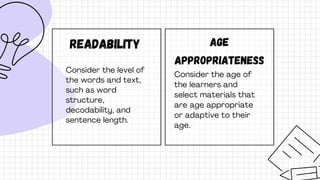
Readability
Consider the level of
the words and text,
such as word
structure,
decodability, and
sentence length.
Age
appropriateness
Consider the age of
the learners and
select materials that
are age appropriate
or adaptive to their
age.
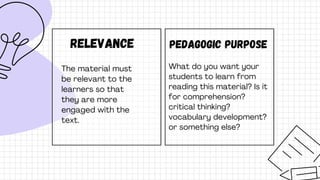
Relevance
The material must
be relevant to the
learners so that
they are more
engaged with the
text.
Pedagogic purpose
What do you want your
students to learn from
reading this material? Is it
for comprehension?
critical thinking?
vocabulary development?
or something else?
Other Considerations:
Accessibility and Availability
Quality of Writing
Diversity or Variety
WAYS TO CHOOSE A
GOOD BOOK
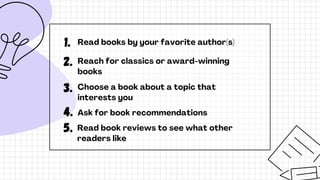
1. Read books by your favorite author(s)
2. Reach for classics or award-winning
books
Choose a book about a topic that
interests you
3.
Ask for book recommendations
4.
5. Read book reviews to see what other
readers like
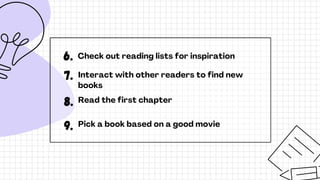
6. Check out reading lists for inspiration
7. Interact with other readers to find new
books
Read the first chapter
8.
Pick a book based on a good movie
9.
conclusion
To sum it all up, there are several ways to choose a good book or
any kind of reading material. It needs to consider one’s interests,
goals, and preferences while being cautious about the value,
authenticity, and appropriateness of its content to ensure the
safety and relevance of the reading materials you’ll use. It’s
indeed true that the journey of choosing books is a gateway to a
world of imagination, learning, and self-discovery. Furthermore,
by being knowledgeable about the things that are needed for
consideration will effectively support your teaching and make
the learners become successful readers.
THANK YOU

CHOOSING BOOKS AND READING MATERIALS .pdf

  • 1.
  • 2.
  • 3.
    format Reading materials canbe classified based on their format, referring to the medium or presentation style through which the content is delivered. topic Reading materials are commonly classified based on their topics or subject matter. This categorization helps readers find content that aligns with their interests, and needs.
  • 4.
    age Classifying reading materialsby age is a common practice to ensure that content is appropriate and engaging for different developmental stages.
  • 5.
    Examples of readingmaterials Books E-books Magazines Newspapers Textbooks Reference Materials Online Content Comics and Graphic Novels Pamphlets and Brochures
  • 6.
    THINGS TO CONSIDER INCHOOSING BOOKS AND READING MATERIALS
  • 7.
    Interest Choose books about thetopics that align with your interests for more enjoyable and motivating reading. Genre What kind of stories do you enjoy? Do you prefer mysteries, romances, comedies, or something else entirely?
  • 8.
    Readability Consider the levelof the words and text, such as word structure, decodability, and sentence length. Age appropriateness Consider the age of the learners and select materials that are age appropriate or adaptive to their age.
  • 9.
    Relevance The material must berelevant to the learners so that they are more engaged with the text. Pedagogic purpose What do you want your students to learn from reading this material? Is it for comprehension? critical thinking? vocabulary development? or something else?
  • 10.
    Other Considerations: Accessibility andAvailability Quality of Writing Diversity or Variety
  • 11.
    WAYS TO CHOOSEA GOOD BOOK
  • 12.
    1. Read booksby your favorite author(s) 2. Reach for classics or award-winning books Choose a book about a topic that interests you 3. Ask for book recommendations 4. 5. Read book reviews to see what other readers like
  • 13.
    6. Check outreading lists for inspiration 7. Interact with other readers to find new books Read the first chapter 8. Pick a book based on a good movie 9.
  • 14.
    conclusion To sum itall up, there are several ways to choose a good book or any kind of reading material. It needs to consider one’s interests, goals, and preferences while being cautious about the value, authenticity, and appropriateness of its content to ensure the safety and relevance of the reading materials you’ll use. It’s indeed true that the journey of choosing books is a gateway to a world of imagination, learning, and self-discovery. Furthermore, by being knowledgeable about the things that are needed for consideration will effectively support your teaching and make the learners become successful readers.
  • 15.