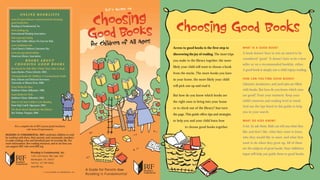
RI F ’ s GU I DE TO

ONLINE BOOKLISTS
www.rif.org/us/literacy-resources/articles/choosinggood-books.htm
Reading Is Fundamental, Inc.
www.reading.org
International Reading Association
kids.nypl.org/reading
New York Public Library On-Lion for Kids
www.carolhurst.com
Carol Hurst’s Children’s Literature Site

Choosing

Good BooAKes
f All g s
f r Children o
o

Choosing Good Books
Access to good books is the first step to
discovering the joy of reading. The more trips

www.ala.org/yalsa/booklists
American Library Association

WHAT IS A GOOD BOOK?

A book doesn’t have to win an award to be

you make to the library together, the more

BOOKS ABOUT
CHOOSING GOOD BOOKS

likely your child will want to choose a book

Best Books for Kids Who (Think They) Hate to Read
Laura Backes. Prima Lifestyle, 2001.

considered “good.” It doesn’t have to be a best
seller or on a recommended booklist, either.
A good book is simply one a child enjoys reading.

from the stacks. The more books you have

Choosing Books for Children: A Commonsense Guide
Betsy Hearne and Deborah Stevenson.
University of Illinois Press, 2000.

in your home, the more likely your child
will pick one up and read it.

Great Books for Boys
Kathleen Odean. Ballantine, 1998.

HOW CAN YOU FIND GOOD BOOKS?

Libraries, bookstores, and yard sales are filled
with books. But how do you know which ones

Great Books for Girls
Kathleen Odean. Ballantine, 2002.

But how do you know which books are

are good? Trust your instincts. Keep your

How to Get Your Child to Love Reading
Esmé Raji Codell. Algonquin, 2003.

the right ones to bring into your home

child’s interests and reading level in mind.

or to check out of the library? Just turn

And use the tips listed in this guide to help

The Read-Aloud Handbook, 6th Edition
Jim Trelease. Penguin, 2006.

the page. This guide offers tips and strategies
to help you and your child learn how

For a complete list of RIF’s parent guide brochures,
visit www.rif.org/resources.

to choose good books together.

WHAT DO KIDS KNOW?

A lot. So ask them. Kids can tell you what they
like and don’t like, what they want to learn,

READING IS FUNDAMENTAL (RIF) motivates children to read

who they would like to meet, and what they

by working with them, their parents, and community members
to make reading a fun and beneficial part of everyday life. For
more information, free reading resources, and to see how you
can support RIF, visit www.RIF.org.

want to do when they grow up. All of these
are the subjects of great books. Your children’s

Reading Is Fundamental, Inc.

input will help you guide them to good books.

1255 23rd Street, NW, Suite 300
Washington, DC 20037
Toll free: 877-RIF-READ
www.RIF.org
© 2010 READING IS FUNDAMENTAL, INC.

you in your search.

A Guide for Parents from
Reading Is Fundamental

®
Take the Mystery Out of

Choosing Good Books

Children’s reading interests and needs change as they grow.
Here are some basic things to look for as you help kids
at any age choose good books.

YOUNG READERS (AGES 6 TO 11)

ADOLESCENTS (AGES 12 AND UP)

✽

✽

✽

✽
✽

INFANTS AND TODDLERS

PRESCHOOLERS (AGES 3 TO 5)

(BIRTH TO AGE 2)

✽

✽

Books with big, bright, colorful
pictures of familiar objects.
✽ Durable books made of cardboard,
plastic, or washable cloth. These
books are usually a good size and
shape for small children to handle.
✽ Books that appeal to their senses, such
as fabric books, books with textures,
and books with scents.
✽ Stories told in short,
simple sentences with
pictures that explain
the text.
✽ Poems and rhymes
that are fun for
parents to
read aloud.

✽
✽
✽

✽
✽

Illustrations and photos that are clear, colorful,
and engaging.
Simple, fun plots. The action should move
quickly, so each book can be read in one sitting.
Lively rhymes and repetition that children
can repeat and remember.
Stories about everyday life and events.
The stories should encourage children
to ask questions and explore their world.
Stories that review basic concepts, such
as letters, numbers, shapes, and colors.
Main characters who are your
child’s age or slightly older.
Playful animals,
both real and
imaginary, will
also hold a child’s
attention.

✽
✽
✽

✽
✽

Clear text that is easy to read.
Colorful, attractive illustrations and photos
that bring the text to life and give clues
to the meaning of unfamiliar words.
Books that appeal to your child’s interests.
“How-to,” craft, and recipe books with
clear, simply worded instructions and
helpful illustrations.
Other books by your child’s favorite authors
and illustrators.
Books with your child’s favorite characters.
Stories your child enjoyed hearing when
he or she was younger. These are great books
for children to begin reading on their own.
Books that encourage discussion.
Chapter books that can be read over several
days instead of in one sitting.

✽

✽
✽
✽

Books about subjects that interest
your child.
Novels that might help your child
cope with daily challenges of growing
up by featuring characters dealing
with similar experiences.
Books that introduce new
experiences and opportunities.
Fact books, such as world record
books, trivia books, and almanacs.
Biographies, classics, folk tales,
historical fiction, and mythology.

Quick Tips!
✽ Knowing how to choose good books is a skill your children will keep for the rest of their lives. Take time
to show them how. Encourage them to select books on their own as soon as they show preferences.
You can even let them pick two kinds of books—one to read with you and one to read on their own.
✽ Get to know the children’s section of your local library, and ask the children’s librarian for recommendations.
Check lists of recommended books, such as those included on the back of this guide.
✽ It’s okay to look through a book and then decide not to read the whole thing. If you don’t like a book
after reading a chapter or a few pages, pick another one. Reading is supposed to be fun, not a chore.

Brochure

  • 1.
    RI F ’s GU I DE TO ONLINE BOOKLISTS www.rif.org/us/literacy-resources/articles/choosinggood-books.htm Reading Is Fundamental, Inc. www.reading.org International Reading Association kids.nypl.org/reading New York Public Library On-Lion for Kids www.carolhurst.com Carol Hurst’s Children’s Literature Site Choosing Good BooAKes f All g s f r Children o o Choosing Good Books Access to good books is the first step to discovering the joy of reading. The more trips www.ala.org/yalsa/booklists American Library Association WHAT IS A GOOD BOOK? A book doesn’t have to win an award to be you make to the library together, the more BOOKS ABOUT CHOOSING GOOD BOOKS likely your child will want to choose a book Best Books for Kids Who (Think They) Hate to Read Laura Backes. Prima Lifestyle, 2001. considered “good.” It doesn’t have to be a best seller or on a recommended booklist, either. A good book is simply one a child enjoys reading. from the stacks. The more books you have Choosing Books for Children: A Commonsense Guide Betsy Hearne and Deborah Stevenson. University of Illinois Press, 2000. in your home, the more likely your child will pick one up and read it. Great Books for Boys Kathleen Odean. Ballantine, 1998. HOW CAN YOU FIND GOOD BOOKS? Libraries, bookstores, and yard sales are filled with books. But how do you know which ones Great Books for Girls Kathleen Odean. Ballantine, 2002. But how do you know which books are are good? Trust your instincts. Keep your How to Get Your Child to Love Reading Esmé Raji Codell. Algonquin, 2003. the right ones to bring into your home child’s interests and reading level in mind. or to check out of the library? Just turn And use the tips listed in this guide to help The Read-Aloud Handbook, 6th Edition Jim Trelease. Penguin, 2006. the page. This guide offers tips and strategies to help you and your child learn how For a complete list of RIF’s parent guide brochures, visit www.rif.org/resources. to choose good books together. WHAT DO KIDS KNOW? A lot. So ask them. Kids can tell you what they like and don’t like, what they want to learn, READING IS FUNDAMENTAL (RIF) motivates children to read who they would like to meet, and what they by working with them, their parents, and community members to make reading a fun and beneficial part of everyday life. For more information, free reading resources, and to see how you can support RIF, visit www.RIF.org. want to do when they grow up. All of these are the subjects of great books. Your children’s Reading Is Fundamental, Inc. input will help you guide them to good books. 1255 23rd Street, NW, Suite 300 Washington, DC 20037 Toll free: 877-RIF-READ www.RIF.org © 2010 READING IS FUNDAMENTAL, INC. you in your search. A Guide for Parents from Reading Is Fundamental ®
  • 2.
    Take the MysteryOut of Choosing Good Books Children’s reading interests and needs change as they grow. Here are some basic things to look for as you help kids at any age choose good books. YOUNG READERS (AGES 6 TO 11) ADOLESCENTS (AGES 12 AND UP) ✽ ✽ ✽ ✽ ✽ INFANTS AND TODDLERS PRESCHOOLERS (AGES 3 TO 5) (BIRTH TO AGE 2) ✽ ✽ Books with big, bright, colorful pictures of familiar objects. ✽ Durable books made of cardboard, plastic, or washable cloth. These books are usually a good size and shape for small children to handle. ✽ Books that appeal to their senses, such as fabric books, books with textures, and books with scents. ✽ Stories told in short, simple sentences with pictures that explain the text. ✽ Poems and rhymes that are fun for parents to read aloud. ✽ ✽ ✽ ✽ ✽ Illustrations and photos that are clear, colorful, and engaging. Simple, fun plots. The action should move quickly, so each book can be read in one sitting. Lively rhymes and repetition that children can repeat and remember. Stories about everyday life and events. The stories should encourage children to ask questions and explore their world. Stories that review basic concepts, such as letters, numbers, shapes, and colors. Main characters who are your child’s age or slightly older. Playful animals, both real and imaginary, will also hold a child’s attention. ✽ ✽ ✽ ✽ ✽ Clear text that is easy to read. Colorful, attractive illustrations and photos that bring the text to life and give clues to the meaning of unfamiliar words. Books that appeal to your child’s interests. “How-to,” craft, and recipe books with clear, simply worded instructions and helpful illustrations. Other books by your child’s favorite authors and illustrators. Books with your child’s favorite characters. Stories your child enjoyed hearing when he or she was younger. These are great books for children to begin reading on their own. Books that encourage discussion. Chapter books that can be read over several days instead of in one sitting. ✽ ✽ ✽ ✽ Books about subjects that interest your child. Novels that might help your child cope with daily challenges of growing up by featuring characters dealing with similar experiences. Books that introduce new experiences and opportunities. Fact books, such as world record books, trivia books, and almanacs. Biographies, classics, folk tales, historical fiction, and mythology. Quick Tips! ✽ Knowing how to choose good books is a skill your children will keep for the rest of their lives. Take time to show them how. Encourage them to select books on their own as soon as they show preferences. You can even let them pick two kinds of books—one to read with you and one to read on their own. ✽ Get to know the children’s section of your local library, and ask the children’s librarian for recommendations. Check lists of recommended books, such as those included on the back of this guide. ✽ It’s okay to look through a book and then decide not to read the whole thing. If you don’t like a book after reading a chapter or a few pages, pick another one. Reading is supposed to be fun, not a chore.