DR.R.TAMILARASI,
DEPARTMENT OF COMMUNITY MEDICINE.
EPIDEMIOLOGY OF CHOLERA
 Introduction
 Agent, Host and Environment
 Sign and symptoms
 Complications.
 Prevention and Control
 National Programmes
 Cholera – an ACUTE DIARRHEAL DISEASE caused by
V.Cholerae O1.
 Symptomless to severe infections.
 Mostly asymptomatic.
 Case fatality rate – 30% to 40%
AGENT FACTORS
 Agent: Vibrio cholerae
 Has over 150 identified serotypes based on O-antigen
 Only the Epidemic strains - O1 and O139 are toxigenic and cause
Cholera disease (Water-borne illness)
 Source of infection: case of Cholera by Fecal-oral transmission
 Reservoir: Humans.
 Infective materials: stools and vomitus of cases and carriers.
V.cholerae
O1
Classical
Eltor
O139
Period of Communicability
During acute stage – 7 to 10 days
Convalescent carriers – 2 to 3 weeks; Chronic carriers – a
month upto 10 years
By end of week, 70% of patients non-infectious
 By end of third week, 98% non-infectious
INCUBATION PERIOD:Ranges from a few hours to 5 days.
Universal I/P is 5 days.
MODE OF TRANSMISSION
A.WATER : Primary ingestion of water (contaminated with
faeces)
OR
B.FOOD & DRINKS: Ingestion of food contaminated by dirty
water, faeces, soiled hands or flies. Eg: feeding bottle
OR
C.DIRECT CONTACT: The disease transmitted from one person to
another person in over crowded and unhygienic conditions.
Eg: fingers , linen, fomites
DEFINITION:
 Apparently healthy person who is excreting V.Cholerae O1 in
stools.
TYPES:
 A) PRE CLINICAL CARRIERS / INCUBATORY CARRIER- potential patients
 B) CONVALESCENT CARRIERS – 2 -3 weeks after recovery
 C) CONTACT OR HEALTHY CARRIERS – sub clinical cases
 D) CHRONIC CARRIERS – 10 years
HOST FACTORS
1. Age: Children: All ages.
2. Sex: Equal in both male and female.
3. Gastric acidity: PH of <5 will destroy vibrio.
4. Population mobility
5. Economic status: Lower SES.
6. Immunity: Less immune higher risk.
7. Blood types
O>> B > A > AB
ENVIRONMENTAL FACTORS
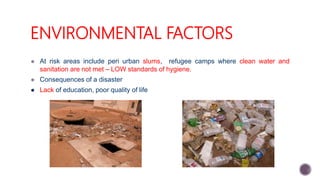
 At risk areas include peri urban slums, refugee camps where clean water and
sanitation are not met – LOW standards of hygiene.
 Consequences of a disaster
 Lack of education, poor quality of life
CLINICAL FEATURES
1) STAGE OF EVACUATION:
 The primary symptoms of cholera are profuse, painless diarrhea and
vomiting of clear fluid.
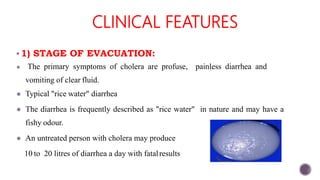
 Typical "rice water" diarrhea
 The diarrhea is frequently described as "rice water" in nature and may have a
fishy odour.
 An untreated person with cholera may produce
10 to 20 litres of diarrhea a day with fatalresults
SIGNS AND SYMPTOMs
2) STAGE OF COLLAPSE
 If the severe diarrhoea is not treated with intravenous rehydration, it
can result in life- threatening dehydration and electrolyte imbalances.
 Sunken eyes, hollow cheeks, scaphoid abdomen, decreased skin turgor
that causes wrinkled hands and skin, rapid pulse, low blood pressure,
sub normal temperature, shallow and quick respirations, decreased
urine output.
 Death due to acidosis.
SIGNS AND SYMPTOMs
3) STAGE OF RECOVERY:
 Severe form occur in 5-10 percent.
 Mild cases recover in 1 to 3 days.
El Tor vs Classical:
 A) higher mild & asymptomatic cases
 B) fewer secondary cases
 C) survive longer in extra intestinal environment
 D) occurrence of chronic carriers
COMPLICATIONS
 The degree and duration of fluid and electrolyte loss determines the
medical consequences of cholera.
 For example, renal failure may stem from the reduced fluid flow through the
kidneys; low blood sugar (hypoglycemia)
 may result in seizures or coma, especially in the young; or
 lowered potassium levels may trigger serious cardiac complications
 1) VERIFICATION OF DIAGNOSIS
 2) NOTIFICATION
 3) EARLY CASE FINDING
 4) ESTABLISHMENT OF TREATMENT CENTRES
 5) REHYDRATION THERAPY
 6) ADJUNCTS TO THERAPY
 7) EPIDEMIOLOGICAL INVESTIGATIONS
 8) SANITATION MEASURES
 9) CHEMOPROPHYLAXIS
 10) VACCINATION
 11) HEALTH EDUCATION
1) VERIFICATION OF DIAGNOSIS – by bacteriological examination of stools.
2) NOTIFICATION – CHW/MPW to local health authority
IHR – within 24 hrs to WHO
3) EARLY CASE FINDING – HOUSE HOLD CONTACTS
4) ESTABLISHMENT OF TREATMENT CENTRES – easily accessible to
treatment – schools , public building.
5) REHYDRATION THERAPY
6) ADJUNCTS TO THERAPY – Antibiotics-floroquinalones, tetracyclines,
azithromycin, ampicillin.
7) EPIDEMIOLOGICAL INVESTIGATIONS
 8) SANITATION MEASURES
Water control: All water used for drinking, washing, or
cooking should be sterilized by either boiling,
chlorination, ozone water treatment, ultraviolet light
sterilization.
Excreta disposal: health education to use sanitary
latrine
Food sanitation: sale of foods under hygienic
conditions, eating cooked hot food, cooking utensils
should be clean and dry.
Disinfection: concurrent and terminal.
CONTROL OF CHOLERA
 9) CHEMOPROPHYLAXIS:
 Household contacts
 Closed community where cholera occurred
 Tetracycline – BD for 3 days
 500mg – adults
 125mg – 4-13 years
 50 mg – 0-3 years
 Doxycycline – single dose
 300 mg for adults
 6mg/kg for < 15 years
 10) VACCINATION:
 ORAL VACCINE:
A) Dukoral (WC-rBS) – heat killed whole cell vaccine
 Contains V.Cholerae O1- Classical & El Tor, Ogawa & Inaba and recombinant
cholera toxin B sbunit.
 3ml single dose vials with bicarbonate buffer.
 Vaccine and buffer ----------- water 150 ml > 5 years; 75 ml - 2-5 years;
 Dosage : 2 oral doses; at 7 days apart for adults and >= 6 years
3 oral doses; at 7 days apart for 2-5 years;
 Booster dose: after 2 years for adults and >= 6 years
every 6 months for 2-5 years;
Not for < 2 years.
B) Sanchol and mORCVAX
Contains both O1 and O139
DOSE: 2 doses at 4 weeks apart for >1 year;
BOOSTER: after 2 years
C) Euvichol
Same as Sanchol.
 11) HEALTH EDUCATION
 About ORT
 Benefits of early reporting to treatment
 Food hygiene practice
 Hand washing
 Cooked and hot food; safe water
DIARRHOEA DISEASE CONTROL PROGRAM
1980 -81 – NATIONAL CHOLERA CONTROL
PROGRAMME
1986 – 87 - ORAL REHYDRATION THERAPY
PROGRAMME
Main objective – prevent diarrhea associated deaths
THANK YOU

Cholera

  • 1.
  • 2.
    EPIDEMIOLOGY OF CHOLERA Introduction  Agent, Host and Environment  Sign and symptoms  Complications.  Prevention and Control  National Programmes
  • 3.
     Cholera –an ACUTE DIARRHEAL DISEASE caused by V.Cholerae O1.  Symptomless to severe infections.  Mostly asymptomatic.  Case fatality rate – 30% to 40%
  • 4.
    AGENT FACTORS  Agent:Vibrio cholerae  Has over 150 identified serotypes based on O-antigen  Only the Epidemic strains - O1 and O139 are toxigenic and cause Cholera disease (Water-borne illness)  Source of infection: case of Cholera by Fecal-oral transmission  Reservoir: Humans.  Infective materials: stools and vomitus of cases and carriers.
  • 5.
  • 6.
    Period of Communicability Duringacute stage – 7 to 10 days Convalescent carriers – 2 to 3 weeks; Chronic carriers – a month upto 10 years By end of week, 70% of patients non-infectious  By end of third week, 98% non-infectious INCUBATION PERIOD:Ranges from a few hours to 5 days. Universal I/P is 5 days.
  • 7.
    MODE OF TRANSMISSION A.WATER: Primary ingestion of water (contaminated with faeces) OR B.FOOD & DRINKS: Ingestion of food contaminated by dirty water, faeces, soiled hands or flies. Eg: feeding bottle OR C.DIRECT CONTACT: The disease transmitted from one person to another person in over crowded and unhygienic conditions. Eg: fingers , linen, fomites
  • 8.
    DEFINITION:  Apparently healthyperson who is excreting V.Cholerae O1 in stools. TYPES:  A) PRE CLINICAL CARRIERS / INCUBATORY CARRIER- potential patients  B) CONVALESCENT CARRIERS – 2 -3 weeks after recovery  C) CONTACT OR HEALTHY CARRIERS – sub clinical cases  D) CHRONIC CARRIERS – 10 years
  • 9.
    HOST FACTORS 1. Age:Children: All ages. 2. Sex: Equal in both male and female. 3. Gastric acidity: PH of <5 will destroy vibrio. 4. Population mobility 5. Economic status: Lower SES. 6. Immunity: Less immune higher risk. 7. Blood types O>> B > A > AB
  • 10.
    ENVIRONMENTAL FACTORS  Atrisk areas include peri urban slums, refugee camps where clean water and sanitation are not met – LOW standards of hygiene.  Consequences of a disaster  Lack of education, poor quality of life
  • 11.
    CLINICAL FEATURES 1) STAGEOF EVACUATION:  The primary symptoms of cholera are profuse, painless diarrhea and vomiting of clear fluid.  Typical "rice water" diarrhea  The diarrhea is frequently described as "rice water" in nature and may have a fishy odour.  An untreated person with cholera may produce 10 to 20 litres of diarrhea a day with fatalresults
  • 12.
    SIGNS AND SYMPTOMs 2)STAGE OF COLLAPSE  If the severe diarrhoea is not treated with intravenous rehydration, it can result in life- threatening dehydration and electrolyte imbalances.  Sunken eyes, hollow cheeks, scaphoid abdomen, decreased skin turgor that causes wrinkled hands and skin, rapid pulse, low blood pressure, sub normal temperature, shallow and quick respirations, decreased urine output.  Death due to acidosis.
  • 13.
    SIGNS AND SYMPTOMs 3)STAGE OF RECOVERY:  Severe form occur in 5-10 percent.  Mild cases recover in 1 to 3 days. El Tor vs Classical:  A) higher mild & asymptomatic cases  B) fewer secondary cases  C) survive longer in extra intestinal environment  D) occurrence of chronic carriers
  • 14.
    COMPLICATIONS  The degreeand duration of fluid and electrolyte loss determines the medical consequences of cholera.  For example, renal failure may stem from the reduced fluid flow through the kidneys; low blood sugar (hypoglycemia)  may result in seizures or coma, especially in the young; or  lowered potassium levels may trigger serious cardiac complications
  • 15.
     1) VERIFICATIONOF DIAGNOSIS  2) NOTIFICATION  3) EARLY CASE FINDING  4) ESTABLISHMENT OF TREATMENT CENTRES  5) REHYDRATION THERAPY  6) ADJUNCTS TO THERAPY  7) EPIDEMIOLOGICAL INVESTIGATIONS  8) SANITATION MEASURES  9) CHEMOPROPHYLAXIS  10) VACCINATION  11) HEALTH EDUCATION
  • 16.
    1) VERIFICATION OFDIAGNOSIS – by bacteriological examination of stools. 2) NOTIFICATION – CHW/MPW to local health authority IHR – within 24 hrs to WHO 3) EARLY CASE FINDING – HOUSE HOLD CONTACTS 4) ESTABLISHMENT OF TREATMENT CENTRES – easily accessible to treatment – schools , public building. 5) REHYDRATION THERAPY 6) ADJUNCTS TO THERAPY – Antibiotics-floroquinalones, tetracyclines, azithromycin, ampicillin. 7) EPIDEMIOLOGICAL INVESTIGATIONS
  • 17.
     8) SANITATIONMEASURES Water control: All water used for drinking, washing, or cooking should be sterilized by either boiling, chlorination, ozone water treatment, ultraviolet light sterilization. Excreta disposal: health education to use sanitary latrine Food sanitation: sale of foods under hygienic conditions, eating cooked hot food, cooking utensils should be clean and dry. Disinfection: concurrent and terminal. CONTROL OF CHOLERA
  • 18.
     9) CHEMOPROPHYLAXIS: Household contacts  Closed community where cholera occurred  Tetracycline – BD for 3 days  500mg – adults  125mg – 4-13 years  50 mg – 0-3 years  Doxycycline – single dose  300 mg for adults  6mg/kg for < 15 years
  • 19.
     10) VACCINATION: ORAL VACCINE: A) Dukoral (WC-rBS) – heat killed whole cell vaccine  Contains V.Cholerae O1- Classical & El Tor, Ogawa & Inaba and recombinant cholera toxin B sbunit.  3ml single dose vials with bicarbonate buffer.  Vaccine and buffer ----------- water 150 ml > 5 years; 75 ml - 2-5 years;  Dosage : 2 oral doses; at 7 days apart for adults and >= 6 years 3 oral doses; at 7 days apart for 2-5 years;  Booster dose: after 2 years for adults and >= 6 years every 6 months for 2-5 years; Not for < 2 years.
  • 20.
    B) Sanchol andmORCVAX Contains both O1 and O139 DOSE: 2 doses at 4 weeks apart for >1 year; BOOSTER: after 2 years C) Euvichol Same as Sanchol.
  • 21.
     11) HEALTHEDUCATION  About ORT  Benefits of early reporting to treatment  Food hygiene practice  Hand washing  Cooked and hot food; safe water
  • 22.
    DIARRHOEA DISEASE CONTROLPROGRAM 1980 -81 – NATIONAL CHOLERA CONTROL PROGRAMME 1986 – 87 - ORAL REHYDRATION THERAPY PROGRAMME Main objective – prevent diarrhea associated deaths
  • 23.