Chirp Spread
Spectrum
Communication
Presented By-
Mahmudul Islam (1506155)
Mohammad Abdul Mobin (1506006)
Spectrum
 “spectrum” is a general term to encompass the spatial and temporal
properties of any medium , including fiber optic cable , coaxial cable , and
ambient air.
Spread Spectrum
• Spread-spectrum techniques are methods by which a signal
(e.g an electrical , electromagnetic, or acoustic signal generated in
a particular bandwidth is deliberately spread in the frequency
domain , resulting in a signal with a wider bandwidth.)
• These techniques are used for varieties of reasons , including
a . The establishment of secure communications
b. increasing resistance to natural interference, noise
c. jamming , to prevent detection , and
d. to limit power flux density (e.g. in satellite downlinks)
Chirp
• A short, high-pitched sound , such as that made by a small bird or an
insect.
• The sound emitted by crickets is commonly referred to as chirping.
• The specificity of bird calls has been used extensively for species
identification.
• The calls of birds have been described using words or nonsense syllables
or line diagrams.
• Common terms in English include words such as quack,chirp
Chirp(conc.)
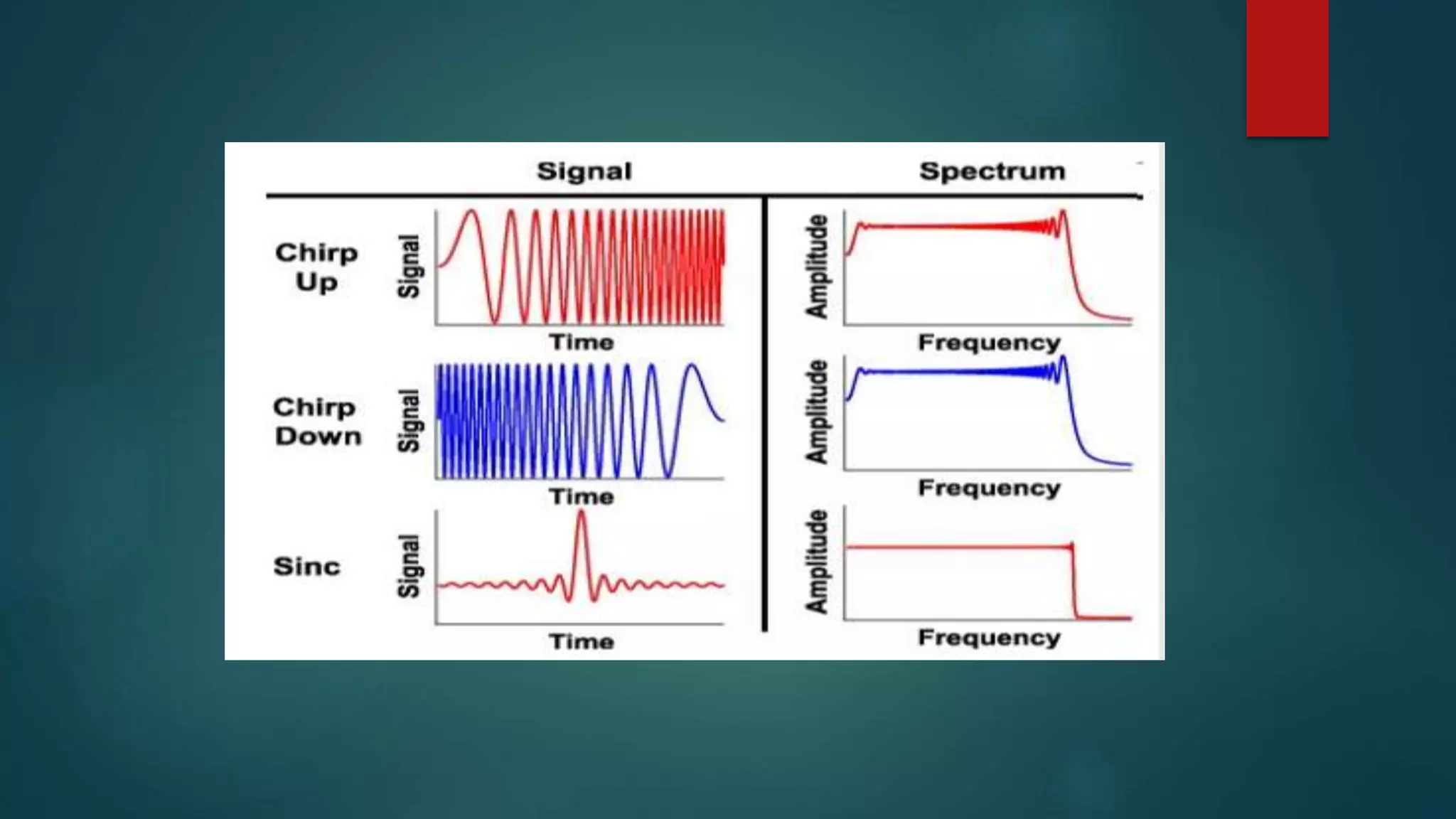
 A chirp is a signal in which frequency increased (‘up-chirp’) or decreases
(‘down-chirp’) with time .
 In some sources , the term chirp is used interchangeably with sweep
signal .
 It is commonly used in sonar and radar , but has other applications , such
as in spread spectrum communications.
 In spread spectrum usage , SAW devices such as RACs are often used to
generate and demodulate the chirped signals .
 In optics , ultrashort laser pulses also exhibit chirp , which , in optical
transmission systems interacts with the dispersion properties of the
materials , increasing or decreasing total pulse dispersion as the signal
propagates .
A chirp signal waveform can be written as
S(t) = a(t) cos[θ(t)]
Where θ(t) is the phase and a(t) is the envelope of the chirp signal which is zero outside a
time interval of length T.
The instantaneous frequency is defined as
fM (t) =
1
2𝜋
𝑑θ
𝑑𝑡
The chirp rate is defined by
µ(t) =
𝑑fM
𝑑𝑡
=
1
2𝜋
𝑑2θ
𝑑𝑡2
and represents the rate of change of the instantaneous frequency.
Chirp(conc.)
 When µ (t) > 0 then the signal is called up-chirps
 When µ (t) < 0 then the signal is called down-chirps
 For a linear chirp µ (t) is constant, and hence fM (t) is a linear
function of t, and θ(t) is a quadratic function those with.
If we take the waveform to be centered at t = 0 it can be written as
s(t) = a(t) cos [2𝜋f0t + 𝜋µ𝑡2
+ φ0 ]
where fc is the center frequency and a(t) = 0 for |t| > T/2
It is convenient to define the bandwidth B as the range of the instantaneous
frequency, so that
B =| µ |T
Chirp(conc.)
 The impulse response of a matched filter for a linear chirp signal is again a linear chirp
signal but with a chirp rate of opposite sign.
 If a chirp waveform is fed into its matched filter the output signal typically has a
narrow IF peak at the chirp center frequency.
 If we consider chirp waveforms with at time domain envelopes and take the matched
filter to be centered at t = 0 we find an analytical expression for the output waveform
g(t) of the matched filter.
Chirp(conc.)
g(t) = h(t)*s(t)= φss (t)
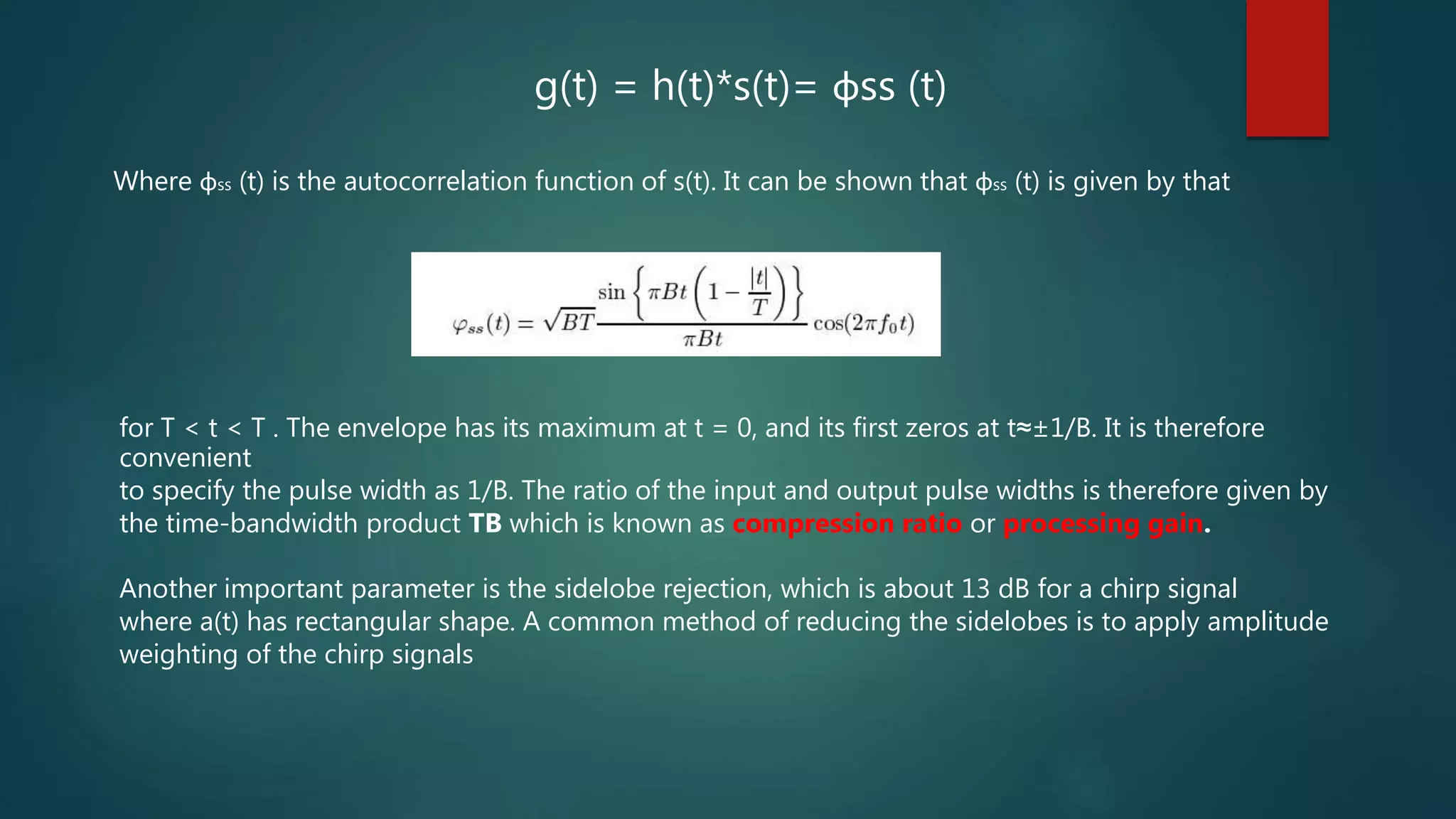
Where φss (t) is the autocorrelation function of s(t). It can be shown that φss (t) is given by that
for T < t < T . The envelope has its maximum at t = 0, and its first zeros at t≈±1/B. It is therefore
convenient
to specify the pulse width as 1/B. The ratio of the input and output pulse widths is therefore given by
the time-bandwidth product TB which is known as compression ratio or processing gain.
Another important parameter is the sidelobe rejection, which is about 13 dB for a chirp signal
where a(t) has rectangular shape. A common method of reducing the sidelobes is to apply amplitude
weighting of the chirp signals
Characteristics of Chirp pulses
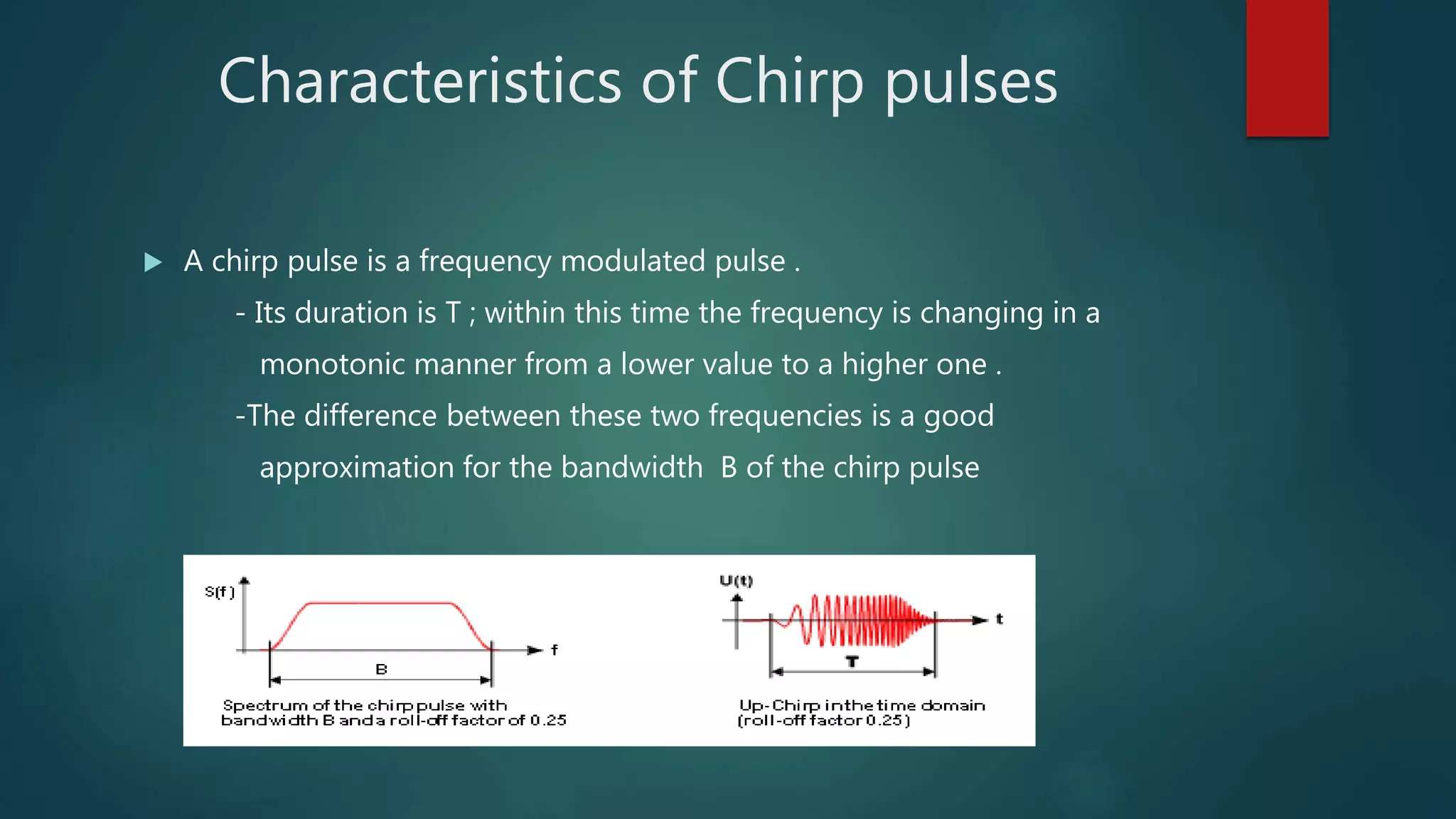
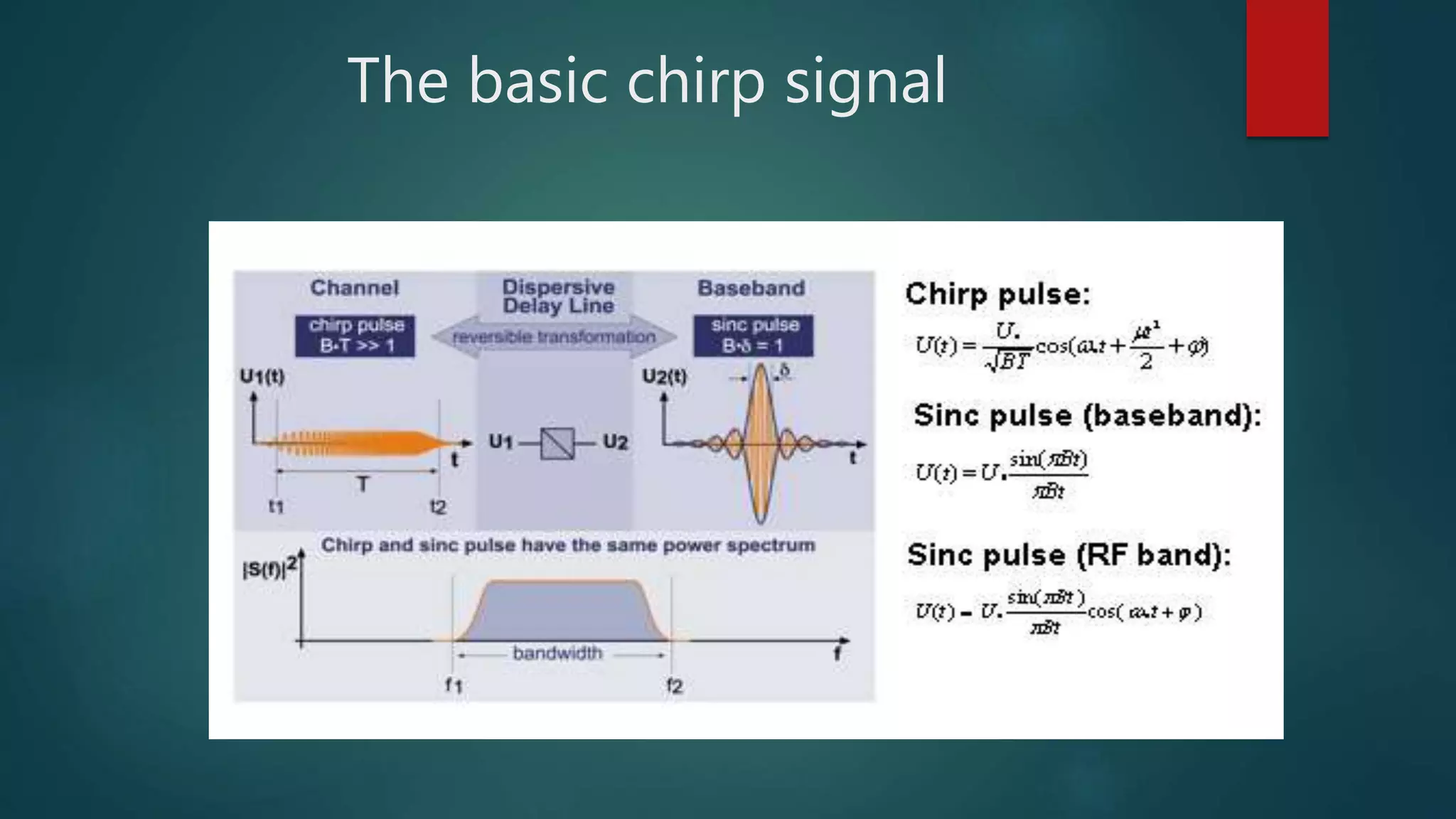
 A chirp pulse is a frequency modulated pulse .
- Its duration is T ; within this time the frequency is changing in a
monotonic manner from a lower value to a higher one .
-The difference between these two frequencies is a good
approximation for the bandwidth B of the chirp pulse
The basic chirp signal
Chirp Modulation
 Chirp modulation was patented by Sidney Darlington in 1954 with
significant later work performed by Winkler in 1962.
 This type of modulation employs sinusoidal waveforms whose
instantaneous frequency increases or decreases linearly over time . These
waveforms are commonly referred to as linear chirps or simply chirps .
 Hence the rate at which their frequency changes is called the “chirp rate”.
 In birnary chirp modulation , binary data is transmitted by mapping the
bits into chrips of opposite chirp rates. For instance, over one bit period “1”
is assigned a chrip with positive rate a and “0” a chirp with negative rate –
a .
Chirp Spread Spectrum (CSS) system
overview:
 Simplicity
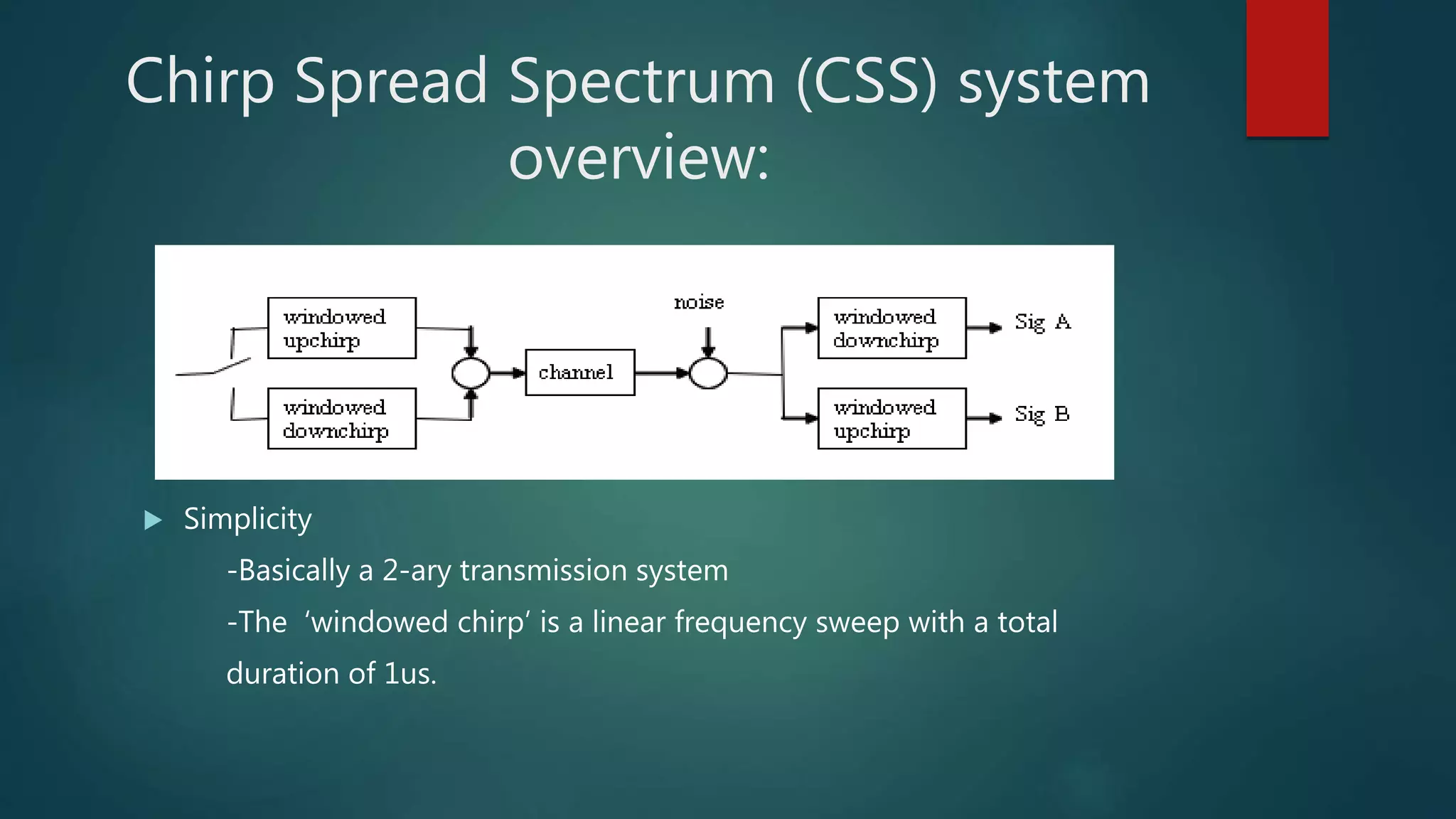
-Basically a 2-ary transmission system
-The ‘windowed chirp’ is a linear frequency sweep with a total
duration of 1us.
Key Properties of Chirp Spread
Spectrum (CSS)
• High robustness:
Due to the high BT product ,chirp pulses are very resistant
against disturbances
• Multipath resistant:
Due to the broadband chirp pulse , CSS is very immune against
multipath fading; CSS can ever take advantage of RF echoes.
• Low power consumption:
CSS allows the designer to choose an analog implementation ,
which often consumes much less power.
• Low latency :
CSS needs no synchronization ; a wireless connection can be
established very quickly.
Mobility Properties of CSS
 Resistance against Doppler effect :
The Doppler effect causes a frequency shift of the chirp pulse ,
Which introduces a negligible shift of the baseband signal on the time axis.
Coexistence Properties of CSS
 Immune to in-band interferer:
Scalable processing gain (determined by BT product of the chirp)
enables selection fo appropriate immunity level against in-band interferences
.

Chirp spread spectrum communication

  • 1.
    Chirp Spread Spectrum Communication Presented By- MahmudulIslam (1506155) Mohammad Abdul Mobin (1506006)
  • 2.
    Spectrum  “spectrum” isa general term to encompass the spatial and temporal properties of any medium , including fiber optic cable , coaxial cable , and ambient air.
  • 3.
    Spread Spectrum • Spread-spectrumtechniques are methods by which a signal (e.g an electrical , electromagnetic, or acoustic signal generated in a particular bandwidth is deliberately spread in the frequency domain , resulting in a signal with a wider bandwidth.) • These techniques are used for varieties of reasons , including a . The establishment of secure communications b. increasing resistance to natural interference, noise c. jamming , to prevent detection , and d. to limit power flux density (e.g. in satellite downlinks)
  • 4.
    Chirp • A short,high-pitched sound , such as that made by a small bird or an insect. • The sound emitted by crickets is commonly referred to as chirping. • The specificity of bird calls has been used extensively for species identification. • The calls of birds have been described using words or nonsense syllables or line diagrams. • Common terms in English include words such as quack,chirp
  • 5.
    Chirp(conc.)  A chirpis a signal in which frequency increased (‘up-chirp’) or decreases (‘down-chirp’) with time .  In some sources , the term chirp is used interchangeably with sweep signal .  It is commonly used in sonar and radar , but has other applications , such as in spread spectrum communications.  In spread spectrum usage , SAW devices such as RACs are often used to generate and demodulate the chirped signals .  In optics , ultrashort laser pulses also exhibit chirp , which , in optical transmission systems interacts with the dispersion properties of the materials , increasing or decreasing total pulse dispersion as the signal propagates .
  • 6.
    A chirp signalwaveform can be written as S(t) = a(t) cos[θ(t)] Where θ(t) is the phase and a(t) is the envelope of the chirp signal which is zero outside a time interval of length T. The instantaneous frequency is defined as fM (t) = 1 2𝜋 𝑑θ 𝑑𝑡 The chirp rate is defined by µ(t) = 𝑑fM 𝑑𝑡 = 1 2𝜋 𝑑2θ 𝑑𝑡2 and represents the rate of change of the instantaneous frequency. Chirp(conc.)
  • 7.
     When µ(t) > 0 then the signal is called up-chirps  When µ (t) < 0 then the signal is called down-chirps  For a linear chirp µ (t) is constant, and hence fM (t) is a linear function of t, and θ(t) is a quadratic function those with. If we take the waveform to be centered at t = 0 it can be written as s(t) = a(t) cos [2𝜋f0t + 𝜋µ𝑡2 + φ0 ] where fc is the center frequency and a(t) = 0 for |t| > T/2 It is convenient to define the bandwidth B as the range of the instantaneous frequency, so that B =| µ |T Chirp(conc.)
  • 8.
     The impulseresponse of a matched filter for a linear chirp signal is again a linear chirp signal but with a chirp rate of opposite sign.  If a chirp waveform is fed into its matched filter the output signal typically has a narrow IF peak at the chirp center frequency.  If we consider chirp waveforms with at time domain envelopes and take the matched filter to be centered at t = 0 we find an analytical expression for the output waveform g(t) of the matched filter. Chirp(conc.)
  • 9.
    g(t) = h(t)*s(t)=φss (t) Where φss (t) is the autocorrelation function of s(t). It can be shown that φss (t) is given by that for T < t < T . The envelope has its maximum at t = 0, and its first zeros at t≈±1/B. It is therefore convenient to specify the pulse width as 1/B. The ratio of the input and output pulse widths is therefore given by the time-bandwidth product TB which is known as compression ratio or processing gain. Another important parameter is the sidelobe rejection, which is about 13 dB for a chirp signal where a(t) has rectangular shape. A common method of reducing the sidelobes is to apply amplitude weighting of the chirp signals
  • 10.
    Characteristics of Chirppulses  A chirp pulse is a frequency modulated pulse . - Its duration is T ; within this time the frequency is changing in a monotonic manner from a lower value to a higher one . -The difference between these two frequencies is a good approximation for the bandwidth B of the chirp pulse
  • 11.
  • 12.
    Chirp Modulation  Chirpmodulation was patented by Sidney Darlington in 1954 with significant later work performed by Winkler in 1962.  This type of modulation employs sinusoidal waveforms whose instantaneous frequency increases or decreases linearly over time . These waveforms are commonly referred to as linear chirps or simply chirps .  Hence the rate at which their frequency changes is called the “chirp rate”.  In birnary chirp modulation , binary data is transmitted by mapping the bits into chrips of opposite chirp rates. For instance, over one bit period “1” is assigned a chrip with positive rate a and “0” a chirp with negative rate – a .
  • 14.
    Chirp Spread Spectrum(CSS) system overview:  Simplicity -Basically a 2-ary transmission system -The ‘windowed chirp’ is a linear frequency sweep with a total duration of 1us.
  • 17.
    Key Properties ofChirp Spread Spectrum (CSS) • High robustness: Due to the high BT product ,chirp pulses are very resistant against disturbances • Multipath resistant: Due to the broadband chirp pulse , CSS is very immune against multipath fading; CSS can ever take advantage of RF echoes. • Low power consumption: CSS allows the designer to choose an analog implementation , which often consumes much less power. • Low latency : CSS needs no synchronization ; a wireless connection can be established very quickly.
  • 18.
    Mobility Properties ofCSS  Resistance against Doppler effect : The Doppler effect causes a frequency shift of the chirp pulse , Which introduces a negligible shift of the baseband signal on the time axis.
  • 19.
    Coexistence Properties ofCSS  Immune to in-band interferer: Scalable processing gain (determined by BT product of the chirp) enables selection fo appropriate immunity level against in-band interferences .