Comm760: Social Constructions of Reality Adrian Lin
  1 
Chinese Dialects or Languages?
A Constructivist Approach to Linguistic Realities
Comm760
Adrian Lin
Professor Klaus Krippendorff
Comm760: Social Constructions of Reality Adrian Lin
  2 
Abstract: 
Linguistics, as the science of language, often creates classifications with criteria based on its 
own criteria and standards. This institutionalized discourse community might therefore 
not accurately represent the world as it purports to do because of the particular self‐
regulating ways of thinking that confines it to exclude certain standards that come from 
within the studied group, which must admittedly be included if any comprehensive view of 
the reality of languages and dialects in the world. This paper seeks to allow greater 
inclusion of the oft‐ignored subjects of linguistic studies to show the narratives, accounts 
and other social constructed criteria with which they describe themselves.
Comm760: Social Constructions of Reality Adrian Lin
  3 
Table of Contents: 
 
INTRODUCTION: NOTIONS OF LANGUAGES AND DIALECTS  4 
INCOMPATIBILITY OF LINGUISTIC DIVISIONS OF LANGUAGE WITH SOCIAL REALITY  5 
LINGUISTICS AS IMPOSING A FALSE OBJECTIVITY IN DESCRIBING REALITY  7 
CHINESE FĀNGYÁN: AUTOCHTHONOUS VIEWS ON CHINESE VARIETIES  11 
SURVEY:  12 
JUSTIFICATIONS AND DISCOURSES OF SPOKEN LANGUAGE WITHIN CHINA:  13 
ARGUMENT FROM GEOPOLITICS:  13 
ARGUMENT FROM SOCIAL VALUES AND UNITY:  14 
ARGUMENT FROM SIMILITUDE:  16 
ARGUMENT FROM THE SHARED WRITING SYSTEM:  17 
ON THE SURVEY LIMITATIONS:  18 
CONCLUSIONS:  19 
REFERENCES:  21 
APPENDIX A: SURVEY QUESTIONS  22 
APPENDIX B: SURVEY RESULTS  23 
APPENDIX B2: CONTINUED SURVEY RESULTS  32 
 
Comm760: Social Constructions of Reality Adrian Lin
  4 
Introduction: Notions of languages and dialects
Broadly speaking, there exist two methods of understanding what constitutes 
languages and dialects. The first is commonly employed by the field of Linguistics1 and 
scientifically uses the criterion of mutual intelligibility to organize speech varieties into 
languages or dialects; dialects would, under this definition, be “mutually intelligible” with 
the language it is said to branch off from.  Thus, all languages are judged by a single formal 
and immutable criterion, and none of the plethora of social factors. 
 
The other notion is actually built from an amalgamation of different societal factors 
and notions, including political, historical, ethnic, and national understandings, which 
together I shall term as the socially constructed understandings. These factors can each 
constitute an independent understanding of languages and dialects but commonly work in 
tandem in various social situations. They are often not fully compatible with each other, so 
it may seem odd that I group them as one; however, I group them together not only 
because they are even more commonly non‐coterminous with the linguistic definition but 
also as they provide a greater outlet for the speakers of such languages and dialects to 
describe their social reality, whereas the scientific, objectivist understanding espoused by 
Linguistics often does not.  
 
                                                        
1 Due to the double meaning of the adjective “linguistic” as either pertaining to language, or pertaining to the 
scientific study of language, I shall identify the latter meaning with capitalization. 
Comm760: Social Constructions of Reality Adrian Lin
  5 
Incompatibility of Linguistic divisions of language with social reality
Linguistics, being a scientific field, maintains and perpetuates itself within the a 
specific discourse with its own assumptions and institutions, often conflicts in view with 
those of lay people, those that its theories purport to describe and whose behaviors it tries 
to model.  For example, Hindi and Urdu, which respectively have statuses as one of the 
official languages in India and Pakistan are often called a single language by Linguistic 
standards, contrary to Indians’ and Pakistanis’ political understandings and identities, 
suggesting more similarities than these peoples wish to believe. Conversely, speech 
varieties in spoken by ethnic Han Chinese are Linguistically considered to be different 
languages. However, most Han Chinese feel that they speak not different languages, but 
various dialects.  
 
Because Linguistics as a field has its own discursive practices and institutes itself, 
Linguists from other cultures, in order to be accepted by the wider global Linguistics 
community, have to conform to these standards to be taken seriously and considered part 
of this discourse community. Mair (1991) echoes this Linguistic sentiment, although he 
takes care to consider other non‐Linguistic viewpoints: 
 
Unless the notion of dialect is somehow separated from politics, ethnicity, culture, and  
other non‐linguistic factors, the classification of languages and peoples of China can never  
be made fully compatible with work that is done for other parts of the world. (p. 13). 
 
Comm760: Social Constructions of Reality Adrian Lin
  6 
Indeed, Mair further mentions an example of Chinese Linguists’ reservations 
between the two discourse communities to which they belong, that of Linguistics and other 
being the wider Chinese community: 
 
Chinese scholars have repeatedly and confidentially told me on many occasions that  
Hanyu ‐‐ on purely linguistic grounds alone ‐‐ really ought to be considered as a group  
(yuzu), but that there are “traditional”, “political”, “nationalistic” and other factors that  
prevent them from declaring this publicly.” [boldening in original] (p. 10). 
 
Mair concludes his paper saying that although current Linguistic terms are 
incongruent with Chinese societal notions, this issue must be addressed “if Sino‐Tibetan 
linguistics is ever to take its place on an equal footing with Indo‐European and other areas 
of linguistic research,” and that the “best way to gain speedy respectability for our field is to 
apply impartially the same standards that are used throughout the world for all other 
languages” (p. 15). 
 
Thus, it can be seen that the rigid Linguistic definition makes affords no room for 
these individuals caught between the two institutionalized discourses that to them are very 
real and undeniable realities.  
 
The linguistic notion tries to remain objective by applying a single criterion 
systematically to all speech varieties. However, as seen, it is possible that this method is not 
without bias, due to Linguistics’ origins and historical association with one region of the 
world and its cultural academic practices; through this shortcoming and the rejection of 
Comm760: Social Constructions of Reality Adrian Lin
  7 
popular understandings of language and dialects denies the very real reality that the 
speakers of such “languages” and “dialects” themselves inhabit, and in no small part, help to 
construct. Only in combination can these two notions truly describe the nature of the 
various realities of different positions languages and dialects hold for the subjects these 
notions describe.  
Linguistics as imposing a false objectivity in describing reality
 
  To understand the dangers of using solely the linguistic definition of languages and 
dialects, one must first understand the history and development of modern Linguistics. 
Modern Linguistics developed out of the discipline of Philology, which, unlike Linguistics, 
emphasized history as well as literary studies. Modern Linguistics has since divorced itself 
from these two aspects, having been influenced by Ferdinand de Saussure’s emphasis on 
synchronic analysis and avoiding diachronic analysis. A problem with this is that cultural 
and political notions that stem from historical roots such as identity, which are integral to 
people’s lives are not considered. Had Linguistics remained more rooted in diachronic 
analyses, the current field of Linguistics might have been more wholesome. 
 
Blum (2005) quotes from Romaine illustrates this problem suggesting that the 
metaphor of dividing up languages and dialects into distinct bounded regions could be a 
cultural artifact, itself socially constructed out of the Western origins of modern Linguistics, 
“fostered by processes such as literacy and standardization” (p. 136) and stemming from 
the very political issues it strives to avoid. Thus, one might liken this view of its own 
Comm760: Social Constructions of Reality Adrian Lin
  8 
objectivity as a Stoltzenberg trap, because of the unquestioned axioms upon which is built 
the belief that the classification of languages and dialects reflects a universal reality. This 
view of social construction rather than inherent existence of languages and dialects is 
supported by Nic Craith (2006), who asserts that “[l]anguage is a concept that is 
increasingly recognised by political scientists and theorists as having been constructed in 
the era of nation states – as an idea that is closely linked to the erection of national 
boundaries” (106). 
 
Blum (2005) suggests instead that different possible metaphors used by various 
cultures, dividing the various cultural understandings of language into three categories: 
The first, boundary contesting, is common in Europe, where national boundaries are 
commonly coterminous with and often determined by language boundaries (134). This is 
the more common of the metaphors of language and is the notion upon which Linguistics 
bases its classification schemes. This metaphor often results in “othering” speakers in an 
insider‐outsider relationship and a narrative of self‐evidency in clear‐cut boundaries. 
 
  This particular metaphor was, perhaps, an example of an imperfect manner of 
understanding and representing the world which itself brought about the realization of the 
notions it described.  Languages had likely existed in continua merging seamlessly from 
one area to the next without clear natural boundaries one could use to define an area as 
having a preferred speech style. However, because of the standardization policies assumed 
such a reality or at least ideal reality in which one area’s speech variety could be thought of 
as standard and the rest, non‐standard in comparison, it eventually brought about the 
Comm760: Social Constructions of Reality Adrian Lin
  9 
actual manifestation of this idea by carving out boundaries from this metaphor and 
conforming each language to the speech of an arbitrarily defined speech community, 
roughly analogous and coterminous with the various nations of people in Europe. Indeed, 
Nic Craith (2006) gives the example of Norway’s two standards of language: “Nyorsh, the 
artificial standard, is somewhat different from Danish” but “the language commonly spoken 
is remarkably similar,” and also quotes from McWhorter (2002), that ‘ “what is today 
“Norwegian” was just “the way they speak Danish in Norway” until Norway broke with 
Denmark in 1814’ (p. 24). 
 
  The second metaphor, boundary celebrating, is one in which linguistic differences 
are exaggerated and, Blum quotes from Romaine (2000) in her example on Papua New 
Guinea’s linguistic diversity, “has none of the pressures towards convergence found for a 
long time in Europe and elsewhere, such as literacy, standardization, centralized 
administrative control, schooling, media, was present to any degree in pre‐colonial days.” 
 
  Blum calls the third metaphor boundary shrugging, for which she uses the example 
of Chinese language and nationalism, and which will also be the focus of this paper. She 
draws examples from Chinese society to describe its boundary shrugging perspective for 
the following reasons. 
 
1.   Linguistic difficulties are rarely mentioned in Chinese contexts where  
familiarity with other (mostly Indo‐European) societies would lead one to  
expect them: definitions of the nation, war, or political struggles. 
 
Comm760: Social Constructions of Reality Adrian Lin
  10 
  2.   Most attention in China has been paid to the written form of the language,  
and most people are scarcely aware of the characteristics of speech. Though  
there has been concern with literacy, it has not led to suppression of variation. 
 
  3.   Many people acquire multiple varieties of language easily and often, leading to  
a disposition that tolerates rather than rebuffs linguistic differences. (p. 136‐137). 
 
These two other means of understanding the social phenomenon of language 
suggest that the imposition of a single one may not adequately encapsulate the social 
realities that speakers know. A pure linguistic definition of languages and dialects still 
favours a particular standpoint or perspective, and therefore is perhaps less suitable in 
describing other cultures’ social reality of languages. 
 
Comm760: Social Constructions of Reality Adrian Lin
  11 
Chinese Fāngyán:
Autochthonous views on Chinese varieties
 
In this paper, I2 will explore the more popular understanding of spoken language in 
China on the speakers’ own terms, pointing out how social reality is constructed and 
maintained. This is in contrast to the common Linguistic practice to impose its criterion of 
mutual intelligibility, reducing its studied subjects to silent observers in their classification 
and without acknowledging their views and realities, resulting in an i‐other relationship. 
 
To start off, I should describe the term 方言 (fāngyán) as it is understood in China. 
Literally, it means region­speech, indicating a speech of a region. Mair (1991) discusses the 
evolution of the term fāngyán, mentioning that earlier definitions “stressed crudity or non‐
standardness of its exemplars” (p. 4), but nowadays is understood with a variety of 
definitions, although most emphasize shared linguistic history and the speakers’ shared 
method of written communication, which Linguistics does not see as justifiable factors. 
Nevertheless, the described speech varieties are invariably coterminous with what 
Linguistics currently calls the Chinese languages as well as the dialects of those languages. 
Mair attributes much of the confusion to the habit of translating fāngyán as dialects and 
proposes the neutral term topolect and stresses that this term be applied in lieu of dialect 
to syncretize the differing views.
                                                        
2 At this point, I will discontinue the sole use of the impersonal passive in reporting my findings so as not to 
conform to the institutional practice of supposed objectivism by denying the possible influence my 
background in Linguistics may have on my analysis. 
Comm760: Social Constructions of Reality Adrian Lin
  12 
Survey:
 
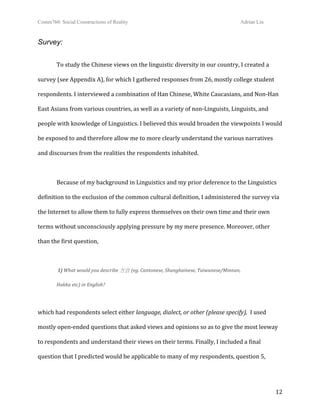
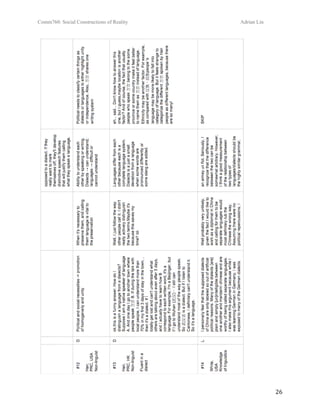
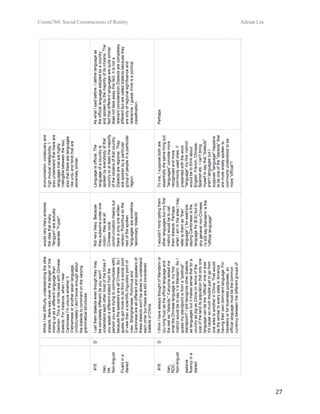
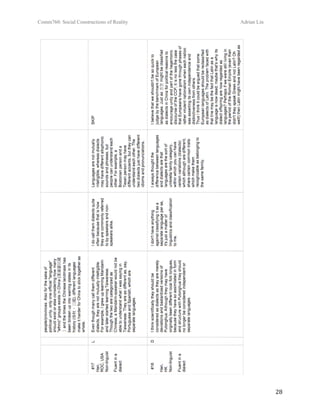
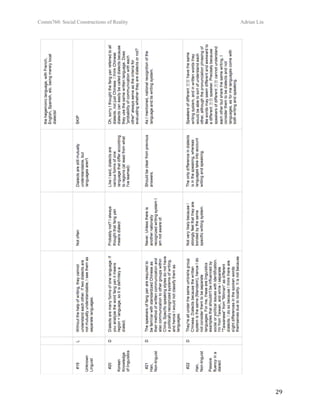
To study the Chinese views on the linguistic diversity in our country, I created a 
survey (see Appendix A), for which I gathered responses from 26, mostly college student 
respondents. I interviewed a combination of Han Chinese, White Caucasians, and Non‐Han 
East Asians from various countries, as well as a variety of non‐Linguists, Linguists, and 
people with knowledge of Linguistics. I believed this would broaden the viewpoints I would 
be exposed to and therefore allow me to more clearly understand the various narratives 
and discourses from the realities the respondents inhabited. 
 
Because of my background in Linguistics and my prior deference to the Linguistics 
definition to the exclusion of the common cultural definition, I administered the survey via 
the Internet to allow them to fully express themselves on their own time and their own 
terms without unconsciously applying pressure by my mere presence. Moreover, other 
than the first question,  
 
 1) What would you describe 方言 (eg. Cantonese, Shanghainese, Taiwanese/Minnan,  
Hakka etc) in English? 
 
which had respondents select either language, dialect, or other (please specify),  I used 
mostly open‐ended questions that asked views and opinions so as to give the most leeway 
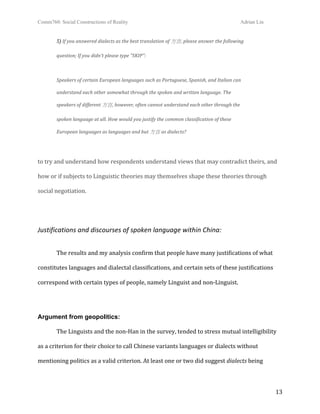
to respondents and understand their views on their terms. Finally, I included a final 
question that I predicted would be applicable to many of my respondents, question 5, 
 
Comm760: Social Constructions of Reality Adrian Lin
  13 
5) If you answered dialects as the best translation of 方言, please answer the following  
question; If you didn't please type "SKIP": 
 
Speakers of certain European languages such as Portuguese, Spanish, and Italian can  
understand each other somewhat through the spoken and written language. The  
speakers of different 方言, however, often cannot understand each other through the  
spoken language at all. How would you justify the common classification of these  
European languages as languages and but 方言 as dialects? 
 
to try and understand how respondents understand views that may contradict theirs, and 
how or if subjects to Linguistic theories may themselves shape these theories through 
social negotiation.  
 
Justifications and discourses of spoken language within China: 
 
  The results and my analysis confirm that people have many justifications of what 
constitutes languages and dialectal classifications, and certain sets of these justifications 
correspond with certain types of people, namely Linguist and non‐Linguist.  
 
Argument from geopolitics:
  The Linguists and the non‐Han in the survey, tended to stress mutual intelligibility 
as a criterion for their choice to call Chinese variants languages or dialects without 
mentioning politics as a valid criterion. At least one or two did suggest dialects being 
Comm760: Social Constructions of Reality Adrian Lin
  14 
“labeled so out of artificial political reasons” thus mostly downplaying agency to the 
common Chinese speaker. 
 
Han Chinese respondents seemed to view geopolitics as an important factor in 
determining fāngyán. They commonly stressed that languages are “official” while dialects 
are not, with one respondent calling regional boundaries the most important factor. While 
at first this seems to align with the previously mentioned respondent’s belief in a top‐down 
sanctioned official‐ness of certain speech variants as languages, many Han Chinese have 
seemed to take agency in negotiating ownership of and internalizing this belief. At least one 
respondent (#18) exhibited knowledge of the opposing view of official sanctioning of 
terminology but calling out the flip‐side that European nations themselves may have 
artificially emphasized differences for political reasons and even mused that it could be 
argued the various languages of southern Europe should be “re‐classified as dialects of 
Latin,” although also suggesting that one might not want to be so quick to “judge by the 
benchmark of European languages.” Verily, as Kurpaska (2010) succinctly puts, “[c]alling 
the varieties of Chinese ‘dialects’… rather than languages does have a strong political 
undertone, as it serves the unity of the Chinese people,” and can even “interfere in the 
sense of ethnic identity.” (p. 2‐3). 
 
Argument from social values and unity:
Many also recognized an aspect of national unity associated with a language, calling 
dialects variants of the language that branched off of the main language. Moreover, the 
ethnic diversity and size of China was also mentioned, and used as a justification for an 
Comm760: Social Constructions of Reality Adrian Lin
  15 
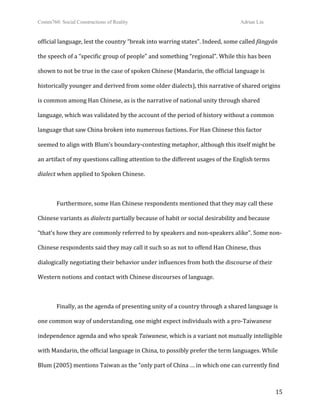
official language, lest the country “break into warring states”. Indeed, some called fāngyán 
the speech of a “specific group of people” and something “regional”. While this has been 
shown to not be true in the case of spoken Chinese (Mandarin, the official language is 
historically younger and derived from some older dialects), this narrative of shared origins 
is common among Han Chinese, as is the narrative of national unity through shared 
language, which was validated by the account of the period of history without a common 
language that saw China broken into numerous factions. For Han Chinese this factor 
seemed to align with Blum’s boundary‐contesting metaphor, although this itself might be 
an artifact of my questions calling attention to the different usages of the English terms 
dialect when applied to Spoken Chinese.  
 
Furthermore, some Han Chinese respondents mentioned that they may call these 
Chinese variants as dialects partially because of habit or social desirability and because 
“that’s how they are commonly referred to by speakers and non‐speakers alike”. Some non‐
Chinese respondents said they may call it such so as not to offend Han Chinese, thus 
dialogically negotiating their behavior under influences from both the discourse of their 
Western notions and contact with Chinese discourses of language. 
 
Finally, as the agenda of presenting unity of a country through a shared language is 
one common way of understanding, one might expect individuals with a pro‐Taiwanese 
independence agenda and who speak Taiwanese, which is a variant not mutually intelligible 
with Mandarin, the official language in China, to possibly prefer the term languages. While 
Blum (2005) mentions Taiwan as the “only part of China … in which one can currently find 
Comm760: Social Constructions of Reality Adrian Lin
  16 
activism on behalf of a linguistic variety” (p.139), respondent #24 who is Taiwanese and 
pro‐independence did not call them dialects, while respondent #17 did, although in the 
latter’s case, she had recently taken Ling001: Intro to Linguistics. 
 
Argument from similitude:
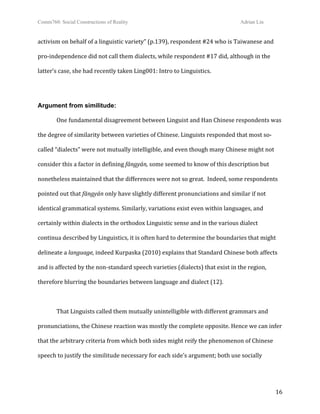
  One fundamental disagreement between Linguist and Han Chinese respondents was 
the degree of similarity between varieties of Chinese. Linguists responded that most so‐
called “dialects” were not mutually intelligible, and even though many Chinese might not 
consider this a factor in defining fāngyán, some seemed to know of this description but 
nonetheless maintained that the differences were not so great.  Indeed, some respondents 
pointed out that fāngyán only have slightly different pronunciations and similar if not 
identical grammatical systems. Similarly, variations exist even within languages, and 
certainly within dialects in the orthodox Linguistic sense and in the various dialect 
continua described by Linguistics, it is often hard to determine the boundaries that might 
delineate a language, indeed Kurpaska (2010) explains that Standard Chinese both affects 
and is affected by the non‐standard speech varieties (dialects) that exist in the region, 
therefore blurring the boundaries between language and dialect (12). 
 
  That Linguists called them mutually unintelligible with different grammars and 
pronunciations, the Chinese reaction was mostly the complete opposite. Hence we can infer 
that the arbitrary criteria from which both sides might reify the phenomenon of Chinese 
speech to justify the similitude necessary for each side’s argument; both use socially 
Comm760: Social Constructions of Reality Adrian Lin
  17 
constructed criteria that may or may not be grounded in an objective reality but perhaps a 
socially constructed one. 
 
Argument from the shared writing system:
  Various linguists in the survey, and in the field of Linguistics refute the common 
Chinese claim that all Chinese “dialects” are written the same, and indeed if we take the 
written script to be a relatively faithful representation of formal speech, they would be 
correct in asserting that because of grammatical and lexical differences, the written script 
most closely represents Mandarin, the official language. However, if we were to contend 
that all Chinese dialect speakers are in the habit of writing using a shared system and that 
no dialects are formally written, literally this would be a correct statement according to 
both sides and may also be a justification for common Chinese view on this matter.  
   
  The survey tended to reinforce these views with Linguists mentioning that without 
the common writing system the speakers of different varieties of Chinese would not 
understand each other, whereas Han Chinese respondents instead emphasized the 
corollary—that all Chinese speakers understand each other through the shared written 
standard. From a literal objectivist point of view, Han Chinese responses were, as 
mentioned previously, technically incorrect if we take a writing system as belonging to a 
language or dialect if its units such as letters (or logograms in the Chinese case) correspond 
highly with the said language or dialect. But, as suggested before, it is possible that such 
notions are not directly analogous in Chinese society; it is possible that to Chinese, the 
writing system is the language and not the system of coding language and thus Linguistic 
Comm760: Social Constructions of Reality Adrian Lin
  18 
notions as a construct may be neither tangible nor applicable to the average Chinese 
person. Indeed, Blum (2005) gives evidence of an example of cultural differences causing 
respondents to not understand interviewer questions: 
   
  In interviews and conversations, students of minority background failed to understand  
my question, Do you feel you lose anything of your own culture when you function  
entirely in the majority language for your education? Incomprehension was consistent. (p. 150) 
 
Blum infers from this that cultural metaphors of competition between varieties, which is 
prevalent in European societies is not applicable to at least Chinese society. Similarly a 
notion of a writing system as necessarily being a highly consistent representation of speech 
may be a cultural artifact, as suggested by the differing viewpoints of my respondents. 
   
On the survey limitations:
  A concern, as briefly touched upon earlier is that this survey itself might be affecting 
the results that it seeks. This is not only because of the nature of the medium which might 
constrain possible responses, but also because of the nature of this paper that the results  
inform and for which the survey was designed. Indeed, it is entirely possible that such a 
discourse of this discussion on the linguistic diversity of China may have in being studied, 
affected or created the results it sees—Chinese speakers might not ever even discuss such a 
topic but for my survey forcing them to consider the realities they live in, albeit not with 
the same manner that Linguistics may impose its definitions. 
Comm760: Social Constructions of Reality Adrian Lin
  19 
Conclusions:
 
The main problem in describing other cultures lies in the translation of certain 
terms not only from one language to another but from one social environment or culture to 
another. While terms in different languages have different definitions and entailments, 
sometimes even a description of such terms will not suffice as the values inherent in these 
definitions may be inherently valued differently in different societies so as to be rejected by 
the other culture as a label imposed from the outside instead of something autochthonous. 
 
While Linguistics, which has roots and influences from European culture, uses a 
more uniform set of criteria that can be applied to all cultures, it still describes things in 
terms of values that are less valued in other cultures, such as in China, where native views 
of linguistic variety does not hold to the same degree of import, the issue of mutual 
intelligibility, due to the presence of a society with a unified written communication form.  
Conversely, the Linguistics community rejects this cultural notion as a reality if viewed 
from its commonly objectivist point of view, although the idea that scripts need to 
represent the spoken language may have roots in the standardization and boundary‐
contesting Western cultural narratives. Kurpaska (2010) succinctly summarizes this type 
of practice saying that  
 
[t]he question whether or not the lack of mutual intelligibility does determine the  
linguistic borders goes beyond the domain of linguistics and enters the area of politics,  
anthropology and history. The question touches also upon the feeling of ethnic identity  
Comm760: Social Constructions of Reality Adrian Lin
  20 
and linguistic ideology, which may, as in many cases in for example Europe, dominate the 
controversies around linguistic diversification. This is why it is probably best to leave this  
question aside. (p. 203). 
 
  Verily, what has been said here seems to be a recurring theme in the Constructivist 
critiques of Positivism and the issues at stake are similar. As commonly said, it is important 
to understand the viewpoint of the observer when considering the observation as they are 
invariably colored by a lesser or greater degree by the lens of his or her viewpoint. Only 
from multiple viewpoints, including the viewpoint of the observed can one truly come to 
understand the complex nature of socially constructed reality. 
Comm760: Social Constructions of Reality Adrian Lin
  21 
References:
 
Blum, S. D. (2005). Nationalism without linguism: Tolerating Chinese variants. In W. M.  
Bloomer (Ed.), The Contest of Language.  (134‐164). Indiana: University of Notre 
Dame Press.  
 
Kurpaska, M. (2006).  Chinese Language(s): A look through the prism of the great dictionary  
of modern Chinese dialects V. Gast, (Ed.). Germany: De Gruyter Mouton. 
 
Mair, V. H. (1991). What is a Chinese “dialect/topolect”?: Reflections on some key Sino­English  
linguistic terms. Sino‐Platonic Papers, 1(29), 1‐29. 
 
McWhorter, J. (2002). The Power of Babel: A natural history of language. London: William  
Heinemann. 
 
Nic Craith, M. (2006). Europe and the Politics of Language: Citizens, Migrants and Outsiders.  
Great Britain: Antony Row Ltd, Chippenham and Eastbourne. 
 
Romaine, S. (2000). Language in Society: An Introduction to Sociolinguistics. (2nd ed.).  
Oxford: Oxford University Press, 2000. 
Comm760: Social Constructions of Reality Adrian Lin
  22 
Appendix A: Survey Questions
 
1) What would you describe 方言 (eg. Cantonese, Shanghainese, Taiwanese/Minnan, Hakka 
etc) in English? 
 
2) For what reasons (eg. Social, Historical, Political, Scientific reasons etc) are you arguing that 
they should be referred to as dialects or languages (or any other term)?  
 
 
3) How likely are you to ever endorse or actively call them another/the other term? When? 
Why?  
 
4) What, to you, is the difference between languages and dialects? 
 
 
5) If you answered dialects as the best translation of 方言, please answer the following 
question; If you didn't please type "SKIP":  
 
Speakers of certain European languages such as Portuguese, Spanish, and Italian can 
understand each other somewhat through the spoken and written language. The speakers 
of different 方言, however, often cannot understand each other through the spoken 
language at all. How would you justify the common classification of these European 
languages as languages and but 方言 as dialects?  
Comm760: Social Constructions of Reality Adrian Lin
  23 
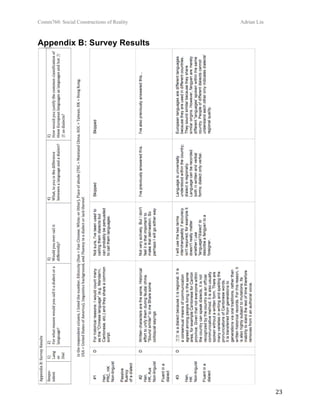
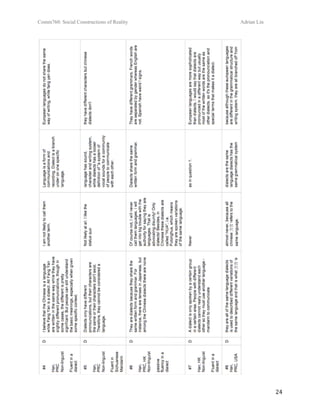
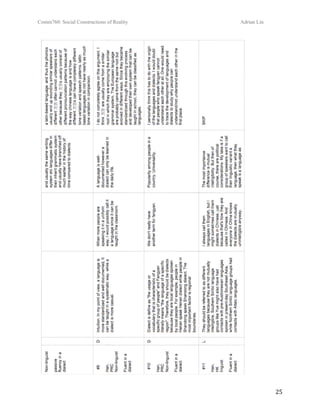
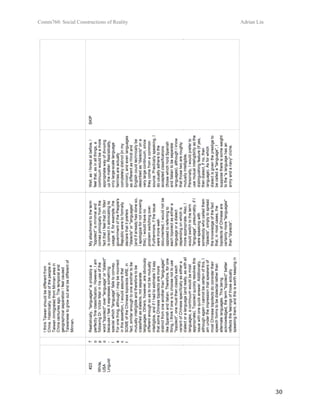
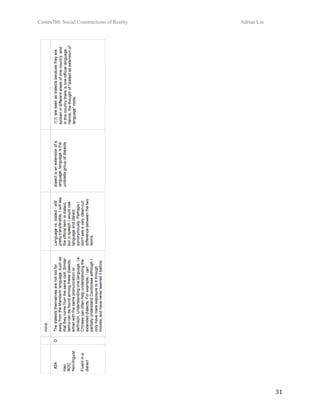
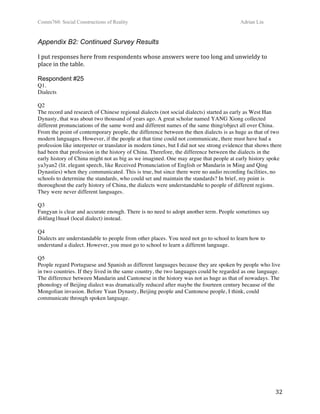
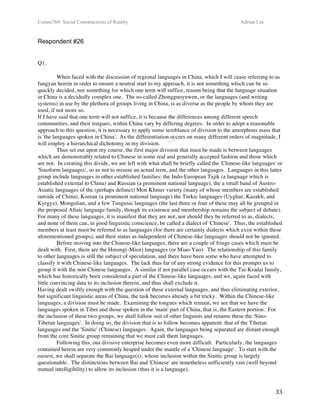
Appendix B: Survey Results
Comm760: Social Constructions of Reality Adrian Lin
  24 
Comm760: Social Constructions of Reality Adrian Lin
  25 
Comm760: Social Constructions of Reality Adrian Lin
  26 
Comm760: Social Constructions of Reality Adrian Lin
  27 
Comm760: Social Constructions of Reality Adrian Lin
  28 
Comm760: Social Constructions of Reality Adrian Lin
  29 
Comm760: Social Constructions of Reality Adrian Lin
  30 
Comm760: Social Constructions of Reality Adrian Lin
  31 
Comm760: Social Constructions of Reality Adrian Lin
  32 
Appendix B2: Continued Survey Results
 
I put responses here from respondents whose answers were too long and unwieldy to 
place in the table. 
 
Respondent #25
Q1.
Dialects
Q2
The record and research of Chinese regional dialects (not social dialects) started as early as West Han
Dynasty, that was about two thousand of years ago. A great scholar named YANG Xiong collected
different pronunciations of the same word and different names of the same thing/object all over China.
From the point of contemporary people, the difference between the then dialects is as huge as that of two
modern languages. However, if the people at that time could not communicate, there must have had a
profession like interpreter or translator in modern times, but I did not see strong evidence that shows there
had been that profession in the history of China. Therefore, the difference between the dialects in the
early history of China might not as big as we imagined. One may argue that people at early history spoke
ya3yan2 (lit. elegant speech, like Received Pronunciation of English or Mandarin in Ming and Qing
Dynasties) when they communicated. This is true, but since there were no audio recording facilities, no
schools to determine the standards, who could set and maintain the standards? In brief, my point is
thoroughout the early history of China, the dialects were understandable to people of different regions.
They were never different languages.
Q3
Fangyan is clear and accurate enough. There is no need to adopt another term. People sometimes say
di4fang1hua4 (local dialect) instead.
Q4
Dialects are understandable to people from other places. You need not go to school to learn how to
understand a dialect. However, you must go to school to learn a different language.
Q5
People regard Portuguese and Spanish as different languages because they are spoken by people who live
in two countries. If they lived in the same country, the two languages could be regarded as one language.
The difference between Mandarin and Cantonese in the history was not as huge as that of nowadays. The
phonology of Beijing dialect was dramatically reduced after maybe the fourteen century because of the
Mongolian invasion. Before Yuan Dynasty, Beijing people and Cantonese people, I think, could
communicate through spoken language.
Comm760: Social Constructions of Reality Adrian Lin
  33 
Respondent #26
 
 
Q1.
 
When faced with the discussion of regional languages in China, which I will cease referring to as
fangyan herein in order to ensure a neutral start to my approach, it is not something which can be so
quickly decided, nor something for which one term will suffice, reason being that the language situation
in China is a decidedly complex one. The so-called Zhongguoyuwen, or the languages (and writing
systems) in use by the plethora of groups living in China, is as diverse as the people by whom they are
used, if not more so.  
If I have said that one term will not suffice, it is because the differences among different speech
communities, and their tongues, within China vary by differing degrees. In order to adopt a reasonable
approach to this question, it is necessary to apply some semblance of division to the amorphous mass that
is 'the languages spoken in China'. As the differentiation occurs on many different orders of magnitude, I
will employ a hierarchical dichotomy in my division.  
Thus set out upon my course, the first major division that must be made is between languages
which are demonstrably related to Chinese in some real and generally accepted fashion and those which
are not. In creating this divide, we are left with what shall be briefly called the 'Chinese-like languages' or
'Sinoform languages', so as not to misuse an actual term, and the other languages. Languages in this latter
group include languages in other established families: the Indo-European Tajik (a language which is
established external to China) and Russian (a prominent national language), the a small band of Austro-
Asiatic languages of the (perhaps defunct) Mon Khmer variety (many of whose members are established
outside of China), Korean (a prominent national language) the Turkic languages (Uyghur, Kazakh, and
Kyrgyz), Mongolian, and a few Tungusic languages (the last three or four of these may all be grouped in
the proposed Altaic language family, though its existence and membership remains the subject of debate).
For many of these languages, it is manifest that they are not, nor should they be referred to as, dialects,
and none of them can, in good linguistic conscience, be called a dialect of 'Chinese'. Thus, the established
members at least must be referred to as languages (for there are certainly dialects which exist within these
aforementioned groups), and their status as independent of Chinese-like languages should not be ignored.  
Before moving into the Chinese-like languages, there are a couple of fringe cases which must be
dealt with. First, there are the Hmong(-Mien) languages (or Miao-Yao). The relationship of this family
to other languages is still the subject of speculation, and there have been some who have attempted to
classify it with Chinese-like languages. The lack thus far of any strong evidence for this prompts us to
group it with the non Chinese langauges. A similar if not parallel case occurs with the Tai-Kradai family,
which has historically been considered a part of the Chinese-like languages, and we, again faced with
little convincing data to its inclusion therein, and thus shall exclude it.  
Having dealt swiftly enough with the question of these external languages, and thus eliminating exterior,
but significant linguistic areas of China, the task becomes already a bit tricky. Within the Chinese-like
languages, a division must be made. Examining the tongues which remain, we see that we have the
languages spoken in Tibet and those spoken in the 'main' part of China, that is, the Eastern portion. For
the inclusion of these two groups, we shall follow suit of other linguists and rename these the 'Sino-
Tibetan languages'. In doing so, the division that is to follow becomes apparent: that of the Tibetan
languages and the 'Sinitic' (Chinese) languages. Again, the languages being separated are distant enough
from the core Sinitic group remaining that we must call them languages.  
Following this, our divisive enterprise becomes even more difficult. Particularly, the languages
contained herein are very commonly heaped under the mantle of a 'Chinese language'. To start with the
easiest, we shall separate the Bai language(s), whose inclusion within the Sinitic group is largely
questionable. The distinctions between Bai and 'Chinese' are nonetheless sufficiently vast (well beyond
mutual intelligibility) to allow its inclusion (thus it is a language).  
Comm760: Social Constructions of Reality Adrian Lin
  34 
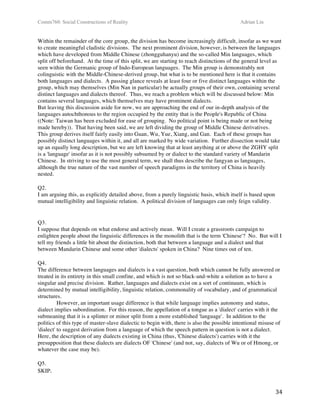
Within the remainder of the core group, the division has become increasingly difficult, insofar as we want
to create meaningful cladistic divisions. The next prominent division, however, is between the languages
which have developed from Middle Chinese (zhongguhanyu) and the so-called Min languages, which
split off beforehand. At the time of this split, we are starting to reach distinctions of the general level as
seen within the Germanic group of Indo-European languages. The Min group is demonstrably not
colinguistic with the Middle-Chinese-derived group, but what is to be mentioned here is that it contains
both languages and dialects. A passing glance reveals at least four or five distinct languages within the
group, which may themselves (Min Nan in particular) be actually groups of their own, containing several
distinct languages and dialects thereof. Thus, we reach a problem which will be discussed below: Min
contains several languages, which themselves may have prominent dialects.  
But leaving this discussion aside for now, we are approaching the end of our in-depth analysis of the
languages autochthonous to the region occupied by the entity that is the People's Republic of China
((Note: Taiwan has been excluded for ease of grouping. No political point is being made or not being
made hereby)). That having been said, we are left dividing the group of Middle Chinese derivatives.
This group derives itself fairly easily into Guan, Wu, Yue, Xiang, and Gan. Each of these groups has
possibly distinct languages within it, and all are marked by wide variation. Further dissection would take
up an equally long description, but we are left knowing that at least anything at or above the ZGHY split
is a 'language' insofar as it is not possibly subsumed by or dialect to the standard variety of Mandarin
Chinese. In striving to use the most general term, we shall thus describe the fangyan as languages,
although the true nature of the vast number of speech paradigms in the territory of China is heavily
nested.  
 
Q2. 
I am arguing this, as explicitly detailed above, from a purely linguistic basis, which itself is based upon
mutual intelligibility and linguistic relation. A political division of languages can only feign validity.  
 
 
Q3. 
I suppose that depends on what endorse and actively mean. Will I create a grassroots campaign to
enlighten people about the linguistic differences in the monolith that is the term 'Chinese'? No. But will I
tell my friends a little bit about the distinction, both that between a language and a dialect and that
between Mandarin Chinese and some other 'dialects' spoken in China? Nine times out of ten.  
 
Q4. 
The difference between languages and dialects is a vast question, both which cannot be fully answered or
treated in its entirety in this small confine, and which is not so black-and-white a solution as to have a
singular and precise division. Rather, languages and dialects exist on a sort of continuum, which is
determined by mutual intelligibility, linguistic relation, commonality of vocabulary, and of grammatical
structures.  
However, an important usage difference is that while language implies autonomy and status,
dialect implies subordination. For this reason, the appellation of a tongue as a 'dialect' carries with it the
submeaning that it is a splinter or minor split from a more established 'language'. In addition to the
politics of this type of master-slave dialectic to begin with, there is also the possible intentional misuse of
'dialect' to suggest derivation from a language of which the speech pattern in question is not a dialect.
Here, the description of any dialects existing in China (thus, 'Chinese dialects') carries with it the
presupposition that these dialects are dialects OF 'Chinese' (and not, say, dialects of Wu or of Hmong, or
whatever the case may be).  
 
Q5.
SKIP. 

Chinese language or dialects - a constructivist approach to linguistic realities

  • 1.
    Comm760: Social Constructionsof Reality Adrian Lin   1  Chinese Dialects or Languages? A Constructivist Approach to Linguistic Realities Comm760 Adrian Lin Professor Klaus Krippendorff
  • 2.
    Comm760: Social Constructionsof Reality Adrian Lin   2  Abstract:  Linguistics, as the science of language, often creates classifications with criteria based on its  own criteria and standards. This institutionalized discourse community might therefore  not accurately represent the world as it purports to do because of the particular self‐ regulating ways of thinking that confines it to exclude certain standards that come from  within the studied group, which must admittedly be included if any comprehensive view of  the reality of languages and dialects in the world. This paper seeks to allow greater  inclusion of the oft‐ignored subjects of linguistic studies to show the narratives, accounts  and other social constructed criteria with which they describe themselves.
  • 3.
    Comm760: Social Constructionsof Reality Adrian Lin   3  Table of Contents:    INTRODUCTION: NOTIONS OF LANGUAGES AND DIALECTS  4  INCOMPATIBILITY OF LINGUISTIC DIVISIONS OF LANGUAGE WITH SOCIAL REALITY  5  LINGUISTICS AS IMPOSING A FALSE OBJECTIVITY IN DESCRIBING REALITY  7  CHINESE FĀNGYÁN: AUTOCHTHONOUS VIEWS ON CHINESE VARIETIES  11  SURVEY:  12  JUSTIFICATIONS AND DISCOURSES OF SPOKEN LANGUAGE WITHIN CHINA:  13  ARGUMENT FROM GEOPOLITICS:  13  ARGUMENT FROM SOCIAL VALUES AND UNITY:  14  ARGUMENT FROM SIMILITUDE:  16  ARGUMENT FROM THE SHARED WRITING SYSTEM:  17  ON THE SURVEY LIMITATIONS:  18  CONCLUSIONS:  19  REFERENCES:  21  APPENDIX A: SURVEY QUESTIONS  22  APPENDIX B: SURVEY RESULTS  23  APPENDIX B2: CONTINUED SURVEY RESULTS  32   
  • 4.
    Comm760: Social Constructionsof Reality Adrian Lin   4  Introduction: Notions of languages and dialects Broadly speaking, there exist two methods of understanding what constitutes  languages and dialects. The first is commonly employed by the field of Linguistics1 and  scientifically uses the criterion of mutual intelligibility to organize speech varieties into  languages or dialects; dialects would, under this definition, be “mutually intelligible” with  the language it is said to branch off from.  Thus, all languages are judged by a single formal  and immutable criterion, and none of the plethora of social factors.    The other notion is actually built from an amalgamation of different societal factors  and notions, including political, historical, ethnic, and national understandings, which  together I shall term as the socially constructed understandings. These factors can each  constitute an independent understanding of languages and dialects but commonly work in  tandem in various social situations. They are often not fully compatible with each other, so  it may seem odd that I group them as one; however, I group them together not only  because they are even more commonly non‐coterminous with the linguistic definition but  also as they provide a greater outlet for the speakers of such languages and dialects to  describe their social reality, whereas the scientific, objectivist understanding espoused by  Linguistics often does not.                                                              1 Due to the double meaning of the adjective “linguistic” as either pertaining to language, or pertaining to the  scientific study of language, I shall identify the latter meaning with capitalization. 
  • 5.
    Comm760: Social Constructionsof Reality Adrian Lin   5  Incompatibility of Linguistic divisions of language with social reality Linguistics, being a scientific field, maintains and perpetuates itself within the a  specific discourse with its own assumptions and institutions, often conflicts in view with  those of lay people, those that its theories purport to describe and whose behaviors it tries  to model.  For example, Hindi and Urdu, which respectively have statuses as one of the  official languages in India and Pakistan are often called a single language by Linguistic  standards, contrary to Indians’ and Pakistanis’ political understandings and identities,  suggesting more similarities than these peoples wish to believe. Conversely, speech  varieties in spoken by ethnic Han Chinese are Linguistically considered to be different  languages. However, most Han Chinese feel that they speak not different languages, but  various dialects.     Because Linguistics as a field has its own discursive practices and institutes itself,  Linguists from other cultures, in order to be accepted by the wider global Linguistics  community, have to conform to these standards to be taken seriously and considered part  of this discourse community. Mair (1991) echoes this Linguistic sentiment, although he  takes care to consider other non‐Linguistic viewpoints:    Unless the notion of dialect is somehow separated from politics, ethnicity, culture, and   other non‐linguistic factors, the classification of languages and peoples of China can never   be made fully compatible with work that is done for other parts of the world. (p. 13).   
  • 6.
    Comm760: Social Constructionsof Reality Adrian Lin   6  Indeed, Mair further mentions an example of Chinese Linguists’ reservations  between the two discourse communities to which they belong, that of Linguistics and other  being the wider Chinese community:    Chinese scholars have repeatedly and confidentially told me on many occasions that   Hanyu ‐‐ on purely linguistic grounds alone ‐‐ really ought to be considered as a group   (yuzu), but that there are “traditional”, “political”, “nationalistic” and other factors that   prevent them from declaring this publicly.” [boldening in original] (p. 10).    Mair concludes his paper saying that although current Linguistic terms are  incongruent with Chinese societal notions, this issue must be addressed “if Sino‐Tibetan  linguistics is ever to take its place on an equal footing with Indo‐European and other areas  of linguistic research,” and that the “best way to gain speedy respectability for our field is to  apply impartially the same standards that are used throughout the world for all other  languages” (p. 15).    Thus, it can be seen that the rigid Linguistic definition makes affords no room for  these individuals caught between the two institutionalized discourses that to them are very  real and undeniable realities.     The linguistic notion tries to remain objective by applying a single criterion  systematically to all speech varieties. However, as seen, it is possible that this method is not  without bias, due to Linguistics’ origins and historical association with one region of the  world and its cultural academic practices; through this shortcoming and the rejection of 
  • 7.
    Comm760: Social Constructionsof Reality Adrian Lin   7  popular understandings of language and dialects denies the very real reality that the  speakers of such “languages” and “dialects” themselves inhabit, and in no small part, help to  construct. Only in combination can these two notions truly describe the nature of the  various realities of different positions languages and dialects hold for the subjects these  notions describe.   Linguistics as imposing a false objectivity in describing reality     To understand the dangers of using solely the linguistic definition of languages and  dialects, one must first understand the history and development of modern Linguistics.  Modern Linguistics developed out of the discipline of Philology, which, unlike Linguistics,  emphasized history as well as literary studies. Modern Linguistics has since divorced itself  from these two aspects, having been influenced by Ferdinand de Saussure’s emphasis on  synchronic analysis and avoiding diachronic analysis. A problem with this is that cultural  and political notions that stem from historical roots such as identity, which are integral to  people’s lives are not considered. Had Linguistics remained more rooted in diachronic  analyses, the current field of Linguistics might have been more wholesome.    Blum (2005) quotes from Romaine illustrates this problem suggesting that the  metaphor of dividing up languages and dialects into distinct bounded regions could be a  cultural artifact, itself socially constructed out of the Western origins of modern Linguistics,  “fostered by processes such as literacy and standardization” (p. 136) and stemming from  the very political issues it strives to avoid. Thus, one might liken this view of its own 
  • 8.
    Comm760: Social Constructionsof Reality Adrian Lin   8  objectivity as a Stoltzenberg trap, because of the unquestioned axioms upon which is built  the belief that the classification of languages and dialects reflects a universal reality. This  view of social construction rather than inherent existence of languages and dialects is  supported by Nic Craith (2006), who asserts that “[l]anguage is a concept that is  increasingly recognised by political scientists and theorists as having been constructed in  the era of nation states – as an idea that is closely linked to the erection of national  boundaries” (106).    Blum (2005) suggests instead that different possible metaphors used by various  cultures, dividing the various cultural understandings of language into three categories:  The first, boundary contesting, is common in Europe, where national boundaries are  commonly coterminous with and often determined by language boundaries (134). This is  the more common of the metaphors of language and is the notion upon which Linguistics  bases its classification schemes. This metaphor often results in “othering” speakers in an  insider‐outsider relationship and a narrative of self‐evidency in clear‐cut boundaries.      This particular metaphor was, perhaps, an example of an imperfect manner of  understanding and representing the world which itself brought about the realization of the  notions it described.  Languages had likely existed in continua merging seamlessly from  one area to the next without clear natural boundaries one could use to define an area as  having a preferred speech style. However, because of the standardization policies assumed  such a reality or at least ideal reality in which one area’s speech variety could be thought of  as standard and the rest, non‐standard in comparison, it eventually brought about the 
  • 9.
    Comm760: Social Constructionsof Reality Adrian Lin   9  actual manifestation of this idea by carving out boundaries from this metaphor and  conforming each language to the speech of an arbitrarily defined speech community,  roughly analogous and coterminous with the various nations of people in Europe. Indeed,  Nic Craith (2006) gives the example of Norway’s two standards of language: “Nyorsh, the  artificial standard, is somewhat different from Danish” but “the language commonly spoken  is remarkably similar,” and also quotes from McWhorter (2002), that ‘ “what is today  “Norwegian” was just “the way they speak Danish in Norway” until Norway broke with  Denmark in 1814’ (p. 24).      The second metaphor, boundary celebrating, is one in which linguistic differences  are exaggerated and, Blum quotes from Romaine (2000) in her example on Papua New  Guinea’s linguistic diversity, “has none of the pressures towards convergence found for a  long time in Europe and elsewhere, such as literacy, standardization, centralized  administrative control, schooling, media, was present to any degree in pre‐colonial days.”      Blum calls the third metaphor boundary shrugging, for which she uses the example  of Chinese language and nationalism, and which will also be the focus of this paper. She  draws examples from Chinese society to describe its boundary shrugging perspective for  the following reasons.    1.   Linguistic difficulties are rarely mentioned in Chinese contexts where   familiarity with other (mostly Indo‐European) societies would lead one to   expect them: definitions of the nation, war, or political struggles.   
  • 10.
    Comm760: Social Constructionsof Reality Adrian Lin   10    2.   Most attention in China has been paid to the written form of the language,   and most people are scarcely aware of the characteristics of speech. Though   there has been concern with literacy, it has not led to suppression of variation.      3.   Many people acquire multiple varieties of language easily and often, leading to   a disposition that tolerates rather than rebuffs linguistic differences. (p. 136‐137).    These two other means of understanding the social phenomenon of language  suggest that the imposition of a single one may not adequately encapsulate the social  realities that speakers know. A pure linguistic definition of languages and dialects still  favours a particular standpoint or perspective, and therefore is perhaps less suitable in  describing other cultures’ social reality of languages.   
  • 11.
    Comm760: Social Constructionsof Reality Adrian Lin   11  Chinese Fāngyán: Autochthonous views on Chinese varieties   In this paper, I2 will explore the more popular understanding of spoken language in  China on the speakers’ own terms, pointing out how social reality is constructed and  maintained. This is in contrast to the common Linguistic practice to impose its criterion of  mutual intelligibility, reducing its studied subjects to silent observers in their classification  and without acknowledging their views and realities, resulting in an i‐other relationship.    To start off, I should describe the term 方言 (fāngyán) as it is understood in China.  Literally, it means region­speech, indicating a speech of a region. Mair (1991) discusses the  evolution of the term fāngyán, mentioning that earlier definitions “stressed crudity or non‐ standardness of its exemplars” (p. 4), but nowadays is understood with a variety of  definitions, although most emphasize shared linguistic history and the speakers’ shared  method of written communication, which Linguistics does not see as justifiable factors.  Nevertheless, the described speech varieties are invariably coterminous with what  Linguistics currently calls the Chinese languages as well as the dialects of those languages.  Mair attributes much of the confusion to the habit of translating fāngyán as dialects and  proposes the neutral term topolect and stresses that this term be applied in lieu of dialect  to syncretize the differing views.                                                          2 At this point, I will discontinue the sole use of the impersonal passive in reporting my findings so as not to  conform to the institutional practice of supposed objectivism by denying the possible influence my  background in Linguistics may have on my analysis. 
  • 12.
    Comm760: Social Constructionsof Reality Adrian Lin   12  Survey:   To study the Chinese views on the linguistic diversity in our country, I created a  survey (see Appendix A), for which I gathered responses from 26, mostly college student  respondents. I interviewed a combination of Han Chinese, White Caucasians, and Non‐Han  East Asians from various countries, as well as a variety of non‐Linguists, Linguists, and  people with knowledge of Linguistics. I believed this would broaden the viewpoints I would  be exposed to and therefore allow me to more clearly understand the various narratives  and discourses from the realities the respondents inhabited.    Because of my background in Linguistics and my prior deference to the Linguistics  definition to the exclusion of the common cultural definition, I administered the survey via  the Internet to allow them to fully express themselves on their own time and their own  terms without unconsciously applying pressure by my mere presence. Moreover, other  than the first question,      1) What would you describe 方言 (eg. Cantonese, Shanghainese, Taiwanese/Minnan,   Hakka etc) in English?    which had respondents select either language, dialect, or other (please specify),  I used  mostly open‐ended questions that asked views and opinions so as to give the most leeway  to respondents and understand their views on their terms. Finally, I included a final  question that I predicted would be applicable to many of my respondents, question 5,   
  • 13.
    Comm760: Social Constructionsof Reality Adrian Lin   13  5) If you answered dialects as the best translation of 方言, please answer the following   question; If you didn't please type "SKIP":    Speakers of certain European languages such as Portuguese, Spanish, and Italian can   understand each other somewhat through the spoken and written language. The   speakers of different 方言, however, often cannot understand each other through the   spoken language at all. How would you justify the common classification of these   European languages as languages and but 方言 as dialects?    to try and understand how respondents understand views that may contradict theirs, and  how or if subjects to Linguistic theories may themselves shape these theories through  social negotiation.     Justifications and discourses of spoken language within China:      The results and my analysis confirm that people have many justifications of what  constitutes languages and dialectal classifications, and certain sets of these justifications  correspond with certain types of people, namely Linguist and non‐Linguist.     Argument from geopolitics:   The Linguists and the non‐Han in the survey, tended to stress mutual intelligibility  as a criterion for their choice to call Chinese variants languages or dialects without  mentioning politics as a valid criterion. At least one or two did suggest dialects being 
  • 14.
    Comm760: Social Constructionsof Reality Adrian Lin   14  “labeled so out of artificial political reasons” thus mostly downplaying agency to the  common Chinese speaker.    Han Chinese respondents seemed to view geopolitics as an important factor in  determining fāngyán. They commonly stressed that languages are “official” while dialects  are not, with one respondent calling regional boundaries the most important factor. While  at first this seems to align with the previously mentioned respondent’s belief in a top‐down  sanctioned official‐ness of certain speech variants as languages, many Han Chinese have  seemed to take agency in negotiating ownership of and internalizing this belief. At least one  respondent (#18) exhibited knowledge of the opposing view of official sanctioning of  terminology but calling out the flip‐side that European nations themselves may have  artificially emphasized differences for political reasons and even mused that it could be  argued the various languages of southern Europe should be “re‐classified as dialects of  Latin,” although also suggesting that one might not want to be so quick to “judge by the  benchmark of European languages.” Verily, as Kurpaska (2010) succinctly puts, “[c]alling  the varieties of Chinese ‘dialects’… rather than languages does have a strong political  undertone, as it serves the unity of the Chinese people,” and can even “interfere in the  sense of ethnic identity.” (p. 2‐3).    Argument from social values and unity: Many also recognized an aspect of national unity associated with a language, calling  dialects variants of the language that branched off of the main language. Moreover, the  ethnic diversity and size of China was also mentioned, and used as a justification for an 
  • 15.
    Comm760: Social Constructionsof Reality Adrian Lin   15  official language, lest the country “break into warring states”. Indeed, some called fāngyán  the speech of a “specific group of people” and something “regional”. While this has been  shown to not be true in the case of spoken Chinese (Mandarin, the official language is  historically younger and derived from some older dialects), this narrative of shared origins  is common among Han Chinese, as is the narrative of national unity through shared  language, which was validated by the account of the period of history without a common  language that saw China broken into numerous factions. For Han Chinese this factor  seemed to align with Blum’s boundary‐contesting metaphor, although this itself might be  an artifact of my questions calling attention to the different usages of the English terms  dialect when applied to Spoken Chinese.     Furthermore, some Han Chinese respondents mentioned that they may call these  Chinese variants as dialects partially because of habit or social desirability and because  “that’s how they are commonly referred to by speakers and non‐speakers alike”. Some non‐ Chinese respondents said they may call it such so as not to offend Han Chinese, thus  dialogically negotiating their behavior under influences from both the discourse of their  Western notions and contact with Chinese discourses of language.    Finally, as the agenda of presenting unity of a country through a shared language is  one common way of understanding, one might expect individuals with a pro‐Taiwanese  independence agenda and who speak Taiwanese, which is a variant not mutually intelligible  with Mandarin, the official language in China, to possibly prefer the term languages. While  Blum (2005) mentions Taiwan as the “only part of China … in which one can currently find 
  • 16.
    Comm760: Social Constructionsof Reality Adrian Lin   16  activism on behalf of a linguistic variety” (p.139), respondent #24 who is Taiwanese and  pro‐independence did not call them dialects, while respondent #17 did, although in the  latter’s case, she had recently taken Ling001: Intro to Linguistics.    Argument from similitude:   One fundamental disagreement between Linguist and Han Chinese respondents was  the degree of similarity between varieties of Chinese. Linguists responded that most so‐ called “dialects” were not mutually intelligible, and even though many Chinese might not  consider this a factor in defining fāngyán, some seemed to know of this description but  nonetheless maintained that the differences were not so great.  Indeed, some respondents  pointed out that fāngyán only have slightly different pronunciations and similar if not  identical grammatical systems. Similarly, variations exist even within languages, and  certainly within dialects in the orthodox Linguistic sense and in the various dialect  continua described by Linguistics, it is often hard to determine the boundaries that might  delineate a language, indeed Kurpaska (2010) explains that Standard Chinese both affects  and is affected by the non‐standard speech varieties (dialects) that exist in the region,  therefore blurring the boundaries between language and dialect (12).      That Linguists called them mutually unintelligible with different grammars and  pronunciations, the Chinese reaction was mostly the complete opposite. Hence we can infer  that the arbitrary criteria from which both sides might reify the phenomenon of Chinese  speech to justify the similitude necessary for each side’s argument; both use socially 
  • 17.
    Comm760: Social Constructionsof Reality Adrian Lin   17  constructed criteria that may or may not be grounded in an objective reality but perhaps a  socially constructed one.    Argument from the shared writing system:   Various linguists in the survey, and in the field of Linguistics refute the common  Chinese claim that all Chinese “dialects” are written the same, and indeed if we take the  written script to be a relatively faithful representation of formal speech, they would be  correct in asserting that because of grammatical and lexical differences, the written script  most closely represents Mandarin, the official language. However, if we were to contend  that all Chinese dialect speakers are in the habit of writing using a shared system and that  no dialects are formally written, literally this would be a correct statement according to  both sides and may also be a justification for common Chinese view on this matter.         The survey tended to reinforce these views with Linguists mentioning that without  the common writing system the speakers of different varieties of Chinese would not  understand each other, whereas Han Chinese respondents instead emphasized the  corollary—that all Chinese speakers understand each other through the shared written  standard. From a literal objectivist point of view, Han Chinese responses were, as  mentioned previously, technically incorrect if we take a writing system as belonging to a  language or dialect if its units such as letters (or logograms in the Chinese case) correspond  highly with the said language or dialect. But, as suggested before, it is possible that such  notions are not directly analogous in Chinese society; it is possible that to Chinese, the  writing system is the language and not the system of coding language and thus Linguistic 
  • 18.
    Comm760: Social Constructionsof Reality Adrian Lin   18  notions as a construct may be neither tangible nor applicable to the average Chinese  person. Indeed, Blum (2005) gives evidence of an example of cultural differences causing  respondents to not understand interviewer questions:        In interviews and conversations, students of minority background failed to understand   my question, Do you feel you lose anything of your own culture when you function   entirely in the majority language for your education? Incomprehension was consistent. (p. 150)    Blum infers from this that cultural metaphors of competition between varieties, which is  prevalent in European societies is not applicable to at least Chinese society. Similarly a  notion of a writing system as necessarily being a highly consistent representation of speech  may be a cultural artifact, as suggested by the differing viewpoints of my respondents.      On the survey limitations:   A concern, as briefly touched upon earlier is that this survey itself might be affecting  the results that it seeks. This is not only because of the nature of the medium which might  constrain possible responses, but also because of the nature of this paper that the results   inform and for which the survey was designed. Indeed, it is entirely possible that such a  discourse of this discussion on the linguistic diversity of China may have in being studied,  affected or created the results it sees—Chinese speakers might not ever even discuss such a  topic but for my survey forcing them to consider the realities they live in, albeit not with  the same manner that Linguistics may impose its definitions. 
  • 19.
    Comm760: Social Constructionsof Reality Adrian Lin   19  Conclusions:   The main problem in describing other cultures lies in the translation of certain  terms not only from one language to another but from one social environment or culture to  another. While terms in different languages have different definitions and entailments,  sometimes even a description of such terms will not suffice as the values inherent in these  definitions may be inherently valued differently in different societies so as to be rejected by  the other culture as a label imposed from the outside instead of something autochthonous.    While Linguistics, which has roots and influences from European culture, uses a  more uniform set of criteria that can be applied to all cultures, it still describes things in  terms of values that are less valued in other cultures, such as in China, where native views  of linguistic variety does not hold to the same degree of import, the issue of mutual  intelligibility, due to the presence of a society with a unified written communication form.   Conversely, the Linguistics community rejects this cultural notion as a reality if viewed  from its commonly objectivist point of view, although the idea that scripts need to  represent the spoken language may have roots in the standardization and boundary‐ contesting Western cultural narratives. Kurpaska (2010) succinctly summarizes this type  of practice saying that     [t]he question whether or not the lack of mutual intelligibility does determine the   linguistic borders goes beyond the domain of linguistics and enters the area of politics,   anthropology and history. The question touches also upon the feeling of ethnic identity  
  • 20.
    Comm760: Social Constructionsof Reality Adrian Lin   20  and linguistic ideology, which may, as in many cases in for example Europe, dominate the  controversies around linguistic diversification. This is why it is probably best to leave this   question aside. (p. 203).      Verily, what has been said here seems to be a recurring theme in the Constructivist  critiques of Positivism and the issues at stake are similar. As commonly said, it is important  to understand the viewpoint of the observer when considering the observation as they are  invariably colored by a lesser or greater degree by the lens of his or her viewpoint. Only  from multiple viewpoints, including the viewpoint of the observed can one truly come to  understand the complex nature of socially constructed reality. 
  • 21.
    Comm760: Social Constructionsof Reality Adrian Lin   21  References:   Blum, S. D. (2005). Nationalism without linguism: Tolerating Chinese variants. In W. M.   Bloomer (Ed.), The Contest of Language.  (134‐164). Indiana: University of Notre  Dame Press.     Kurpaska, M. (2006).  Chinese Language(s): A look through the prism of the great dictionary   of modern Chinese dialects V. Gast, (Ed.). Germany: De Gruyter Mouton.    Mair, V. H. (1991). What is a Chinese “dialect/topolect”?: Reflections on some key Sino­English   linguistic terms. Sino‐Platonic Papers, 1(29), 1‐29.    McWhorter, J. (2002). The Power of Babel: A natural history of language. London: William   Heinemann.    Nic Craith, M. (2006). Europe and the Politics of Language: Citizens, Migrants and Outsiders.   Great Britain: Antony Row Ltd, Chippenham and Eastbourne.    Romaine, S. (2000). Language in Society: An Introduction to Sociolinguistics. (2nd ed.).   Oxford: Oxford University Press, 2000. 
  • 22.
    Comm760: Social Constructionsof Reality Adrian Lin   22  Appendix A: Survey Questions   1) What would you describe 方言 (eg. Cantonese, Shanghainese, Taiwanese/Minnan, Hakka  etc) in English?    2) For what reasons (eg. Social, Historical, Political, Scientific reasons etc) are you arguing that  they should be referred to as dialects or languages (or any other term)?       3) How likely are you to ever endorse or actively call them another/the other term? When?  Why?     4) What, to you, is the difference between languages and dialects?      5) If you answered dialects as the best translation of 方言, please answer the following  question; If you didn't please type "SKIP":     Speakers of certain European languages such as Portuguese, Spanish, and Italian can  understand each other somewhat through the spoken and written language. The speakers  of different 方言, however, often cannot understand each other through the spoken  language at all. How would you justify the common classification of these European  languages as languages and but 方言 as dialects?  
  • 23.
    Comm760: Social Constructionsof Reality Adrian Lin   23  Appendix B: Survey Results
  • 24.
    Comm760: Social Constructionsof Reality Adrian Lin   24 
  • 25.
    Comm760: Social Constructionsof Reality Adrian Lin   25 
  • 26.
    Comm760: Social Constructionsof Reality Adrian Lin   26 
  • 27.
    Comm760: Social Constructionsof Reality Adrian Lin   27 
  • 28.
    Comm760: Social Constructionsof Reality Adrian Lin   28 
  • 29.
    Comm760: Social Constructionsof Reality Adrian Lin   29 
  • 30.
    Comm760: Social Constructionsof Reality Adrian Lin   30 
  • 31.
    Comm760: Social Constructionsof Reality Adrian Lin   31 
  • 32.
    Comm760: Social Constructionsof Reality Adrian Lin   32  Appendix B2: Continued Survey Results   I put responses here from respondents whose answers were too long and unwieldy to  place in the table.    Respondent #25 Q1. Dialects Q2 The record and research of Chinese regional dialects (not social dialects) started as early as West Han Dynasty, that was about two thousand of years ago. A great scholar named YANG Xiong collected different pronunciations of the same word and different names of the same thing/object all over China. From the point of contemporary people, the difference between the then dialects is as huge as that of two modern languages. However, if the people at that time could not communicate, there must have had a profession like interpreter or translator in modern times, but I did not see strong evidence that shows there had been that profession in the history of China. Therefore, the difference between the dialects in the early history of China might not as big as we imagined. One may argue that people at early history spoke ya3yan2 (lit. elegant speech, like Received Pronunciation of English or Mandarin in Ming and Qing Dynasties) when they communicated. This is true, but since there were no audio recording facilities, no schools to determine the standards, who could set and maintain the standards? In brief, my point is thoroughout the early history of China, the dialects were understandable to people of different regions. They were never different languages. Q3 Fangyan is clear and accurate enough. There is no need to adopt another term. People sometimes say di4fang1hua4 (local dialect) instead. Q4 Dialects are understandable to people from other places. You need not go to school to learn how to understand a dialect. However, you must go to school to learn a different language. Q5 People regard Portuguese and Spanish as different languages because they are spoken by people who live in two countries. If they lived in the same country, the two languages could be regarded as one language. The difference between Mandarin and Cantonese in the history was not as huge as that of nowadays. The phonology of Beijing dialect was dramatically reduced after maybe the fourteen century because of the Mongolian invasion. Before Yuan Dynasty, Beijing people and Cantonese people, I think, could communicate through spoken language.
  • 33.
    Comm760: Social Constructionsof Reality Adrian Lin   33  Respondent #26     Q1.   When faced with the discussion of regional languages in China, which I will cease referring to as fangyan herein in order to ensure a neutral start to my approach, it is not something which can be so quickly decided, nor something for which one term will suffice, reason being that the language situation in China is a decidedly complex one. The so-called Zhongguoyuwen, or the languages (and writing systems) in use by the plethora of groups living in China, is as diverse as the people by whom they are used, if not more so.   If I have said that one term will not suffice, it is because the differences among different speech communities, and their tongues, within China vary by differing degrees. In order to adopt a reasonable approach to this question, it is necessary to apply some semblance of division to the amorphous mass that is 'the languages spoken in China'. As the differentiation occurs on many different orders of magnitude, I will employ a hierarchical dichotomy in my division.   Thus set out upon my course, the first major division that must be made is between languages which are demonstrably related to Chinese in some real and generally accepted fashion and those which are not. In creating this divide, we are left with what shall be briefly called the 'Chinese-like languages' or 'Sinoform languages', so as not to misuse an actual term, and the other languages. Languages in this latter group include languages in other established families: the Indo-European Tajik (a language which is established external to China) and Russian (a prominent national language), the a small band of Austro- Asiatic languages of the (perhaps defunct) Mon Khmer variety (many of whose members are established outside of China), Korean (a prominent national language) the Turkic languages (Uyghur, Kazakh, and Kyrgyz), Mongolian, and a few Tungusic languages (the last three or four of these may all be grouped in the proposed Altaic language family, though its existence and membership remains the subject of debate). For many of these languages, it is manifest that they are not, nor should they be referred to as, dialects, and none of them can, in good linguistic conscience, be called a dialect of 'Chinese'. Thus, the established members at least must be referred to as languages (for there are certainly dialects which exist within these aforementioned groups), and their status as independent of Chinese-like languages should not be ignored.   Before moving into the Chinese-like languages, there are a couple of fringe cases which must be dealt with. First, there are the Hmong(-Mien) languages (or Miao-Yao). The relationship of this family to other languages is still the subject of speculation, and there have been some who have attempted to classify it with Chinese-like languages. The lack thus far of any strong evidence for this prompts us to group it with the non Chinese langauges. A similar if not parallel case occurs with the Tai-Kradai family, which has historically been considered a part of the Chinese-like languages, and we, again faced with little convincing data to its inclusion therein, and thus shall exclude it.   Having dealt swiftly enough with the question of these external languages, and thus eliminating exterior, but significant linguistic areas of China, the task becomes already a bit tricky. Within the Chinese-like languages, a division must be made. Examining the tongues which remain, we see that we have the languages spoken in Tibet and those spoken in the 'main' part of China, that is, the Eastern portion. For the inclusion of these two groups, we shall follow suit of other linguists and rename these the 'Sino- Tibetan languages'. In doing so, the division that is to follow becomes apparent: that of the Tibetan languages and the 'Sinitic' (Chinese) languages. Again, the languages being separated are distant enough from the core Sinitic group remaining that we must call them languages.   Following this, our divisive enterprise becomes even more difficult. Particularly, the languages contained herein are very commonly heaped under the mantle of a 'Chinese language'. To start with the easiest, we shall separate the Bai language(s), whose inclusion within the Sinitic group is largely questionable. The distinctions between Bai and 'Chinese' are nonetheless sufficiently vast (well beyond mutual intelligibility) to allow its inclusion (thus it is a language).  
  • 34.
    Comm760: Social Constructionsof Reality Adrian Lin   34  Within the remainder of the core group, the division has become increasingly difficult, insofar as we want to create meaningful cladistic divisions. The next prominent division, however, is between the languages which have developed from Middle Chinese (zhongguhanyu) and the so-called Min languages, which split off beforehand. At the time of this split, we are starting to reach distinctions of the general level as seen within the Germanic group of Indo-European languages. The Min group is demonstrably not colinguistic with the Middle-Chinese-derived group, but what is to be mentioned here is that it contains both languages and dialects. A passing glance reveals at least four or five distinct languages within the group, which may themselves (Min Nan in particular) be actually groups of their own, containing several distinct languages and dialects thereof. Thus, we reach a problem which will be discussed below: Min contains several languages, which themselves may have prominent dialects.   But leaving this discussion aside for now, we are approaching the end of our in-depth analysis of the languages autochthonous to the region occupied by the entity that is the People's Republic of China ((Note: Taiwan has been excluded for ease of grouping. No political point is being made or not being made hereby)). That having been said, we are left dividing the group of Middle Chinese derivatives. This group derives itself fairly easily into Guan, Wu, Yue, Xiang, and Gan. Each of these groups has possibly distinct languages within it, and all are marked by wide variation. Further dissection would take up an equally long description, but we are left knowing that at least anything at or above the ZGHY split is a 'language' insofar as it is not possibly subsumed by or dialect to the standard variety of Mandarin Chinese. In striving to use the most general term, we shall thus describe the fangyan as languages, although the true nature of the vast number of speech paradigms in the territory of China is heavily nested.     Q2.  I am arguing this, as explicitly detailed above, from a purely linguistic basis, which itself is based upon mutual intelligibility and linguistic relation. A political division of languages can only feign validity.       Q3.  I suppose that depends on what endorse and actively mean. Will I create a grassroots campaign to enlighten people about the linguistic differences in the monolith that is the term 'Chinese'? No. But will I tell my friends a little bit about the distinction, both that between a language and a dialect and that between Mandarin Chinese and some other 'dialects' spoken in China? Nine times out of ten.     Q4.  The difference between languages and dialects is a vast question, both which cannot be fully answered or treated in its entirety in this small confine, and which is not so black-and-white a solution as to have a singular and precise division. Rather, languages and dialects exist on a sort of continuum, which is determined by mutual intelligibility, linguistic relation, commonality of vocabulary, and of grammatical structures.   However, an important usage difference is that while language implies autonomy and status, dialect implies subordination. For this reason, the appellation of a tongue as a 'dialect' carries with it the submeaning that it is a splinter or minor split from a more established 'language'. In addition to the politics of this type of master-slave dialectic to begin with, there is also the possible intentional misuse of 'dialect' to suggest derivation from a language of which the speech pattern in question is not a dialect. Here, the description of any dialects existing in China (thus, 'Chinese dialects') carries with it the presupposition that these dialects are dialects OF 'Chinese' (and not, say, dialects of Wu or of Hmong, or whatever the case may be).     Q5. SKIP.