Arts 8
Music of China
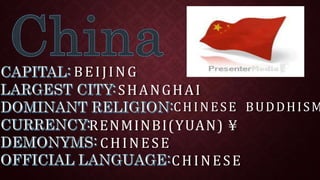
BEIJING
SHANGHAI
CHINESE BUDDHISM
RENMINBI(YUAN) ¥
CHINESE
CHINESE
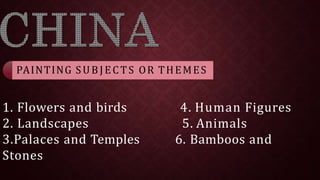
1. Flowers and birds 4. Human Figures
5. Animals
6. Bamboos and
2. Landscapes
3.Palaces and Temples
Stones
PAINTING SUBJECTS OR THEMES
Landscape painting was regarded as the
highest form of Chinese painting. They also
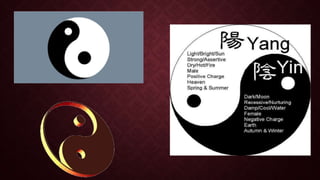
consider the three concepts of their arts:
Nature, Heaven and Humankind (YinYang). Chinese society,
basically
agricultural, has always laid great stress on
understanding the pattern of nature and
living in accordance with it. Oriental artists
often created landscapes rather than
paintings with the human figure as subjects.
Silk was often used as the medium to paint upon, but it was
quite expensive. When the Han court eunuch, Cai Lun,
invented the paper in the 1st Century AD it provided not
only a cheap and widespread medium for writing but
painting became more economical.
The ideologies of Confucianism, Daoism, and Buddhism
played important roles in
East Asian art.
Chinese art expresses the human understanding of the
relationship between nature and human. This is evident in
the form of painting of landscapes, bamboo, birds, and
flowers, etc. This might be called the metaphysical, Daoist
aspect of Chinese painting.
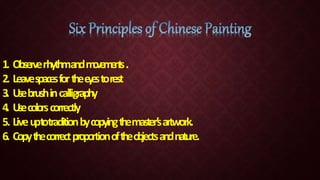
To make make your painting interesting and realistic apply
these Six Principles of Chinese Painting established by Xie
He, a writer, art historian and critic in 5th century China.
1. Observerhythmandm
o
ve
m
e
n
t
s.
2. Leavespacesforthee
y
estorest
3. Usebrushincalligraphy
4. Usecolorscorrectly
5. Liveuptotraditionbycopyingthemaster’
sartwork.
6. Copythecorrectproportionoftheob
jectsandnature.
To the chinese, Calligraphy is the art of beautiful
handwriting. Traditional painting involves essentially the
same techniques as calligraphy and is done with a brush
dipped in black or colored ink; oils are not used. In
calligraphy, the popular materials which paintings are
made of are paper and silk. Poets write their calligraphy on
their paintings.
Your paintings can be mounted on scrolls, such
as hanging scrolls or hand scrolls, album sheets,
walls, lacquerware, folding screens, and other media.
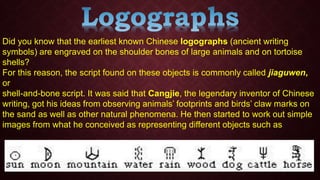
Did you know that the earliest known Chinese logographs (ancient writing
symbols) are engraved on the shoulder bones of large animals and on tortoise
shells?
For this reason, the script found on these objects is commonly called jiaguwen,
or
shell-and-bone script. It was said that Cangjie, the legendary inventor of Chinese
writing, got his ideas from observing animals’ footprints and birds’ claw marks on
the sand as well as other natural phenomena. He then started to work out simple
images from what he conceived as representing different objects such as
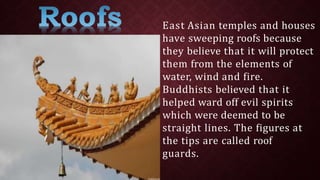
East Asian temples and houses
have sweeping roofs because
they believe that it will protect
them from the elements of
water, wind and fire.
Buddhists believed that it
helped ward off evil spirits
which were deemed to be
straight lines. The figures at
the tips are called roof
guards.
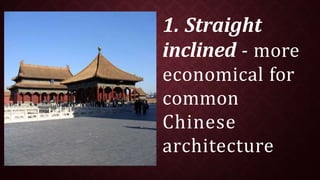
1. Straight
inclined - more
economical for
common
Chinese
architecture
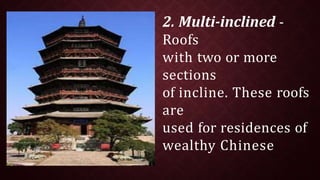
2. Multi-inclined -
Roofs
with two or more
sections
of incline. These roofs
are
used for residences of
wealthy Chinese
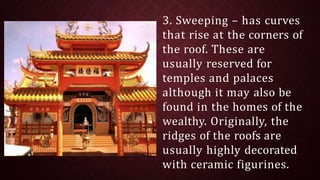
3. Sweeping – has curves
that rise at the corners of
the roof. These are
usually reserved for
temples and palaces
although it may also be
found in the homes of the
wealthy. Originally, the
ridges of the roofs are
usually highly decorated
with ceramic figurines.
Peking opera face-painting orJingju Lianpu is done with
different colors in accordance with the performing characters’
personality and historical assessment. The
hero type characters are normally painted in relatively simple
colors, whereas enemies, bandits, rebels
and others have more complicated
designs on their faces. It is a traditional special way
of make-up in Chinese operas in pursuit of the expected effect
of performance. Originally, Lianpu is
called the false mask.
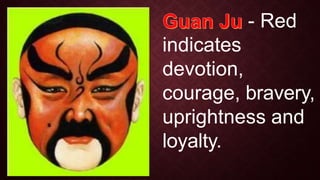
- Red
indicates
devotion,
courage, bravery,
uprightness and
loyalty.
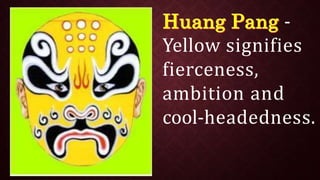
-
Yellow signifies
fierceness,
ambition and
cool-headedness.
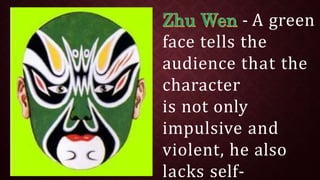
- A green
face tells the
audience that the
character
is not only
impulsive and
violent, he also
lacks self-
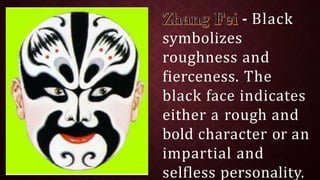
- Black
symbolizes
roughness and
fierceness. The
black face indicates
either a rough and
bold character or an
impartial and
selfless personality.
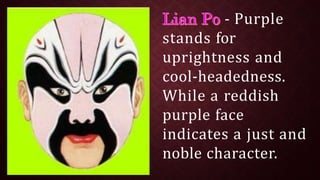
- Purple
stands for
uprightness and
cool-headedness.
While a reddish
purple face
indicates a just and
noble character.
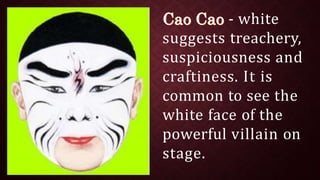
- white
suggests treachery,
suspiciousness and
craftiness. It is
common to see the
white face of the
powerful villain on
stage.
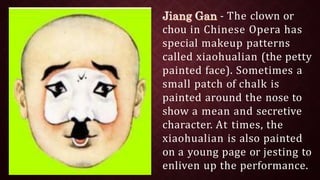
- The clown or
chou in Chinese Opera has
special makeup patterns
called xiaohualian (the petty
painted face). Sometimes a
small patch of chalk is
painted around the nose to
show a mean and secretive
character. At times, the
xiaohualian is also painted
on a young page or jesting to
enliven up the performance.
Paper was first invented by Cai
Lun of the Eastern Han
Dynasty in China. It is indeed
one of the greatest contributions
of ancient China in the
development of arts.
KNOT TYING
Zhongguo is the Chinese decorative
handicraft art that began as a form
of Chinese folk art in the Tang and
Song Dynasty (960-1279 AD) in
China.
PAPER CUTTING
Jianzhi is the first type of paper cutting
design, since paper was invented by the
Chinese. The cut outs are also used to
decorate doors and windows.
They are sometimes referred to "chuāng
huā", meaning Window Flower.
ORIGAMI(PAPER FOLDING)
The term Origami came from “ori” meaning
"folding", and “kami” meaning "paper". It is the
traditional Japanese art of paper folding, which
started in the 17th century AD and was
popularized internationally in the mid-1900s. It
eventually evolved into a modern art form. The
goal of this art is to transform a flat sheet of paper
into a finished sculpture through folding and
sculpting techniques without cutting as much as
KITE MAKING
A kite is an assembled or joined aircraft that was traditionally made of
silk or paper with a bowline and a resilient bamboo. Today, kites can be
made out of plastic. Kites are flown for recreational purposes, display of
one’s artistic skills. Chinese Kites originated in WeiFang, Sandong,
China was the capital city of kites during the Song Dynasty (960-1279),
and by the Ming Dynasty (1368– 1644). Since 1984 the city is hosting
the largest international kite festival on earth. According to Joseph
Needham, one of the important contributions of Chinese in science and
technology to Europe is the kite.
Chinese kites may be differentiated into four main categories:
1. Centipede
2. Hard-Winged Kites
3. Soft-Winged Kites
4. Flat Kites

artsofjapan-190604014938.pptx

  • 1.
  • 2.
  • 3.
    1. Flowers andbirds 4. Human Figures 5. Animals 6. Bamboos and 2. Landscapes 3.Palaces and Temples Stones PAINTING SUBJECTS OR THEMES
  • 4.
    Landscape painting wasregarded as the highest form of Chinese painting. They also consider the three concepts of their arts: Nature, Heaven and Humankind (YinYang). Chinese society, basically agricultural, has always laid great stress on understanding the pattern of nature and living in accordance with it. Oriental artists often created landscapes rather than paintings with the human figure as subjects.
  • 6.
    Silk was oftenused as the medium to paint upon, but it was quite expensive. When the Han court eunuch, Cai Lun, invented the paper in the 1st Century AD it provided not only a cheap and widespread medium for writing but painting became more economical. The ideologies of Confucianism, Daoism, and Buddhism played important roles in East Asian art.
  • 7.
    Chinese art expressesthe human understanding of the relationship between nature and human. This is evident in the form of painting of landscapes, bamboo, birds, and flowers, etc. This might be called the metaphysical, Daoist aspect of Chinese painting. To make make your painting interesting and realistic apply these Six Principles of Chinese Painting established by Xie He, a writer, art historian and critic in 5th century China.
  • 8.
    1. Observerhythmandm o ve m e n t s. 2. Leavespacesforthee y estorest 3.Usebrushincalligraphy 4. Usecolorscorrectly 5. Liveuptotraditionbycopyingthemaster’ sartwork. 6. Copythecorrectproportionoftheob jectsandnature.
  • 9.
    To the chinese,Calligraphy is the art of beautiful handwriting. Traditional painting involves essentially the same techniques as calligraphy and is done with a brush dipped in black or colored ink; oils are not used. In calligraphy, the popular materials which paintings are made of are paper and silk. Poets write their calligraphy on their paintings. Your paintings can be mounted on scrolls, such as hanging scrolls or hand scrolls, album sheets, walls, lacquerware, folding screens, and other media.
  • 10.
    Did you knowthat the earliest known Chinese logographs (ancient writing symbols) are engraved on the shoulder bones of large animals and on tortoise shells? For this reason, the script found on these objects is commonly called jiaguwen, or shell-and-bone script. It was said that Cangjie, the legendary inventor of Chinese writing, got his ideas from observing animals’ footprints and birds’ claw marks on the sand as well as other natural phenomena. He then started to work out simple images from what he conceived as representing different objects such as
  • 11.
    East Asian templesand houses have sweeping roofs because they believe that it will protect them from the elements of water, wind and fire. Buddhists believed that it helped ward off evil spirits which were deemed to be straight lines. The figures at the tips are called roof guards.
  • 13.
    1. Straight inclined -more economical for common Chinese architecture
  • 14.
    2. Multi-inclined - Roofs withtwo or more sections of incline. These roofs are used for residences of wealthy Chinese
  • 15.
    3. Sweeping –has curves that rise at the corners of the roof. These are usually reserved for temples and palaces although it may also be found in the homes of the wealthy. Originally, the ridges of the roofs are usually highly decorated with ceramic figurines.
  • 16.
    Peking opera face-paintingorJingju Lianpu is done with different colors in accordance with the performing characters’ personality and historical assessment. The hero type characters are normally painted in relatively simple colors, whereas enemies, bandits, rebels and others have more complicated designs on their faces. It is a traditional special way of make-up in Chinese operas in pursuit of the expected effect of performance. Originally, Lianpu is called the false mask.
  • 18.
  • 19.
  • 20.
    - A green facetells the audience that the character is not only impulsive and violent, he also lacks self-
  • 21.
    - Black symbolizes roughness and fierceness.The black face indicates either a rough and bold character or an impartial and selfless personality.
  • 22.
    - Purple stands for uprightnessand cool-headedness. While a reddish purple face indicates a just and noble character.
  • 23.
    - white suggests treachery, suspiciousnessand craftiness. It is common to see the white face of the powerful villain on stage.
  • 24.
    - The clownor chou in Chinese Opera has special makeup patterns called xiaohualian (the petty painted face). Sometimes a small patch of chalk is painted around the nose to show a mean and secretive character. At times, the xiaohualian is also painted on a young page or jesting to enliven up the performance.
  • 25.
    Paper was firstinvented by Cai Lun of the Eastern Han Dynasty in China. It is indeed one of the greatest contributions of ancient China in the development of arts.
  • 27.
    KNOT TYING Zhongguo isthe Chinese decorative handicraft art that began as a form of Chinese folk art in the Tang and Song Dynasty (960-1279 AD) in China.
  • 28.
    PAPER CUTTING Jianzhi isthe first type of paper cutting design, since paper was invented by the Chinese. The cut outs are also used to decorate doors and windows. They are sometimes referred to "chuāng huā", meaning Window Flower.
  • 29.
    ORIGAMI(PAPER FOLDING) The termOrigami came from “ori” meaning "folding", and “kami” meaning "paper". It is the traditional Japanese art of paper folding, which started in the 17th century AD and was popularized internationally in the mid-1900s. It eventually evolved into a modern art form. The goal of this art is to transform a flat sheet of paper into a finished sculpture through folding and sculpting techniques without cutting as much as
  • 30.
    KITE MAKING A kiteis an assembled or joined aircraft that was traditionally made of silk or paper with a bowline and a resilient bamboo. Today, kites can be made out of plastic. Kites are flown for recreational purposes, display of one’s artistic skills. Chinese Kites originated in WeiFang, Sandong, China was the capital city of kites during the Song Dynasty (960-1279), and by the Ming Dynasty (1368– 1644). Since 1984 the city is hosting the largest international kite festival on earth. According to Joseph Needham, one of the important contributions of Chinese in science and technology to Europe is the kite. Chinese kites may be differentiated into four main categories: 1. Centipede 2. Hard-Winged Kites 3. Soft-Winged Kites 4. Flat Kites