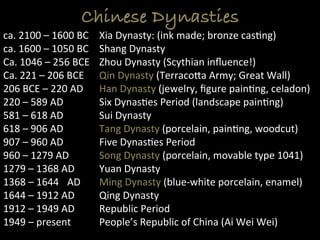
Chinese Dynasties
ca.	
  2100	
  –	
  1600	
  BC 	
  Xia	
  Dynasty:	
  (ink	
  made;	
  bronze	
  cas>ng)	
  
ca.	
  1600	
  –	
  1050	
  BC 	
  Shang	
  Dynasty	
  
Ca.	
  1046	
  –	
  256	
  BCE 	
  Zhou	
  Dynasty	
  (Scythian	
  influence!)	
  
Ca.	
  221	
  –	
  206	
  BCE 	
  Qin	
  Dynasty	
  (TerracoLa	
  Army;	
  Great	
  Wall)	
  
206	
  BCE	
  –	
  220	
  AD 	
  Han	
  Dynasty	
  (jewelry,	
  figure	
  pain>ng,	
  celadon)	
  
220	
  –	
  589	
  AD	
  	
   	
  Six	
  Dynas>es	
  Period	
  (landscape	
  pain>ng)	
  
581	
  –	
  618	
  AD	
   	
  Sui	
  Dynasty	
  
618	
  –	
  906	
  AD	
   	
  Tang	
  Dynasty	
  (porcelain,	
  pain>ng,	
  woodcut)	
  
907	
  –	
  960	
  AD	
   	
  Five	
  Dynas>es	
  Period	
  
960	
  –	
  1279	
  AD	
   	
  Song	
  Dynasty	
  (porcelain,	
  movable	
  type	
  1041)	
  
1279	
  –	
  1368	
  AD 	
  Yuan	
  Dynasty	
  
1368	
  –	
  1644 	
  AD 	
  Ming	
  Dynasty	
  (blue-­‐white	
  porcelain,	
  enamel)	
  
1644	
  –	
  1912	
  AD 	
  Qing	
  Dynasty	
  
1912	
  –	
  1949	
  AD 	
  Republic	
  Period	
  
1949	
  –	
  present 	
  People’s	
  Republic	
  of	
  China	
  (Ai	
  Wei	
  Wei) 	
  	
  
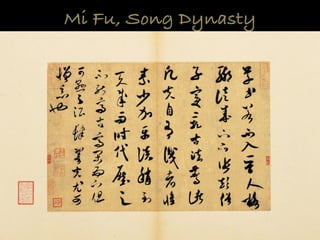
Mi Fu, Song Dynasty
Chinese Calligraphy
	
  
•  Ini>ally	
  characters	
  –	
  pictograms	
  –	
  were	
  incised	
  
into	
  bone	
  or	
  clay	
  that	
  was	
  later	
  cast	
  in	
  bronze.	
  
•  As	
  characters	
  developed	
  and	
  became	
  more	
  
regular,	
  around	
  300	
  BC	
  the	
  brush	
  was	
  invented	
  
and	
  used	
  on	
  silk.	
  Shortly	
  thereafer,	
  paper	
  was	
  
invented	
  (for	
  toilet	
  paper!!!)	
  and	
  became	
  the	
  
primary	
  support	
  for	
  wriLen	
  expression.	
  
•  The	
  brush	
  has	
  certain	
  quali>es	
  that	
  make	
  wri>ng	
  
look	
  dis>nct	
  from	
  carving	
  or	
  incising.	
  
Materials: “The Four Treasures”
•  Wri>ng	
  brush	
  –	
  invented	
  ca.	
  300	
  BCE	
  
•  Inks>ck	
  –	
  Chinese	
  ink	
  comes	
  in	
  solid	
  form,	
  
made	
  of	
  soot	
  (tradi>onally	
  from	
  an	
  oil	
  lamp,	
  
later	
  from	
  pine	
  soot,	
  mixed	
  with	
  animal	
  glue	
  
(tradi>onally	
  deer)	
  
•  Paper	
  –	
  made	
  from	
  inner	
  bark	
  of	
  mulberry	
  
tree,	
  hemp	
  or	
  bamboo;	
  invented	
  ca.	
  300	
  BCE	
  
•  Inkstone	
  –	
  used	
  to	
  both	
  grind	
  the	
  solid	
  ink	
  into	
  
liquid	
  and	
  as	
  wet	
  ink	
  container	
  
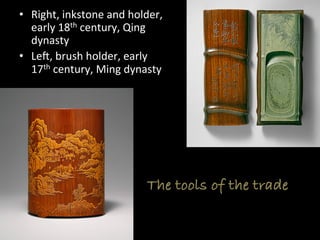
•  Right,	
  inkstone	
  and	
  holder,	
  
early	
  18th	
  century,	
  Qing	
  
dynasty	
  
•  Lef,	
  brush	
  holder,	
  early	
  
17th	
  century,	
  Ming	
  dynasty	
  
The tools of the trade
•  An>que	
  ink	
  s>cks	
  
•  An>que	
  brush	
  
•  An>que	
  ink	
  set	
  
Oracle Bone Style
•  Chinese	
  wriLen	
  language	
  began	
  to	
  
develop	
  ca.	
  1000	
  BCE	
  
•  Earliest	
  form:	
  pictographs,	
  scored	
  
into	
  surfaces	
  of	
  jades	
  and	
  oracle	
  
bones.	
  
•  Shang	
  dynasty	
  oracle	
  bones	
  
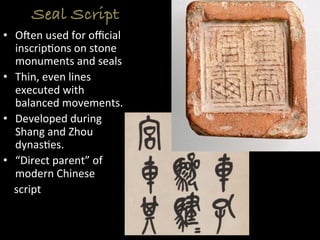
Seal Script
•  Ofen	
  used	
  for	
  official	
  
inscrip>ons	
  on	
  stone	
  
monuments	
  and	
  seals	
  
•  Thin,	
  even	
  lines	
  
executed	
  with	
  
balanced	
  movements.	
  
•  Developed	
  during	
  
Shang	
  and	
  Zhou	
  
dynas>es.	
  
•  “Direct	
  parent”	
  of	
  
modern	
  Chinese	


  script	
  
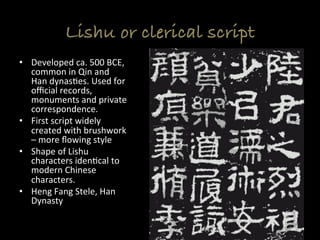
Lishu or clerical script
•  Developed	
  ca.	
  500	
  BCE,	
  
common	
  in	
  Qin	
  and	
  
Han	
  dynas>es.	
  Used	
  for	
  
official	
  records,	
  
monuments	
  and	
  private	
  
correspondence.	
  
•  First	
  script	
  widely	
  
created	
  with	
  brushwork	
  
–	
  more	
  flowing	
  style	
  
•  Shape	
  of	
  Lishu	
  
characters	
  iden>cal	
  to	
  
modern	
  Chinese	
  
characters.	
  
•  Heng	
  Fang	
  Stele,	
  Han	
  
Dynasty	
  
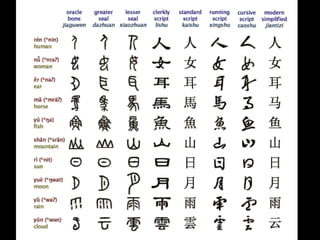
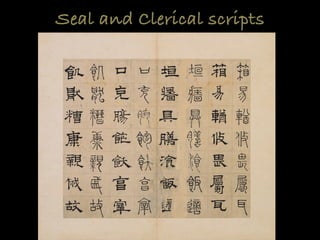
Seal and Clerical scripts
Kaishu or “standard” script
•  Appeared	
  ca.	
  220	
  AD	
  during	
  Han	
  dynasty	
  
•  Essen>ally	
  the	
  tradi>onal	
  script	
  used	
  today	
  
•  Similar	
  to	
  Lishu	
  but	
  more	
  cursive,	
  containing	
  serif-­‐type	
  elements	
  at	
  the	
  
end	
  of	
  strokes	
  
“Thousand	
  Character	
  
	
  Classic”	
  in	
  Standard	
  and	
  	
  
Cursive	
  Scripts	


Zhiyong,	
  7th	
  genera>on	
  
Descendant	
  of	
  famed	
  	
  
Calligrapher	
  Wang	
  Xizhi.	
  
Ca.	
  510	
  –	
  610	
  AD,	
  	
  
Sui	
  Dynasty	


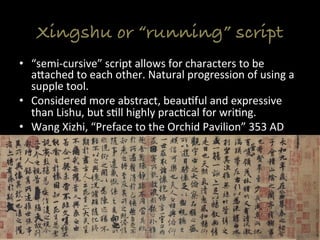
Xingshu or “running” script
•  “semi-­‐cursive”	
  script	
  allows	
  for	
  characters	
  to	
  be	
  
aLached	
  to	
  each	
  other.	
  Natural	
  progression	
  of	
  using	
  a	
  
supple	
  tool.	
  
•  Considered	
  more	
  abstract,	
  beau>ful	
  and	
  expressive	
  
than	
  Lishu,	
  but	
  s>ll	
  highly	
  prac>cal	
  for	
  wri>ng.	
  	
  
•  Wang	
  Xizhi,	
  “Preface	
  to	
  the	
  Orchid	
  Pavilion”	
  353	
  AD	
  
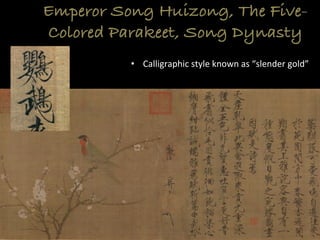
Emperor Song Huizong, The Five-
Colored Parakeet, Song Dynasty
•  Calligraphic	
  style	
  known	
  as	
  “slender	
  gold”	
  
Cao shu or “grass script”
•  Without	
  training,	
  this	
  script	
  cannot	
  be	
  read	
  
•  En>re	
  characters	
  may	
  be	
  wriLen	
  without	
  
lifing	
  the	
  brush	
  from	
  paper	
  at	
  all.	
  
•  Strokes	
  are	
  modified	
  or	
  eliminated	
  to	
  facilitate	
  
smooth	
  wri>ng	
  	
  
•  Characters	
  are	
  rounded	
  and	
  sof	
  in	
  
appearance,	
  lacking	
  angular	
  lines.	
  	
  
•  Aesthe>c	
  and	
  expressive	
  concerns	
  dominate	
  
over	
  communica>on.	
  
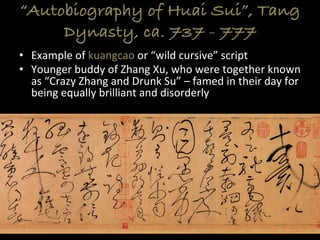
“Autobiography of Huai Sui”, Tang
Dynasty, ca. 737 - 777
•  Example	
  of	
  kuangcao	
  or	
  “wild	
  cursive”	
  script	
  
•  Younger	
  buddy	
  of	
  Zhang	
  Xu,	
  who	
  were	
  together	
  known	
  
as	
  “Crazy	
  Zhang	
  and	
  Drunk	
  Su”	
  –	
  famed	
  in	
  their	
  day	
  for	
  
being	
  equally	
  brilliant	
  and	
  disorderly	
  
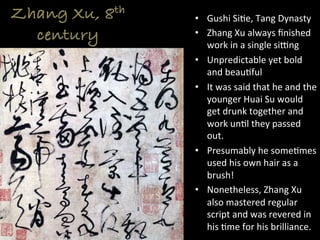
Zhang Xu, 8th
century
•  Gushi	
  Si>e,	
  Tang	
  Dynasty	
  
•  Zhang	
  Xu	
  always	
  finished	
  
work	
  in	
  a	
  single	
  siong	
  
•  Unpredictable	
  yet	
  bold	
  
and	
  beau>ful	
  
•  It	
  was	
  said	
  that	
  he	
  and	
  the	
  
younger	
  Huai	
  Su	
  would	
  
get	
  drunk	
  together	
  and	
  
work	
  un>l	
  they	
  passed	
  
out.	
  
•  Presumably	
  he	
  some>mes	
  
used	
  his	
  own	
  hair	
  as	
  a	
  
brush!	
  
•  Nonetheless,	
  Zhang	
  Xu	
  
also	
  mastered	
  regular	
  
script	
  and	
  was	
  revered	
  in	
  
his	
  >me	
  for	
  his	
  brilliance.	
  
Zhao Zhiquian,
1867
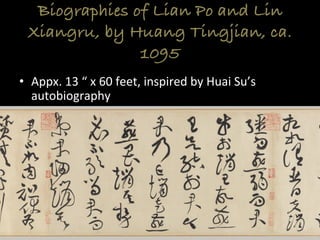
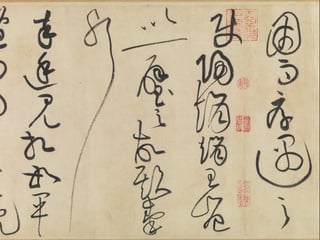
Biographies of Lian Po and Lin
Xiangru, by Huang Tingjian, ca.
1095
•  Appx.	
  13	
  “	
  x	
  60	
  feet,	
  inspired	
  by	
  Huai	
  Su’s	
  
autobiography	
  
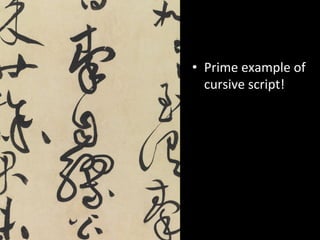
•  Prime	
  example	
  of	
  
cursive	
  script!	
  
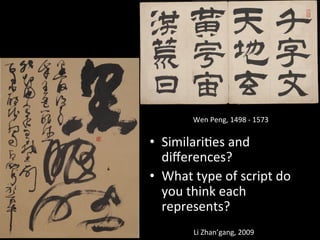
•  Similari>es	
  and	
  
differences?	
  
•  What	
  type	
  of	
  script	
  do	
  
you	
  think	
  each	
  
represents?	
  
Li	
  Zhan’gang,	
  2009	
  
Wen	
  Peng,	
  1498	
  -­‐	
  1573	
  
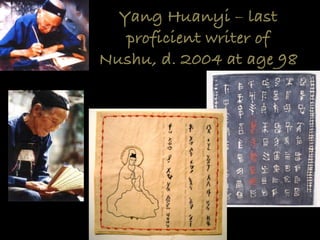
Nushu
•  “Women’s	
  
Wri>ng”	
  
Yang Huanyi – last
proficient writer of
Nushu, d. 2004 at age 98
https://www.youtube.com/watch?
v=oRRiTo8sUwk
Chinese	
  Pain>ng	
  
•  Closely	
  linked	
  to	
  calligraphy	
  
•  One	
  of	
  “The	
  Three	
  Perfec>ons”	
  along	
  with	
  poetry	
  and	
  
calligraphy	
  
•  For	
  Chinese	
  ar>sts,	
  the	
  point	
  is	
  to	
  depict	
  the	
  ESSENCE	
  
of	
  the	
  subject,	
  rather	
  than	
  just	
  the	
  LIKENESS.	
  	
  
•  Main	
  techniques:	
  Gong-­‐bi	
  “me>culous”	
  –	
  detailed,	
  
usually	
  colored	
  and	
  figural	
  subjects	
  
•  Shui-­‐mo	
  (Japanese:	
  sumi-­‐e)	
  “water-­‐ink”	
  pain>ng,	
  
da>ng	
  to	
  Tang	
  dynasty.	
  
•  Wen-­‐jen-­‐hua	
  “litera>”	
  pain>ng	
  –	
  self-­‐expression	
  and	
  
crea>vity,	
  introduced	
  during	
  Song	
  dynasty	
  
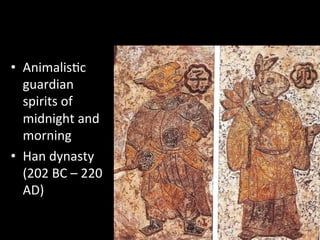
•  Animalis>c	
  
guardian	
  
spirits	
  of	
  
midnight	
  and	
  
morning	
  
•  Han	
  dynasty	
  
(202	
  BC	
  –	
  220	
  
AD)	
  
Mi Fu: poet, calligrapher, painter
1052 – 1107 (Song Dynasty)
•  First	
  to	
  use	
  calligraphic	
  techniques	
  in	
  pain>ng	
  
•  Valued	
  historic	
  styles,	
  collec>ng	
  historic	
  examples	
  of	
  
calligraphy,	
  which	
  he	
  copied	
  and	
  mastered.	
  
•  While	
  fas>dious	
  (probably	
  OCD),	
  he	
  was	
  also	
  eccentric,	
  
preferring	
  clothes	
  of	
  ancient	
  dynas>es	
  and	
  obsessively	
  
collec>ng	
  stones.	
  
•  Above	
  all,	
  ar>s>cally	
  he	
  value	
  spontaneity	
  and	
  self-­‐
expression.	
  
•  His	
  handling	
  of	
  the	
  brush	
  was	
  described	
  as	
  “like	
  a	
  sharp	
  
sword	
  handled	
  skillfully	
  in	
  fight,	
  or	
  a	
  bow	
  which	
  could	
  
shoot	
  an	
  arrow	
  …	
  piercing	
  anything	
  that	
  might	
  be	
  in	
  its	
  
way.”	
  U>lized	
  Xingshu	
  (running	
  script)	
  and	
  Caoshu	
  (cursive)	
  
•  With	
  other	
  intellectuals,	
  rediscovered	
  key	
  Tang	
  painters	
  
and	
  formulated	
  the	
  theory	
  and	
  prac>ceof	
  crea>ve	
  self-­‐
expression,	
  known	
  as	
  wen-­‐jua-­‐hen.	
  
Mi	
  Fu	
  	
  
Chinese calligraphy 1

Chinese calligraphy 1

  • 1.
    Chinese Dynasties ca.  2100  –  1600  BC  Xia  Dynasty:  (ink  made;  bronze  cas>ng)   ca.  1600  –  1050  BC  Shang  Dynasty   Ca.  1046  –  256  BCE  Zhou  Dynasty  (Scythian  influence!)   Ca.  221  –  206  BCE  Qin  Dynasty  (TerracoLa  Army;  Great  Wall)   206  BCE  –  220  AD  Han  Dynasty  (jewelry,  figure  pain>ng,  celadon)   220  –  589  AD      Six  Dynas>es  Period  (landscape  pain>ng)   581  –  618  AD    Sui  Dynasty   618  –  906  AD    Tang  Dynasty  (porcelain,  pain>ng,  woodcut)   907  –  960  AD    Five  Dynas>es  Period   960  –  1279  AD    Song  Dynasty  (porcelain,  movable  type  1041)   1279  –  1368  AD  Yuan  Dynasty   1368  –  1644  AD  Ming  Dynasty  (blue-­‐white  porcelain,  enamel)   1644  –  1912  AD  Qing  Dynasty   1912  –  1949  AD  Republic  Period   1949  –  present  People’s  Republic  of  China  (Ai  Wei  Wei)    
  • 2.
    Mi Fu, SongDynasty
  • 3.
    Chinese Calligraphy   • Ini>ally  characters  –  pictograms  –  were  incised   into  bone  or  clay  that  was  later  cast  in  bronze.   •  As  characters  developed  and  became  more   regular,  around  300  BC  the  brush  was  invented   and  used  on  silk.  Shortly  thereafer,  paper  was   invented  (for  toilet  paper!!!)  and  became  the   primary  support  for  wriLen  expression.   •  The  brush  has  certain  quali>es  that  make  wri>ng   look  dis>nct  from  carving  or  incising.  
  • 4.
    Materials: “The FourTreasures” •  Wri>ng  brush  –  invented  ca.  300  BCE   •  Inks>ck  –  Chinese  ink  comes  in  solid  form,   made  of  soot  (tradi>onally  from  an  oil  lamp,   later  from  pine  soot,  mixed  with  animal  glue   (tradi>onally  deer)   •  Paper  –  made  from  inner  bark  of  mulberry   tree,  hemp  or  bamboo;  invented  ca.  300  BCE   •  Inkstone  –  used  to  both  grind  the  solid  ink  into   liquid  and  as  wet  ink  container  
  • 5.
    •  Right,  inkstone  and  holder,   early  18th  century,  Qing   dynasty   •  Lef,  brush  holder,  early   17th  century,  Ming  dynasty   The tools of the trade
  • 6.
    •  An>que  ink  s>cks   •  An>que  brush   •  An>que  ink  set  
  • 8.
    Oracle Bone Style • Chinese  wriLen  language  began  to   develop  ca.  1000  BCE   •  Earliest  form:  pictographs,  scored   into  surfaces  of  jades  and  oracle   bones.   •  Shang  dynasty  oracle  bones  
  • 9.
    Seal Script •  Ofen  used  for  official   inscrip>ons  on  stone   monuments  and  seals   •  Thin,  even  lines   executed  with   balanced  movements.   •  Developed  during   Shang  and  Zhou   dynas>es.   •  “Direct  parent”  of   modern  Chinese            script  
  • 10.
    Lishu or clericalscript •  Developed  ca.  500  BCE,   common  in  Qin  and   Han  dynas>es.  Used  for   official  records,   monuments  and  private   correspondence.   •  First  script  widely   created  with  brushwork   –  more  flowing  style   •  Shape  of  Lishu   characters  iden>cal  to   modern  Chinese   characters.   •  Heng  Fang  Stele,  Han   Dynasty  
  • 11.
  • 12.
    Kaishu or “standard”script •  Appeared  ca.  220  AD  during  Han  dynasty   •  Essen>ally  the  tradi>onal  script  used  today   •  Similar  to  Lishu  but  more  cursive,  containing  serif-­‐type  elements  at  the   end  of  strokes   “Thousand  Character    Classic”  in  Standard  and     Cursive  Scripts     Zhiyong,  7th  genera>on   Descendant  of  famed     Calligrapher  Wang  Xizhi.   Ca.  510  –  610  AD,     Sui  Dynasty    
  • 13.
    Xingshu or “running”script •  “semi-­‐cursive”  script  allows  for  characters  to  be   aLached  to  each  other.  Natural  progression  of  using  a   supple  tool.   •  Considered  more  abstract,  beau>ful  and  expressive   than  Lishu,  but  s>ll  highly  prac>cal  for  wri>ng.     •  Wang  Xizhi,  “Preface  to  the  Orchid  Pavilion”  353  AD  
  • 14.
    Emperor Song Huizong,The Five- Colored Parakeet, Song Dynasty •  Calligraphic  style  known  as  “slender  gold”  
  • 15.
    Cao shu or“grass script” •  Without  training,  this  script  cannot  be  read   •  En>re  characters  may  be  wriLen  without   lifing  the  brush  from  paper  at  all.   •  Strokes  are  modified  or  eliminated  to  facilitate   smooth  wri>ng     •  Characters  are  rounded  and  sof  in   appearance,  lacking  angular  lines.     •  Aesthe>c  and  expressive  concerns  dominate   over  communica>on.  
  • 16.
    “Autobiography of HuaiSui”, Tang Dynasty, ca. 737 - 777 •  Example  of  kuangcao  or  “wild  cursive”  script   •  Younger  buddy  of  Zhang  Xu,  who  were  together  known   as  “Crazy  Zhang  and  Drunk  Su”  –  famed  in  their  day  for   being  equally  brilliant  and  disorderly  
  • 17.
    Zhang Xu, 8th century • Gushi  Si>e,  Tang  Dynasty   •  Zhang  Xu  always  finished   work  in  a  single  siong   •  Unpredictable  yet  bold   and  beau>ful   •  It  was  said  that  he  and  the   younger  Huai  Su  would   get  drunk  together  and   work  un>l  they  passed   out.   •  Presumably  he  some>mes   used  his  own  hair  as  a   brush!   •  Nonetheless,  Zhang  Xu   also  mastered  regular   script  and  was  revered  in   his  >me  for  his  brilliance.  
  • 18.
  • 19.
    Biographies of LianPo and Lin Xiangru, by Huang Tingjian, ca. 1095 •  Appx.  13  “  x  60  feet,  inspired  by  Huai  Su’s   autobiography  
  • 21.
    •  Prime  example  of   cursive  script!  
  • 22.
    •  Similari>es  and   differences?   •  What  type  of  script  do   you  think  each   represents?   Li  Zhan’gang,  2009   Wen  Peng,  1498  -­‐  1573  
  • 23.
  • 24.
    Yang Huanyi –last proficient writer of Nushu, d. 2004 at age 98
  • 26.
  • 27.
    Chinese  Pain>ng   • Closely  linked  to  calligraphy   •  One  of  “The  Three  Perfec>ons”  along  with  poetry  and   calligraphy   •  For  Chinese  ar>sts,  the  point  is  to  depict  the  ESSENCE   of  the  subject,  rather  than  just  the  LIKENESS.     •  Main  techniques:  Gong-­‐bi  “me>culous”  –  detailed,   usually  colored  and  figural  subjects   •  Shui-­‐mo  (Japanese:  sumi-­‐e)  “water-­‐ink”  pain>ng,   da>ng  to  Tang  dynasty.   •  Wen-­‐jen-­‐hua  “litera>”  pain>ng  –  self-­‐expression  and   crea>vity,  introduced  during  Song  dynasty  
  • 28.
    •  Animalis>c   guardian   spirits  of   midnight  and   morning   •  Han  dynasty   (202  BC  –  220   AD)  
  • 31.
    Mi Fu: poet,calligrapher, painter 1052 – 1107 (Song Dynasty) •  First  to  use  calligraphic  techniques  in  pain>ng   •  Valued  historic  styles,  collec>ng  historic  examples  of   calligraphy,  which  he  copied  and  mastered.   •  While  fas>dious  (probably  OCD),  he  was  also  eccentric,   preferring  clothes  of  ancient  dynas>es  and  obsessively   collec>ng  stones.   •  Above  all,  ar>s>cally  he  value  spontaneity  and  self-­‐ expression.   •  His  handling  of  the  brush  was  described  as  “like  a  sharp   sword  handled  skillfully  in  fight,  or  a  bow  which  could   shoot  an  arrow  …  piercing  anything  that  might  be  in  its   way.”  U>lized  Xingshu  (running  script)  and  Caoshu  (cursive)   •  With  other  intellectuals,  rediscovered  key  Tang  painters   and  formulated  the  theory  and  prac>ceof  crea>ve  self-­‐ expression,  known  as  wen-­‐jua-­‐hen.  
  • 32.