© Reaktor 2013
Three perspectives to Agile Leadership
Sami Lilja
Agile Coach and Certified Scrum Trainer
Reaktor
Helsinki, Finland
Wednesday, July 24, 13
© Reaktor 2013
About me
• Sami Lilja, coach and trainer
• Reaktor since March 2011
• Certified Scrum Trainer since July 2013
• Before Reaktor, 15+ years experience at Nokia Networks and
Nokia Siemens Networks
• SW engineer 1994-1998
• 10+ years management experience: Project manager, Department
manager 1997-2008
• Assignment in China (Hangzhou) 2005-2007
• Agile coach 2008-2010
• Contact and connect
sami.lilja@reaktor.fi LinkedIn: samililja
Wednesday, July 24, 13
© Reaktor 2013
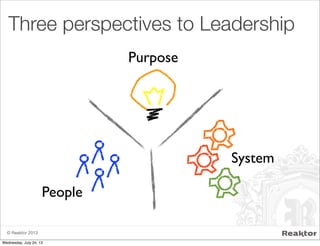
Purpose
People
Three perspectives to Leadership
System
Wednesday, July 24, 13
© Reaktor 2013
System
Systems Thinking
Wednesday, July 24, 13
”
© Reaktor 2013
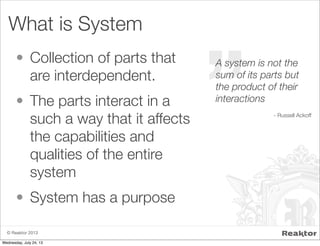
A system is not the
sum of its parts but
the product of their
interactions
- Russell Ackoff
What is System
• Collection of parts that
are interdependent.
• The parts interact in a
such a way that it affects
the capabilities and
qualities of the entire
system
• System has a purpose
Wednesday, July 24, 13
© Reaktor 2013
How can we see the system?
Wednesday, July 24, 13
© Reaktor 2013
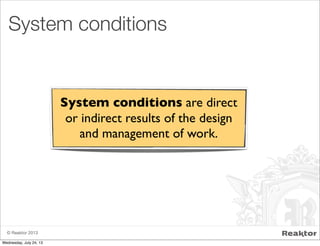
System conditions are direct
or indirect results of the design
and management of work.
System conditions
Wednesday, July 24, 13
© Reaktor 2013
Some system conditions
Processes Training
Existing source code
Stage gates
Tools
Organizational
structures
Policies
Governance
Bonuses
Existing source code
IT systems
Physical working
environment
Quality of
requirements
Project model
Relationship with
customers
Culture of high
utilization rate Technologies
Approval chains
Missing feedback
Metrics
Roles and
responsibilities
Meetings
Outsourcing and
off-shoring
Wednesday, July 24, 13
© Reaktor 2013
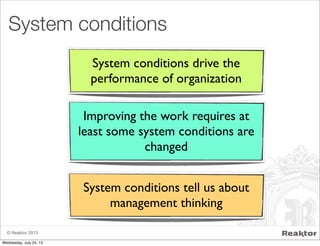
System conditions
System conditions drive the
performance of organization
Improving the work requires at
least some system conditions are
changed
System conditions tell us about
management thinking
Wednesday, July 24, 13
© Reaktor 2013
Wednesday, July 24, 13
© Reaktor 2013
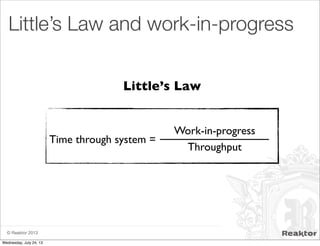
Little’s Law and work-in-progress
Time through system =
Work-in-progress
Throughput
Little’s Law
Wednesday, July 24, 13
© Reaktor 2013
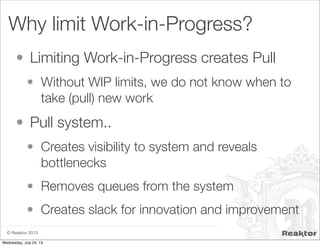
Why limit Work-in-Progress?
• Limiting Work-in-Progress creates Pull
• Without WIP limits, we do not know when to
take (pull) new work
• Pull system..
• Creates visibility to system and reveals
bottlenecks
• Removes queues from the system
• Creates slack for innovation and improvement
Wednesday, July 24, 13
© Reaktor 2013
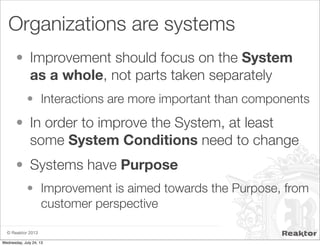
Organizations are systems
• Improvement should focus on the System
as a whole, not parts taken separately
• Interactions are more important than components
• In order to improve the System, at least
some System Conditions need to change
• Systems have Purpose
• Improvement is aimed towards the Purpose, from
customer perspective
Wednesday, July 24, 13
© Reaktor 2013
Purpose
Wednesday, July 24, 13
© Reaktor 2013
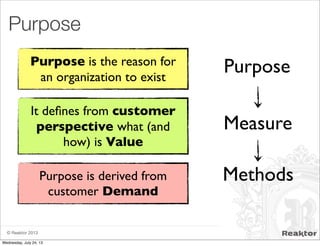
Purpose
Purpose
Measure
Methods
Purpose is the reason for
an organization to exist
It defines from customer
perspective what (and
how) is Value
Purpose is derived from
customer Demand
Wednesday, July 24, 13
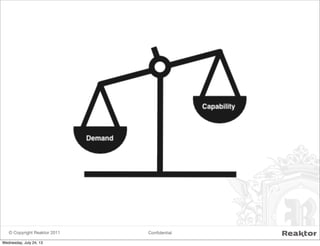
© Copyright Reaktor 2011 Confidential
Wednesday, July 24, 13
© Copyright Reaktor 2011 Confidential
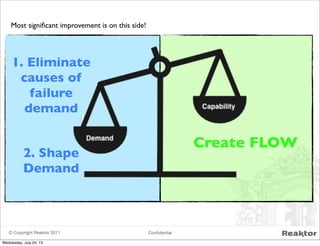
1. Eliminate
causes of
failure
demand
2. Shape
Demand
1
Most significant improvement is on this side!
Create FLOW
Wednesday, July 24, 13
© Reaktor 2013
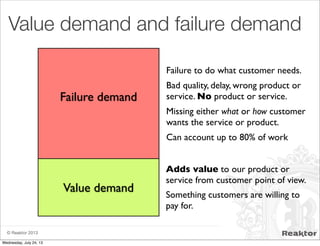
Value demand and failure demand
Value demand
Adds value to our product or
service from customer point of view.
Something customers are willing to
pay for.
Failure demand
Failure to do what customer needs.
Bad quality, delay, wrong product or
service. No product or service.
Missing either what or how customer
wants the service or product.
Can account up to 80% of work
Wednesday, July 24, 13
© Reaktor 2013
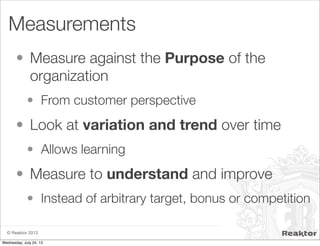
Measurements
• Measure against the Purpose of the
organization
• From customer perspective
• Look at variation and trend over time
• Allows learning
• Measure to understand and improve
• Instead of arbitrary target, bonus or competition
Wednesday, July 24, 13
© Reaktor 2013
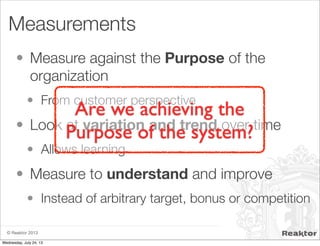
Measurements
• Measure against the Purpose of the
organization
• From customer perspective
• Look at variation and trend over time
• Allows learning
• Measure to understand and improve
• Instead of arbitrary target, bonus or competition
Are we achieving the
Purpose of the system?
Wednesday, July 24, 13
© Reaktor 2013
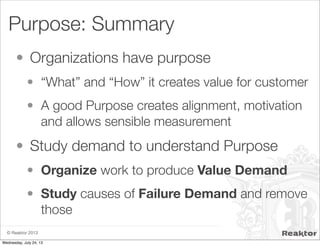
Purpose: Summary
• Organizations have purpose
• “What” and “How” it creates value for customer
• A good Purpose creates alignment, motivation
and allows sensible measurement
• Study demand to understand Purpose
• Organize work to produce Value Demand
• Study causes of Failure Demand and remove
those
Wednesday, July 24, 13
© Reaktor 2013
People
Wednesday, July 24, 13
”
© Reaktor 2013
John Seddon
People issues are not the point of
intervention.
Wednesday, July 24, 13
© Reaktor 2013
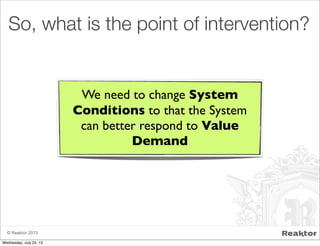
So, what is the point of intervention?
We need to change System
Conditions to that the System
can better respond to Value
Demand
Wednesday, July 24, 13
© Reaktor 2013
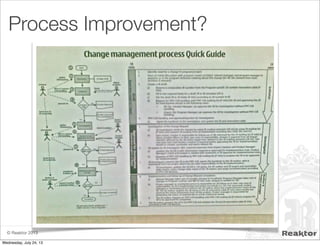
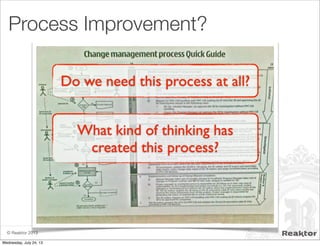
Process Improvement?
Wednesday, July 24, 13
© Reaktor 2013
Process Improvement?
Do we need this process at all?
What kind of thinking has
created this process?
Wednesday, July 24, 13
© Reaktor 2013
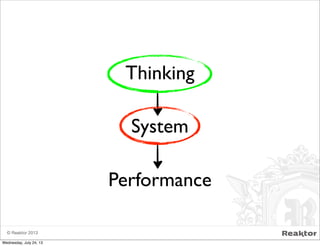
System
Thinking
Performance
Wednesday, July 24, 13
© Reaktor 2013
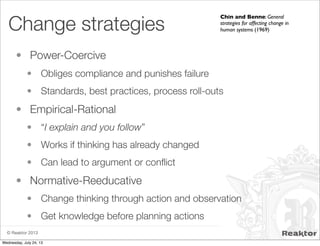
Change strategies
• Power-Coercive
• Obliges compliance and punishes failure
• Standards, best practices, process roll-outs
• Empirical-Rational
• “I explain and you follow”
• Works if thinking has already changed
• Can lead to argument or conflict
• Normative-Reeducative
• Change thinking through action and observation
• Get knowledge before planning actions
Chin and Benne: General
strategies for affecting change in
human systems (1969)
Wednesday, July 24, 13
© Reaktor 2013
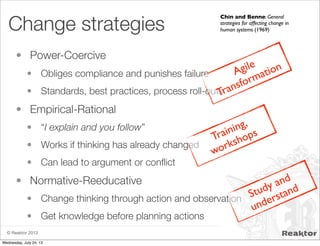
Change strategies
• Power-Coercive
• Obliges compliance and punishes failure
• Standards, best practices, process roll-outs
• Empirical-Rational
• “I explain and you follow”
• Works if thinking has already changed
• Can lead to argument or conflict
• Normative-Reeducative
• Change thinking through action and observation
• Get knowledge before planning actions
Chin and Benne: General
strategies for affecting change in
human systems (1969)
Agile
Transformation
Training,
workshops
Study and
understand
Wednesday, July 24, 13
© Reaktor 2013
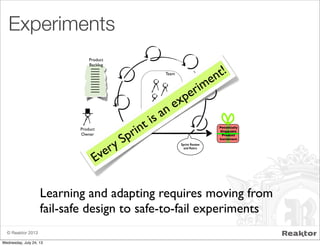
Experiments
Team
Product
Owner
Sprint
Planning Sprint Review
and Retro
Potentially
Shippable
Product
Increment
Product
Backlog
Every Sprint is an experiment!
Learning and adapting requires moving from
fail-safe design to safe-to-fail experiments
Wednesday, July 24, 13
© Reaktor 2013
Roll-in vs. Roll-out
• Roll-out: developing an improved process, standardizing it
and applying it to other areas.
• Problems
• The solution is not optimized for each specific context
• The other units have not been through the same learning --> lack
sense of ownership, loss of control and resist change.
• Roll-in: A method to scale up a change to the whole
organization that was successful in one unit.
• Change is not imposed. Instead, each area needs to learn how to
do the analysis for themselves and devise own solutions.
• Engages the people and creates better, more sustainable solutions.
Wednesday, July 24, 13
© Reaktor 2013
Agile Leadership is about studying and
improving the System, creating Purpose
and learning through experiments
Wednesday, July 24, 13
© Reaktor 2013
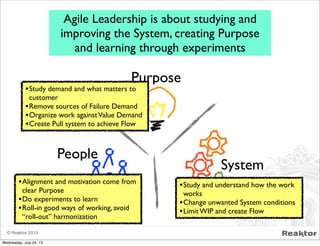
Agile Leadership is about studying and
improving the System, creating Purpose
and learning through experiments
Purpose
People
System
•Study and understand how the work
works
•Change unwanted System conditions
•Limit WIP and create Flow
•Study demand and what matters to
customer
•Remove sources of Failure Demand
•Organize work againstValue Demand
•Create Pull system to achieve Flow
•Alignment and motivation come from
clear Purpose
•Do experiments to learn
•Roll-in good ways of working, avoid
“roll-out” harmonization
Wednesday, July 24, 13
© Reaktor 2013
Thank you!
Wednesday, July 24, 13

China slilja-leadership-publish

  • 1.
    © Reaktor 2013 Threeperspectives to Agile Leadership Sami Lilja Agile Coach and Certified Scrum Trainer Reaktor Helsinki, Finland Wednesday, July 24, 13
  • 2.
    © Reaktor 2013 Aboutme • Sami Lilja, coach and trainer • Reaktor since March 2011 • Certified Scrum Trainer since July 2013 • Before Reaktor, 15+ years experience at Nokia Networks and Nokia Siemens Networks • SW engineer 1994-1998 • 10+ years management experience: Project manager, Department manager 1997-2008 • Assignment in China (Hangzhou) 2005-2007 • Agile coach 2008-2010 • Contact and connect sami.lilja@reaktor.fi LinkedIn: samililja Wednesday, July 24, 13
  • 3.
    © Reaktor 2013 Purpose People Threeperspectives to Leadership System Wednesday, July 24, 13
  • 4.
    © Reaktor 2013 System SystemsThinking Wednesday, July 24, 13
  • 5.
    ” © Reaktor 2013 Asystem is not the sum of its parts but the product of their interactions - Russell Ackoff What is System • Collection of parts that are interdependent. • The parts interact in a such a way that it affects the capabilities and qualities of the entire system • System has a purpose Wednesday, July 24, 13
  • 6.
    © Reaktor 2013 Howcan we see the system? Wednesday, July 24, 13
  • 7.
    © Reaktor 2013 Systemconditions are direct or indirect results of the design and management of work. System conditions Wednesday, July 24, 13
  • 8.
    © Reaktor 2013 Somesystem conditions Processes Training Existing source code Stage gates Tools Organizational structures Policies Governance Bonuses Existing source code IT systems Physical working environment Quality of requirements Project model Relationship with customers Culture of high utilization rate Technologies Approval chains Missing feedback Metrics Roles and responsibilities Meetings Outsourcing and off-shoring Wednesday, July 24, 13
  • 9.
    © Reaktor 2013 Systemconditions System conditions drive the performance of organization Improving the work requires at least some system conditions are changed System conditions tell us about management thinking Wednesday, July 24, 13
  • 10.
  • 11.
    © Reaktor 2013 Little’sLaw and work-in-progress Time through system = Work-in-progress Throughput Little’s Law Wednesday, July 24, 13
  • 12.
    © Reaktor 2013 Whylimit Work-in-Progress? • Limiting Work-in-Progress creates Pull • Without WIP limits, we do not know when to take (pull) new work • Pull system.. • Creates visibility to system and reveals bottlenecks • Removes queues from the system • Creates slack for innovation and improvement Wednesday, July 24, 13
  • 13.
    © Reaktor 2013 Organizationsare systems • Improvement should focus on the System as a whole, not parts taken separately • Interactions are more important than components • In order to improve the System, at least some System Conditions need to change • Systems have Purpose • Improvement is aimed towards the Purpose, from customer perspective Wednesday, July 24, 13
  • 14.
  • 15.
    © Reaktor 2013 Purpose Purpose Measure Methods Purposeis the reason for an organization to exist It defines from customer perspective what (and how) is Value Purpose is derived from customer Demand Wednesday, July 24, 13
  • 16.
    © Copyright Reaktor2011 Confidential Wednesday, July 24, 13
  • 17.
    © Copyright Reaktor2011 Confidential 1. Eliminate causes of failure demand 2. Shape Demand 1 Most significant improvement is on this side! Create FLOW Wednesday, July 24, 13
  • 18.
    © Reaktor 2013 Valuedemand and failure demand Value demand Adds value to our product or service from customer point of view. Something customers are willing to pay for. Failure demand Failure to do what customer needs. Bad quality, delay, wrong product or service. No product or service. Missing either what or how customer wants the service or product. Can account up to 80% of work Wednesday, July 24, 13
  • 19.
    © Reaktor 2013 Measurements •Measure against the Purpose of the organization • From customer perspective • Look at variation and trend over time • Allows learning • Measure to understand and improve • Instead of arbitrary target, bonus or competition Wednesday, July 24, 13
  • 20.
    © Reaktor 2013 Measurements •Measure against the Purpose of the organization • From customer perspective • Look at variation and trend over time • Allows learning • Measure to understand and improve • Instead of arbitrary target, bonus or competition Are we achieving the Purpose of the system? Wednesday, July 24, 13
  • 21.
    © Reaktor 2013 Purpose:Summary • Organizations have purpose • “What” and “How” it creates value for customer • A good Purpose creates alignment, motivation and allows sensible measurement • Study demand to understand Purpose • Organize work to produce Value Demand • Study causes of Failure Demand and remove those Wednesday, July 24, 13
  • 22.
  • 23.
    ” © Reaktor 2013 JohnSeddon People issues are not the point of intervention. Wednesday, July 24, 13
  • 24.
    © Reaktor 2013 So,what is the point of intervention? We need to change System Conditions to that the System can better respond to Value Demand Wednesday, July 24, 13
  • 25.
    © Reaktor 2013 ProcessImprovement? Wednesday, July 24, 13
  • 26.
    © Reaktor 2013 ProcessImprovement? Do we need this process at all? What kind of thinking has created this process? Wednesday, July 24, 13
  • 27.
  • 28.
    © Reaktor 2013 Changestrategies • Power-Coercive • Obliges compliance and punishes failure • Standards, best practices, process roll-outs • Empirical-Rational • “I explain and you follow” • Works if thinking has already changed • Can lead to argument or conflict • Normative-Reeducative • Change thinking through action and observation • Get knowledge before planning actions Chin and Benne: General strategies for affecting change in human systems (1969) Wednesday, July 24, 13
  • 29.
    © Reaktor 2013 Changestrategies • Power-Coercive • Obliges compliance and punishes failure • Standards, best practices, process roll-outs • Empirical-Rational • “I explain and you follow” • Works if thinking has already changed • Can lead to argument or conflict • Normative-Reeducative • Change thinking through action and observation • Get knowledge before planning actions Chin and Benne: General strategies for affecting change in human systems (1969) Agile Transformation Training, workshops Study and understand Wednesday, July 24, 13
  • 30.
    © Reaktor 2013 Experiments Team Product Owner Sprint PlanningSprint Review and Retro Potentially Shippable Product Increment Product Backlog Every Sprint is an experiment! Learning and adapting requires moving from fail-safe design to safe-to-fail experiments Wednesday, July 24, 13
  • 31.
    © Reaktor 2013 Roll-invs. Roll-out • Roll-out: developing an improved process, standardizing it and applying it to other areas. • Problems • The solution is not optimized for each specific context • The other units have not been through the same learning --> lack sense of ownership, loss of control and resist change. • Roll-in: A method to scale up a change to the whole organization that was successful in one unit. • Change is not imposed. Instead, each area needs to learn how to do the analysis for themselves and devise own solutions. • Engages the people and creates better, more sustainable solutions. Wednesday, July 24, 13
  • 32.
    © Reaktor 2013 AgileLeadership is about studying and improving the System, creating Purpose and learning through experiments Wednesday, July 24, 13
  • 33.
    © Reaktor 2013 AgileLeadership is about studying and improving the System, creating Purpose and learning through experiments Purpose People System •Study and understand how the work works •Change unwanted System conditions •Limit WIP and create Flow •Study demand and what matters to customer •Remove sources of Failure Demand •Organize work againstValue Demand •Create Pull system to achieve Flow •Alignment and motivation come from clear Purpose •Do experiments to learn •Roll-in good ways of working, avoid “roll-out” harmonization Wednesday, July 24, 13
  • 34.
    © Reaktor 2013 Thankyou! Wednesday, July 24, 13