Mommy, I am not feeling
well!
Dr Kripa Jacob
Shifa Al Jazeera Polyclinic
© Business & Legal Reports, Inc. 1110
What is a normal temperature?
• A normal temperature is about 98.6°F (37°C) when taken
orally (in your child’s mouth) and 99.6°F (37.5°C) when taken
rectally (in your child’s bottom).
• Many doctors define a fever as an oral temperature above
99.5°F (37.5°C) or a rectal temperature above 100.4°F (38°C).
© Business & Legal Reports, Inc. 1110
How should I take my child’s
temperature?
• Use a digital thermometer. Do not use a mercury
thermometer.
• You can use it orally or rectally
© Business & Legal Reports, Inc. 1110
When to take the temperature?
• Not immediately after eating or drinking hot or cold foods
• Not after he or she has had a bath.
• Clean the thermometer before and after use
© Business & Legal Reports, Inc. 1110
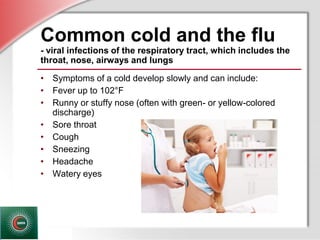
Common cold and the flu
- viral infections of the respiratory tract, which includes the
throat, nose, airways and lungs
• Symptoms of a cold develop slowly and can include:
• Fever up to 102°F
• Runny or stuffy nose (often with green- or yellow-colored
discharge)
• Sore throat
• Cough
• Sneezing
• Headache
• Watery eyes
© Business & Legal Reports, Inc. 1110
Flu
Flu symptoms usually appear suddenly and can
include:
• Fever over 102°F
• Stuffy nose
• Nausea
• Chills and sweats
• Cough
• Headache
• Loss of appetite
© Business & Legal Reports, Inc. 1110
Call your doctor if you have these
cold and flu symptoms:
• High fever (above 103°F)
• Symptoms for more than 10 days
• Trouble breathing, fast breathing or wheezing
• Bluish skin color
• Earache or drainage from the ear
• Changes in mental state (such as not waking up, irritability or
seizures)
• Vomiting or abdominal pain
© Business & Legal Reports, Inc. 1110
Can I prevent catching a cold or the flu?
• Get the influenza vaccine.
• Washing your hands frequently
• Eating healthy, exercising and getting enough sleep
• Cough and sneeze into the inside of your elbow (rather than
into your hand).
• Clean common surfaces, such as table and counter tops, your
child’s toys, door handles, and bathroom facilities with anti-
bacterial disinfectant.
© Business & Legal Reports, Inc. 1110
What medicines can I give my
child?
• There is no cure for the cold or the flu, and antibiotics do not work
• Give Paracetamol for headaches, muscle aches and sore throats,
fevers.
• Nasal sprays and decongestants are not recommended
• Cough and cold medicines are not recommended for children,
especially those younger than 2 years of age.
• Rest and drink plenty of fluids.
• You can use a humidifier to help moisten the air in your child’s
bedroom.
• Saline nasal spray to thin nasal mucus, and a bulb syringe to suction
mucus out of your baby or child’s nose.
© Business & Legal Reports, Inc. 1110
What else can I do to help my
child feel better?
• Dress your child in light cotton pajamas.
• If your child has chills, give him or her an extra blanket.
Remove it when the chills stop.
© Business & Legal Reports, Inc. 1110
When Should I Call My Doctor?
If your child has any of the
following warning signs, call
your family doctor right away:
• Constant vomiting or diarrhea
• Dry mouth
• Earache or pulling at ears
• Fever comes and goes over
several days
• High-pitched crying
• Irritability
• No appetite
• Pale appearance
• Seizures
• Severe headache
• Skin rash
© Business & Legal Reports, Inc. 1110
…..contd.
• Sore or swollen joints
• Sore throat
• Stiff neck
• Stomach pain
• Swelling of the soft spot on an infant’s head
• Unresponsiveness or limpness
• Wheezing or breathing problems
© Business & Legal Reports, Inc. 1110
Vomiting and diarrhea
Vomiting (throwing up) and diarrhea (frequent,
watery bowel movements) can be harmful because they can
cause dehydration.
Dehydration occurs when you lose too much fluid. Young
children can become dehydrated quickly, but dehydration can
occur at any age.
© Business & Legal Reports, Inc. 1110
How can I prevent dehydration?
• Anyone who has had several bouts of vomiting or diarrhea will need
to replace lost fluids and electrolytes.
• For babies: If you are breastfeeding, continue to give your baby
breast milk along with an oral rehydration solution (ORS). If you feed
your baby formula, try switching to one that is lactose free while your
baby is sick. Your doctor may also suggest switching from formula to
an ORS for 12 to 24 hours, and then switching back.
• For toddlers and young children: Use an ORS,. Children older than 1
year may also have clear soups to help prevent dehydration.
• You should avoid giving your child plain water and soft drinks. Soft
drinks are typically very high in sugar and can irritate your child’s
stomach.
© Business & Legal Reports, Inc. 1110
Signs of dehydration
• Little or lack of urine, or urine that is darker than usual
• Irritability
• Not eating as well as usual
• Dry mouth
• No tears when crying
• In babies who are younger than 18 months old, sunken soft spots on
the top of their heads
• Skin that isn’t as springy or elastic as usual
• Sleepiness
© Business & Legal Reports, Inc. 1110
What is tonsillitis?
• Tonsils are the oval-shaped structure on each side at the back
of your throat.
• Tonsillitis occurs when your tonsils are infected by a virus or
by bacteria. This causes your tonsils to become inflamed and
swollen
© Business & Legal Reports, Inc. 1110
What are the symptoms of tonsillitis?
• Red or swollen tonsils
• Sore throat
• Trouble swallowing
• Swollen lymph nodes (glands) in the neck
• Fever
• Chills
• Ear pain
• Headache
• Bad breath
• Loss of voice (called laryngitis)
• In children, abdominal pain
© Business & Legal Reports, Inc. 1110
How is tonsillitis treated?
• Drinking warm, soothing liquids, such as soup, broth, or tea with honey and
lemon
• Gargling with warm salt water
• Taking Paracetamol for fever and pain.
• Using a cool-mist humidifier to moisten the air
• Resting your voice
• Antibiotics can treat tonsillitis caused by bacteria..
© Business & Legal Reports, Inc. 1110
How can I avoid getting tonsillitis?
Spread through contact with other people.
Washing your hands frequently
Don’t share drinking glasses or utensils.
Avoid close contact with people who are sick
© Business & Legal Reports, Inc. 1110
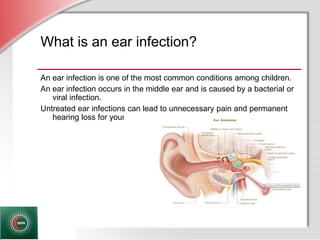
What is an ear infection?
An ear infection is one of the most common conditions among children.
An ear infection occurs in the middle ear and is caused by a bacterial or
viral infection.
Untreated ear infections can lead to unnecessary pain and permanent
hearing loss for your child.
© Business & Legal Reports, Inc. 1110
Symptoms of ear infections
Intense pain in your child’s affected ear is usually the first sign of
an ear infection.
Your child may repeatedly pull on the ear that hurts.
The pain is usually worse at night
Other symptoms include a runny nose, cough, fever, vomiting, or
dizziness, and hearing loss.
Chronic, frequent ear infections can cause permanent hearing
loss. You might suspect your child has hearing loss if you
have to talk louder to your child, your child turns up the
volume of the TV or music or is suddenly less attentive at
school.
© Business & Legal Reports, Inc. 1110
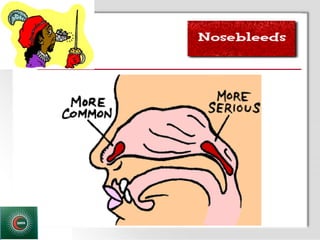
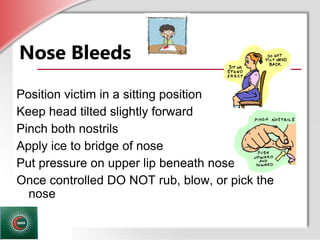
Nose Bleeds
Position victim in a sitting position
Keep head tilted slightly forward
Pinch both nostrils
Apply ice to bridge of nose
Put pressure on upper lip beneath nose
Once controlled DO NOT rub, blow, or pick the
nosenose
© Business & Legal Reports, Inc. 1110
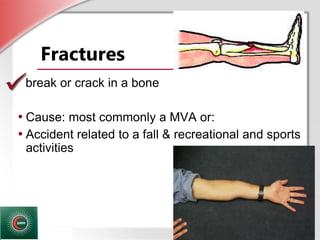
Fractures
A break or crack in a bone
• Cause: most commonly a MVA or:
• Accident related to a fall & recreational and sports
activities
© Business & Legal Reports, Inc. 1110
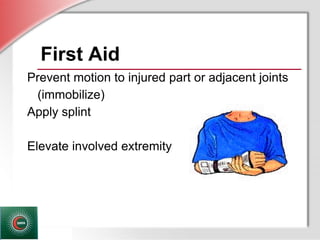
First Aid
Prevent motion to injured part or adjacent joints
(immobilize)
Apply splint
Elevate involved extremity
© Business & Legal Reports, Inc. 1110
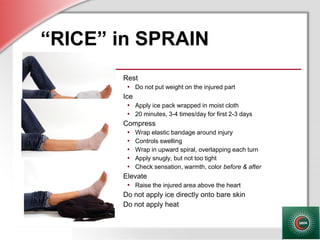
“RICE” in SPRAIN
Rest
• Do not put weight on the injured part
Ice
• Apply ice pack wrapped in moist cloth
• 20 minutes, 3-4 times/day for first 2-3 days
Compress
• Wrap elastic bandage around injury
• Controls swelling
• Wrap in upward spiral, overlapping each turn
• Apply snugly, but not too tight
• Check sensation, warmth, color before & after
Elevate
• Raise the injured area above the heart
Do not apply ice directly onto bare skin
Do not apply heat
© Business & Legal Reports, Inc. 1110
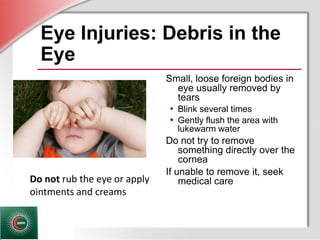
Eye Injuries: Debris in the
Eye
Small, loose foreign bodies in
eye usually removed by
tears
• Blink several times
• Gently flush the area with
lukewarm water
Do not try to remove
something directly over the
cornea
If unable to remove it, seek
medical careDo not rub the eye or apply
ointments and creams
© Business & Legal Reports, Inc. 1110
Paracetamol
© Business & Legal Reports, Inc. 1110
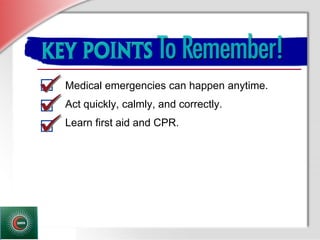
Key Points to Remember
Medical emergencies can happen anytime.
Act quickly, calmly, and correctly.
Learn first aid and CPR.
© Business & Legal Reports, Inc. 1110

Children's basic illnesses - a primer for mothers

  • 1.
    Mommy, I amnot feeling well! Dr Kripa Jacob Shifa Al Jazeera Polyclinic
  • 2.
    © Business &Legal Reports, Inc. 1110
  • 3.
    © Business &Legal Reports, Inc. 1110 What is a normal temperature? • A normal temperature is about 98.6°F (37°C) when taken orally (in your child’s mouth) and 99.6°F (37.5°C) when taken rectally (in your child’s bottom). • Many doctors define a fever as an oral temperature above 99.5°F (37.5°C) or a rectal temperature above 100.4°F (38°C).
  • 4.
    © Business &Legal Reports, Inc. 1110 How should I take my child’s temperature? • Use a digital thermometer. Do not use a mercury thermometer. • You can use it orally or rectally
  • 5.
    © Business &Legal Reports, Inc. 1110 When to take the temperature? • Not immediately after eating or drinking hot or cold foods • Not after he or she has had a bath. • Clean the thermometer before and after use
  • 6.
    © Business &Legal Reports, Inc. 1110 Common cold and the flu - viral infections of the respiratory tract, which includes the throat, nose, airways and lungs • Symptoms of a cold develop slowly and can include: • Fever up to 102°F • Runny or stuffy nose (often with green- or yellow-colored discharge) • Sore throat • Cough • Sneezing • Headache • Watery eyes
  • 7.
    © Business &Legal Reports, Inc. 1110 Flu Flu symptoms usually appear suddenly and can include: • Fever over 102°F • Stuffy nose • Nausea • Chills and sweats • Cough • Headache • Loss of appetite
  • 8.
    © Business &Legal Reports, Inc. 1110 Call your doctor if you have these cold and flu symptoms: • High fever (above 103°F) • Symptoms for more than 10 days • Trouble breathing, fast breathing or wheezing • Bluish skin color • Earache or drainage from the ear • Changes in mental state (such as not waking up, irritability or seizures) • Vomiting or abdominal pain
  • 9.
    © Business &Legal Reports, Inc. 1110 Can I prevent catching a cold or the flu? • Get the influenza vaccine. • Washing your hands frequently • Eating healthy, exercising and getting enough sleep • Cough and sneeze into the inside of your elbow (rather than into your hand). • Clean common surfaces, such as table and counter tops, your child’s toys, door handles, and bathroom facilities with anti- bacterial disinfectant.
  • 10.
    © Business &Legal Reports, Inc. 1110 What medicines can I give my child? • There is no cure for the cold or the flu, and antibiotics do not work • Give Paracetamol for headaches, muscle aches and sore throats, fevers. • Nasal sprays and decongestants are not recommended • Cough and cold medicines are not recommended for children, especially those younger than 2 years of age. • Rest and drink plenty of fluids. • You can use a humidifier to help moisten the air in your child’s bedroom. • Saline nasal spray to thin nasal mucus, and a bulb syringe to suction mucus out of your baby or child’s nose.
  • 11.
    © Business &Legal Reports, Inc. 1110 What else can I do to help my child feel better? • Dress your child in light cotton pajamas. • If your child has chills, give him or her an extra blanket. Remove it when the chills stop.
  • 12.
    © Business &Legal Reports, Inc. 1110 When Should I Call My Doctor? If your child has any of the following warning signs, call your family doctor right away: • Constant vomiting or diarrhea • Dry mouth • Earache or pulling at ears • Fever comes and goes over several days • High-pitched crying • Irritability • No appetite • Pale appearance • Seizures • Severe headache • Skin rash
  • 13.
    © Business &Legal Reports, Inc. 1110 …..contd. • Sore or swollen joints • Sore throat • Stiff neck • Stomach pain • Swelling of the soft spot on an infant’s head • Unresponsiveness or limpness • Wheezing or breathing problems
  • 14.
    © Business &Legal Reports, Inc. 1110 Vomiting and diarrhea Vomiting (throwing up) and diarrhea (frequent, watery bowel movements) can be harmful because they can cause dehydration. Dehydration occurs when you lose too much fluid. Young children can become dehydrated quickly, but dehydration can occur at any age.
  • 15.
    © Business &Legal Reports, Inc. 1110 How can I prevent dehydration? • Anyone who has had several bouts of vomiting or diarrhea will need to replace lost fluids and electrolytes. • For babies: If you are breastfeeding, continue to give your baby breast milk along with an oral rehydration solution (ORS). If you feed your baby formula, try switching to one that is lactose free while your baby is sick. Your doctor may also suggest switching from formula to an ORS for 12 to 24 hours, and then switching back. • For toddlers and young children: Use an ORS,. Children older than 1 year may also have clear soups to help prevent dehydration. • You should avoid giving your child plain water and soft drinks. Soft drinks are typically very high in sugar and can irritate your child’s stomach.
  • 16.
    © Business &Legal Reports, Inc. 1110 Signs of dehydration • Little or lack of urine, or urine that is darker than usual • Irritability • Not eating as well as usual • Dry mouth • No tears when crying • In babies who are younger than 18 months old, sunken soft spots on the top of their heads • Skin that isn’t as springy or elastic as usual • Sleepiness
  • 17.
    © Business &Legal Reports, Inc. 1110 What is tonsillitis? • Tonsils are the oval-shaped structure on each side at the back of your throat. • Tonsillitis occurs when your tonsils are infected by a virus or by bacteria. This causes your tonsils to become inflamed and swollen
  • 18.
    © Business &Legal Reports, Inc. 1110 What are the symptoms of tonsillitis? • Red or swollen tonsils • Sore throat • Trouble swallowing • Swollen lymph nodes (glands) in the neck • Fever • Chills • Ear pain • Headache • Bad breath • Loss of voice (called laryngitis) • In children, abdominal pain
  • 19.
    © Business &Legal Reports, Inc. 1110 How is tonsillitis treated? • Drinking warm, soothing liquids, such as soup, broth, or tea with honey and lemon • Gargling with warm salt water • Taking Paracetamol for fever and pain. • Using a cool-mist humidifier to moisten the air • Resting your voice • Antibiotics can treat tonsillitis caused by bacteria..
  • 20.
    © Business &Legal Reports, Inc. 1110 How can I avoid getting tonsillitis? Spread through contact with other people. Washing your hands frequently Don’t share drinking glasses or utensils. Avoid close contact with people who are sick
  • 21.
    © Business &Legal Reports, Inc. 1110 What is an ear infection? An ear infection is one of the most common conditions among children. An ear infection occurs in the middle ear and is caused by a bacterial or viral infection. Untreated ear infections can lead to unnecessary pain and permanent hearing loss for your child.
  • 22.
    © Business &Legal Reports, Inc. 1110 Symptoms of ear infections Intense pain in your child’s affected ear is usually the first sign of an ear infection. Your child may repeatedly pull on the ear that hurts. The pain is usually worse at night Other symptoms include a runny nose, cough, fever, vomiting, or dizziness, and hearing loss. Chronic, frequent ear infections can cause permanent hearing loss. You might suspect your child has hearing loss if you have to talk louder to your child, your child turns up the volume of the TV or music or is suddenly less attentive at school.
  • 23.
    © Business &Legal Reports, Inc. 1110
  • 24.
    © Business &Legal Reports, Inc. 1110 Nose Bleeds Position victim in a sitting position Keep head tilted slightly forward Pinch both nostrils Apply ice to bridge of nose Put pressure on upper lip beneath nose Once controlled DO NOT rub, blow, or pick the nosenose
  • 25.
    © Business &Legal Reports, Inc. 1110 Fractures A break or crack in a bone • Cause: most commonly a MVA or: • Accident related to a fall & recreational and sports activities
  • 26.
    © Business &Legal Reports, Inc. 1110 First Aid Prevent motion to injured part or adjacent joints (immobilize) Apply splint Elevate involved extremity
  • 27.
    © Business &Legal Reports, Inc. 1110 “RICE” in SPRAIN Rest • Do not put weight on the injured part Ice • Apply ice pack wrapped in moist cloth • 20 minutes, 3-4 times/day for first 2-3 days Compress • Wrap elastic bandage around injury • Controls swelling • Wrap in upward spiral, overlapping each turn • Apply snugly, but not too tight • Check sensation, warmth, color before & after Elevate • Raise the injured area above the heart Do not apply ice directly onto bare skin Do not apply heat
  • 28.
    © Business &Legal Reports, Inc. 1110 Eye Injuries: Debris in the Eye Small, loose foreign bodies in eye usually removed by tears • Blink several times • Gently flush the area with lukewarm water Do not try to remove something directly over the cornea If unable to remove it, seek medical careDo not rub the eye or apply ointments and creams
  • 29.
    © Business &Legal Reports, Inc. 1110
  • 30.
    © Business &Legal Reports, Inc. 1110 Paracetamol
  • 31.
    © Business &Legal Reports, Inc. 1110 Key Points to Remember Medical emergencies can happen anytime. Act quickly, calmly, and correctly. Learn first aid and CPR.
  • 32.
    © Business &Legal Reports, Inc. 1110