CHILDHOOD
STUDIES
DIFFERENT PRESPECTIVES OF CHIDLHOOD STUDIES
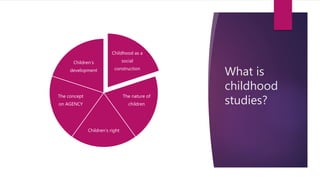
What is
childhood
studies?
Childhood as a
social
construction
The nature of
children
Children’s right
The concept
on AGENCY
Children’s
development
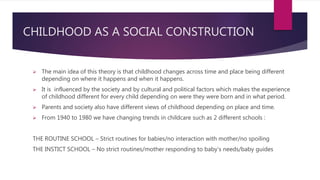
CHILDHOOD AS A SOCIAL CONSTRUCTION
 The main idea of this theory is that childhood changes across time and place being different
depending on where it happens and when it happens.
 It is influenced by the society and by cultural and political factors which makes the experience
of childhood different for every child depending on were they were born and in what period.
 Parents and society also have different views of childhood depending on place and time.
 From 1940 to 1980 we have changing trends in childcare such as 2 different schools :
THE ROUTINE SCHOOL – Strict routines for babies/no interaction with mother/no spoiling
THE INSTICT SCHOOL – No strict routines/mother responding to baby’s needs/baby guides
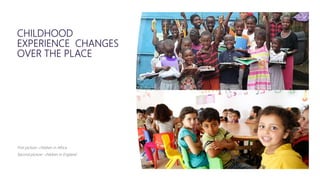
CHILDHOOD
EXPERIENCE CHANGES
OVER THE PLACE
First picture- children in Africa
Second picture- children in England
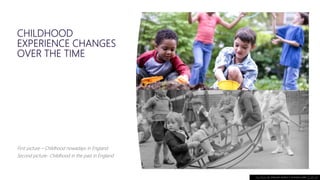
CHILDHOOD
EXPERIENCE CHANGES
OVER THE TIME
First picture – Childhood nowadays in England
Second picture- Childhood in the past in England
This Photo by Unknown Author is licensed under CC BY-SA
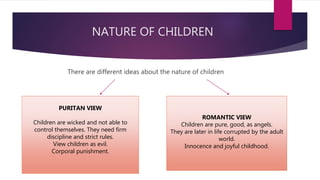
NATURE OF CHILDREN
There are different ideas about the nature of children
PURITAN VIEW
Children are wicked and not able to
control themselves. They need firm
discipline and strict rules.
View children as evil.
Corporal punishment.
ROMANTIC VIEW
Children are pure, good, as angels.
They are later in life corrupted by the adult
world.
Innocence and joyful childhood.
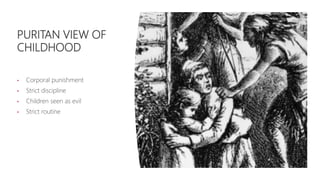
PURITAN VIEW OF
CHILDHOOD
• Corporal punishment
• Strict discipline
• Children seen as evil
• Strict routine
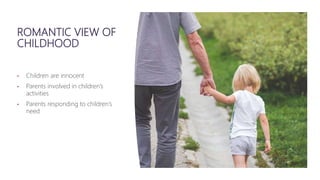
ROMANTIC VIEW OF
CHILDHOOD
• Children are innocent
• Parents involved in children’s
activities
• Parents responding to children’s
need
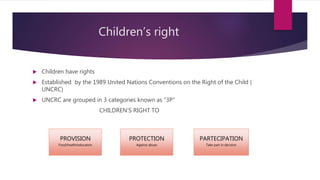
Children’s right
 Children have rights
 Established by the 1989 United Nations Conventions on the Right of the Child (
UNCRC)
 UNCRC are grouped in 3 categories known as “3P”
CHILDREN’S RIGHT TO
PROVISION
Food/health/education
PROTECTION
Against abuse
PARTECIPATION
Take part in decision
The concept of AGENCY
 There is the idea that children have an agency, which means
they are able to influence the world around them.
 Children understand and make their own choice in life.
 They influence their life and those of others.
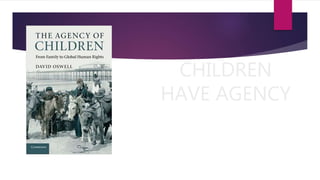
CHILDREN
HAVE AGENCY
FACTS
 Childhood studies covers childhood from 0 to 18 years old.
 It is divided in more stages which are:
EARLY YEARS
MIDDLE CHILDHOOD
YOUTH
There is no agreement on which ages these specialisms cover.

Childhood studies

  • 1.
  • 2.
    What is childhood studies? Childhood asa social construction The nature of children Children’s right The concept on AGENCY Children’s development
  • 3.
    CHILDHOOD AS ASOCIAL CONSTRUCTION  The main idea of this theory is that childhood changes across time and place being different depending on where it happens and when it happens.  It is influenced by the society and by cultural and political factors which makes the experience of childhood different for every child depending on were they were born and in what period.  Parents and society also have different views of childhood depending on place and time.  From 1940 to 1980 we have changing trends in childcare such as 2 different schools : THE ROUTINE SCHOOL – Strict routines for babies/no interaction with mother/no spoiling THE INSTICT SCHOOL – No strict routines/mother responding to baby’s needs/baby guides
  • 4.
    CHILDHOOD EXPERIENCE CHANGES OVER THEPLACE First picture- children in Africa Second picture- children in England
  • 5.
    CHILDHOOD EXPERIENCE CHANGES OVER THETIME First picture – Childhood nowadays in England Second picture- Childhood in the past in England This Photo by Unknown Author is licensed under CC BY-SA
  • 6.
    NATURE OF CHILDREN Thereare different ideas about the nature of children PURITAN VIEW Children are wicked and not able to control themselves. They need firm discipline and strict rules. View children as evil. Corporal punishment. ROMANTIC VIEW Children are pure, good, as angels. They are later in life corrupted by the adult world. Innocence and joyful childhood.
  • 7.
    PURITAN VIEW OF CHILDHOOD •Corporal punishment • Strict discipline • Children seen as evil • Strict routine
  • 8.
    ROMANTIC VIEW OF CHILDHOOD •Children are innocent • Parents involved in children’s activities • Parents responding to children’s need
  • 9.
    Children’s right  Childrenhave rights  Established by the 1989 United Nations Conventions on the Right of the Child ( UNCRC)  UNCRC are grouped in 3 categories known as “3P” CHILDREN’S RIGHT TO PROVISION Food/health/education PROTECTION Against abuse PARTECIPATION Take part in decision
  • 10.
    The concept ofAGENCY  There is the idea that children have an agency, which means they are able to influence the world around them.  Children understand and make their own choice in life.  They influence their life and those of others.
  • 11.
  • 12.
    FACTS  Childhood studiescovers childhood from 0 to 18 years old.  It is divided in more stages which are: EARLY YEARS MIDDLE CHILDHOOD YOUTH There is no agreement on which ages these specialisms cover.