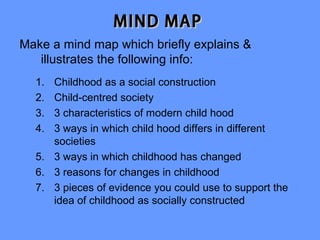
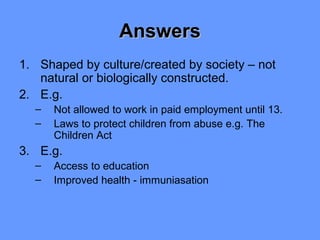
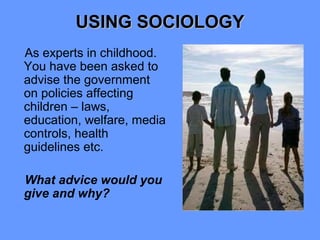
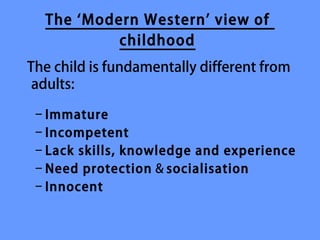
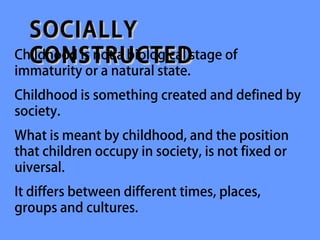
1. Recognize that childhood is socially constructed and views of children differ across cultures. Policies should be sensitive to these cultural differences rather than impose a single view of childhood.
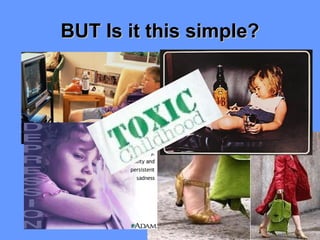
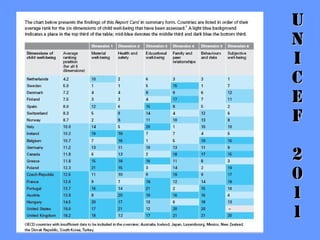
2. Consider the structural factors like poverty, lack of access to healthcare and education, that impact children in different communities. Policies need to address the social inequalities that negatively affect children.
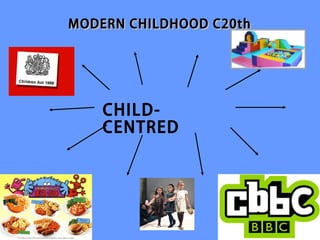
3. Involve children and gain their perspectives when designing policies that concern them. A child-centered approach that gives agency to children is important to develop policies that effectively address their needs and rights.

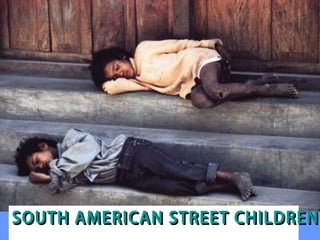
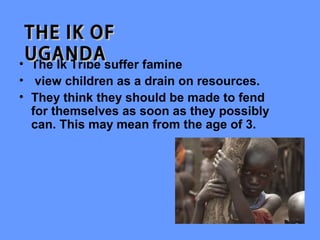
![Cross Cultural Experiences of
Childhood
Benedict, 1934, [comparative approach] .
3 distinct differences between modern ‘western’
What differences have you
children and children from simpler, non industrial
identified between your
societies
meanings and experiences of
– Earlier Responsibility (Holmes – Samoa)
childhood and those in other -
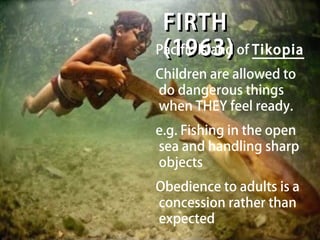
– Less Obedience to Adult Authority (Firth
Tikopia)
societies?
– Sexual Behaviour (Malinowski – Trobriand
Islands)](https://image.slidesharecdn.com/sociologyexchangecouk-shared-resource2678-121020075324-phpapp02/85/SociologyExchange-co-uk-Shared-Resource-14-320.jpg)
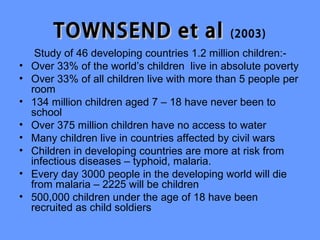

![Pre- industrial society C10-
C13th
[Aries]
• Same work – fields &
home
• Same clothes
• Same leisure
• Same rights
• Same skills
• Same punishments
• No distinction in law
An accurate
view?](https://image.slidesharecdn.com/sociologyexchangecouk-shared-resource2678-121020075324-phpapp02/85/SociologyExchange-co-uk-Shared-Resource-19-320.jpg)
![Beginnings of childhood C13 –
C18
[Aries]
• Public schools for rich children
• Church – children in need of
protection & discipline
• 17th century U/C boys dress](https://image.slidesharecdn.com/sociologyexchangecouk-shared-resource2678-121020075324-phpapp02/85/SociologyExchange-co-uk-Shared-Resource-20-320.jpg)