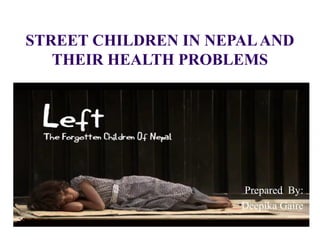
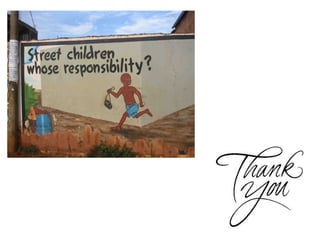
STREET CHILDREN IN NEPALAND
THEIR HEALTH PROBLEMS
•Prepared By:
•Deepika Gaire
1
INTRODUCTION
• Whilst there is no international agreed definition on street
children .UNICEF refers to ‘street children’ as children for
whom the street, more than their family, becomes their real
home.
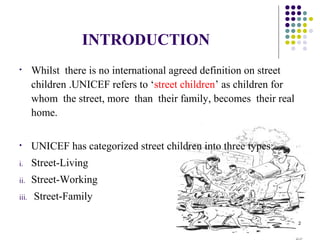
• UNICEF has categorized street children into three types:
i. Street-Living
ii. Street-Working
iii. Street-Family
2
THE TYPICAL AGE AND
GENDER OF A STREET CHILD
 The typical age of a street child varies from place to place. In
developing countries children as young as eight live
completely on their own. In developed countries, street
children are usually over the age of twelve.
 The proportion of girls among street children is reported to be
less than 30% in developing countries and about 50% in many
developed countries.
3
OBJECTIVE
• General objective
i. To study about the situation of street children and their health
problems in Nepal
• Specific objective
i. To study about the situation of street children in Nepal
ii. To study about the reason for children going to street
iii. To study about the difficulties faced by street children
iv. To study about the health problems of street children
4
METHODOLOGY
• To prepare this report Google was used to retrieve journal and
articles. The articles, pdf files, electronic articles related to
street children and their health problems were downloaded and
studied. This report was prepared by using various secondary
data sources available on internet.
• The key words used were street children, street children and
their situation and street children and their health problems.
5
CURRENT SITUATION AND
COMPARISION
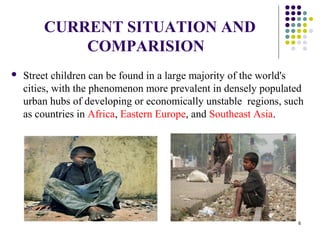
 Street children can be found in a large majority of the world's
cities, with the phenomenon more prevalent in densely populated
urban hubs of developing or economically unstable regions, such
as countries in Africa, Eastern Europe, and Southeast Asia.
6
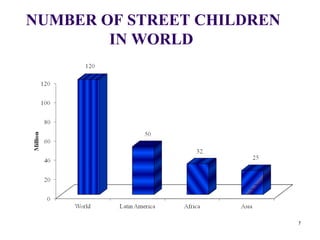
NUMBER OF STREET CHILDREN
IN WORLD
7
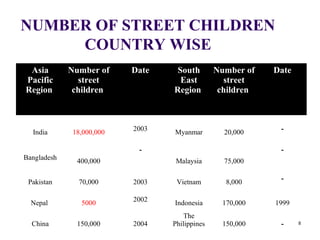
NUMBER OF STREET CHILDREN
COUNTRY WISE
Asia
Pacific
Region
Number of
street
children
Date South
East
Region
Number of
street
children
Date
India 18,000,000 2003 Myanmar 20,000 -
Bangladesh 400,000
-
Malaysia 75,000
-
Pakistan 70,000 2003 Vietnam 8,000 -
Nepal 5000 2002 Indonesia 170,000 1999
China 150,000 2004
The
Philippines 150,000 - 8
Africa Number of street
children
America Number of
street
children
Europe Number of
street
children
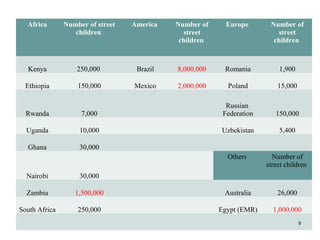
Kenya 250,000 Brazil 8,000,000 Romania 1,900
Ethiopia 150,000 Mexico 2,000,000 Poland 15,000
Rwanda 7,000
Russian
Federation 150,000
Uganda 10,000 Uzbekistan 5,400
Ghana 30,000
Nairobi 30,000
Others Number of
street children
Zambia 1,500,000 Australia 26,000
South Africa 250,000 Egypt (EMR) 1,000,000
9
IN NEPAL
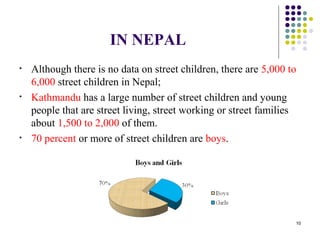
• Although there is no data on street children, there are 5,000 to
6,000 street children in Nepal;
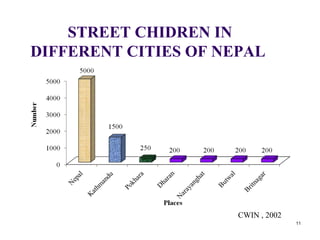
• Kathmandu has a large number of street children and young
people that are street living, street working or street families
about 1,500 to 2,000 of them.
• 70 percent or more of street children are boys.
10
STREET CHIDREN IN
DIFFERENT CITIES OF NEPAL
11
CWIN , 2002
CONTD..
• The distribution of street children is through out the urbanized
cities of the country.
• Their number exceed in Kathmandu, Patan and Bhakatapur
comparatively to other cities of the country because of being
tourist places.
• Estimates put the number well over 1,000 with 500 new street
children arriving every year.
12
REASON FOR COMING TO THE
STREETS
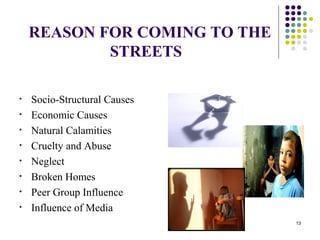
• Socio-Structural Causes
• Economic Causes
• Natural Calamities
• Cruelty and Abuse
• Neglect
• Broken Homes
• Peer Group Influence
• Influence of Media
13
DIFFICULTIES AND PROBLEMS
OF STREET CHILDREN
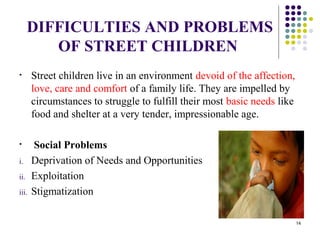
• Street children live in an environment devoid of the affection,
love, care and comfort of a family life. They are impelled by
circumstances to struggle to fulfill their most basic needs like
food and shelter at a very tender, impressionable age.
• Social Problems
i. Deprivation of Needs and Opportunities
ii. Exploitation
iii. Stigmatization
14
CONTD..
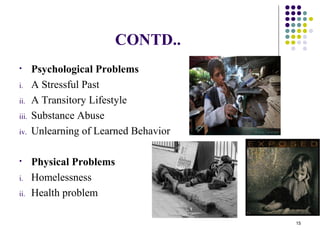
• Psychological Problems
i. A Stressful Past
ii. A Transitory Lifestyle
iii. Substance Abuse
iv. Unlearning of Learned Behavior
• Physical Problems
i. Homelessness
ii. Health problem
15
HEALTH PROBLEM OF STREET
CHILDREN
1. Lack of Adequate Nutrition : Even though many street
children can usually get some amount of food to eat, they do
not have nutritious or balanced diets. This deficiency thus
manifests itself in the form of anemia, malnutrition, and
vitamin deficiencies.
2. Respiratory disease: Due to exposure to dust and other
pollutants while they work near traffic junctions and other
congested places, they suffer from bronchitis, asthma and
even severe tuberculosis.
16
CONTD..
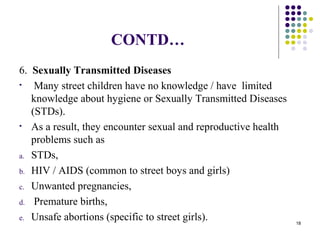
3. Skin disease: Since they do not have the opportunity to bathe
for several days at a time, and because of the unhygienic
conditions in which they live, they are prone to skin diseases
such as scabies, ulcers and rashes.
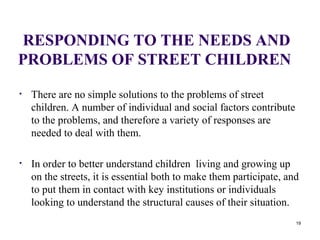
4. Stress: Street children live in an atmosphere of continued
physical and mental strain.
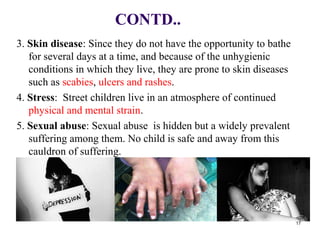
5. Sexual abuse: Sexual abuse is hidden but a widely prevalent
suffering among them. No child is safe and away from this
cauldron of suffering.
17
CONTD…
6. Sexually Transmitted Diseases
• Many street children have no knowledge / have limited
knowledge about hygiene or Sexually Transmitted Diseases
(STDs).
• As a result, they encounter sexual and reproductive health
problems such as
a. STDs,
b. HIV / AIDS (common to street boys and girls)
c. Unwanted pregnancies,
d. Premature births,
e. Unsafe abortions (specific to street girls). 18
RESPONDING TO THE NEEDS AND
PROBLEMS OF STREET CHILDREN
• There are no simple solutions to the problems of street
children. A number of individual and social factors contribute
to the problems, and therefore a variety of responses are
needed to deal with them.
• In order to better understand children living and growing up
on the streets, it is essential both to make them participate, and
to put them in contact with key institutions or individuals
looking to understand the structural causes of their situation.
19
• Some of the NGOs responding to the street children in Nepal
are as follows:
i. CWIN-: Kathmandu and Pokhara
ii. CPCS-: Kathmandu, Narayanghat and Butwal
iii. SAHARA- Kathmandu
iv. Voice of Children-: Kathmandu and Lalitpur
v. Sath-Sath-: Kathmandu
vi. CWSN-: Pokhara
vii. UPC-: Dharan, Britnagar and Inaruwa
viii.Diaylo Parivaar-: Narayanghat
ix. Bal Watawaran Kendra-: Kathmandu
x. CAPCON-: Lalitpur
xi. CCC-: Butwal
xii. Jagaran Manch Nepal (JAFON)-: Lalitpur 20
CONCLUSION
 Street children are a term for children experiencing
homelessness who live and survive on the streets of a city.
They often grow up in public landfills, train stations, our under
the bridges of the world’s major cities.
 There are about 5,000 to 6,000 street children in Nepal.
 Neglect/ abuse, poverty, peer influences and city life attract
are the main are the main reason for going to the street.
21
CONTD..
 The main health problems of street children are malnutrition,
HIV/AIDs, skin disease, substance abuse, stress and
depression.
 Street-based children share an environment and practices that
make them vulnerable to HIV infection.
 Street children are the worst victims of child labor in Nepal.
 The number of organization working for street children's
sector has increased but still initiatives and outcome doesn’t
look satisfactory.
22
RECOMMENDATION
 There is a need for progressive amendments of existing national
laws and harmonization of International laws to ensure highest
possible rights for street children.
 A safe and supportive environment for every child .
 Providing information and counseling regarding different health
problems and improving access to health services.
 Providing opportunities to street children for building skills.
 Responding to the needs of street children through individual,
community, National and International level .
 Study and research on street children’s sector should be
emphasized.
23
REFERENCES
1. Wikipedia. Street children. [cited 2014]; Available from:
http://en.wikipedia.org/wiki/Street_children.
2. WTMY. Nepal and the street children Available from: Nepal &
The Street Children.htm.
3. WHO. Working with street children: A Training Package on
Substance Use,Sexual and
4. Reproductive Health including HIV/AIDS and STDs. Geneva
Williams mf. Kathmandu kids Fighting to offer children a brighter
future Nepali Times. 01 JAN 2010 - 07 JAN 2010.
5. Humanium. Children living on the street. [updated 1st september
2011; cited 2014]; Available from:
http://www.humanium.org/en/street-children.
24
CONTD..
6.SDN. World of Street Children. [cited 2014]; Available from:
https://sites.google.com/site/shelterdb/world-of-street-
children-1
7. CSTS. Street children 2012 [cited 2014]; Available from:
http://www.child-Nepal.com/?page_id=1147.
8. Google. programs for helping street children in nepal. [cited
2014]; Available from: https://www.google.com.np/search?
q=program+for+helping+street+children+in+Nepal&ie=utf-
8&oe=utf-8&rls=org.mozilla:en-US:official&client=firefox
a&gws_rd=cr&ei=foE2U-_QBoTkkQXZ6oCoBg.
25
26

Street children dpka finalll

  • 1.
    STREET CHILDREN INNEPALAND THEIR HEALTH PROBLEMS •Prepared By: •Deepika Gaire 1
  • 2.
    INTRODUCTION • Whilst thereis no international agreed definition on street children .UNICEF refers to ‘street children’ as children for whom the street, more than their family, becomes their real home. • UNICEF has categorized street children into three types: i. Street-Living ii. Street-Working iii. Street-Family 2
  • 3.
    THE TYPICAL AGEAND GENDER OF A STREET CHILD  The typical age of a street child varies from place to place. In developing countries children as young as eight live completely on their own. In developed countries, street children are usually over the age of twelve.  The proportion of girls among street children is reported to be less than 30% in developing countries and about 50% in many developed countries. 3
  • 4.
    OBJECTIVE • General objective i.To study about the situation of street children and their health problems in Nepal • Specific objective i. To study about the situation of street children in Nepal ii. To study about the reason for children going to street iii. To study about the difficulties faced by street children iv. To study about the health problems of street children 4
  • 5.
    METHODOLOGY • To preparethis report Google was used to retrieve journal and articles. The articles, pdf files, electronic articles related to street children and their health problems were downloaded and studied. This report was prepared by using various secondary data sources available on internet. • The key words used were street children, street children and their situation and street children and their health problems. 5
  • 6.
    CURRENT SITUATION AND COMPARISION Street children can be found in a large majority of the world's cities, with the phenomenon more prevalent in densely populated urban hubs of developing or economically unstable regions, such as countries in Africa, Eastern Europe, and Southeast Asia. 6
  • 7.
    NUMBER OF STREETCHILDREN IN WORLD 7
  • 8.
    NUMBER OF STREETCHILDREN COUNTRY WISE Asia Pacific Region Number of street children Date South East Region Number of street children Date India 18,000,000 2003 Myanmar 20,000 - Bangladesh 400,000 - Malaysia 75,000 - Pakistan 70,000 2003 Vietnam 8,000 - Nepal 5000 2002 Indonesia 170,000 1999 China 150,000 2004 The Philippines 150,000 - 8
  • 9.
    Africa Number ofstreet children America Number of street children Europe Number of street children Kenya 250,000 Brazil 8,000,000 Romania 1,900 Ethiopia 150,000 Mexico 2,000,000 Poland 15,000 Rwanda 7,000 Russian Federation 150,000 Uganda 10,000 Uzbekistan 5,400 Ghana 30,000 Nairobi 30,000 Others Number of street children Zambia 1,500,000 Australia 26,000 South Africa 250,000 Egypt (EMR) 1,000,000 9
  • 10.
    IN NEPAL • Althoughthere is no data on street children, there are 5,000 to 6,000 street children in Nepal; • Kathmandu has a large number of street children and young people that are street living, street working or street families about 1,500 to 2,000 of them. • 70 percent or more of street children are boys. 10
  • 11.
    STREET CHIDREN IN DIFFERENTCITIES OF NEPAL 11 CWIN , 2002
  • 12.
    CONTD.. • The distributionof street children is through out the urbanized cities of the country. • Their number exceed in Kathmandu, Patan and Bhakatapur comparatively to other cities of the country because of being tourist places. • Estimates put the number well over 1,000 with 500 new street children arriving every year. 12
  • 13.
    REASON FOR COMINGTO THE STREETS • Socio-Structural Causes • Economic Causes • Natural Calamities • Cruelty and Abuse • Neglect • Broken Homes • Peer Group Influence • Influence of Media 13
  • 14.
    DIFFICULTIES AND PROBLEMS OFSTREET CHILDREN • Street children live in an environment devoid of the affection, love, care and comfort of a family life. They are impelled by circumstances to struggle to fulfill their most basic needs like food and shelter at a very tender, impressionable age. • Social Problems i. Deprivation of Needs and Opportunities ii. Exploitation iii. Stigmatization 14
  • 15.
    CONTD.. • Psychological Problems i.A Stressful Past ii. A Transitory Lifestyle iii. Substance Abuse iv. Unlearning of Learned Behavior • Physical Problems i. Homelessness ii. Health problem 15
  • 16.
    HEALTH PROBLEM OFSTREET CHILDREN 1. Lack of Adequate Nutrition : Even though many street children can usually get some amount of food to eat, they do not have nutritious or balanced diets. This deficiency thus manifests itself in the form of anemia, malnutrition, and vitamin deficiencies. 2. Respiratory disease: Due to exposure to dust and other pollutants while they work near traffic junctions and other congested places, they suffer from bronchitis, asthma and even severe tuberculosis. 16
  • 17.
    CONTD.. 3. Skin disease:Since they do not have the opportunity to bathe for several days at a time, and because of the unhygienic conditions in which they live, they are prone to skin diseases such as scabies, ulcers and rashes. 4. Stress: Street children live in an atmosphere of continued physical and mental strain. 5. Sexual abuse: Sexual abuse is hidden but a widely prevalent suffering among them. No child is safe and away from this cauldron of suffering. 17
  • 18.
    CONTD… 6. Sexually TransmittedDiseases • Many street children have no knowledge / have limited knowledge about hygiene or Sexually Transmitted Diseases (STDs). • As a result, they encounter sexual and reproductive health problems such as a. STDs, b. HIV / AIDS (common to street boys and girls) c. Unwanted pregnancies, d. Premature births, e. Unsafe abortions (specific to street girls). 18
  • 19.
    RESPONDING TO THENEEDS AND PROBLEMS OF STREET CHILDREN • There are no simple solutions to the problems of street children. A number of individual and social factors contribute to the problems, and therefore a variety of responses are needed to deal with them. • In order to better understand children living and growing up on the streets, it is essential both to make them participate, and to put them in contact with key institutions or individuals looking to understand the structural causes of their situation. 19
  • 20.
    • Some ofthe NGOs responding to the street children in Nepal are as follows: i. CWIN-: Kathmandu and Pokhara ii. CPCS-: Kathmandu, Narayanghat and Butwal iii. SAHARA- Kathmandu iv. Voice of Children-: Kathmandu and Lalitpur v. Sath-Sath-: Kathmandu vi. CWSN-: Pokhara vii. UPC-: Dharan, Britnagar and Inaruwa viii.Diaylo Parivaar-: Narayanghat ix. Bal Watawaran Kendra-: Kathmandu x. CAPCON-: Lalitpur xi. CCC-: Butwal xii. Jagaran Manch Nepal (JAFON)-: Lalitpur 20
  • 21.
    CONCLUSION  Street childrenare a term for children experiencing homelessness who live and survive on the streets of a city. They often grow up in public landfills, train stations, our under the bridges of the world’s major cities.  There are about 5,000 to 6,000 street children in Nepal.  Neglect/ abuse, poverty, peer influences and city life attract are the main are the main reason for going to the street. 21
  • 22.
    CONTD..  The mainhealth problems of street children are malnutrition, HIV/AIDs, skin disease, substance abuse, stress and depression.  Street-based children share an environment and practices that make them vulnerable to HIV infection.  Street children are the worst victims of child labor in Nepal.  The number of organization working for street children's sector has increased but still initiatives and outcome doesn’t look satisfactory. 22
  • 23.
    RECOMMENDATION  There isa need for progressive amendments of existing national laws and harmonization of International laws to ensure highest possible rights for street children.  A safe and supportive environment for every child .  Providing information and counseling regarding different health problems and improving access to health services.  Providing opportunities to street children for building skills.  Responding to the needs of street children through individual, community, National and International level .  Study and research on street children’s sector should be emphasized. 23
  • 24.
    REFERENCES 1. Wikipedia. Streetchildren. [cited 2014]; Available from: http://en.wikipedia.org/wiki/Street_children. 2. WTMY. Nepal and the street children Available from: Nepal & The Street Children.htm. 3. WHO. Working with street children: A Training Package on Substance Use,Sexual and 4. Reproductive Health including HIV/AIDS and STDs. Geneva Williams mf. Kathmandu kids Fighting to offer children a brighter future Nepali Times. 01 JAN 2010 - 07 JAN 2010. 5. Humanium. Children living on the street. [updated 1st september 2011; cited 2014]; Available from: http://www.humanium.org/en/street-children. 24
  • 25.
    CONTD.. 6.SDN. World ofStreet Children. [cited 2014]; Available from: https://sites.google.com/site/shelterdb/world-of-street- children-1 7. CSTS. Street children 2012 [cited 2014]; Available from: http://www.child-Nepal.com/?page_id=1147. 8. Google. programs for helping street children in nepal. [cited 2014]; Available from: https://www.google.com.np/search? q=program+for+helping+street+children+in+Nepal&ie=utf- 8&oe=utf-8&rls=org.mozilla:en-US:official&client=firefox a&gws_rd=cr&ei=foE2U-_QBoTkkQXZ6oCoBg. 25
  • 26.