STREET CHILDREN
WHAT IS A STREET CHILDREN?
• Street children is a term for children
experiencing homelessness who live on the streets of a city.
Homeless youth are often called street kids and street youth; the
definition of street children is contested, but many practitioners
and policymakers use UNICEF’s concept of boys and girls, aged
under eighteen years, for whom "the street" (including
unoccupied dwellings and wasteland) has become home and/or their
source of livelihood, and who are inadequately protected or
supervised.
• Some street children, notably in more developed nations, are part of a
subcategory called thrown away children who are children that have been
forced to leave home. Thrown away children are more likely to come from
working class and single parent homes.
• Female street children are sometimes called gamines, a term that
is also used for Colombian street children of either gender.
• Street children are often subject to abuse, neglect, exploitation, or, in
extreme cases, murder by "clean-up squads" that have been hired by
local businesses or police. In Western societies, such children are
sometimes treated as homeless children rather than criminals or
beggars.
WHO ARE THE STREET CHILDREN?
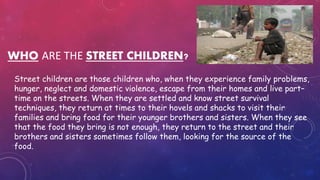
Street children are those children who, when they experience family problems,
hunger, neglect and domestic violence, escape from their homes and live part–
time on the streets. When they are settled and know street survival
techniques, they return at times to their hovels and shacks to visit their
families and bring food for their younger brothers and sisters. When they see
that the food they bring is not enough, they return to the street and their
brothers and sisters sometimes follow them, looking for the source of the
food.
• Children on the streets make up approximately 75% of the
street children in the Philippines. They work on the streets but do
not live there. They generally have a home to return to after
working, and some even continue to attend school while working
long hours on the streets.
ACCORDING TO THE "A BETTER LIFE" FOUNDATION,
THERE ARE THREE DIFFERENT CATEGORIES OF
STREET CHILDREN:
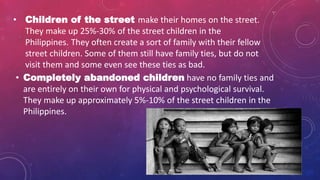
• Completely abandoned children have no family ties and
are entirely on their own for physical and psychological survival.
They make up approximately 5%-10% of the street children in the
Philippines.
• Children of the street make their homes on the street.
They make up 25%-30% of the street children in the
Philippines. They often create a sort of family with their fellow
street children. Some of them still have family ties, but do not
visit them and some even see these ties as bad.
STATISTICS
• The approximate numbers of street children in the different
districts of the Philippines are: Manila (3,266), Quezon (2,867),
Caloocan (1,530), and Pasay (1,420). Regional numbers are:.
• Luzon regional totals: 1,557 (highly visible), 22,728 (estimated
total)
• Visayas regional totals: 5,291 (highly visible), 40,860 (estimated
total) and
• Approximately 70% of the children are boys.
• Mindanao regional totals: 22,556 (highly visible), 138,328
(estimated total)
PROBLEMS FACING STREET CHILDREN
Health problems
• Street children are generally thin, untidy, undernourished, and
hardly equipped to survive the hazards of everyday living and
working on the streets. Some of the hazards they face include
sickness, physical injuries from motor accidents, street fights,
harassment from extortionists and police, sexual exploitation by
pedophiles and pimps, exposure to substance abuse and sexually
transmitted diseases.
Drugs and Substance Abuse
• The most common substances are inhalants, such as solvents, rugby
(a toluene-based glue) and cough syrups, followed by marijuana
and shabu. Marijuana and shabu in particular are shared with
friends whenever one of the group has enough money to buy them.
Some street children take drugs as often as once a day.
• Human rights groups said the killings have become an unwritten
government policy to deal with crime, largely because of an
ineffective criminal justice system and the tendency of the
authorities to take shortcuts in the administration of justice. The
execution-style killings are openly endorsed by local officials,
strengthening the long-running suspicion that the death squads
were formed by the government.
Summary execution of
street children
• Many street children were in danger of summary execution during
the Marcos Government era. In Davao City, 39 children in conflict
with the law have been killed by vigilante groups since 2001. Most
were killed after being released from police detention cells.
• Child prostitutes are used by foreign sex tourists and pedophiles, as well as
local people. Many street children are lured into prostitution as a means of
survival, while others do it to earn money for their families. A variety of
different factors contribute to the commercial sexual exploitation of
children in the Philippines.
• Rooted in poverty, as elsewhere, the problem of child
prostitution in Angeles was exacerbated in the 1980s by Clark Air Base,
where bars employed children who ended up as sex workers for American
soldiers. Street children are at particular risk because many of the 200
brothels in Angeles offer children for sex. According to 1996 statistics of
the Philippine Resource Network, 60,000 of the 1.5 million street children in
the Philippines were prostituted.
Child prostitution
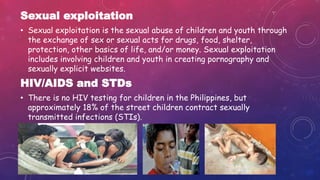
Sexual exploitation
• Sexual exploitation is the sexual abuse of children and youth through
the exchange of sex or sexual acts for drugs, food, shelter,
protection, other basics of life, and/or money. Sexual exploitation
includes involving children and youth in creating pornography and
sexually explicit websites.
HIV/AIDS and STDs
• There is no HIV testing for children in the Philippines, but
approximately 18% of the street children contract sexually
transmitted infections (STIs).
Corruption
• Children are often jailed for things such as playing cards on a
sidewalk and held there until their family can pay off a bribe to
corrupt police.
Charities
• A number of charities are active in helping children in jail in the
Philippines.
• Preda Foundation visits the jails on a regular basis and hands out
food and medicines.
Charities
• A number of charities are active in helping children in
jail in the Philippines.
• Preda Foundation visits the jails on a regular basis and
hands out food and medicines.
Help…

Street Children

  • 1.
  • 2.
    WHAT IS ASTREET CHILDREN? • Street children is a term for children experiencing homelessness who live on the streets of a city. Homeless youth are often called street kids and street youth; the definition of street children is contested, but many practitioners and policymakers use UNICEF’s concept of boys and girls, aged under eighteen years, for whom "the street" (including unoccupied dwellings and wasteland) has become home and/or their source of livelihood, and who are inadequately protected or supervised.
  • 3.
    • Some streetchildren, notably in more developed nations, are part of a subcategory called thrown away children who are children that have been forced to leave home. Thrown away children are more likely to come from working class and single parent homes. • Female street children are sometimes called gamines, a term that is also used for Colombian street children of either gender. • Street children are often subject to abuse, neglect, exploitation, or, in extreme cases, murder by "clean-up squads" that have been hired by local businesses or police. In Western societies, such children are sometimes treated as homeless children rather than criminals or beggars.
  • 4.
    WHO ARE THESTREET CHILDREN? Street children are those children who, when they experience family problems, hunger, neglect and domestic violence, escape from their homes and live part– time on the streets. When they are settled and know street survival techniques, they return at times to their hovels and shacks to visit their families and bring food for their younger brothers and sisters. When they see that the food they bring is not enough, they return to the street and their brothers and sisters sometimes follow them, looking for the source of the food.
  • 5.
    • Children onthe streets make up approximately 75% of the street children in the Philippines. They work on the streets but do not live there. They generally have a home to return to after working, and some even continue to attend school while working long hours on the streets. ACCORDING TO THE "A BETTER LIFE" FOUNDATION, THERE ARE THREE DIFFERENT CATEGORIES OF STREET CHILDREN:
  • 6.
    • Completely abandonedchildren have no family ties and are entirely on their own for physical and psychological survival. They make up approximately 5%-10% of the street children in the Philippines. • Children of the street make their homes on the street. They make up 25%-30% of the street children in the Philippines. They often create a sort of family with their fellow street children. Some of them still have family ties, but do not visit them and some even see these ties as bad.
  • 7.
    STATISTICS • The approximatenumbers of street children in the different districts of the Philippines are: Manila (3,266), Quezon (2,867), Caloocan (1,530), and Pasay (1,420). Regional numbers are:. • Luzon regional totals: 1,557 (highly visible), 22,728 (estimated total) • Visayas regional totals: 5,291 (highly visible), 40,860 (estimated total) and • Approximately 70% of the children are boys. • Mindanao regional totals: 22,556 (highly visible), 138,328 (estimated total)
  • 8.
    PROBLEMS FACING STREETCHILDREN Health problems • Street children are generally thin, untidy, undernourished, and hardly equipped to survive the hazards of everyday living and working on the streets. Some of the hazards they face include sickness, physical injuries from motor accidents, street fights, harassment from extortionists and police, sexual exploitation by pedophiles and pimps, exposure to substance abuse and sexually transmitted diseases. Drugs and Substance Abuse • The most common substances are inhalants, such as solvents, rugby (a toluene-based glue) and cough syrups, followed by marijuana and shabu. Marijuana and shabu in particular are shared with friends whenever one of the group has enough money to buy them. Some street children take drugs as often as once a day.
  • 9.
    • Human rightsgroups said the killings have become an unwritten government policy to deal with crime, largely because of an ineffective criminal justice system and the tendency of the authorities to take shortcuts in the administration of justice. The execution-style killings are openly endorsed by local officials, strengthening the long-running suspicion that the death squads were formed by the government. Summary execution of street children • Many street children were in danger of summary execution during the Marcos Government era. In Davao City, 39 children in conflict with the law have been killed by vigilante groups since 2001. Most were killed after being released from police detention cells.
  • 10.
    • Child prostitutesare used by foreign sex tourists and pedophiles, as well as local people. Many street children are lured into prostitution as a means of survival, while others do it to earn money for their families. A variety of different factors contribute to the commercial sexual exploitation of children in the Philippines. • Rooted in poverty, as elsewhere, the problem of child prostitution in Angeles was exacerbated in the 1980s by Clark Air Base, where bars employed children who ended up as sex workers for American soldiers. Street children are at particular risk because many of the 200 brothels in Angeles offer children for sex. According to 1996 statistics of the Philippine Resource Network, 60,000 of the 1.5 million street children in the Philippines were prostituted. Child prostitution
  • 11.
    Sexual exploitation • Sexualexploitation is the sexual abuse of children and youth through the exchange of sex or sexual acts for drugs, food, shelter, protection, other basics of life, and/or money. Sexual exploitation includes involving children and youth in creating pornography and sexually explicit websites. HIV/AIDS and STDs • There is no HIV testing for children in the Philippines, but approximately 18% of the street children contract sexually transmitted infections (STIs).
  • 12.
    Corruption • Children areoften jailed for things such as playing cards on a sidewalk and held there until their family can pay off a bribe to corrupt police. Charities • A number of charities are active in helping children in jail in the Philippines. • Preda Foundation visits the jails on a regular basis and hands out food and medicines.
  • 13.
    Charities • A numberof charities are active in helping children in jail in the Philippines. • Preda Foundation visits the jails on a regular basis and hands out food and medicines. Help…

Editor's Notes

  • #5 Parents at times send them out to beg and scavenge and even prostitute them or sell them in to bonded labor. We cannot forget the children born of teenage street children and aborted in backstreet clinics. Other street children are child workers, permanently on the streets and engaged in scavenging, child labor, begging, peddling drugs and petty theft. Many end up in jail. Their rights are frequently abused by the police while on the streets. The girls are sometimes raped in custody and forced to hand over their daily earnings. Others are accused falsely for crimes committed by street children who have been recruited into gangs controlled and protected by the police. The gangs of street children prey on the younger and weaker children and sometimes make them sex slaves, using drugs, food and fear to control and dominate them. The street children are trained to be drug couriers. Although innocent, the younger and unprotected can suffer untold abuse by the other street youth. When in the jails, they can be mixed with criminals, rapists and pedophiles. They are runaways from dysfunctional, broken homes with an abusive parent. In the home, usually a hovel and poor environment beside a polluted canal or malarial swamp, they suffer sexual abuse, rape, physical abuse, verbal battering, rejection, malnutrition, malaria, diarrhea and dengue. Most street children are illiterate. Having no incentive, money or support and encouragement to study, they have dropped out of elementary school. They join street gangs for their own protection and use industrial glue as a mind– and mood–altering tranquilizer. They work selling plastic bags, newspapers and flowers or begging for a syndicate. Many are controlled by pimps and sold to sex tourists on street corners or brought to the casa, a house of prostitu tion. Street children are the poorest of the poor; they are the most vulnerable and weakest and unless they are helped they will be the HIV/AIDS victims of the future. They are forced to be child prostitutes that attract foreign sex tourists. They are susceptible to becoming criminals or even terrorists angry at the adult world that gave them life in the worst misery imaginable. The adult world has done this to the children.