‱Pursuant to the 1987 Philippine
Constitution, the State shall
defend the right of children to
assistance, including proper care
and nutrition, and special
protection from all forms of
neglect, abuse, cruelty,
exploitation and other conditions
prejudicial to their development
(Article XV, Section 3 [2])
VISION
We dream of Filipinos
who passionately love their country
and whose values and competencies
enable them to realize their full
potential
and contribute meaningfully to building
the nation.
As a learner-centered public institution,
the Department of Education
continuously improves itself
to better serve its stakeholders.
MISSION
To protect and promote the right of every Filipino to
quality, equitable, culture-based, and complete basic
education where:
Students learn in a child-friendly, gender-sensitive, safe,
and motivating environment.
Teachers facilitate learning and constantly nurture every
learner.
Administrators and staff, as stewards of the institution,
ensure an enabling and supportive environment for
effective learning to happen.
Family, community, and other stakeholders are actively
engaged and share responsibility for developing life-long
learners.
DepEd Order no.
40 s.2012
Policy & Guidelines on protecting
children in school from abuse, violence,
exploitation, violation, discrimination,
bullying and other forms of abuse
The Department Order shall
be known as the “DepEd
Child Protection Policy’’
Organize and convene
the child protection
committee for the school
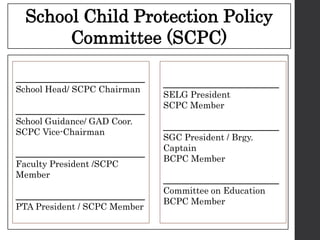
School Child Protection Policy
Committee (SCPC)
__________________________
SELG President
SCPC Member
__________________________
SGC President / Brgy.
Captain
BCPC Member
__________________________
Committee on Education
BCPC Member
_____________________________
School Head/ SCPC Chairman
_____________________________
School Guidance/ GAD Coor.
SCPC Vice-Chairman
_____________________________
Faculty President /SCPC
Member
_____________________________
PTA President / SCPC Member
The CPC shall perform the
following Functions:
1. Draft a school child protection policy with code of conduct and
a plan to ensure child protection and safety, which shall be
reviewed every three years
2. Initiate information dissemination programs and organize
activities for the protection of children from abuse,
exploitation, violence, discrimination and bullying of peer
abuse
3. Develop and implement a school-based referral and
monitoring system
4. Establish a system for identifying students who may be
suffering from significant harm based on any physical,
emotional or behavioral signs
5. Identify, refer and if appropriate, report to the
appropriate offices' cases involving child abuse,
exploitation, violence, discrimination and bullying.
6. Give assistance to parents or guardians, whenever
necessary in securing expert guidance counseling from
the appropriate offices or institutions
7. Coordinate closely with the Women and Child
Protection Desk of the PNP, the Local SWDO other
government agencies & non-government agencies as
may be appropriate
8. Monitor the implementation of positive measures and
effective procedures in providing the necessary
support for the child and for those who care for the
child
9. Ensure that the children’s right to be heard, respected
and upheld in all matters and procedures affecting
their welfare
STATEMENT
OF POLICY
I. Every pupil should learn in a safe
and motivating environment where:
a. Corporal punishment is not imposed
as a form of discipline but instead
gives pieces of training and control
b. Administrators and teachers provide
values and spiritual guidance and
always inspires pupils
II. The school is committed to safeguarding
and promoting the welfare of pupils and
encouraging stakeholders to:
a. Protect each pupil from any form of abuse from adults
or another pupil
b. Take steps to prevent bullying, peer abuse,
description, and other circumstance that affect the
normal development of the pupils
c. Act appropriately to complain of abuse
d. Support pupils who are victims of abuse in
accordance with policy
e. provides appropriate intervention, counseling, and
services to a victim of abuse or violence
f. Administrators and teachers should be sensitive to
the signs of abuse among school children
g. Ensure that everybody is aware of the Child
Protection Policy of School
h. Adopt and operating procedures in accordance with
DepEd Child Protection Policy
DEFINITION
OF
TERMS
Child Abuse – is any form of physical, emotional,
or sexual mistreatment or lack of care that leads to
injury or harm, it commonly occurs within a
relationship of trust or responsibility and is an
abuse of power or a breach of trust. Abuse can
happen to a young person regardless of their age,
gender, race, or ability.
Emotional Abuse – the persistent emotional ill-
treatment of a young person, likely to cause severe
and lasting emotional development. It may involve
telling a young person they are useless, worthless,
unloved, inadequate, or valued in person. It may
feature expectations of young people that are not
appropriate to their age or development.
Bullying – may come from another young person or an
adult. Bullying is defined as deliberate hurtful behavior,
usually repeated over a period of time, where it is
difficult for those bullied to defend themselves. There
are three main types of bullying. It may be:
physical (e.g. Hitting, kicking, slapping).
Verbal (e.g. Racist, or homophobic remarks, name-
calling, graffiti, threats, abusive text messages),
emotional (e.g. Tormenting, ridiculing, humiliating,
ignoring, isolating from the group),
sexual (e.g. Unwanted physical contact or abusive
comments.)
Neglect - occurs when an adult fails to
meet the person’s basic and/or
psychological needs to an extent that is
likely to result in serious impairment of the
child’s health or development.
For example, failing to provide adequate
food, shelter, and clothing, failing to
protect from physical harm or danger, or
failing to ensure access to appropriate
medical care or treatment.
ABUSES OCCURRING IN THE
INSTITUTION/ COMMUNITY
1. Bullying
2. Peer Abuse
3. Verbal Abuse
4. Emotional Abuse
5. Child Labor
6. Physical Abuse
SIGNS OF ABUSE
1. Unexplained or suspicious injuries such as bruising, cuts, or burns,
particularly if situated on a part of the body not normally prone to such
injuries.
2. An injury for which an explanation seems inconsistent.
3. The young person describes what appears to be an abusive act involving
them
4. Another young person or adult expresses concern about the welfare of the
young person.
5. Unexplained changes in young person behavior e.g becoming very upset,
quiet, withdrawn or displaying sudden outbursts of temper.
6. Distrust of adult’s particularly those with whom a close relationship would
normally be expelled.
7. Difficulty in making friends
8. Being prevented from socializing with others
9. Displaying variations in eating patterns including overeating or loss of
appetite.
10. Losing weight for no apparent reason
11. Becoming increasingly dirty or unkept
DUTIES AND RESPONSIBILITIES
OF FACULTY AND STAFF
1. Ensure the institution of effective child protection policies
and procedures and monitor compliance thereof.
2. Ensure that the school adopts a child protection policy,
organized and convene Child Protection Committee
(CPC) for the school
3. Conduct the capacity building for the members of the
CPC and Guidance Counselors/ Teachers
4. Ensure that the participatory and other rights of children
are respected and upheld in all matters and procedures
affecting their welfare.
5. Coordinate with appropriate offices and other agencies or
instrumentality for appropriate assistance and
intervention, as may be required the performance of its
functions.
6. Keep a sufficient record of any significant complaint, the
conversation of the event.
7. To report any matters of concern to the committee
INTERVENTIONS
1. Creation of board of signage of the rights of every child
based on Presidential Decree No. 603 for public
awareness to be posted on different parts of the school/
barangay.
2. Conduct seminar/ workshop on the rights of a child and
responsible parenthood to all welfare and the parents of
the School for their own welfare and awareness.
3. Integrate small group sessions/ discussions on positive
peer relationships among pupils in different subject areas.
4. Call the attention of Barangay Officials in maintaining
safety and security for a peaceful community with the
help of the education sector.
INTERVENTIONS
5. Provide activities promoting collaborative learning and
teamwork like scouting for socialization and gaining
friends.
6. Promote healthy competition in the class/ school to avoid
misunderstanding and conflicts
7. Avoid making sexually suggestive comments to a young
person, even in fun.
8. Prevent engaging in rough, physical or sexually
provocative games, including horseplay or other
activities in class/ school
9. Avoid bringing / holding sharp object like barbeque
sticks, small knives, nail cutter knives, etc. to prevent
injuries / abuse.
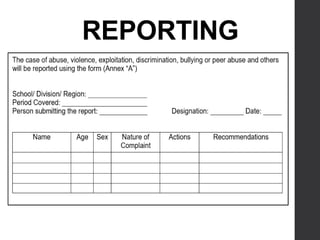
REPORTING
DOCUMENTATION
Every effort should be made to ensure that confidentiality is
maintained for all concerned. Information should be handled
and disseminated on a need-to-know basis only. This
includes the following people:
‱ The class adviser/subject teacher
‱ The Guidance Counsellor
‱ The School Head
‱ The School Child Protection Committee
‱ The Parents of the Child
‱ The person making the allegation
‱ Social Services
‱ The alleged abuser (and parent if the alleged abuser is a
child)
Seek social services advice on how should approach the
alleged abuser.
All information should be stored in a secure place with
access to designated people, in line with data protection
laws.

Child Protection Policy Powerpoint Presentation.pptx

  • 2.
    ‱Pursuant to the1987 Philippine Constitution, the State shall defend the right of children to assistance, including proper care and nutrition, and special protection from all forms of neglect, abuse, cruelty, exploitation and other conditions prejudicial to their development (Article XV, Section 3 [2])
  • 3.
    VISION We dream ofFilipinos who passionately love their country and whose values and competencies enable them to realize their full potential and contribute meaningfully to building the nation. As a learner-centered public institution, the Department of Education continuously improves itself to better serve its stakeholders.
  • 4.
    MISSION To protect andpromote the right of every Filipino to quality, equitable, culture-based, and complete basic education where: Students learn in a child-friendly, gender-sensitive, safe, and motivating environment. Teachers facilitate learning and constantly nurture every learner. Administrators and staff, as stewards of the institution, ensure an enabling and supportive environment for effective learning to happen. Family, community, and other stakeholders are actively engaged and share responsibility for developing life-long learners.
  • 5.
    DepEd Order no. 40s.2012 Policy & Guidelines on protecting children in school from abuse, violence, exploitation, violation, discrimination, bullying and other forms of abuse The Department Order shall be known as the “DepEd Child Protection Policy’’ Organize and convene the child protection committee for the school
  • 6.
    School Child ProtectionPolicy Committee (SCPC) __________________________ SELG President SCPC Member __________________________ SGC President / Brgy. Captain BCPC Member __________________________ Committee on Education BCPC Member _____________________________ School Head/ SCPC Chairman _____________________________ School Guidance/ GAD Coor. SCPC Vice-Chairman _____________________________ Faculty President /SCPC Member _____________________________ PTA President / SCPC Member
  • 7.
    The CPC shallperform the following Functions: 1. Draft a school child protection policy with code of conduct and a plan to ensure child protection and safety, which shall be reviewed every three years 2. Initiate information dissemination programs and organize activities for the protection of children from abuse, exploitation, violence, discrimination and bullying of peer abuse 3. Develop and implement a school-based referral and monitoring system 4. Establish a system for identifying students who may be suffering from significant harm based on any physical, emotional or behavioral signs
  • 8.
    5. Identify, referand if appropriate, report to the appropriate offices' cases involving child abuse, exploitation, violence, discrimination and bullying. 6. Give assistance to parents or guardians, whenever necessary in securing expert guidance counseling from the appropriate offices or institutions 7. Coordinate closely with the Women and Child Protection Desk of the PNP, the Local SWDO other government agencies & non-government agencies as may be appropriate 8. Monitor the implementation of positive measures and effective procedures in providing the necessary support for the child and for those who care for the child 9. Ensure that the children’s right to be heard, respected and upheld in all matters and procedures affecting their welfare
  • 9.
  • 10.
    I. Every pupilshould learn in a safe and motivating environment where: a. Corporal punishment is not imposed as a form of discipline but instead gives pieces of training and control b. Administrators and teachers provide values and spiritual guidance and always inspires pupils
  • 11.
    II. The schoolis committed to safeguarding and promoting the welfare of pupils and encouraging stakeholders to: a. Protect each pupil from any form of abuse from adults or another pupil b. Take steps to prevent bullying, peer abuse, description, and other circumstance that affect the normal development of the pupils c. Act appropriately to complain of abuse d. Support pupils who are victims of abuse in accordance with policy e. provides appropriate intervention, counseling, and services to a victim of abuse or violence f. Administrators and teachers should be sensitive to the signs of abuse among school children g. Ensure that everybody is aware of the Child Protection Policy of School h. Adopt and operating procedures in accordance with DepEd Child Protection Policy
  • 12.
  • 13.
    Child Abuse –is any form of physical, emotional, or sexual mistreatment or lack of care that leads to injury or harm, it commonly occurs within a relationship of trust or responsibility and is an abuse of power or a breach of trust. Abuse can happen to a young person regardless of their age, gender, race, or ability. Emotional Abuse – the persistent emotional ill- treatment of a young person, likely to cause severe and lasting emotional development. It may involve telling a young person they are useless, worthless, unloved, inadequate, or valued in person. It may feature expectations of young people that are not appropriate to their age or development.
  • 14.
    Bullying – maycome from another young person or an adult. Bullying is defined as deliberate hurtful behavior, usually repeated over a period of time, where it is difficult for those bullied to defend themselves. There are three main types of bullying. It may be: physical (e.g. Hitting, kicking, slapping). Verbal (e.g. Racist, or homophobic remarks, name- calling, graffiti, threats, abusive text messages), emotional (e.g. Tormenting, ridiculing, humiliating, ignoring, isolating from the group), sexual (e.g. Unwanted physical contact or abusive comments.)
  • 15.
    Neglect - occurswhen an adult fails to meet the person’s basic and/or psychological needs to an extent that is likely to result in serious impairment of the child’s health or development. For example, failing to provide adequate food, shelter, and clothing, failing to protect from physical harm or danger, or failing to ensure access to appropriate medical care or treatment.
  • 16.
    ABUSES OCCURRING INTHE INSTITUTION/ COMMUNITY 1. Bullying 2. Peer Abuse 3. Verbal Abuse 4. Emotional Abuse 5. Child Labor 6. Physical Abuse
  • 17.
    SIGNS OF ABUSE 1.Unexplained or suspicious injuries such as bruising, cuts, or burns, particularly if situated on a part of the body not normally prone to such injuries. 2. An injury for which an explanation seems inconsistent. 3. The young person describes what appears to be an abusive act involving them 4. Another young person or adult expresses concern about the welfare of the young person. 5. Unexplained changes in young person behavior e.g becoming very upset, quiet, withdrawn or displaying sudden outbursts of temper. 6. Distrust of adult’s particularly those with whom a close relationship would normally be expelled. 7. Difficulty in making friends 8. Being prevented from socializing with others 9. Displaying variations in eating patterns including overeating or loss of appetite. 10. Losing weight for no apparent reason 11. Becoming increasingly dirty or unkept
  • 18.
    DUTIES AND RESPONSIBILITIES OFFACULTY AND STAFF 1. Ensure the institution of effective child protection policies and procedures and monitor compliance thereof. 2. Ensure that the school adopts a child protection policy, organized and convene Child Protection Committee (CPC) for the school 3. Conduct the capacity building for the members of the CPC and Guidance Counselors/ Teachers 4. Ensure that the participatory and other rights of children are respected and upheld in all matters and procedures affecting their welfare. 5. Coordinate with appropriate offices and other agencies or instrumentality for appropriate assistance and intervention, as may be required the performance of its functions. 6. Keep a sufficient record of any significant complaint, the conversation of the event. 7. To report any matters of concern to the committee
  • 21.
    INTERVENTIONS 1. Creation ofboard of signage of the rights of every child based on Presidential Decree No. 603 for public awareness to be posted on different parts of the school/ barangay. 2. Conduct seminar/ workshop on the rights of a child and responsible parenthood to all welfare and the parents of the School for their own welfare and awareness. 3. Integrate small group sessions/ discussions on positive peer relationships among pupils in different subject areas. 4. Call the attention of Barangay Officials in maintaining safety and security for a peaceful community with the help of the education sector.
  • 22.
    INTERVENTIONS 5. Provide activitiespromoting collaborative learning and teamwork like scouting for socialization and gaining friends. 6. Promote healthy competition in the class/ school to avoid misunderstanding and conflicts 7. Avoid making sexually suggestive comments to a young person, even in fun. 8. Prevent engaging in rough, physical or sexually provocative games, including horseplay or other activities in class/ school 9. Avoid bringing / holding sharp object like barbeque sticks, small knives, nail cutter knives, etc. to prevent injuries / abuse.
  • 23.
  • 24.
  • 25.
    Every effort shouldbe made to ensure that confidentiality is maintained for all concerned. Information should be handled and disseminated on a need-to-know basis only. This includes the following people: ‱ The class adviser/subject teacher ‱ The Guidance Counsellor ‱ The School Head ‱ The School Child Protection Committee ‱ The Parents of the Child ‱ The person making the allegation ‱ Social Services ‱ The alleged abuser (and parent if the alleged abuser is a child) Seek social services advice on how should approach the alleged abuser. All information should be stored in a secure place with access to designated people, in line with data protection laws.

Editor's Notes

  • #6 DepEd Order Dated May 14, 2012
  • #7 The CPC shall perform the following Functions: Draft a school child protection policy with code of conduct and a plan to ensure child protection and safefty, wich shall be reviewd every three years Initiate information dissemination programs and organize activities for the protection of children from buse, exploitation, violence, discrimination and bullying of peer abuse Develop and implement a school-based referral and monitoring system Establish a system for identifying students who may be suffering from significant harm based on any physical, emotional or behavioral signs Identify, refer and if appropriate, report to the appropriate offices cases involving child abuse, exploitation, violence, discrimination and bullying. Give assistance to parents or guardians, whenever necessary in securing expert guidance counseling from the appropriate offices or institutions Coordinate closely with the Women and Child Protection Desk of the PNP, the Local SWDO other government agencies & non-government agencies as may be appropriate Monitor the implementation of positive measures and effective procedures in providing the necessary support for the child and for those who care for the child Ensure that the children’s right to be heard, respected and upheld in all matters and procedures affecting their welfare