DepED
CHILD PROTECTION
POLICY
DepED Order No. 40, s. 2012
“POLICY AND GUIDELINES ON PROTECTING
CHILDREN IN SCHOOL FROM ABUSE, VIOLENCE,
EXPLOITATION, DISCRIMINATION, BULLYING AND
OTHER FORMS OF ABUSE”
DepED Child Protection Policy
The policy aim to protect the child from all forms
of violence that may be inflicted by adults, persons
in authority as well as their fellow students,
including bullying.
To provide special protection to children who are
gravely threatened or endangered by
circumstances which affect their normal
development and over which they have no control,
and to assist the concerned agencies in their
rehabilitation.
DepED Child Protection Policy
To ensure that such special protection from all
forms of abuse and exploitation and care as is
necessary for the child's well-being, taking into
account the primary rights and duties of parents,
legal guardians, or other individuals who are
legally responsible and exercise custody over the
child.
Zero tolerance for any act of child abuse,
exploitation, violence, discrimination, bullying and
other forms of abuse.
DepED Child Protection Policy
The policy guidelines have listed down the specific
acts that constitute child abuse and violence
which public and private schools cases used as
a guide in addressing this social problem.
DepED Child Protection Policy
Section 3 (2) Article XV of the 1987 Constitution
*the state shall defend the right of children to assistance,
including proper care and nutrition, and special protection
from all forms of neglect, abuse, cruelty, exploitation and
other conditions prejudicial to their development.
Convention on the Rights of the Child (CRC)
*aims to protect children from all forms of physical or
mental violence, injury and abuse, neglect or negligent
treatment maltreatment and exploitation, including sexual
abuse.
DepED Child Protection Policy
CHILD
– refers to any person below eighteen (18) years of
age or those over but are unable to fully take care
of themselves or protect themselves from abuse,
neglect, cruelty, exploitation or discrimination of
physical or mental disability or condition (RA 7610).
-- includes pupils or students who may be eighteen
(18) years of age or older but are in school.
DepED Child Protection Policy
CHILDREN IN SCHOOL
-- refers to bonafide pupils, students or learners
who are enrolled in the basic education system,
whether regular, irregular, transferee or repeater,
including those who have been temporarily out of
school, who are in the school or learning centers
premises or participating in school sanctioned
activities.
DepED Child Protection Policy
PUPIL, STUDENT OR LEARNER
-- means a child who regularly attends classes in
any level of the basic education system, under the
supervision of a teacher or facilitator.
DepED Child Protection Policy
PROHIBITED ACTS :
 Abuse Violence
 Exploitation
 Discrimination
 Corporal Punishment
 Bullying
 Other Forms of Abuse
PROHIBITED ACT :
CHILD ABUSE – refers to the maltreatment of a
child whether habitual or not, which includes the
following :
1)Psychological or physical abuse, neglect, cruelty,
sexual abuse and emotional maltreatment.
2)Any act or deeds or words which debases,
degrades or demeans the intrinsic worth dignity of
a child as a human being.
PROHIBITED ACT :
CHILD ABUSE
3)Unreasonable deprivation of the child's basic
needs for survival such as food and shelter; or
4)Failure to immediately give medical treatment to
an injured child resulting in serious impairment of
his or her growth and development or in the child's
permanent in capacity or death.
(section 3 (b) RA 7610)
PROHIBITED ACT :
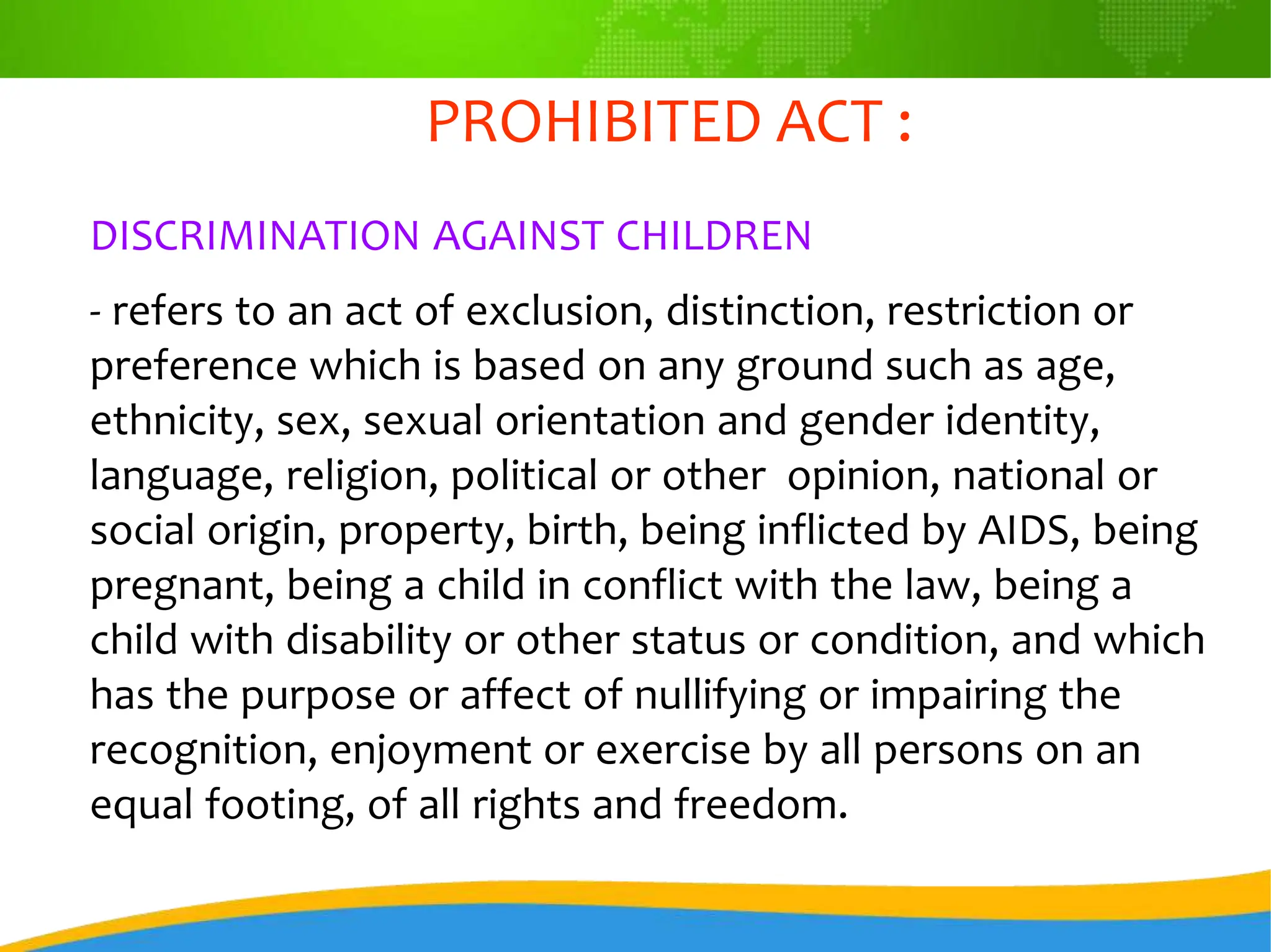
DISCRIMINATION AGAINST CHILDREN
- refers to an act of exclusion, distinction, restriction or
preference which is based on any ground such as age,
ethnicity, sex, sexual orientation and gender identity,
language, religion, political or other opinion, national or
social origin, property, birth, being inflicted by AIDS, being
pregnant, being a child in conflict with the law, being a
child with disability or other status or condition, and which
has the purpose or affect of nullifying or impairing the
recognition, enjoyment or exercise by all persons on an
equal footing, of all rights and freedom.
PROHIBITED ACT :
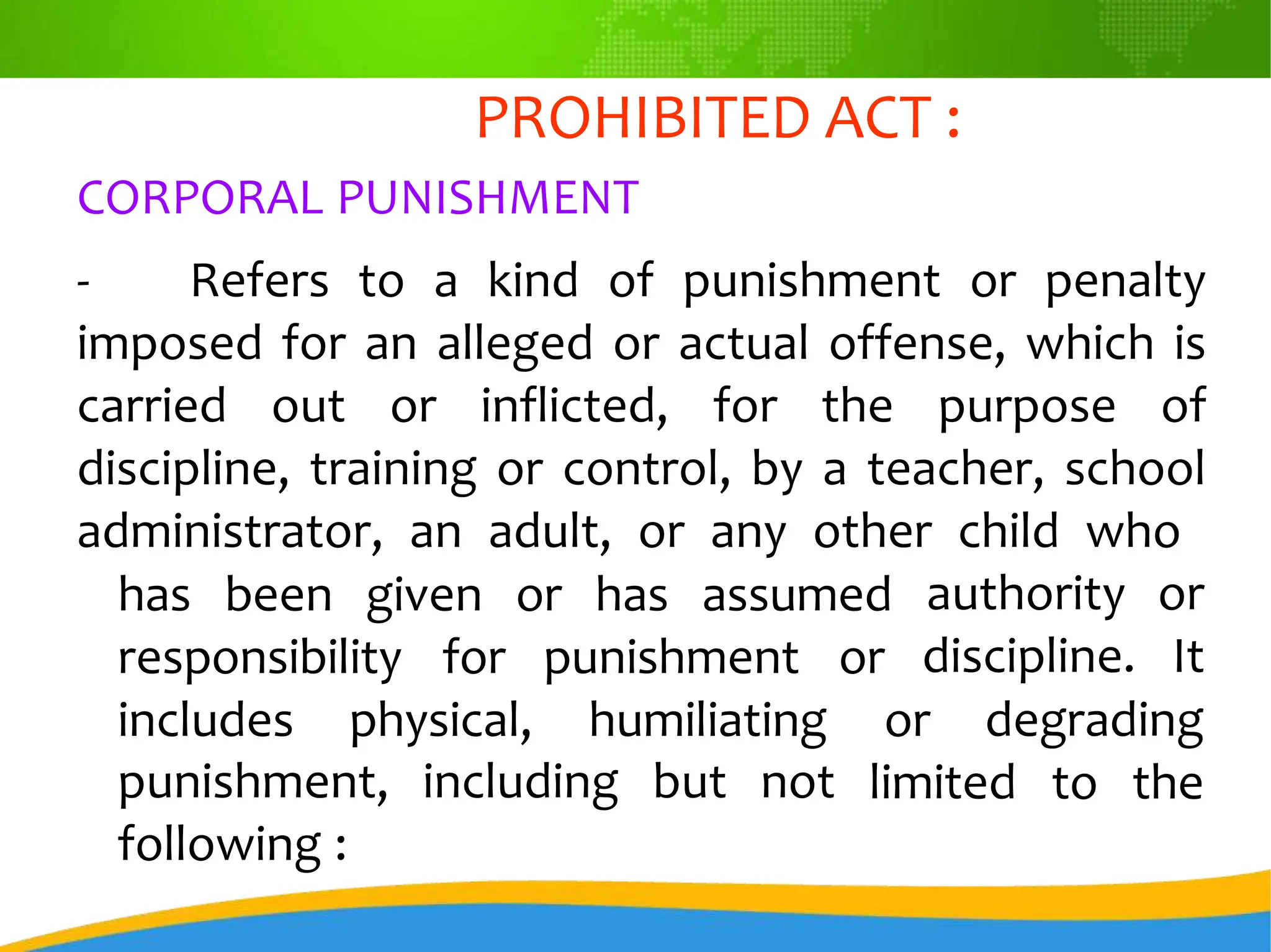
CORPORAL PUNISHMENT
- Refers to a kind of punishment or penalty
imposed for an alleged or actual offense, which is
carried out or inflicted, for the purpose of
discipline, training or control, by a teacher, school
administrator, an adult, or any other child who
has been given or has assumed authority or
discipline. It
responsibility for punishment or
includes physical, humiliating or degrading
punishment, including but not
following :
limited to the
CORPORAL PUNISHMENT
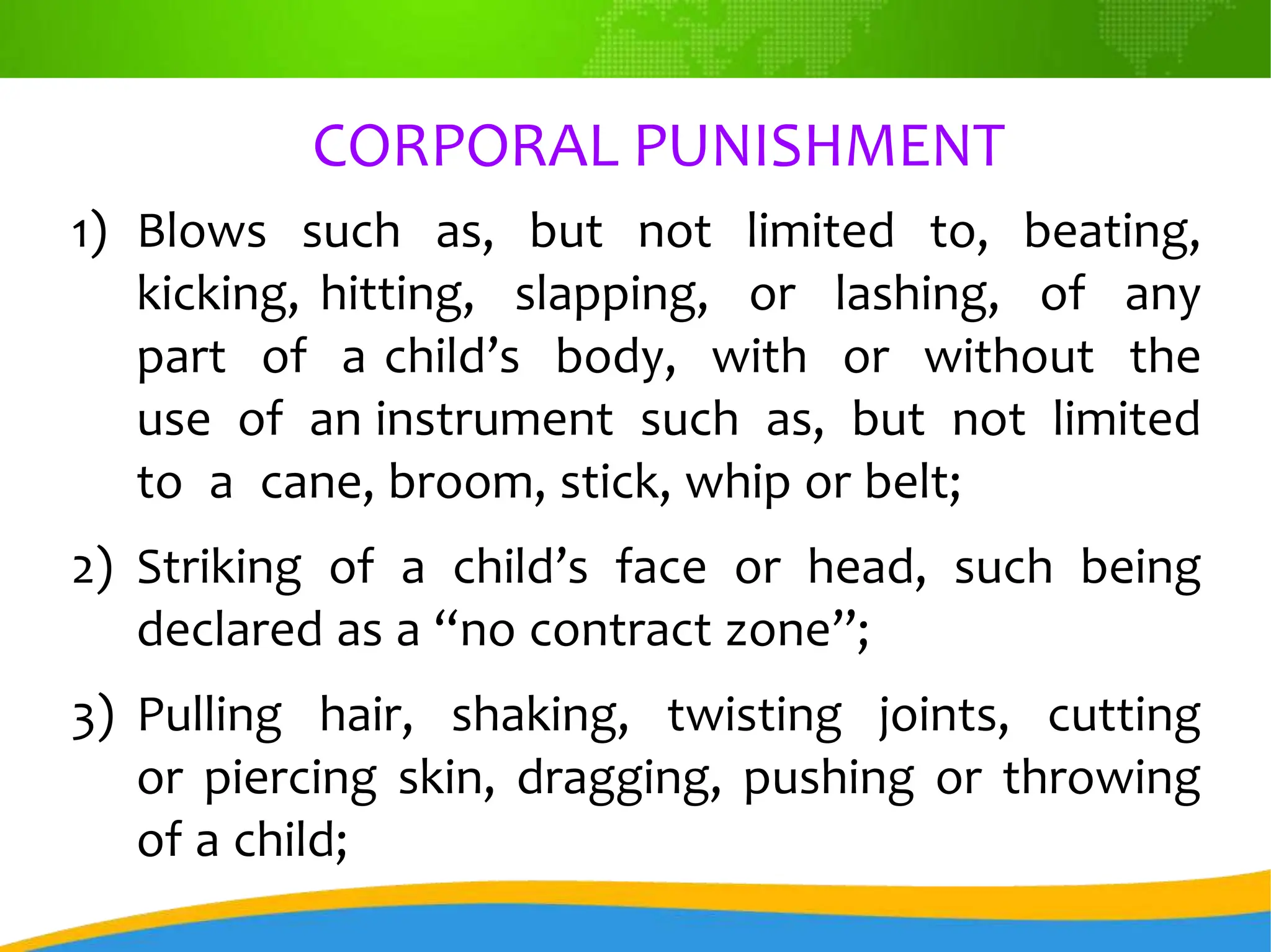
1) Blows such as, but not limited to, beating,
kicking, hitting, slapping, or lashing, of any
part of a child’s body, with or without the
use of an instrument such as, but not limited
to a cane, broom, stick, whip or belt;
2) Striking of a child’s face or head, such being
declared as a “no contract zone”;
3) Pulling hair, shaking, twisting joints, cutting
or piercing skin, dragging, pushing or throwing
of a child;
CORPORAL PUNISHMENT
4)Forcing a child to perform physically painful or
damaging acts such as, but not limited to, holding a
weight or weights for an extended period and kneeling
on stones, salt, pebbles or other objects;
5)Deprivation of a child’s physical needs as a form of
punishment;
6)Deliberate exposure to fire, ice water, smoke,
sunlight, rain, pepper, alcohol, or forcing the child to
swallow substances, dangerous chemicals, and other
materials that can cause discomfort or threaten
the child’s health, safety and sense of security such
as, but not limited to insecticides, excrement or urine;
CORPORAL PUNISHMENT
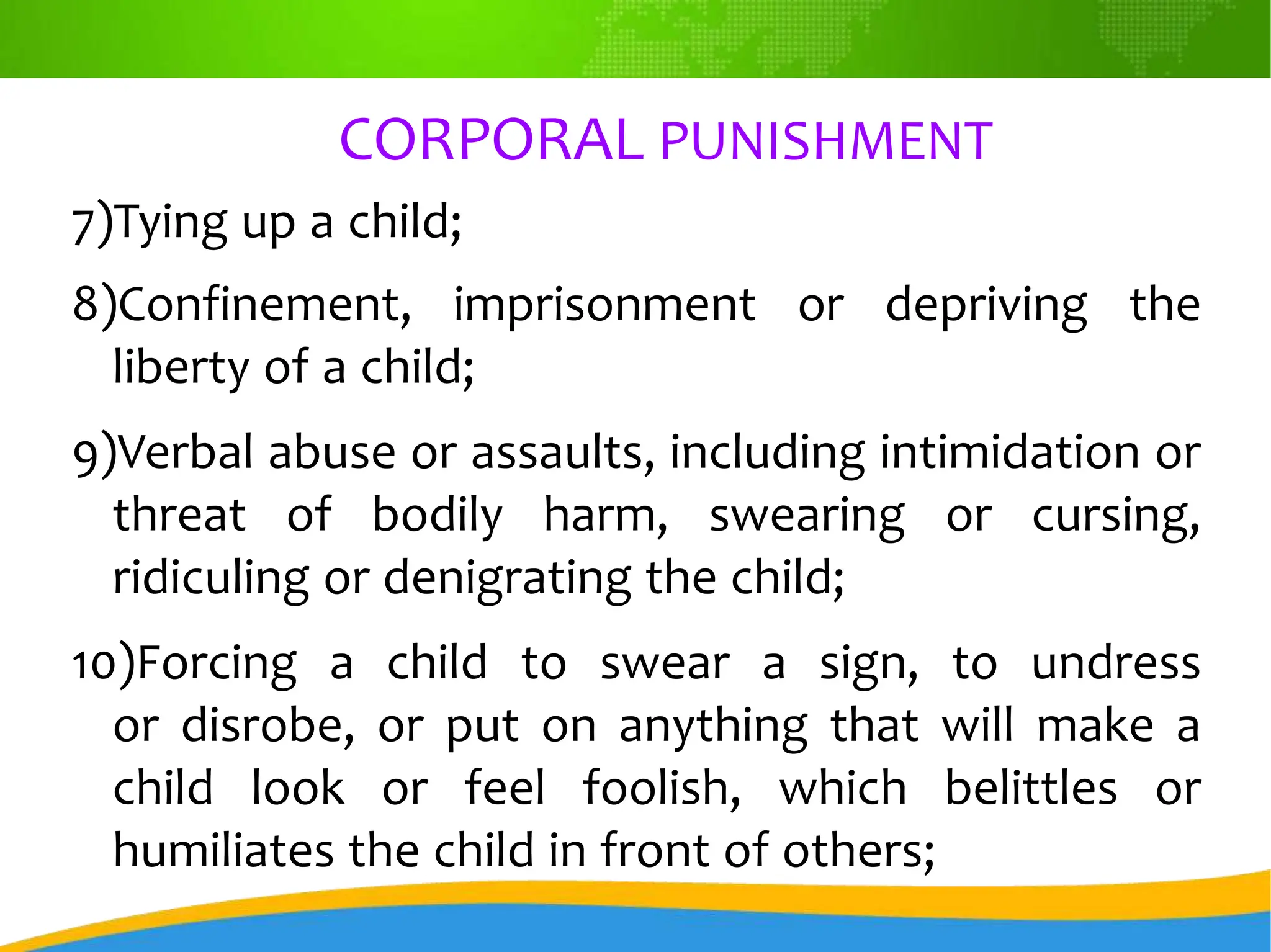
7)Tying up a child;
8)Confinement, imprisonment or depriving the
liberty of a child;
9)Verbal abuse or assaults, including intimidation or
threat of bodily harm, swearing or cursing,
ridiculing or denigrating the child;
10)Forcing a child to swear a sign, to undress
or disrobe, or put on anything that will make a
child look or feel foolish, which belittles or
humiliates the child in front of others;
CORPORAL PUNISHMENT
11)Permanent confiscation of personal property of
pupils, students or learners, except when
such pieces of property pose a danger to the
child or to others, and
12)Other analogous acts.
PROHIBITED ACT :
CHILD EXPLOITATION – refers to the use of children
for someone else's advantage, gratification or
profit resulting in an unjust, cruel and harmful
treatment of the child.
Two forms :
1)Sexual exploitation – abuse of position of
vulnerability, differential power, or trust, for sexual
purposes.
2)Economic exploitation – use of the child in work
or other activities for the benefit of others.
JILL ANN 1-9
PROHIBITED ACT :
VIOLENCE AGAINST CHILDREN COMMITTED IN
SCHOOLS – refers to a single act or a series of acts
committed by school administrators, academic and
non-academic personnel against a child which
result in or is likely to result in physical, sexual,
psychological harm or suffering or other abuses
including threats of such acts, battery, assault,
coercion, harassment or arbitrary deprivation of
liberty. It includes, but is not limited to the
following acts :
PROHIBITED ACT :
VIOLENCE AGAINST CHILDREN COMMITTED IN
SCHS
1)Physical violence - bodily or physical harm. It
includes assigning tasks which are hazardous to
their physical well-being.
2)Sexual violence – acts that sexual in nature. It
includes, but not limited to : rape, sexual
harassment, forcing the child to watch obsence or
incident shows, forcing the child to engage in sexual
activity.
PROHIBITED ACT :
VIOLENCE AGAINST CHILDREN COMMITTED IN
SCHOOLS
3)Psychological violence – acts or omissions causing
or likely to cause mental or emotional suffering of
the child.
3)Other acts of violence of a physical, sexual or
psychological nature that are prejudicial to the best
interest of the child.
PROHIBITED ACT :
BULLYING OR PEER ABUSE
is committed when a student commits an act
or a series of acts directed towards another
student, or a series of single acts directed
towards several students in a school setting or
a place of learning, which results in physical and
mental abuse, harassment, intimidation, or
humiliation.
BULLYING
a)Threats to inflict a wrong upon a person, honor or
property of the person or on his or her family;
b)Stalking or constantly following or pursuing a person
in his or her daily activities, with unwanted and obsessive
attention;
c)Taking of property;
d)Public humiliation, or public and malicious
imputation of a crime or of a vice or defect, whether real
or imaginary, or any act, omission, condition, status, or
circumstance tending to cause dishonor, discredit or
expose a person to contempt;
BULLYING
e)Deliberate destruction or defacement of, or damage to
the child's property;
f)Physical violence committed upon a student, which may
or may not result to harm or injury, with or without the act
of weapon. Such violence may be in the form of mauling,
hitting, punching, kicking, throwing things at the student,
pinching, spanking, or other similar acts;
g)Demanding or requiring sexual or monetary favors or
exacting money or property from a pupil or student; and
h)Restraining the liberty and freedom of a pupil or student.
CYBER-BULYING
--- is any conduct which results to harassment,
intimidation, or humiliation, through electronic
means or other technology, such as, but not limited
to texting, email, instant messaging, chatting,
websites or other
internet, social networking
platforms or formats.
PROCEDURES IN HANDLING BULLYING
INCIDENTS IN SCHOOLS
*it shall be acted upon by the School Head who
shall inform the parents or guardians of the
victim and offending child;
*the incident will be referred to the Child Protection
Committee for counseling and other intervention.
*If warranted, penalties may be imposed by the
School Head.
PROCEDURES IN HANDLING BULLYING
INCIDENTS IN SCHOOLS
Penalties
1st st Offense - reprimand 2nd offense and subsequent
2nd Offense - suspension for not more than one (1) week
(this is after the offending child has received counseling or other interventions)
* during the period of suspension, the offending child and the
parents or guardians may be required to attend further seminars
and counseling.
PROCEDURES IN HANDLING BULLYING
INCIDENTS IN SCHOOLS
In all cases where the imposable penalty on the offending child is
suspension, exclusion or expulsion, the following minimum
requirements of due process shall be complied with :
1) The child and the parents or guardians must be informed of the
complaint in writing;
2)The child shall be given the opportunity to answer the complaint
in writing, with the assistance of the parents or guardians;
3)The decision of the school head must be writing, stating the
facts and the reasons for the decisions;
4)The decision of the school head may be appealed as provided in
existing rules of the Department.
Bullying that results in serious
physical injuries or death
If the bullying or peer abuse resulted in serious
physical injuries or death, whenever appropriate, the
case shall be dealth with in accordance with the
provisions of Republic Act No. 7610 and its
Implementing Rules and Regulations.
IMPLEMENTATION OF NON- DISCIPLINARY
MEASURES
Depending on the gravity of the bullying
committed by any pupil, student or learner, the
school may impose other non-disciplinary
measures.
JASON 20-32
HOUSE BILL No. 5496
“Anti-Bullying Act of 2012”
Approved in the Senate and House of
Representatives on June 7, 2013
* It empowers the DepED to penalize
schools that do not stop bullying or
sanction bullies.
* Authorize schools to impose sanctions
on student bullies.
HOUSE BILL No. 5496
“Anti-Bullying Act of 2012”
All elementary and high schools would be required
to adopt anti-bullying policies and sanctions,
which would apply to prohibited acts committed
within their campuses at school sponsored
activities, whether done on or off school grounds,
school bus stops, school buses, or other
properties owned or leased by the school.
DepED Child Protection Policy
POSITIVE AND NON-VIOLENT DISCIPLINE OF CHILDREN
is a way of thinking and a holistic, constructive and pro-active approach
to teaching that helps children develop appropriate thinking and
behavior in the short and long-term and fosters self-discipline. It is
based on the fundamental principle that children begins with setting
the long-term goals or impacts that teachers want to have on their
students' adult lives, and using everyday situations and challenges to
teach life-long skills and values to students.
DepED Child Protection Policy
DUTIES AND RESPONSIBILITIES :
Central Office
Regional Office
Division Office
School
DepED Child Protection Policy
DUTIES AND RESPONSIBILITIES :
Central Office
*Develop policy and guidelines for the prevention
of violence against children in schools and make
these available to all schools;
*Conduct a nationwide information dissemination;
*Devise programs, campaigns and activities;
*Formulate a system of standard reporting of cases;
*The Secretary exercise disciplinary jurisdiction
DepED Child Protection Policy
DUTIES AND RESPONSIBILITIES :
Regional Office
* Encourage and support advocacy campaigns;
* Consolidate reports on incidents and cases;
* Monitor and evaluate the implementation of CPC
* Exercise disciplinary jurisdiction
* Give recommendation to the Central Office
DepED Child Protection Policy
DUTIES AND RESPONSIBILITIES :
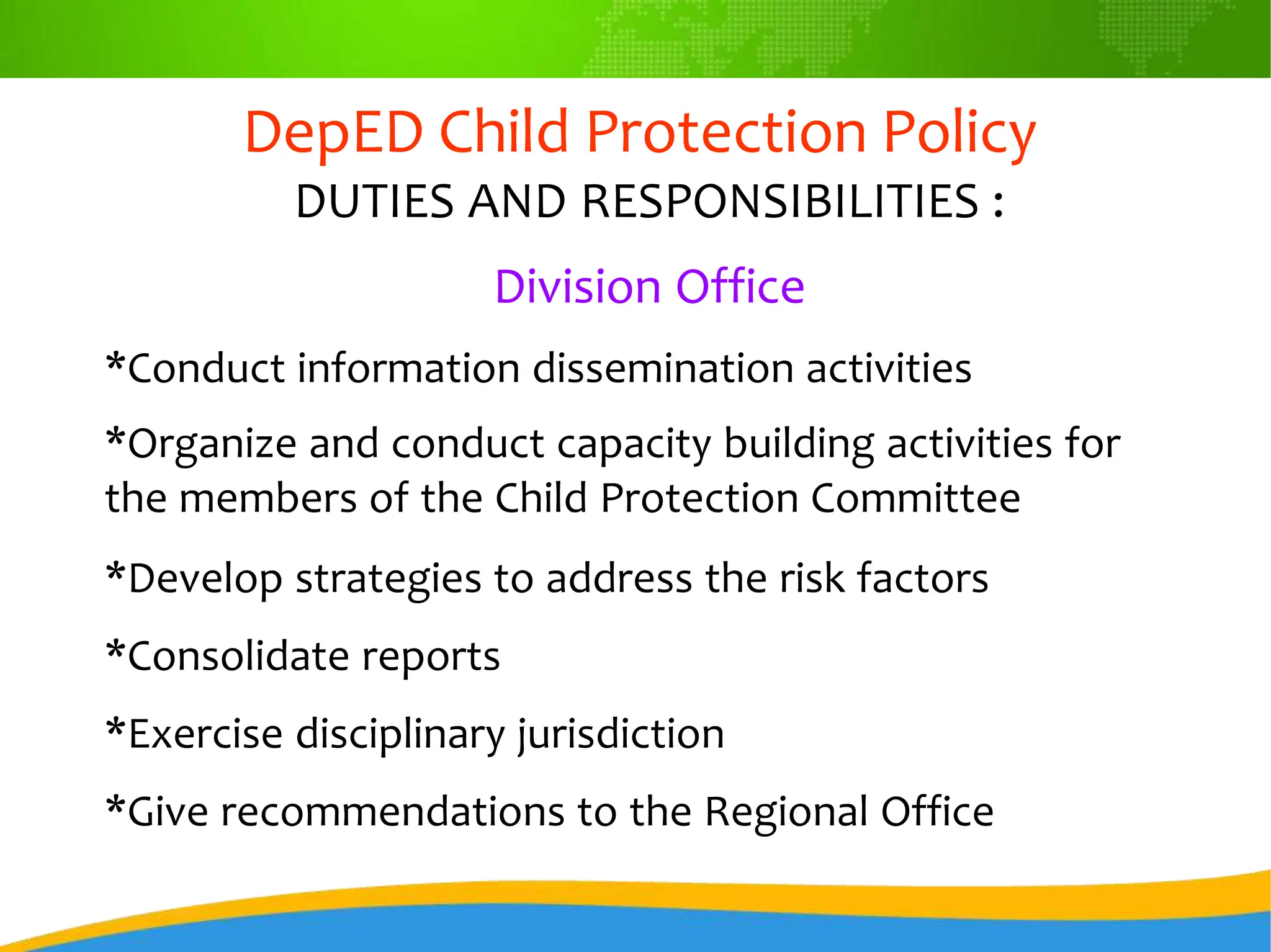
Division Office
*Conduct information dissemination activities
*Organize and conduct capacity building activities for
the members of the Child Protection Committee
*Develop strategies to address the risk factors
*Consolidate reports
*Exercise disciplinary jurisdiction
*Give recommendations to the Regional Office
DepED Child Protection Policy
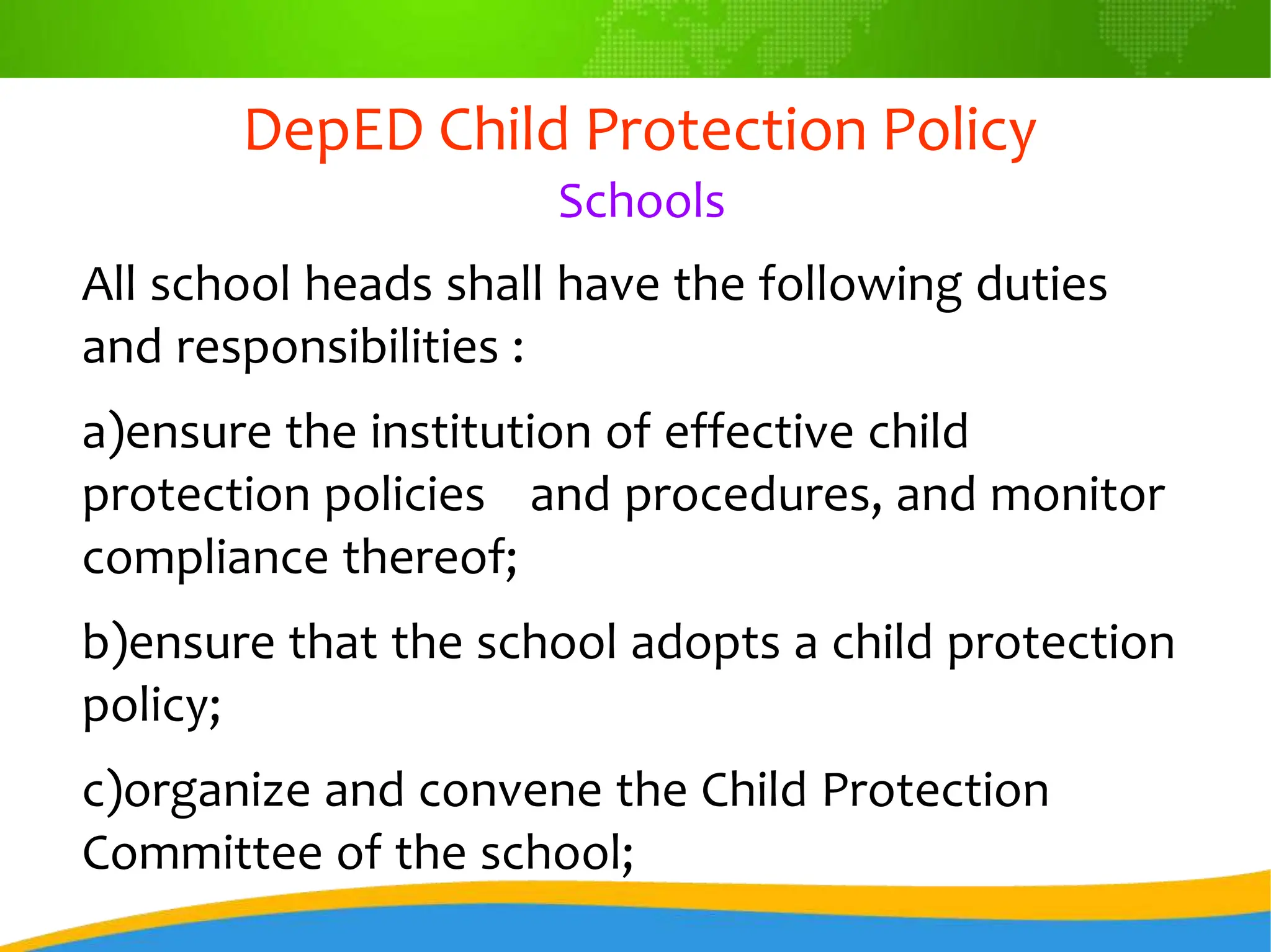
Schools
All school heads shall have the following duties
and responsibilities :
a)ensure the institution of effective child
protection policies and procedures, and monitor
compliance thereof;
b)ensure that the school adopts a child protection
policy;
c)organize and convene the Child Protection
Committee of the school;
DepED Child Protection Policy
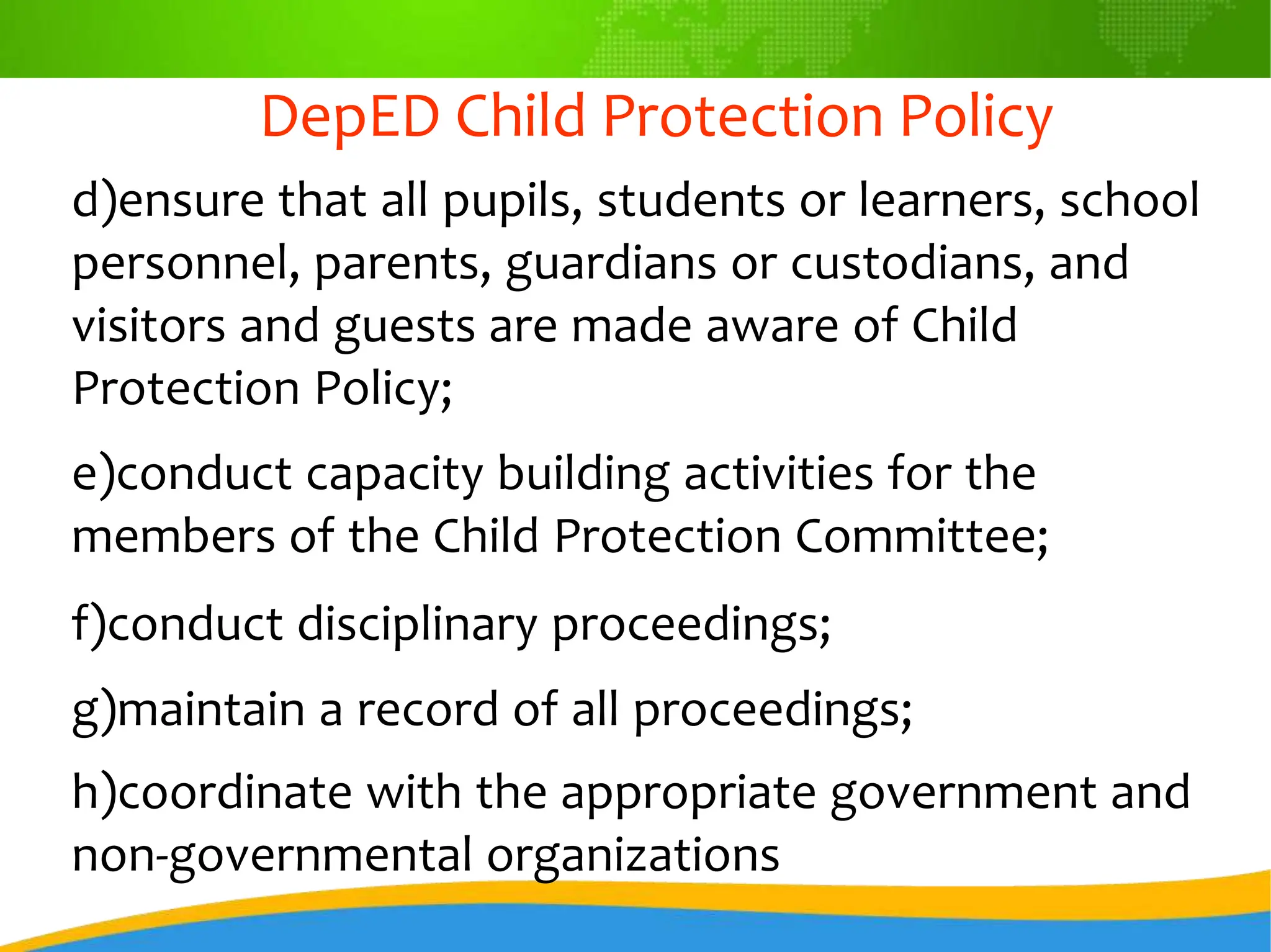
d)ensure that all pupils, students or learners, school
personnel, parents, guardians or custodians, and
visitors and guests are made aware of Child
Protection Policy;
e)conduct capacity building activities for the
members of the Child Protection Committee;
f)conduct disciplinary proceedings;
g)maintain a record of all proceedings;
h)coordinate with the appropriate government and
non-governmental organizations
CHILD PROTECTION COMMITTEE :
Chairperson : School Head/Administrator Guidance
Counselor/Teacher
Rep. Of the Teachers as designated by
the
Vice-Chair :
Members :
Faculty Club
Rep. Of the Parents as designated by the PTA Rep. Of
pupils, students and learners as designated by the the
Supreme Student Council
Rep. From the Community as designated by the Punong
Brgy., preferably a member of the
Brgy. Council for the Protection of Children
CHILD PROTECTION COMMITTEE :
a)draft a school child protection policy with a code
of conduct and a plan to ensure child protection
and safety, which shall be reviewed every 3 years;
(template will be provided)
b)initiate information dissemination programs and
organize activities for the protection of children
from abuse;
c)develop and implement a school-based referral
and monitoring system; (template will be provided)
CHILD PROTECTION COMMITTEE :
d)give assistance to parents or guardians, whenever
necessary;
e)coordinate closely with the PNP, DSWD, NGOs
and other non-governmental institutions;
f)monitor implementation of positive measures and
effective procedures;
g)ensure that children's right to be heard are
respected and upheld in all matters and procedures
affecting their welfare.
RULES AND PROCEEDINGS IN HANDLING CHILD ABUSE,
EXPLOITATION, VIOLENCE AND DISCRIMINATION CASES
Private Schools :
Complaint against school personnel or official
A complaint for child abuse, violence, exploitation or
discrimination in a private school shall be filed with the
School Head/Chief Executive Officer and shall be acted
upon pursuant to the school's rules of procedures on
administrative cases. The penalty shall be that which is
provided by the rules of the school, subject to the
requirements of due process.
The administrative cases shall be without prejudice to
any civil or criminal cases that may be filed.
RULES AND PROCEEDINGS IN HANDLING
CHILD ABUSE, EXPLOITATION, VIOLENCE
AND DISCRIMINATION CASES
Public Schools :
The investigation shall be in accordance with the
Revised Rules of Procedure of the Department of
Education.
DepED Child Protection Policy
DUTIES OF PRIVATE SCHOOLS
Private Schools shall be responsible for
promulgating a school child protection policy,
including a policy on bullying, a protocol for
reporting and procedures for handling and
management of cases, consistent with these
policies and guidelines.
THANK YOU
and GOD
BLESS!!!

CHILD PROTECTION POLICY on gender and development.ppt

  • 1.
  • 2.
    DepED Order No.40, s. 2012 “POLICY AND GUIDELINES ON PROTECTING CHILDREN IN SCHOOL FROM ABUSE, VIOLENCE, EXPLOITATION, DISCRIMINATION, BULLYING AND OTHER FORMS OF ABUSE”
  • 3.
    DepED Child ProtectionPolicy The policy aim to protect the child from all forms of violence that may be inflicted by adults, persons in authority as well as their fellow students, including bullying. To provide special protection to children who are gravely threatened or endangered by circumstances which affect their normal development and over which they have no control, and to assist the concerned agencies in their rehabilitation.
  • 4.
    DepED Child ProtectionPolicy To ensure that such special protection from all forms of abuse and exploitation and care as is necessary for the child's well-being, taking into account the primary rights and duties of parents, legal guardians, or other individuals who are legally responsible and exercise custody over the child. Zero tolerance for any act of child abuse, exploitation, violence, discrimination, bullying and other forms of abuse.
  • 5.
    DepED Child ProtectionPolicy The policy guidelines have listed down the specific acts that constitute child abuse and violence which public and private schools cases used as a guide in addressing this social problem.
  • 6.
    DepED Child ProtectionPolicy Section 3 (2) Article XV of the 1987 Constitution *the state shall defend the right of children to assistance, including proper care and nutrition, and special protection from all forms of neglect, abuse, cruelty, exploitation and other conditions prejudicial to their development. Convention on the Rights of the Child (CRC) *aims to protect children from all forms of physical or mental violence, injury and abuse, neglect or negligent treatment maltreatment and exploitation, including sexual abuse.
  • 7.
    DepED Child ProtectionPolicy CHILD – refers to any person below eighteen (18) years of age or those over but are unable to fully take care of themselves or protect themselves from abuse, neglect, cruelty, exploitation or discrimination of physical or mental disability or condition (RA 7610). -- includes pupils or students who may be eighteen (18) years of age or older but are in school.
  • 8.
    DepED Child ProtectionPolicy CHILDREN IN SCHOOL -- refers to bonafide pupils, students or learners who are enrolled in the basic education system, whether regular, irregular, transferee or repeater, including those who have been temporarily out of school, who are in the school or learning centers premises or participating in school sanctioned activities.
  • 9.
    DepED Child ProtectionPolicy PUPIL, STUDENT OR LEARNER -- means a child who regularly attends classes in any level of the basic education system, under the supervision of a teacher or facilitator.
  • 10.
    DepED Child ProtectionPolicy PROHIBITED ACTS :  Abuse Violence  Exploitation  Discrimination  Corporal Punishment  Bullying  Other Forms of Abuse
  • 11.
    PROHIBITED ACT : CHILDABUSE – refers to the maltreatment of a child whether habitual or not, which includes the following : 1)Psychological or physical abuse, neglect, cruelty, sexual abuse and emotional maltreatment. 2)Any act or deeds or words which debases, degrades or demeans the intrinsic worth dignity of a child as a human being.
  • 12.
    PROHIBITED ACT : CHILDABUSE 3)Unreasonable deprivation of the child's basic needs for survival such as food and shelter; or 4)Failure to immediately give medical treatment to an injured child resulting in serious impairment of his or her growth and development or in the child's permanent in capacity or death. (section 3 (b) RA 7610)
  • 13.
    PROHIBITED ACT : DISCRIMINATIONAGAINST CHILDREN - refers to an act of exclusion, distinction, restriction or preference which is based on any ground such as age, ethnicity, sex, sexual orientation and gender identity, language, religion, political or other opinion, national or social origin, property, birth, being inflicted by AIDS, being pregnant, being a child in conflict with the law, being a child with disability or other status or condition, and which has the purpose or affect of nullifying or impairing the recognition, enjoyment or exercise by all persons on an equal footing, of all rights and freedom.
  • 14.
    PROHIBITED ACT : CORPORALPUNISHMENT - Refers to a kind of punishment or penalty imposed for an alleged or actual offense, which is carried out or inflicted, for the purpose of discipline, training or control, by a teacher, school administrator, an adult, or any other child who has been given or has assumed authority or discipline. It responsibility for punishment or includes physical, humiliating or degrading punishment, including but not following : limited to the
  • 15.
    CORPORAL PUNISHMENT 1) Blowssuch as, but not limited to, beating, kicking, hitting, slapping, or lashing, of any part of a child’s body, with or without the use of an instrument such as, but not limited to a cane, broom, stick, whip or belt; 2) Striking of a child’s face or head, such being declared as a “no contract zone”; 3) Pulling hair, shaking, twisting joints, cutting or piercing skin, dragging, pushing or throwing of a child;
  • 16.
    CORPORAL PUNISHMENT 4)Forcing achild to perform physically painful or damaging acts such as, but not limited to, holding a weight or weights for an extended period and kneeling on stones, salt, pebbles or other objects; 5)Deprivation of a child’s physical needs as a form of punishment; 6)Deliberate exposure to fire, ice water, smoke, sunlight, rain, pepper, alcohol, or forcing the child to swallow substances, dangerous chemicals, and other materials that can cause discomfort or threaten the child’s health, safety and sense of security such as, but not limited to insecticides, excrement or urine;
  • 17.
    CORPORAL PUNISHMENT 7)Tying upa child; 8)Confinement, imprisonment or depriving the liberty of a child; 9)Verbal abuse or assaults, including intimidation or threat of bodily harm, swearing or cursing, ridiculing or denigrating the child; 10)Forcing a child to swear a sign, to undress or disrobe, or put on anything that will make a child look or feel foolish, which belittles or humiliates the child in front of others;
  • 18.
    CORPORAL PUNISHMENT 11)Permanent confiscationof personal property of pupils, students or learners, except when such pieces of property pose a danger to the child or to others, and 12)Other analogous acts.
  • 19.
    PROHIBITED ACT : CHILDEXPLOITATION – refers to the use of children for someone else's advantage, gratification or profit resulting in an unjust, cruel and harmful treatment of the child. Two forms : 1)Sexual exploitation – abuse of position of vulnerability, differential power, or trust, for sexual purposes. 2)Economic exploitation – use of the child in work or other activities for the benefit of others.
  • 20.
  • 21.
    PROHIBITED ACT : VIOLENCEAGAINST CHILDREN COMMITTED IN SCHOOLS – refers to a single act or a series of acts committed by school administrators, academic and non-academic personnel against a child which result in or is likely to result in physical, sexual, psychological harm or suffering or other abuses including threats of such acts, battery, assault, coercion, harassment or arbitrary deprivation of liberty. It includes, but is not limited to the following acts :
  • 22.
    PROHIBITED ACT : VIOLENCEAGAINST CHILDREN COMMITTED IN SCHS 1)Physical violence - bodily or physical harm. It includes assigning tasks which are hazardous to their physical well-being. 2)Sexual violence – acts that sexual in nature. It includes, but not limited to : rape, sexual harassment, forcing the child to watch obsence or incident shows, forcing the child to engage in sexual activity.
  • 23.
    PROHIBITED ACT : VIOLENCEAGAINST CHILDREN COMMITTED IN SCHOOLS 3)Psychological violence – acts or omissions causing or likely to cause mental or emotional suffering of the child. 3)Other acts of violence of a physical, sexual or psychological nature that are prejudicial to the best interest of the child.
  • 24.
    PROHIBITED ACT : BULLYINGOR PEER ABUSE is committed when a student commits an act or a series of acts directed towards another student, or a series of single acts directed towards several students in a school setting or a place of learning, which results in physical and mental abuse, harassment, intimidation, or humiliation.
  • 25.
    BULLYING a)Threats to inflicta wrong upon a person, honor or property of the person or on his or her family; b)Stalking or constantly following or pursuing a person in his or her daily activities, with unwanted and obsessive attention; c)Taking of property; d)Public humiliation, or public and malicious imputation of a crime or of a vice or defect, whether real or imaginary, or any act, omission, condition, status, or circumstance tending to cause dishonor, discredit or expose a person to contempt;
  • 26.
    BULLYING e)Deliberate destruction ordefacement of, or damage to the child's property; f)Physical violence committed upon a student, which may or may not result to harm or injury, with or without the act of weapon. Such violence may be in the form of mauling, hitting, punching, kicking, throwing things at the student, pinching, spanking, or other similar acts; g)Demanding or requiring sexual or monetary favors or exacting money or property from a pupil or student; and h)Restraining the liberty and freedom of a pupil or student.
  • 27.
    CYBER-BULYING --- is anyconduct which results to harassment, intimidation, or humiliation, through electronic means or other technology, such as, but not limited to texting, email, instant messaging, chatting, websites or other internet, social networking platforms or formats.
  • 28.
    PROCEDURES IN HANDLINGBULLYING INCIDENTS IN SCHOOLS *it shall be acted upon by the School Head who shall inform the parents or guardians of the victim and offending child; *the incident will be referred to the Child Protection Committee for counseling and other intervention. *If warranted, penalties may be imposed by the School Head.
  • 29.
    PROCEDURES IN HANDLINGBULLYING INCIDENTS IN SCHOOLS Penalties 1st st Offense - reprimand 2nd offense and subsequent 2nd Offense - suspension for not more than one (1) week (this is after the offending child has received counseling or other interventions) * during the period of suspension, the offending child and the parents or guardians may be required to attend further seminars and counseling.
  • 30.
    PROCEDURES IN HANDLINGBULLYING INCIDENTS IN SCHOOLS In all cases where the imposable penalty on the offending child is suspension, exclusion or expulsion, the following minimum requirements of due process shall be complied with : 1) The child and the parents or guardians must be informed of the complaint in writing; 2)The child shall be given the opportunity to answer the complaint in writing, with the assistance of the parents or guardians; 3)The decision of the school head must be writing, stating the facts and the reasons for the decisions; 4)The decision of the school head may be appealed as provided in existing rules of the Department.
  • 31.
    Bullying that resultsin serious physical injuries or death If the bullying or peer abuse resulted in serious physical injuries or death, whenever appropriate, the case shall be dealth with in accordance with the provisions of Republic Act No. 7610 and its Implementing Rules and Regulations.
  • 32.
    IMPLEMENTATION OF NON-DISCIPLINARY MEASURES Depending on the gravity of the bullying committed by any pupil, student or learner, the school may impose other non-disciplinary measures.
  • 33.
  • 34.
    HOUSE BILL No.5496 “Anti-Bullying Act of 2012” Approved in the Senate and House of Representatives on June 7, 2013 * It empowers the DepED to penalize schools that do not stop bullying or sanction bullies. * Authorize schools to impose sanctions on student bullies.
  • 35.
    HOUSE BILL No.5496 “Anti-Bullying Act of 2012” All elementary and high schools would be required to adopt anti-bullying policies and sanctions, which would apply to prohibited acts committed within their campuses at school sponsored activities, whether done on or off school grounds, school bus stops, school buses, or other properties owned or leased by the school.
  • 36.
    DepED Child ProtectionPolicy POSITIVE AND NON-VIOLENT DISCIPLINE OF CHILDREN is a way of thinking and a holistic, constructive and pro-active approach to teaching that helps children develop appropriate thinking and behavior in the short and long-term and fosters self-discipline. It is based on the fundamental principle that children begins with setting the long-term goals or impacts that teachers want to have on their students' adult lives, and using everyday situations and challenges to teach life-long skills and values to students.
  • 37.
    DepED Child ProtectionPolicy DUTIES AND RESPONSIBILITIES : Central Office Regional Office Division Office School
  • 38.
    DepED Child ProtectionPolicy DUTIES AND RESPONSIBILITIES : Central Office *Develop policy and guidelines for the prevention of violence against children in schools and make these available to all schools; *Conduct a nationwide information dissemination; *Devise programs, campaigns and activities; *Formulate a system of standard reporting of cases; *The Secretary exercise disciplinary jurisdiction
  • 39.
    DepED Child ProtectionPolicy DUTIES AND RESPONSIBILITIES : Regional Office * Encourage and support advocacy campaigns; * Consolidate reports on incidents and cases; * Monitor and evaluate the implementation of CPC * Exercise disciplinary jurisdiction * Give recommendation to the Central Office
  • 40.
    DepED Child ProtectionPolicy DUTIES AND RESPONSIBILITIES : Division Office *Conduct information dissemination activities *Organize and conduct capacity building activities for the members of the Child Protection Committee *Develop strategies to address the risk factors *Consolidate reports *Exercise disciplinary jurisdiction *Give recommendations to the Regional Office
  • 41.
    DepED Child ProtectionPolicy Schools All school heads shall have the following duties and responsibilities : a)ensure the institution of effective child protection policies and procedures, and monitor compliance thereof; b)ensure that the school adopts a child protection policy; c)organize and convene the Child Protection Committee of the school;
  • 42.
    DepED Child ProtectionPolicy d)ensure that all pupils, students or learners, school personnel, parents, guardians or custodians, and visitors and guests are made aware of Child Protection Policy; e)conduct capacity building activities for the members of the Child Protection Committee; f)conduct disciplinary proceedings; g)maintain a record of all proceedings; h)coordinate with the appropriate government and non-governmental organizations
  • 43.
    CHILD PROTECTION COMMITTEE: Chairperson : School Head/Administrator Guidance Counselor/Teacher Rep. Of the Teachers as designated by the Vice-Chair : Members : Faculty Club Rep. Of the Parents as designated by the PTA Rep. Of pupils, students and learners as designated by the the Supreme Student Council Rep. From the Community as designated by the Punong Brgy., preferably a member of the Brgy. Council for the Protection of Children
  • 44.
    CHILD PROTECTION COMMITTEE: a)draft a school child protection policy with a code of conduct and a plan to ensure child protection and safety, which shall be reviewed every 3 years; (template will be provided) b)initiate information dissemination programs and organize activities for the protection of children from abuse; c)develop and implement a school-based referral and monitoring system; (template will be provided)
  • 45.
    CHILD PROTECTION COMMITTEE: d)give assistance to parents or guardians, whenever necessary; e)coordinate closely with the PNP, DSWD, NGOs and other non-governmental institutions; f)monitor implementation of positive measures and effective procedures; g)ensure that children's right to be heard are respected and upheld in all matters and procedures affecting their welfare.
  • 46.
    RULES AND PROCEEDINGSIN HANDLING CHILD ABUSE, EXPLOITATION, VIOLENCE AND DISCRIMINATION CASES Private Schools : Complaint against school personnel or official A complaint for child abuse, violence, exploitation or discrimination in a private school shall be filed with the School Head/Chief Executive Officer and shall be acted upon pursuant to the school's rules of procedures on administrative cases. The penalty shall be that which is provided by the rules of the school, subject to the requirements of due process. The administrative cases shall be without prejudice to any civil or criminal cases that may be filed.
  • 47.
    RULES AND PROCEEDINGSIN HANDLING CHILD ABUSE, EXPLOITATION, VIOLENCE AND DISCRIMINATION CASES Public Schools : The investigation shall be in accordance with the Revised Rules of Procedure of the Department of Education.
  • 48.
    DepED Child ProtectionPolicy DUTIES OF PRIVATE SCHOOLS Private Schools shall be responsible for promulgating a school child protection policy, including a policy on bullying, a protocol for reporting and procedures for handling and management of cases, consistent with these policies and guidelines.
  • 49.