Submitted to: S.P.UNIVERSITY
V.V.NAGAR
Name: Urvesh M Patel
Roll no: 3357
College: AMCOST
Exam no:
 Child Marriage: is one of the burning problems of
Indian society. In India, despite amended amended laws
advocating 18 as the legal minimum age at marriage for
females, a substantial proportion i.e every third
adolescent girl has given birth to a child.
Report(2001)Rajasthan has the highest (40.8)% Bihar
(39.6)% Madhya Pradesh (34.1)% Jarkhand (32.9)%
and Andhra Pradesh (32.3)%. Bhilwara is at the top
61.9 Percent every third adolescent girl in the age in the
group has given birth to a child.
 INTRODUCTION
RATIONALE,OBJECTIVE
AND HYPOTHESES
METHODOLOGY
RESULTS AND DISCUSSIONS
SUGGESTIONS AND
RECOMMENDATIONS
 Reflecting the country’ s diversity, few women(12%)
marry before age 18 in goa Himachal Pradesh, while
nearly 57 to 61 percent do so in Rajasthan, Jarkhand
and Bihar. Differences by area of residence are also
stark:28% in urban areas vs. 53% in rural areas
Yet, there has been a slow trend towared
delaying marriage: Nationally, the proporation of
woman marrying before their 18th birthday declined by
five percent from 1993 to 2006 (50%to45%).
 Prohibition of child Marriage Act,2006,: India defines
marriage is a marriage of individuals before they attain
the legal age i.e. 18 years for girls and 21 years for
boys.
UN’s Convention on the Rigths of
Children define:the union of children or adolescents
under the age of 18 as child marriage.
IAC(2003) child marriage, also
known as early marriage, is defined as “any marriage
carried out below the age of 18 years.
 (UNICEF-2009) 47% OF India’s women aged 20-24
were married before 18, with 56% in rural areas and
40% of the world’s child marriages occur in India.
(NGHS-3) 57.1% of women aged 20-24,
married by the time they are 18 in Rajasthan. Median
age at marriage among urban and rural women age 20-
49- 18.8 years and 16.4 years. According to Census
1981, 1991 and 2001, mean age at marriage for female
in Bhilwara district is 14.5, 16.2 and 16.4 years
respectively.
 Median age at marriage among urban and rural women age
20-49-18.8 years and 16.4 years.
 (RGI-2001) Rajasthan has the highest(40.8)% of females ever
married among 15-19 year old girls as compared to India
(24.9%) followed by Bihar
(39.6%),mp(34.1%),Jarkhand(32.9%)and AP(32.3%). Among
the various district of raj, bilwara is at the top with 61.9%.
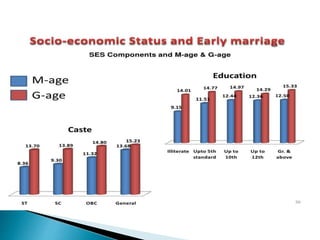
 To assess the socio- economic status (SES) and demographic
components of the respondents under study. To find out the
significant differences and impact SES components on age at
marriage (M-age) and age at Gauna (G-age) of the respondents
belonging to different SES.
To predict the psycho – social
consequences and overall life satisfaction in relation to age at
marriage (within different age group) of the respondents under
study. To predict the determinants of age at marriage (within
different age of the respondents under study.
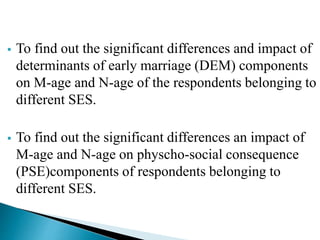
 To find out the significant differences and impact of
determinants of early marriage (DEM) components
on M-age and N-age of the respondents belonging to
different SES.
 To find out the significant differences an impact of
M-age and N-age on physcho-social consequence
(PSE)components of respondents belonging to
different SES.
 Present study was conducted on determinants of early
marriages and it’s psycho-social consequences. Further
study could be planned by taking different variables
like physical health, mental health, and reproductive
health, personal and marital adjustment.
A comparative
study of urban and rural setting could be planned by
taking wide samples. Intervention programmes can be
planned to rise awareness at micro, meso and exo level
for unmarried boys and girls and their parents.
Thank You

Child marriage

  • 1.
    Submitted to: S.P.UNIVERSITY V.V.NAGAR Name:Urvesh M Patel Roll no: 3357 College: AMCOST Exam no:
  • 2.
     Child Marriage:is one of the burning problems of Indian society. In India, despite amended amended laws advocating 18 as the legal minimum age at marriage for females, a substantial proportion i.e every third adolescent girl has given birth to a child. Report(2001)Rajasthan has the highest (40.8)% Bihar (39.6)% Madhya Pradesh (34.1)% Jarkhand (32.9)% and Andhra Pradesh (32.3)%. Bhilwara is at the top 61.9 Percent every third adolescent girl in the age in the group has given birth to a child.
  • 3.
     INTRODUCTION RATIONALE,OBJECTIVE AND HYPOTHESES METHODOLOGY RESULTSAND DISCUSSIONS SUGGESTIONS AND RECOMMENDATIONS
  • 4.
     Reflecting thecountry’ s diversity, few women(12%) marry before age 18 in goa Himachal Pradesh, while nearly 57 to 61 percent do so in Rajasthan, Jarkhand and Bihar. Differences by area of residence are also stark:28% in urban areas vs. 53% in rural areas Yet, there has been a slow trend towared delaying marriage: Nationally, the proporation of woman marrying before their 18th birthday declined by five percent from 1993 to 2006 (50%to45%).
  • 5.
     Prohibition ofchild Marriage Act,2006,: India defines marriage is a marriage of individuals before they attain the legal age i.e. 18 years for girls and 21 years for boys. UN’s Convention on the Rigths of Children define:the union of children or adolescents under the age of 18 as child marriage. IAC(2003) child marriage, also known as early marriage, is defined as “any marriage carried out below the age of 18 years.
  • 6.
     (UNICEF-2009) 47%OF India’s women aged 20-24 were married before 18, with 56% in rural areas and 40% of the world’s child marriages occur in India. (NGHS-3) 57.1% of women aged 20-24, married by the time they are 18 in Rajasthan. Median age at marriage among urban and rural women age 20- 49- 18.8 years and 16.4 years. According to Census 1981, 1991 and 2001, mean age at marriage for female in Bhilwara district is 14.5, 16.2 and 16.4 years respectively.
  • 7.
     Median ageat marriage among urban and rural women age 20-49-18.8 years and 16.4 years.  (RGI-2001) Rajasthan has the highest(40.8)% of females ever married among 15-19 year old girls as compared to India (24.9%) followed by Bihar (39.6%),mp(34.1%),Jarkhand(32.9%)and AP(32.3%). Among the various district of raj, bilwara is at the top with 61.9%.
  • 8.
     To assessthe socio- economic status (SES) and demographic components of the respondents under study. To find out the significant differences and impact SES components on age at marriage (M-age) and age at Gauna (G-age) of the respondents belonging to different SES. To predict the psycho – social consequences and overall life satisfaction in relation to age at marriage (within different age group) of the respondents under study. To predict the determinants of age at marriage (within different age of the respondents under study.
  • 9.
     To findout the significant differences and impact of determinants of early marriage (DEM) components on M-age and N-age of the respondents belonging to different SES.  To find out the significant differences an impact of M-age and N-age on physcho-social consequence (PSE)components of respondents belonging to different SES.
  • 11.
     Present studywas conducted on determinants of early marriages and it’s psycho-social consequences. Further study could be planned by taking different variables like physical health, mental health, and reproductive health, personal and marital adjustment. A comparative study of urban and rural setting could be planned by taking wide samples. Intervention programmes can be planned to rise awareness at micro, meso and exo level for unmarried boys and girls and their parents.
  • 12.