Presented by,
Nithya Krishnan,
2nd semester, MSW,
CUTN
 It is defined as a marriage of a girl or boy before the age of 18 and refers to both formal
marriages and informal unions in which children under the age of 18 live with a partner as if
married.
 One-third of girls around the world - brides before eighteen and one in nine – brides before
fifteen.
 Girls are deprived their fundamental rights to health, nutrition, education and freedom.
 In India, about 56 percent of girls get married before the age of eighteen. Every one out of two
married girl is under age.
 One in three of the world’s child brides live in India.
 Highest rate of child marriage -Uttar Pradesh, Bihar,West Bengal, Maharashtra and Madhya
Pradesh
 Over 40 per cent of young women were married before turning 18 in Bihar and West Bengal,
compared to less than 5 per cent in Lakshadweep.
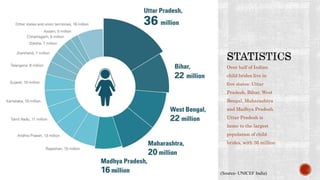
Over half of Indian
child brides live in
five states: Uttar
Pradesh, Bihar, West
Bengal, Maharashtra
and Madhya Pradesh.
Uttar Pradesh is
home to the largest
population of child
brides, with 36 million
(Source- UNICEF India)
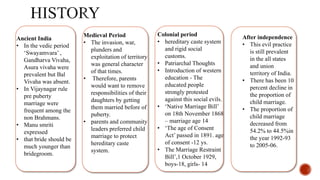
Ancient India
• In the vedic period
‘Swayamvara’ ,
Gandharva Vivaha,
Asura vivaha were
prevalent but Bal
Vivaha was absent.
• In Vijaynagar rule
pre puberty
marriage were
frequent among the
non Brahmans.
• Manu smriti
expressed
• that bride should be
much younger than
bridegroom.
Medieval Period
• The invasion, war,
plunders and
exploitation of territory
was general character
of that times.
• Therefore, parents
would want to remove
responsibilities of their
daughters by getting
them married before of
puberty.
• parents and community
leaders preferred child
marriage to protect
hereditary caste
system.
Colonial period
• hereditary caste system
and rigid social
customs.
• Patriarchal Thoughts
• Introduction of western
education - The
educated people
strongly protested
against this social evils.
• ‘Native Marriage Bill’
on 18th November 1868
– marriage age 14
• ‘The age of Consent
Act’ passed in 1891. age
of consent -12 ys.
• The Marriage Restraint
Bill’,1 October 1929,
boys-18, girls- 14
After independence
• This evil practice
is still prevalent
in the all states
and union
territory of India.
• There has been 10
percent decline in
the proportion of
child marriage.
• The proportion of
child marriage
decreased from
54.2% to 44.5%in
the year 1992-93
to 2005-06.
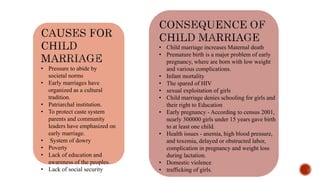
• Pressure to abide by
societal norms
• Early marriages have
organized as a cultural
tradition.
• Patriarchal institution.
• To protect caste system
parents and community
leaders have emphasized on
early marriage.
• System of dowry
• Poverty
• Lack of education and
awareness of the peoples.
• Lack of social security
• Child marriage increases Maternal death
• Premature birth is a major problem of early
pregnancy, where are born with low weight
and various complications.
• Infant mortality
• The spared of HIV
• sexual exploitation of girls
• Child marriage denies schooling for girls and
their right to Education
• Early pregnancy - According to census 2001,
nearly 300000 girls under 15 years gave birth
to at least one child.
• Health issues - anemia, high blood pressure,
and toxemia, delayed or obstructed labor,
complication in pregnancy and weight loss
during lactation.
• Domestic violence
• trafficking of girls.
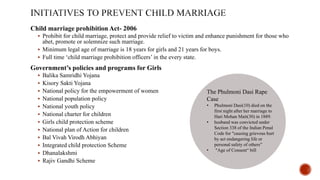
Child marriage prohibition Act- 2006
 Prohibit for child marriage, protect and provide relief to victim and enhance punishment for those who
abet, promote or solemnize such marriage.
 Minimum legal age of marriage is 18 years for girls and 21 years for boys.
 Full time ‘child marriage prohibition officers’ in the every state.
Government’s policies and programs for Girls
 Balika Samridhi Yojana
 Kisory Sakti Yojana
 National policy for the empowerment of women
 National population policy
 National youth policy
 National charter for children
 Girls child protection scheme
 National plan of Action for children
 Bal Vivah Virodh Abhiyan
 Integrated child protection Scheme
 Dhanalakshmi
 Rajiv Gandhi Scheme
The Phulmoni Dasi Rape
Case
• Phulmoni Dasi(10) died on the
first night after her marriage to
Hari Mohan Mait(30) in 1889.
• husband was convicted under
Section 338 of the Indian Penal
Code for "causing grievous hurt
by act endangering life or
personal safety of others”
• "Age of Consent“ bill
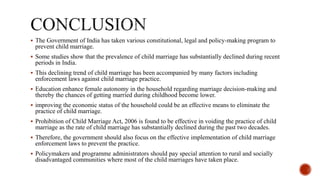
 The Government of India has taken various constitutional, legal and policy-making program to
prevent child marriage.
 Some studies show that the prevalence of child marriage has substantially declined during recent
periods in India.
 This declining trend of child marriage has been accompanied by many factors including
enforcement laws against child marriage practice.
 Education enhance female autonomy in the household regarding marriage decision-making and
thereby the chances of getting married during childhood become lower.
 improving the economic status of the household could be an effective means to eliminate the
practice of child marriage.
 Prohibition of Child Marriage Act, 2006 is found to be effective in voiding the practice of child
marriage as the rate of child marriage has substantially declined during the past two decades.
 Therefore, the government should also focus on the effective implementation of child marriage
enforcement laws to prevent the practice.
 Policymakers and programme administrators should pay special attention to rural and socially
disadvantaged communities where most of the child marriages have taken place.
 Nayan, M. (2015). Child marriage in India: Social maladies and government’s
initiatives. International Journal of Applied Research, 1(5), 72-80.
 Paul, P. (2020). Child marriage among girls in India: Prevalence, trends and socio-
economic correlates. Indian Journal of Human Development, 14(2), 304-319.
 From - UNICEF India- https://www.unicef.org/india/media/1176/file/Ending-Child-
Marriage.pdf

Child marriage

  • 1.
  • 2.
     It isdefined as a marriage of a girl or boy before the age of 18 and refers to both formal marriages and informal unions in which children under the age of 18 live with a partner as if married.  One-third of girls around the world - brides before eighteen and one in nine – brides before fifteen.  Girls are deprived their fundamental rights to health, nutrition, education and freedom.  In India, about 56 percent of girls get married before the age of eighteen. Every one out of two married girl is under age.  One in three of the world’s child brides live in India.  Highest rate of child marriage -Uttar Pradesh, Bihar,West Bengal, Maharashtra and Madhya Pradesh  Over 40 per cent of young women were married before turning 18 in Bihar and West Bengal, compared to less than 5 per cent in Lakshadweep.
  • 3.
    Over half ofIndian child brides live in five states: Uttar Pradesh, Bihar, West Bengal, Maharashtra and Madhya Pradesh. Uttar Pradesh is home to the largest population of child brides, with 36 million (Source- UNICEF India)
  • 4.
    Ancient India • Inthe vedic period ‘Swayamvara’ , Gandharva Vivaha, Asura vivaha were prevalent but Bal Vivaha was absent. • In Vijaynagar rule pre puberty marriage were frequent among the non Brahmans. • Manu smriti expressed • that bride should be much younger than bridegroom. Medieval Period • The invasion, war, plunders and exploitation of territory was general character of that times. • Therefore, parents would want to remove responsibilities of their daughters by getting them married before of puberty. • parents and community leaders preferred child marriage to protect hereditary caste system. Colonial period • hereditary caste system and rigid social customs. • Patriarchal Thoughts • Introduction of western education - The educated people strongly protested against this social evils. • ‘Native Marriage Bill’ on 18th November 1868 – marriage age 14 • ‘The age of Consent Act’ passed in 1891. age of consent -12 ys. • The Marriage Restraint Bill’,1 October 1929, boys-18, girls- 14 After independence • This evil practice is still prevalent in the all states and union territory of India. • There has been 10 percent decline in the proportion of child marriage. • The proportion of child marriage decreased from 54.2% to 44.5%in the year 1992-93 to 2005-06.
  • 5.
    • Pressure toabide by societal norms • Early marriages have organized as a cultural tradition. • Patriarchal institution. • To protect caste system parents and community leaders have emphasized on early marriage. • System of dowry • Poverty • Lack of education and awareness of the peoples. • Lack of social security • Child marriage increases Maternal death • Premature birth is a major problem of early pregnancy, where are born with low weight and various complications. • Infant mortality • The spared of HIV • sexual exploitation of girls • Child marriage denies schooling for girls and their right to Education • Early pregnancy - According to census 2001, nearly 300000 girls under 15 years gave birth to at least one child. • Health issues - anemia, high blood pressure, and toxemia, delayed or obstructed labor, complication in pregnancy and weight loss during lactation. • Domestic violence • trafficking of girls.
  • 6.
    Child marriage prohibitionAct- 2006  Prohibit for child marriage, protect and provide relief to victim and enhance punishment for those who abet, promote or solemnize such marriage.  Minimum legal age of marriage is 18 years for girls and 21 years for boys.  Full time ‘child marriage prohibition officers’ in the every state. Government’s policies and programs for Girls  Balika Samridhi Yojana  Kisory Sakti Yojana  National policy for the empowerment of women  National population policy  National youth policy  National charter for children  Girls child protection scheme  National plan of Action for children  Bal Vivah Virodh Abhiyan  Integrated child protection Scheme  Dhanalakshmi  Rajiv Gandhi Scheme The Phulmoni Dasi Rape Case • Phulmoni Dasi(10) died on the first night after her marriage to Hari Mohan Mait(30) in 1889. • husband was convicted under Section 338 of the Indian Penal Code for "causing grievous hurt by act endangering life or personal safety of others” • "Age of Consent“ bill
  • 7.
     The Governmentof India has taken various constitutional, legal and policy-making program to prevent child marriage.  Some studies show that the prevalence of child marriage has substantially declined during recent periods in India.  This declining trend of child marriage has been accompanied by many factors including enforcement laws against child marriage practice.  Education enhance female autonomy in the household regarding marriage decision-making and thereby the chances of getting married during childhood become lower.  improving the economic status of the household could be an effective means to eliminate the practice of child marriage.  Prohibition of Child Marriage Act, 2006 is found to be effective in voiding the practice of child marriage as the rate of child marriage has substantially declined during the past two decades.  Therefore, the government should also focus on the effective implementation of child marriage enforcement laws to prevent the practice.  Policymakers and programme administrators should pay special attention to rural and socially disadvantaged communities where most of the child marriages have taken place.
  • 8.
     Nayan, M.(2015). Child marriage in India: Social maladies and government’s initiatives. International Journal of Applied Research, 1(5), 72-80.  Paul, P. (2020). Child marriage among girls in India: Prevalence, trends and socio- economic correlates. Indian Journal of Human Development, 14(2), 304-319.  From - UNICEF India- https://www.unicef.org/india/media/1176/file/Ending-Child- Marriage.pdf