Dr. KAZIM ULLAH
RESIDENT RADIOLOGY
CMH ABBOTTABAD
CHEST ULTRASOUND
SEQUENCE
 Introduction
 Sonographic Anatomy
 Instrumentation
 Technique
 Pathologies
 Limitations
 Take home points
INTRODUCTION
 The portable chest ultrasound is a routine diagnostic tool used in
the ICU setting to assess patient lung function
 Chest ultrasound is useful only for assessing superficial pulmonary,
pleural-based and chest wall lesions
 Chest ultrasound is increasingly used to guide interventional
procedures of the chest, such as biopsy and placement of
intercostal chest drain
Chest ultrasound necessitates the understanding of some basic
signs for interpreting normal and abnormal lung conditions.
SONOGRAPHIC ANATOMY
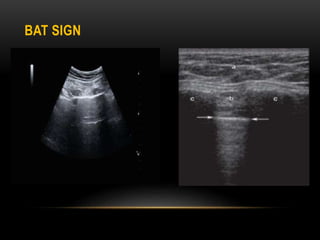
BAT SIGN
A LINES
LUNG SLIDING
SEASHORE SIGN(M-MODE)
B LINES
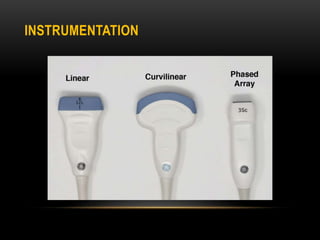
INSTRUMENTATION
TECHNIQUE
SCANNING POSITIONS
SCANNING POSITIONS
PATHOLOGIES
PLEURAL EFFUSION
 The classic appearance of a pleural effusion is an echo free area
between the visceral and parietal portions of the pleura
 Four different appearances are recognized at ultrasound
1. Anechoic 3. Complex and septated
2. Complex but not septated 4. Echogenic
PLEURAL EFFUSION
PLEURAL THICKENING
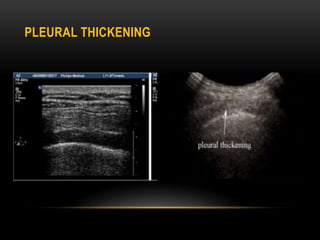
 Pleural thickening appears as hypoechoic broadening of the pleura
 Pleural thickening most frequently related to scarring, fibrosis,
empyema and pleuritis
PLEURAL THICKENING
PLEURAL MASS
 Malignant masses of the pleura include mesothelioma, lymphoma
and metastases
 Mesothelioma is seen as irregular thickening of the pleura that may
appear nodular and is frequently associated with a large pleural
effusion
 Color Doppler ultrasound of a malignant pleural mass may reveal
neovascularity with irregular tortuous vessels
MESOTHELIOMA
PNEUMOTHORAX
 Use of a combination of absent lung sliding and the loss of comet
tail artifacts has a sensitivity of 100% and specificity of 96.5%
 The key sonographic signs used to diagnose pneumothorax
include
 Absent lung sliding
 Exaggerated horizontal artifacts/A lines
 Loss of comet tail artifacts/B lines
 Broadening of the pleural line to a band
DIAGNOSTIC ALGORITHM OF PNEUMOTHORAX
LUNG POINT SIGN
 The most specific finding of pneumothorax at ultrasound is the lung
point sign
 The lung point sign represents the boundary between the aerated
lung and pneumothorax
LUNG POINT SIGN
LUNG POINT SIGN
BAR CODE SIGN
 At M mode ultrasound , the area underneath soft tissue-
pneumothorax interface demonstrates multiple horizontal bands of
hyperechoic artifacts caused by the lack of visible lung motion
 This M-mode appearance mimics bar code or stratosphere sign
BAR CODE SIGN
M-MODE
DISEASES OF THE LUNG PARENCHYMA
 In healthy individuals, visualization of the lung parenchyma is not
possible because the large difference in acoustic impedance
between the chest wall and the air with in the lung results in near
total reflection of the ultrasound waves
 However, in parenchymal diseases that extend to the pleural
surface, replacement of air with in the lung creates an acoustic
window, allowing assessment of lung tissue
PNEUMONIA
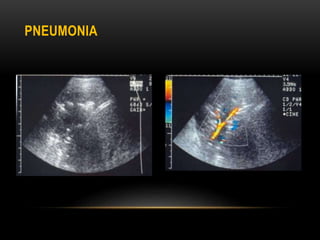
 Consolidation can be visualized on ultrasound
 Appears as hypoechoic area with irregular margins
 Branching echogenic structures are often seen within the
consolidation and represent air bronchograms
 Air bronchogram may be seen as hyperechoic foci moving through
the bronchi(dynamic air bronchogram)within the consolidation
 The branching pattern of vascular flow with in the consolidated
lung segment can be observed by using color Doppler
PNEUMONIA
LUNG ABSCESS
 A lung abscess can be identified as a hypoechoic lesion with a well
defined or irregular wall
 The center of the abscess is usually anechoic but may contain
internal echoes and septations
LUNG ABSCESS
ALVEOLAR-INTERSTITIAL SYNDROME
 Abnormally increased lung water content and reduced air in the
alveoli result in fluid leakage into the pulmonary interstitium and
alveolar spaces
 Patient with interstitial disease have an increased number of
vertical, comet tail artifacts called B lines
PULMONARY EDEMA
 Pulmonary edema is the most common cause of acute alveolar
interstitial syndrome
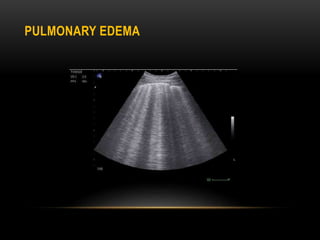
 In pulmonary edema, multiple B lines are seen having diffuse
distribution
 At least 3 lines with curvilinear and 6 lines with linear transducer
are considered multiple and consistent with pathologic B lines
PULMONARY EDEMA
COPD AND ASTHMA
 Multiple B lines at ultrasound are suggestive of alveolar interstitial
syndrome, which can be used to rule out acute COPD exacerbation
 In general, the ultrasound appearance of the lungs and pleura in
asthmatic and COPD patients demonstrates multiple A lines with
normal lung sliding
PULMONARY MASS
 PRIMARY LUNG NEOPLASMS
 Appears as a homogenous, well defined mass that is usually
hypoechoic, but may be slightly echogenic
 There is usually posterior acoustic enhancement
 Color Doppler ultrasound is useful in distinguishing malignant
from benign pulmonary masses
 Malignant masses are associated with neovascularity
LUNG CANCER
METASTATIC
 Peripheral pulmonary metastasis may be detected at sonography,
appearing as multiple sub pleural echogenic nodule measuring 1–2
cm in diameter
 Color Doppler demonstrates the high vascularity of these lesions
METASTATIC LUNG TUMOR
DISEASES OF THE CHEST WALL
 Soft tissue disease
 Ultrasound is sensitive for the detection of soft tissue masses
arising within the chest wall. most of these are benign, such as
lipoma, sebaceous cyst, hematoma and abscess
 Lymph nodes, particularly within the axilla and supraclavicular
fossa are easily examined with ultrasound
LIMITATIONS
 Although the role of chest ultrasound has been well recognized in
evaluation of pleural effusion, pneumothorax, pulmonary edema,
and guidance for thoracentesis or biopsy, the value of ultrasound in
evaluation of the lung remains limited
 Several lung sign at ultrasound are artifacts
 Artifacts are affected by machine factors such as focal zone,
frequency and gain setting
LEARNING OBJECTIVES
TAKE HOME POINTS
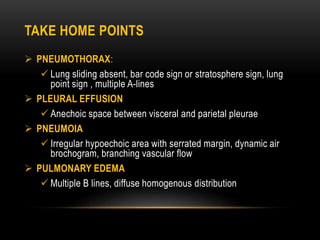
 PNEUMOTHORAX:
 Lung sliding absent, bar code sign or stratosphere sign, lung
point sign , multiple A-lines
 PLEURAL EFFUSION
 Anechoic space between visceral and parietal pleurae
 PNEUMOIA
 Irregular hypoechoic area with serrated margin, dynamic air
brochogram, branching vascular flow
 PULMONARY EDEMA
 Multiple B lines, diffuse homogenous distribution
QUIZ
THANK YOU
INGUNISCROTAL ULTRASOUND BY DR FAZAL
NEXT PRESENTATION

Chest ultrasound.pptx

  • 1.
    Dr. KAZIM ULLAH RESIDENTRADIOLOGY CMH ABBOTTABAD CHEST ULTRASOUND
  • 2.
    SEQUENCE  Introduction  SonographicAnatomy  Instrumentation  Technique  Pathologies  Limitations  Take home points
  • 3.
    INTRODUCTION  The portablechest ultrasound is a routine diagnostic tool used in the ICU setting to assess patient lung function  Chest ultrasound is useful only for assessing superficial pulmonary, pleural-based and chest wall lesions  Chest ultrasound is increasingly used to guide interventional procedures of the chest, such as biopsy and placement of intercostal chest drain
  • 4.
    Chest ultrasound necessitatesthe understanding of some basic signs for interpreting normal and abnormal lung conditions. SONOGRAPHIC ANATOMY
  • 5.
  • 6.
  • 7.
  • 8.
  • 9.
  • 10.
  • 11.
  • 12.
  • 13.
  • 14.
  • 15.
    PLEURAL EFFUSION  Theclassic appearance of a pleural effusion is an echo free area between the visceral and parietal portions of the pleura  Four different appearances are recognized at ultrasound 1. Anechoic 3. Complex and septated 2. Complex but not septated 4. Echogenic
  • 16.
  • 17.
    PLEURAL THICKENING  Pleuralthickening appears as hypoechoic broadening of the pleura  Pleural thickening most frequently related to scarring, fibrosis, empyema and pleuritis
  • 18.
  • 19.
    PLEURAL MASS  Malignantmasses of the pleura include mesothelioma, lymphoma and metastases  Mesothelioma is seen as irregular thickening of the pleura that may appear nodular and is frequently associated with a large pleural effusion  Color Doppler ultrasound of a malignant pleural mass may reveal neovascularity with irregular tortuous vessels
  • 20.
  • 21.
    PNEUMOTHORAX  Use ofa combination of absent lung sliding and the loss of comet tail artifacts has a sensitivity of 100% and specificity of 96.5%  The key sonographic signs used to diagnose pneumothorax include  Absent lung sliding  Exaggerated horizontal artifacts/A lines  Loss of comet tail artifacts/B lines  Broadening of the pleural line to a band
  • 22.
  • 23.
    LUNG POINT SIGN The most specific finding of pneumothorax at ultrasound is the lung point sign  The lung point sign represents the boundary between the aerated lung and pneumothorax
  • 24.
  • 25.
  • 26.
    BAR CODE SIGN At M mode ultrasound , the area underneath soft tissue- pneumothorax interface demonstrates multiple horizontal bands of hyperechoic artifacts caused by the lack of visible lung motion  This M-mode appearance mimics bar code or stratosphere sign
  • 27.
  • 28.
  • 29.
    DISEASES OF THELUNG PARENCHYMA  In healthy individuals, visualization of the lung parenchyma is not possible because the large difference in acoustic impedance between the chest wall and the air with in the lung results in near total reflection of the ultrasound waves  However, in parenchymal diseases that extend to the pleural surface, replacement of air with in the lung creates an acoustic window, allowing assessment of lung tissue
  • 30.
    PNEUMONIA  Consolidation canbe visualized on ultrasound  Appears as hypoechoic area with irregular margins  Branching echogenic structures are often seen within the consolidation and represent air bronchograms  Air bronchogram may be seen as hyperechoic foci moving through the bronchi(dynamic air bronchogram)within the consolidation  The branching pattern of vascular flow with in the consolidated lung segment can be observed by using color Doppler
  • 31.
  • 32.
    LUNG ABSCESS  Alung abscess can be identified as a hypoechoic lesion with a well defined or irregular wall  The center of the abscess is usually anechoic but may contain internal echoes and septations
  • 33.
  • 34.
    ALVEOLAR-INTERSTITIAL SYNDROME  Abnormallyincreased lung water content and reduced air in the alveoli result in fluid leakage into the pulmonary interstitium and alveolar spaces  Patient with interstitial disease have an increased number of vertical, comet tail artifacts called B lines
  • 35.
    PULMONARY EDEMA  Pulmonaryedema is the most common cause of acute alveolar interstitial syndrome  In pulmonary edema, multiple B lines are seen having diffuse distribution  At least 3 lines with curvilinear and 6 lines with linear transducer are considered multiple and consistent with pathologic B lines
  • 36.
  • 37.
    COPD AND ASTHMA Multiple B lines at ultrasound are suggestive of alveolar interstitial syndrome, which can be used to rule out acute COPD exacerbation  In general, the ultrasound appearance of the lungs and pleura in asthmatic and COPD patients demonstrates multiple A lines with normal lung sliding
  • 38.
    PULMONARY MASS  PRIMARYLUNG NEOPLASMS  Appears as a homogenous, well defined mass that is usually hypoechoic, but may be slightly echogenic  There is usually posterior acoustic enhancement  Color Doppler ultrasound is useful in distinguishing malignant from benign pulmonary masses  Malignant masses are associated with neovascularity
  • 39.
  • 40.
    METASTATIC  Peripheral pulmonarymetastasis may be detected at sonography, appearing as multiple sub pleural echogenic nodule measuring 1–2 cm in diameter  Color Doppler demonstrates the high vascularity of these lesions
  • 41.
  • 42.
    DISEASES OF THECHEST WALL  Soft tissue disease  Ultrasound is sensitive for the detection of soft tissue masses arising within the chest wall. most of these are benign, such as lipoma, sebaceous cyst, hematoma and abscess  Lymph nodes, particularly within the axilla and supraclavicular fossa are easily examined with ultrasound
  • 43.
    LIMITATIONS  Although therole of chest ultrasound has been well recognized in evaluation of pleural effusion, pneumothorax, pulmonary edema, and guidance for thoracentesis or biopsy, the value of ultrasound in evaluation of the lung remains limited  Several lung sign at ultrasound are artifacts  Artifacts are affected by machine factors such as focal zone, frequency and gain setting
  • 44.
  • 45.
    TAKE HOME POINTS PNEUMOTHORAX:  Lung sliding absent, bar code sign or stratosphere sign, lung point sign , multiple A-lines  PLEURAL EFFUSION  Anechoic space between visceral and parietal pleurae  PNEUMOIA  Irregular hypoechoic area with serrated margin, dynamic air brochogram, branching vascular flow  PULMONARY EDEMA  Multiple B lines, diffuse homogenous distribution
  • 46.
  • 49.
  • 50.
    INGUNISCROTAL ULTRASOUND BYDR FAZAL NEXT PRESENTATION

Editor's Notes

  • #4 Xxxx Ultrasound cannot penetrate into the substance of aerated lung, it is not a primary modality in evaluating the lung However analysis of lung motion and the pattern of artifacts arising from the lung can help to investigate parenchymal lung disease
  • #6 Normal chest US shows bat sign…when the probe is placed in the sagittal and longitudinal plane on the the chest in between the ribs…bat sign is produce here the cortices and posterior acoustic shadowing of the ribs are the wings, the hyperechoic pleural line is the belly….showing bat sign In the other image a. Subcutaneous fat , b. muscle, c.ribs , between the arrows is the pleural line
  • #7 Normal chest usg shows multiple A lines A lines are multiple horizontal, hyperechoic, reverbration artifacts originating from the pleural line repeating at regular interval indicating air A lines are Seen in normal lung and pneumothorax Formation : air is not a good transducer of sound waves,so sound scatter at the air/pleura interface….some waves reverberate in the interface then back to the probe creating equidistant,parallel bright white arcs called A lines
  • #8 Lung Sliding/Gliding sign : In a normal lung pleural line will slide back and forth the visceral pleura and underlying aerated lung can be seen sliding along the parietal pleura due to respiratory motion………. Video… A lines and posterior acoustic shadowing of ribs
  • #9 If we are unable to see the lung sliding,machine can do this for us. M mode is the way the machine see things that are moving Here are M mode usg images through normal lung giving the appearance of a sea above a sandy shore…sea shore sign Horizontal means static, granny means motion xxxx….Here are two different distinct pattern created by the motion of lung pleura against the relatively more static chest wall
  • #10 In some normal lungs there are a limited no of comet tail artifacts arising from the lung surface known as B lines Lung ultrasound images showing B lines(arrow heads) and pleural line B lines are vertical, hyperechoic, comet tail artifacts that erase A lines More than 3 on curvillinear and 6 on linear probe are multiple b lines Multiple diffuse B lines = abnormal lung Seen when fluid replaces air Formation: as ultrasound waves alternate between air and fluid in the interstitial space ,b lines are formed
  • #11 High frequency linear probe is ideal for imaging superficial structures like pleura or for identifying lung slinding Low frequency curvillinear probe is useful in the assessment of effusion,consolidation and diaphragm A phased array transducer probe is useful because the footprint can be placed easily in the intercostal space
  • #12 The lung ultrasound examination consists of 12 imaging zones, 6 on each side of thorax. The upper and basal part of each hemithorax is divided into anterior, lateral and posterior by the anterior and posterior axillary lines.
  • #13 Ant and post lung zones are examined in supine and sitting positions respectively Supine and sitting for 1 and 3/ant and post zones respectively
  • #14 The lateral zone can be examined in Supine or lateral position
  • #16 Transudates are almost invariably anechoic Exudates may appear anechoic, complex or echogenic we do usg in Coronal/side and longitudinal view above diaphragm
  • #17 Usg images showing pleural effusion Minimal right sided pleural effuion on right sided image Large volume anechoic effusion visualized superior to diaphragm and spleen on left sided image
  • #18 xxxxxx Unlike pleural effusion the pleural thickening does not exhibit the fluid color sign on color doppler
  • #19 Usg image showing pleural thickening as a hypo echoic band just superficial to the echogenic pleural lung interface Usg image showing A hypo /anechoic area causes doubling of the pleural line on right side
  • #20 Pleural masses are generally visualized sonographically… they May be benign or malignant Benign pleural masses such as fibroma, lipoma and neuroma are uncommon xxx….These appear as well defined rounded masses of variable echogenicity, depending on the fat content of the cells A biopsy is usually required to reach definitive diagnosis last….The most common pleural metastases are from primary adenocarcinoma
  • #21 Ultrasound image showing an irregular pleural mass and pleural fluid ……..xxxxxx representing mesothelioma
  • #22 Bedside sonography is useful for excluding pneumothorax
  • #24 Lung point is the tranzition zone between where normal lung is sliding and where the pneumothorax is not sliding
  • #26 M mode USG image showing lung point sign which is the transition zone between normal lung and pneumothorax
  • #28 M mode ultrasound image showing bar code sign/air artifacts…. multiple horizontal bands of hyperechoic artifacts caused by the lack of visible lung motion
  • #29 M mode USG images A…seashore sign B…Bar code sign C… Lung point sign
  • #31 Consolidation resembles the sonographic texture of the liver in pneumonia we lose A lines In ateletasis the air bronchogram is usually static
  • #32 USG image showing an area of consolidation with in the right lower lobe .the texture of the consolidated lung appear isoechoic to the liver. multiple echogenic foci are seen within the consolidated lung and correspond to air filled airways On the color doppler scan, a pulmonary artery branch supplying the segment is clearly seen in pneumonia we lose a lines
  • #33 Pneumonia resulting from pyogenic organisms can undergo necrosis leading to lung abscess
  • #34 Ultrasound image showing a rounded hypoechoic lesion within a left basal consolidation
  • #35 B lines are due to reverberation artifact secondary to reflection of sound waves at the interlobular septa
  • #36 ARDS is another example in which multiple b lines are distributed inhomgeously
  • #37 Chest ultrasound image showing multiple B lines arising from the pleural line and erasing the A lines representig pulmonary edema
  • #39 The primary role of usg in pulmonary mass is to provide guidence for needle biopy Pulmonary masses can be visualized when there is no aerated lung between the mass and transducer xxx…Consolidation and fluid bronchograms may be seen adjacent to the mass Last….Ultrasound is a valuable tool in the assessment of pancoast or superior sulcus tumors
  • #40 Usg image showing hypoechoic mass,slight inhomogenous with irregular surface but sharp delimited from ventilated lung…lung cancer Color doppler usg of lung cancer showing vascularity without normal radial distribution of vessels and bronchi(destruction of normal lung structure)
  • #42 Peripherally located metastatic lung tumor Ultrasound guided biopsy proved this to be a metastasis of a renal cell carcinoma
  • #48 Right….multiple horizontal bands of hyperechoic artifacts caused by the lack of visible lung motion….pneumothorax appearance of a sea above a sandy shore…horizontal…static…granny …motion….normal lung
  • #49 ultrasound image showing multiple B lines arising from the pleural line and erasing the A lines representig pulmonary edema