Dr.Bharat Kalidindi
Dr.Sharad Koirala
Mr.Ziyaulhaq
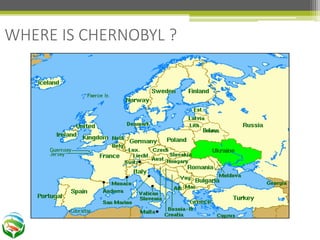
WHERE IS CHERNOBYL ?
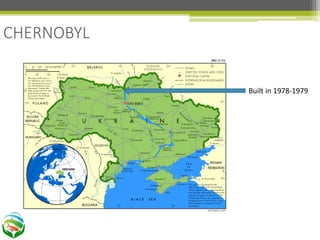
CHERNOBYL
Built in 1978-1979
• The Chernobyl accident in 1986 was the result of a flawed
reactor design that was operated with inadequately trained
personnel.
• The resulting steam explosion and fires released at least 5%
of the radioactive reactor core into the atmosphere and
downwind – some 5200 PBq (I-131 eq).
• Two Chernobyl plant workers died on the night of the
accident, and a further 28 people died within a few weeks
as a result of acute radiation poisoning.
FACTS
• UNSCEAR says that apart from increased thyroid cancers,
"there is no evidence of a major public health impact
attributable to radiation exposure 20 years after the
accident.“
• Resettlement of areas from which people were relocated is
ongoing. In 2011 Chernobyl was officially declared a tourist
attraction
FACTS
1. As the reaction occurs, the uranium fuel becomes hot
2. The water pumped through the core in pressure tubes
removes the heat from the fuel
3. The water is then boiled into steam
4. The steam turns the turbines
5. The water is then cooled
6. Then the process repeats
REACTOR PLANT SCENARIO
• The Chernobyl Power Complex, lying about 130 km north
of Kiev, Ukraine, and about 20 km south of the border with
Belarus
• Consisted of four nuclear reactors of the RBMK-1000
design.
• Units 1 and 2 being constructed between 1970 and 1977,
while units 3 and 4 of the same design were completed in
1983.
CHERNOBYL PLANT
• Two more RBMK reactors were under construction at the
site at the time of the accident.
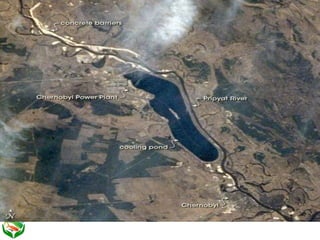
• To the southeast of the plant, an artificial lake of some 22
square kilometres, situated beside the river Pripyat, was
constructed to provide cooling water for the reactors.
CHERNOBYL PLANT
• This area of Ukraine is described as Belarussian-type
woodland with a low population density.
• About 3 km away from the reactor, in the new city, Pripyat,
there were 49,000 inhabitants.
• The old town of Chornobyl, which had a population of
12,500, is about 15 km to the southeast of the complex.
• Within a 30 km radius of the power plant, the total
population was between 115,000 and 135,000.
CHERNOBYL SITE
• On 25 April, prior to a routine shutdown, the reactor crew
at Chernobyl 4 began preparing for a test to determine
how long turbines would spin and supply power to the
main circulating pumps following a loss of main electrical
power supply.
• This test had been carried out at Chernobyl the previous
year, but the power from the turbine ran down too rapidly,
so new voltage regulator designs were to be tested.
THE 1986 CHERNOBYL ACCIDENT
• A series of operator actions, including the disabling of
automatic shutdown mechanisms, preceded the
attempted test early on 26 April.
• By the time that the operator moved to shut down the
reactor, the reactor was in an extremely unstable
condition.
• A peculiarity of the design of the control rods caused a
dramatic power surge as they were inserted into the
reactor
• The interaction of very hot fuel with the cooling water led
to fuel fragmentation along with rapid steam production
and an increase in pressure.
• The design characteristics of the reactor were such that
substantial damage to even three or four fuel assemblies
can – and did – result in the destruction of the reactor.
• The overpressure caused the 1000 t cover plate of the
reactor to become partially detached, rupturing the fuel
channels and jamming all the control rods, which by that
time were only halfway down.
• Intense steam generation then spread throughout the
whole core (fed by water dumped into the core due to the
rupture of the emergency cooling circuit) causing a steam
explosion and releasing fission products to the
atmosphere.
• About two to three seconds later, a second explosion threw
out fragments from the fuel channels and hot graphite.
There is some dispute among experts about the character
of this second explosion, but it is likely to have been caused
by the production of hydrogen from zirconium-steam
reactions.
• Two workers died as a result of these explosions.
• The graphite (about a quarter of the 1200 tonnes of it was
estimated to have been ejected) and fuel became
incandescent and started a number of fires, causing the
main release of radioactivity into the environment.
• A total of about 14 EBq (14 x 1018 Bq) of radioactivity was
released, over half of it being from biologically-inert noble
gases.
• About 200-300 tonnes of water per hour was injected into
the intact half of the reactor using the auxiliary feed water
pumps but this was stopped after half a day owing to the
danger of it flowing into and flooding units 1 and 2.
• From the second to tenth day after the accident, some
5000 tonnes of boron, dolomite, sand, clay and lead were
dropped on to the burning core by helicopter in an effort to
extinguish the blaze and limit the release of radioactive
particles.
• The accident caused the largest uncontrolled radioactive
release into the environment ever recorded for any civilian
operation, and large quantities of radioactive substances
were released into the air for about 10 days.
• This caused serious social and economic disruption for
large populations in Belarus, Russia and Ukraine.
• Two radionuclides, the short-lived iodine-131 and the long-
lived caesium-137, were particularly significant for the
radiation dose they delivered to members of the public.
IMMEDIATE IMPACT OF THE CHERNOBYL
ACCIDENT
• It is estimated that all of the xenon gas, about half of the
iodine and caesium, and at least 5% of the remaining
radioactive material in the Chernobyl 4 reactor core
(which had 192 tonnes of fuel) was released in the
accident.
• Most of the released material was deposited close by as
dust and debris, but the lighter material was carried by
wind over Ukraine, Belarus, Russia and to some extent
over Scandinavia and Europe.
• The casualties included firefighters who attended the initial
fires on the roof of the turbine building.
• All these were put out in a few hours, but radiation doses
on the first day were estimated to range up to 20,000
millisieverts (mSv), causing 28 deaths – six of which were
firemen – by the end of July 1986.
• The next task was cleaning up the radioactivity at the site
so that the remaining three reactors could be restarted,
and the damaged reactor shielded more permanently.
• About 200,000 people ('liquidators') from all over the
Soviet Union were involved in the recovery and clean-up
during 1986 and 1987.
• They received high doses of radiation, averaging around
100 millisieverts.
• Some 20,000 of them received about 250 mSv and a few
received 500 mSv.
• Later, the number of liquidators swelled to over 600,000
but most of these received only low radiation doses.
• The highest doses were received by about 1000
emergency workers and on-site personnel during the first
day of the accident.
• Initial radiation exposure in contaminated areas was due
to short-lived iodine-131; later caesium-137 was the main
hazard. (Half lives of 8 days and 30 years, respectively.)
• About five million people lived in areas of Belarus, Russia
and Ukraine contaminated (above 37 kBq/m2 Cs-137 in
soil) and about 400,000 lived in more contaminated areas
of strict control by authorities (above 555 kBq/m2 Cs-137).
• The plant operators' town of Pripyat was evacuated on 27
April (45,000 residents).
• By 14 May, some 116,000 people that had been living
within a 30-kilometre radius had been evacuated and
later relocated.
• About 1000 of these returned unofficially to live within
the contaminated zone.
• Most of those evacuated received radiation doses of less
than 50 mSv, although a few received 100 mSv or more
• In the years following the accident, a further 220,000
people were resettled into less contaminated areas, and
the initial 30 km radius exclusion zone (2800 km2) was
modified and extended to cover 4300 square kilometres.
• Several organisations have reported on the impacts of the
Chernobyl accident, but all have had problems assessing
the significance of their observations because of the lack of
reliable public health information before 1986.
• About 4000 cases of thyroid cancer had been diagnosed in
exposed children.
• UNSCEAR 2000 – “apart from this [thyroid cancer] increase,
there is no evidence of a major public health impact
attributable to radiation exposure 14 years after the
accident”.
ENVIRONMENTAL AND HEALTH EFFECTS OF
THE CHERNOBYL ACCIDENT
• no scientific evidence of increases in overall cancer
incidence or mortality or in non-malignant disorders
that could be related to radiation exposure.
• (UNSCEAR) says that "the great majority of the
population is not likely to experience serious health
consequences as a result of radiation from the
Chernobyl accident.
• Psycho-social effects among those affected by the
accident are similar to those arising from other
major disasters such as earthquakes, floods and
fires.
• some physicians in Europe advised pregnant women
to undergo abortions on account of radiation
exposure, even though the levels concerned were
vastly below those likely to have teratogenic effects.
• Sarcophagus encases the damaged nuclear reactor and
was designed to halt the release of further radiation into
the atmosphere.
• November 1986 the sarcophagus containing the reactor
was completed using more than 7,000 tonnes of steel
and 410,000m3 of concrete.
• The sarcophagus was designed with a lifetime of only 20
to 30 years in mind.
SARCOPHAGUS
• In the last two decades there has been some
resettlement of the areas evacuated in 1986 and
subsequently. Recently the main resettlement project
has been in Belarus.
• In July 2010, the Belarus government announced that it
had decided to settle back thousands of people in the
'contaminated areas' covered by the Chernobyl fallout,
RESETTLEMENT OF CONTAMINATED AREAS
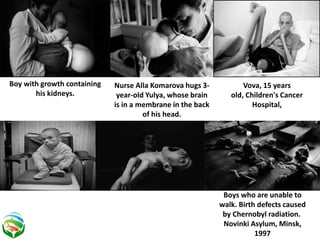
Boy with growth containing
his kidneys.
Nurse Alla Komarova hugs 3-
year-old Yulya, whose brain
is in a membrane in the back
of his head.
Vova, 15 years
old, Children's Cancer
Hospital,
Boys who are unable to
walk. Birth defects caused
by Chernobyl radiation.
Novinki Asylum, Minsk,
1997
• www.world-nuclear.org
• www.greenfacts.org
• www.nrc.gov
• news.bbc.co.uk
• www.britannica.com
• chernobyl.info/en-US
• www.livescience.com
• www.theguardian.com/environment
• www.un.org
REFERENCES
THANK YOU

Chernobyl disaster

  • 1.
  • 2.
  • 3.
  • 5.
    • The Chernobylaccident in 1986 was the result of a flawed reactor design that was operated with inadequately trained personnel. • The resulting steam explosion and fires released at least 5% of the radioactive reactor core into the atmosphere and downwind – some 5200 PBq (I-131 eq). • Two Chernobyl plant workers died on the night of the accident, and a further 28 people died within a few weeks as a result of acute radiation poisoning. FACTS
  • 6.
    • UNSCEAR saysthat apart from increased thyroid cancers, "there is no evidence of a major public health impact attributable to radiation exposure 20 years after the accident.“ • Resettlement of areas from which people were relocated is ongoing. In 2011 Chernobyl was officially declared a tourist attraction FACTS
  • 7.
    1. As thereaction occurs, the uranium fuel becomes hot 2. The water pumped through the core in pressure tubes removes the heat from the fuel 3. The water is then boiled into steam 4. The steam turns the turbines 5. The water is then cooled 6. Then the process repeats REACTOR PLANT SCENARIO
  • 8.
    • The ChernobylPower Complex, lying about 130 km north of Kiev, Ukraine, and about 20 km south of the border with Belarus • Consisted of four nuclear reactors of the RBMK-1000 design. • Units 1 and 2 being constructed between 1970 and 1977, while units 3 and 4 of the same design were completed in 1983. CHERNOBYL PLANT
  • 9.
    • Two moreRBMK reactors were under construction at the site at the time of the accident. • To the southeast of the plant, an artificial lake of some 22 square kilometres, situated beside the river Pripyat, was constructed to provide cooling water for the reactors. CHERNOBYL PLANT
  • 10.
    • This areaof Ukraine is described as Belarussian-type woodland with a low population density. • About 3 km away from the reactor, in the new city, Pripyat, there were 49,000 inhabitants. • The old town of Chornobyl, which had a population of 12,500, is about 15 km to the southeast of the complex. • Within a 30 km radius of the power plant, the total population was between 115,000 and 135,000. CHERNOBYL SITE
  • 11.
    • On 25April, prior to a routine shutdown, the reactor crew at Chernobyl 4 began preparing for a test to determine how long turbines would spin and supply power to the main circulating pumps following a loss of main electrical power supply. • This test had been carried out at Chernobyl the previous year, but the power from the turbine ran down too rapidly, so new voltage regulator designs were to be tested. THE 1986 CHERNOBYL ACCIDENT
  • 12.
    • A seriesof operator actions, including the disabling of automatic shutdown mechanisms, preceded the attempted test early on 26 April. • By the time that the operator moved to shut down the reactor, the reactor was in an extremely unstable condition. • A peculiarity of the design of the control rods caused a dramatic power surge as they were inserted into the reactor
  • 13.
    • The interactionof very hot fuel with the cooling water led to fuel fragmentation along with rapid steam production and an increase in pressure. • The design characteristics of the reactor were such that substantial damage to even three or four fuel assemblies can – and did – result in the destruction of the reactor. • The overpressure caused the 1000 t cover plate of the reactor to become partially detached, rupturing the fuel channels and jamming all the control rods, which by that time were only halfway down.
  • 14.
    • Intense steamgeneration then spread throughout the whole core (fed by water dumped into the core due to the rupture of the emergency cooling circuit) causing a steam explosion and releasing fission products to the atmosphere. • About two to three seconds later, a second explosion threw out fragments from the fuel channels and hot graphite. There is some dispute among experts about the character of this second explosion, but it is likely to have been caused by the production of hydrogen from zirconium-steam reactions.
  • 15.
    • Two workersdied as a result of these explosions. • The graphite (about a quarter of the 1200 tonnes of it was estimated to have been ejected) and fuel became incandescent and started a number of fires, causing the main release of radioactivity into the environment. • A total of about 14 EBq (14 x 1018 Bq) of radioactivity was released, over half of it being from biologically-inert noble gases.
  • 16.
    • About 200-300tonnes of water per hour was injected into the intact half of the reactor using the auxiliary feed water pumps but this was stopped after half a day owing to the danger of it flowing into and flooding units 1 and 2. • From the second to tenth day after the accident, some 5000 tonnes of boron, dolomite, sand, clay and lead were dropped on to the burning core by helicopter in an effort to extinguish the blaze and limit the release of radioactive particles.
  • 17.
    • The accidentcaused the largest uncontrolled radioactive release into the environment ever recorded for any civilian operation, and large quantities of radioactive substances were released into the air for about 10 days. • This caused serious social and economic disruption for large populations in Belarus, Russia and Ukraine. • Two radionuclides, the short-lived iodine-131 and the long- lived caesium-137, were particularly significant for the radiation dose they delivered to members of the public. IMMEDIATE IMPACT OF THE CHERNOBYL ACCIDENT
  • 18.
    • It isestimated that all of the xenon gas, about half of the iodine and caesium, and at least 5% of the remaining radioactive material in the Chernobyl 4 reactor core (which had 192 tonnes of fuel) was released in the accident. • Most of the released material was deposited close by as dust and debris, but the lighter material was carried by wind over Ukraine, Belarus, Russia and to some extent over Scandinavia and Europe.
  • 19.
    • The casualtiesincluded firefighters who attended the initial fires on the roof of the turbine building. • All these were put out in a few hours, but radiation doses on the first day were estimated to range up to 20,000 millisieverts (mSv), causing 28 deaths – six of which were firemen – by the end of July 1986.
  • 20.
    • The nexttask was cleaning up the radioactivity at the site so that the remaining three reactors could be restarted, and the damaged reactor shielded more permanently. • About 200,000 people ('liquidators') from all over the Soviet Union were involved in the recovery and clean-up during 1986 and 1987. • They received high doses of radiation, averaging around 100 millisieverts.
  • 21.
    • Some 20,000of them received about 250 mSv and a few received 500 mSv. • Later, the number of liquidators swelled to over 600,000 but most of these received only low radiation doses. • The highest doses were received by about 1000 emergency workers and on-site personnel during the first day of the accident.
  • 22.
    • Initial radiationexposure in contaminated areas was due to short-lived iodine-131; later caesium-137 was the main hazard. (Half lives of 8 days and 30 years, respectively.) • About five million people lived in areas of Belarus, Russia and Ukraine contaminated (above 37 kBq/m2 Cs-137 in soil) and about 400,000 lived in more contaminated areas of strict control by authorities (above 555 kBq/m2 Cs-137).
  • 23.
    • The plantoperators' town of Pripyat was evacuated on 27 April (45,000 residents). • By 14 May, some 116,000 people that had been living within a 30-kilometre radius had been evacuated and later relocated. • About 1000 of these returned unofficially to live within the contaminated zone. • Most of those evacuated received radiation doses of less than 50 mSv, although a few received 100 mSv or more
  • 24.
    • In theyears following the accident, a further 220,000 people were resettled into less contaminated areas, and the initial 30 km radius exclusion zone (2800 km2) was modified and extended to cover 4300 square kilometres.
  • 25.
    • Several organisationshave reported on the impacts of the Chernobyl accident, but all have had problems assessing the significance of their observations because of the lack of reliable public health information before 1986. • About 4000 cases of thyroid cancer had been diagnosed in exposed children. • UNSCEAR 2000 – “apart from this [thyroid cancer] increase, there is no evidence of a major public health impact attributable to radiation exposure 14 years after the accident”. ENVIRONMENTAL AND HEALTH EFFECTS OF THE CHERNOBYL ACCIDENT
  • 26.
    • no scientificevidence of increases in overall cancer incidence or mortality or in non-malignant disorders that could be related to radiation exposure. • (UNSCEAR) says that "the great majority of the population is not likely to experience serious health consequences as a result of radiation from the Chernobyl accident. • Psycho-social effects among those affected by the accident are similar to those arising from other major disasters such as earthquakes, floods and fires.
  • 27.
    • some physiciansin Europe advised pregnant women to undergo abortions on account of radiation exposure, even though the levels concerned were vastly below those likely to have teratogenic effects.
  • 28.
    • Sarcophagus encasesthe damaged nuclear reactor and was designed to halt the release of further radiation into the atmosphere. • November 1986 the sarcophagus containing the reactor was completed using more than 7,000 tonnes of steel and 410,000m3 of concrete. • The sarcophagus was designed with a lifetime of only 20 to 30 years in mind. SARCOPHAGUS
  • 29.
    • In thelast two decades there has been some resettlement of the areas evacuated in 1986 and subsequently. Recently the main resettlement project has been in Belarus. • In July 2010, the Belarus government announced that it had decided to settle back thousands of people in the 'contaminated areas' covered by the Chernobyl fallout, RESETTLEMENT OF CONTAMINATED AREAS
  • 30.
    Boy with growthcontaining his kidneys. Nurse Alla Komarova hugs 3- year-old Yulya, whose brain is in a membrane in the back of his head. Vova, 15 years old, Children's Cancer Hospital, Boys who are unable to walk. Birth defects caused by Chernobyl radiation. Novinki Asylum, Minsk, 1997
  • 31.
    • www.world-nuclear.org • www.greenfacts.org •www.nrc.gov • news.bbc.co.uk • www.britannica.com • chernobyl.info/en-US • www.livescience.com • www.theguardian.com/environment • www.un.org REFERENCES
  • 32.