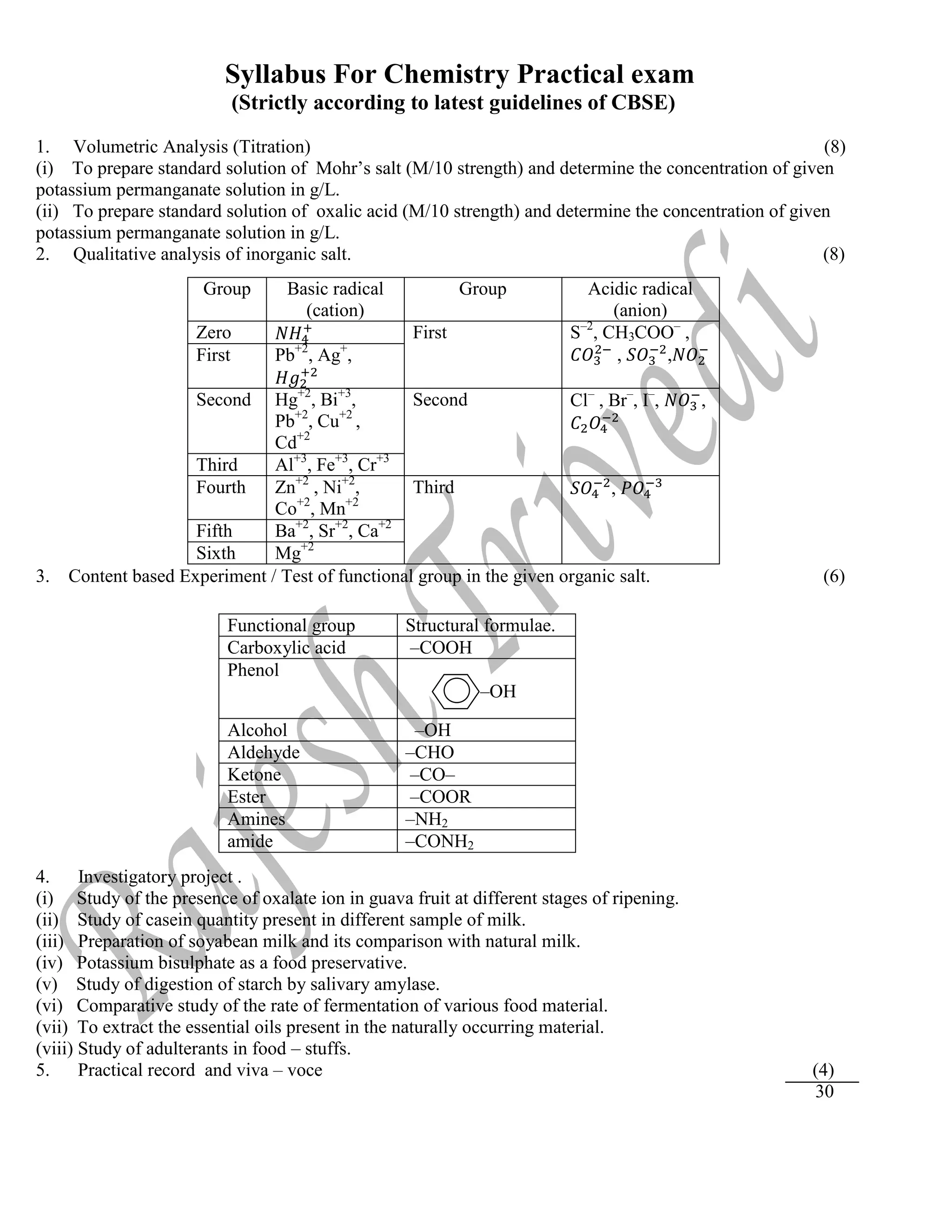
Syllabus For Chemistry Practical exam
(Strictly according to latest guidelines of CBSE)
1. Volumetric Analysis (Titration) (8)
(i) To prepare standard solution of Mohr’s salt (M/10 strength) and determine the concentration of given
potassium permanganate solution in g/L.
(ii) To prepare standard solution of oxalic acid (M/10 strength) and determine the concentration of given
potassium permanganate solution in g/L.
2. Qualitative analysis of inorganic salt. (8)
3. Content based Experiment / Test of functional group in the given organic salt. (6)
4. Investigatory project .
(i) Study of the presence of oxalate ion in guava fruit at different stages of ripening.
(ii) Study of casein quantity present in different sample of milk.
(iii) Preparation of soyabean milk and its comparison with natural milk.
(iv) Potassium bisulphate as a food preservative.
(v) Study of digestion of starch by salivary amylase.
(vi) Comparative study of the rate of fermentation of various food material.
(vii) To extract the essential oils present in the naturally occurring material.
(viii) Study of adulterants in food – stuffs.
5. Practical record and viva – voce (4)
30
Group Basic radical
(cation)
Group Acidic radical
(anion)
Zero First S–2
, CH3COO–
,
, ,
First Pb+2
, Ag+
,
Second Hg+2
, Bi+3
,
Pb+2
, Cu+2
,
Cd+2
Second Cl–
, Br–
, I–
, ,
Third Al+3
, Fe+3
, Cr+3
Fourth Zn+2
, Ni+2
,
Co+2
, Mn+2
Third ,
Fifth Ba+2
, Sr+2
, Ca+2
Sixth Mg+2
Functional group Structural formulae.
Carboxylic acid –COOH
Phenol
–OH
Alcohol –OH
Aldehyde –CHO
Ketone –CO–
Ester –COOR
Amines –NH2
amide –CONH2
Experiment – 1
AIM: Prepare 0.1 M Mohr’s salt solution . Using this solution determine the molarity and strength of the
given potassium permanganate solution.
CHEMICAL EQUATION :
MnO4
–
+ 8H+
+ 5e–
Mn+2
+ 4H2O
Fe+2
Fe+3
+ e–
] × 5
MnO4
–
+ 8H+
+ 5Fe+2
5Fe+3
+ Mn+2
+ 4H2O
INDICATOR : KmnO4 is a self- indicator
END POINT: Colourless to permanent pink colour . (KMnO4in burette)
OBSERVATION TABLE :
CALCULATION :
Preparation of 0.1 M solution of Mohr’s salt
In fact Mohr’s salt is ferrous ammonium sulphate.
Molecular wt. of Mohr’s salt [FeSO4.(NH4)2SO4.6H2O] = 392
As we know w =
w = = 9.8
9.8 gm Mohr’s salt needed to prepare 250 ml of 0.1 M solution .
From the balanced ionic equation , it is clear that1 mole of KMnO4 reacts with 5 mole of Mohr’s salt.
=
M1 = Molarity of KMnO4
M2 = Molarity of Mohr’s salt
V1 = Volume of KMnO4
V2 = Volume of Mohr’s salt
=
S.No. Reading of pipette
(ml)(FAS)
Initial reading of
burette (ml) (KMnO4)
Final reading of
burette (ml) (KMnO4)
Volume of KMnO4
used (ml)
1 10 0.00 10 10
2 10 0.00 9.8 9.8
3 10 0.00 10 10
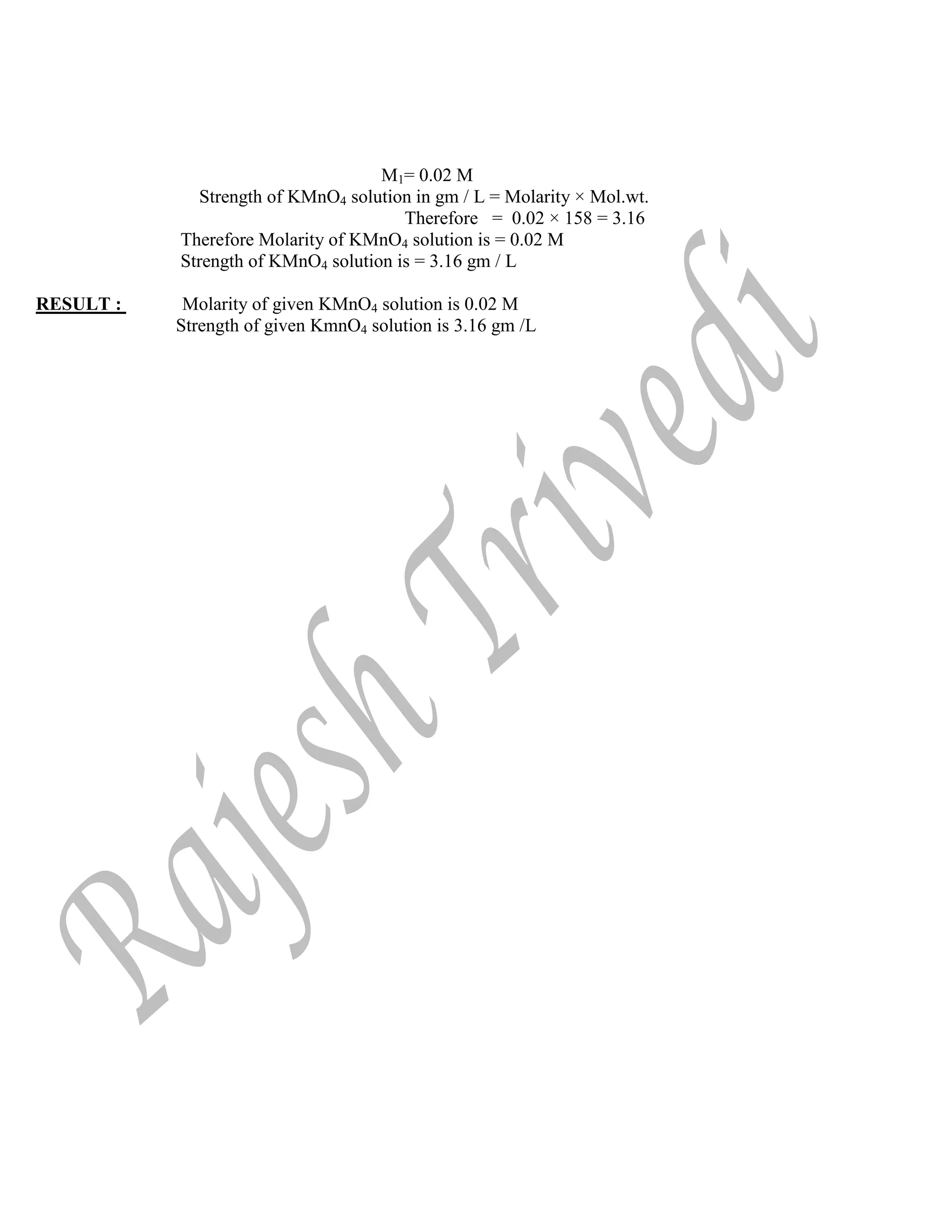
M1= 0.02 M
Strength of KMnO4 solution in gm / L = Molarity × Mol.wt.
Therefore = 0.02 × 158 = 3.16
Therefore Molarity of KMnO4 solution is = 0.02 M
Strength of KMnO4 solution is = 3.16 gm / L
RESULT : Molarity of given KMnO4 solution is 0.02 M
Strength of given KmnO4 solution is 3.16 gm /L
Experiment – 2
AIM: Prepare 0.25 M Mohr’s salt solution . Using this solution determine the molarity and strength of the
given potassium permanganate solution.
CHEMICAL EQUATION :
MnO4
–
+ 8H+
+ 5e–
Mn+2
+ 4H2O
Fe+2
Fe+3
+ e–
] × 5
MnO4
–
+ 8H+
+ 5Fe+2
5Fe+3
+ Mn+2
+ 4H2O
INDICATOR : KmnO4 is a self- indicator
END POINT: Colourless to permanent pink colour . (KMnO4in burette)
OBSERVATION TABLE :
CALCULATION :
Preparation of 0.25 M solution of Mohr’s salt
In fact Mohr’s salt is ferrous ammonium sulphate.
Molecular wt. of Mohr’s salt [FeSO4.(NH4)2SO4.6H2O] = 392
As we know w =
w = = 24.5
24.5 gm Mohr’s salt needed to prepare 250 ml of 0.25 M solution .
From the balanced ionic equation , it is clear that 1 mole of KMnO4 reacts with 5 mole of Mohr’s salt.
=
M1 = Molarity of KMnO4
M2 = Molarity of Mohr’s salt
V1 = Volume of KMnO4
V2 = Volume of Mohr’s salt
=
S.No. Reading of pipette
(ml)(FAS)
Initial reading of
burette (ml) (KMnO4)
Final reading of
burette (ml) (KMnO4)
Volume of KMnO4
used (ml)
1 10 0.00 25 25
2 10 0.00 24.8 24.8
3 10 0.00 25 25
M1= 0.02 M
Strength of KMnO4 solution in gm / L = Molarity × Mol.wt.
Therefore = 0.02 × 158 = 3.16
Therefore Molarity of KMnO4 solution is = 0.02 M
Strength of KMnO4 solution is = 3.16 gm / L
RESULT : Molarity of given KMnO4 solution is 0.02 M
Strength of given KmnO4 solution is 3.16 gm /L
Experiment – 3
AIM: Prepare 0.2 M Mohr’s salt solution . Using this solution determine the molarity and strength of the
given potassium permanganate solution.
CHEMICAL EQUATION :
MnO4
–
+ 8H+
+ 5e–
Mn+2
+ 4H2O
Fe+2
Fe+3
+ e–
] × 5
MnO4
–
+ 8H+
+ 5Fe+2
5Fe+3
+ Mn+2
+ 4H2O
INDICATOR : KmnO4 is a self- indicator
END POINT: Colourless to permanent pink colour . (KMnO4in burette)
OBSERVATION TABLE :
CALCULATION :
Preparation of 0.2 M solution of Mohr’s salt
In fact Mohr’s salt is ferrous ammonium sulphate.
Molecular wt. of Mohr’s salt [FeSO4.(NH4)2SO4.6H2O] = 392
As we know w =
w = = 19.6
19.6 gm Mohr’s salt needed to prepare 250 ml of 0.2 M solution .
From the balanced ionic equation , it is clear that 1 mole of KMnO4 reacts with 5 mole of Mohr’s salt.
=
M1 = Molarity of KMnO4
M2 = Molarity of Mohr’s salt
V1 = Volume of KMnO4
V2 = Volume of Mohr’s salt
=
S.No. Reading of pipette (ml)
(FAS)
Initial reading of
burette (ml) (KMnO4)
Final reading of
burette (ml) (KMnO4)
Volume of
KMnO4 used (ml)
1 10 0.00 20 20
2 10 0.00 19.8 19.8
3 10 0.00 20 20
M1= 0.02 M
Strength of KMnO4 solution in gm / L = Molarity × Mol.wt.
Therefore = 0.02 × 158 = 3.16
Therefore Molarity of KMnO4 solution is = 0.02 M
Strength of KMnO4 solution is = 3.16 gm / L
RESULT : Molarity of given KMnO4 solution is 0.02 M
Strength of given KmnO4 solution is 3.16 gm /L
Experiment – 4
AIM: Prepare 0.15 M Mohr’s salt solution . Using this solution determine the molarity and strength of the
given potassium permanganate solution.
CHEMICAL EQUATION :
MnO4
–
+ 8H+
+ 5e–
Mn+2
+ 4H2O
Fe+2
Fe+3
+ e–
] × 5
MnO4
–
+ 8H+
+ 5Fe+2
5Fe+3
+ Mn+2
+ 4H2O
INDICATOR : KmnO4 is a self- indicator
END POINT: Colourless to permanent pink colour . (KMnO4in burette)
OBSERVATION TABLE :
CALCULATION :
Preparation of 0.2 M solution of Mohr’s salt
In fact Mohr’s salt is ferrous ammonium sulphate.
Molecular wt. of Mohr’s salt [FeSO4.(NH4)2SO4.6H2O] = 392
As we know w =
w = = 14.7
14.7 gm Mohr’s salt needed to prepare 250 ml of 0.15 M solution .
From the balanced ionic equation , it is clear that 1 mole of KMnO4 reacts with 5 mole of Mohr’s salt.
=
M1 = Molarity of KMnO4
M2 = Molarity of Mohr’s salt
V1 = Volume of KMnO4
V2 = Volume of Mohr’s salt
=
S.No. Reading of pipette (ml)
(FAS)
Initial reading of
burette (ml) (KMnO4)
Final reading of
burette (ml) (KMnO4)
Volume of
KMnO4 used (ml)
1 10 0.00 15 15
2 10 0.00 14.8 14.8
3 10 0.00 15 15
M1= 0.02 M
Strength of KMnO4 solution in gm / L = Molarity × Mol.wt.
Therefore = 0.02 × 158 = 3.16
Therefore Molarity of KMnO4 solution is = 0.02 M
Strength of KMnO4 solution is = 3.16 gm / L
RESULT : Molarity of given KMnO4 solution is 0.02 M
Strength of given KmnO4 solution is 3.16 gm /L
Experiment – 5
AIM: Prepare 0.1 M solution of Oxalic acid . Using this solution determine the molarity and strength of
the given potassium permanganate solution.
CHEMICAL EQUATION :
MnO4
–
+ 8H+
+ 5e–
Mn+2
+ 4H2O] × 2
C2O4
–2
2CO2 + 2e–
] × 5
2MnO4
–
+ 16H+
+ 5C2O4
–2
2Mn+2
+ 10CO2 + 8H2O
INDICATOR : KmnO4 is a self- indicator
END POINT: Colourless to permanent pink colour . (KMnO4in burette)
OBSERVATION TABLE :
CALCULATION :
Preparation of 0.1 M Oxalic acid solution
Molecular wt. of Oxalic acid [H2C2O4.2H2O] = 126
As we know w =
w = = 3.15
3.15 gm Oxalic acid needed to prepare 250 ml of 0.1 M solution .
From the balanced ionic equation , it is clear that 2 mole of KMnO4 reacts with 5 mole of Oxalic acid.
=
M1 = Molarity of KMnO4
M2 = Molarity of Oxalic acid
V1 = Volume of KMnO4
V2 = Volume of Oxalic acid
=
S.No. Reading of pipette (ml)
(Oxalic acid)
Initial reading of burette
(ml) (KMnO4)
Final reading of burette
(ml) (KMnO4)
Volume of KMnO4 used
(ml)
1 10 0.00 20 20
2 10 0.00 19.8 19.8
3 10 0.00 20 20
M1= 0.02 M
Strength of KMnO4 solution in gm / L = Molarity × Mol.wt.
Therefore = 0.02 × 158 = 3.16 gm / L
Therefore Molarity of KMnO4 solution is = 0.02 M
Strength of KMnO4 solution is = 3.16 gm / L
RESULT : Molarity of given KMnO4 solution is 0.02 M
Strength of given KMnO4 solution is 3.16 gm /L
Experiment – 6
AIM: Prepare 0.15 M solution of Oxalic acid . Using this solution determine the molarity and strength of
the given potassium permanganate solution.
CHEMICAL EQUATION :
MnO4
–
+ 8H+
+ 5e–
Mn+2
+ 4H2O] × 2
C2O4
–2
2CO2 + 2e–
] × 5
2MnO4
–
+ 16H+
+ 5C2O4
–2
2Mn+2
+ 10CO2 + 8H2O
INDICATOR : KmnO4 is a self- indicator
END POINT: Colourless to permanent pink colour . (KMnO4in burette)
OBSERVATION TABLE :
CALCULATION :
Preparation of 0.15 M Oxalic acid solution
Molecular wt. of Oxalic acid [H2C2O4.2H2O] = 126
As we know w =
w = = 4.725
4.725 gm Oxalic acid needed to prepare 250 ml of 0.15 M solution .
From the balanced ionic equation , it is clear that 2 mole of KMnO4 reacts with 5 mole of Oxalic acid.
=
M1 = Molarity of KMnO4
M2 = Molarity of Oxalic acid
V1 = Volume of KMnO4
V2 = Volume of Oxalic acid
=
S.No. Reading of pipette (ml)
(Oxalic acid)
Initial reading of burette
(ml) (KMnO4)
Final reading of burette
(ml) (KMnO4)
Volume of KMnO4 used
(ml)
1 10 0.00 30 30
2 10 0.00 29.8 29.8
3 10 0.00 30 30
M1= 0.02 M
Strength of KMnO4 solution in gm / L = Molarity × Mol.wt.
Therefore = 0.02 × 158 = 3.16 gm / L
Therefore Molarity of KMnO4 solution is = 0.02 M
Strength of KMnO4 solution is = 3.16 gm / L
RESULT : Molarity of given KMnO4 solution is 0.02 M
Strength of given KMnO4 solution is 3.16 gm /L
Experiment – 7
AIM: Prepare 0.2 M solution of Oxalic acid . Using this solution determine the molarity and strength of
the given potassium permanganate solution.
CHEMICAL EQUATION :
MnO4
–
+ 8H+
+ 5e–
Mn+2
+ 4H2O] × 2
C2O4
–2
2CO2 + 2e–
] × 5
2MnO4
–
+ 16H+
+ 5C2O4
–2
2Mn+2
+ 10CO2 + 8H2O
INDICATOR : KmnO4 is a self- indicator
END POINT: Colourless to permanent pink colour . (KMnO4in burette)
OBSERVATION TABLE :
CALCULATION :
Preparation of 0.2 M Oxalic acid solution
Molecular wt. of Oxalic acid [H2C2O4.2H2O] = 126
As we know w =
w = = 6.3
6.3 gm Oxalic acid needed to prepare 250 ml of 0.2 M solution .
From the balanced ionic equation , it is clear that 2 mole of KMnO4 reacts with 5 mole of Oxalic acid.
=
M1 = Molarity of KMnO4
M2 = Molarity of Oxalic acid
V1 = Volume of KMnO4
V2 = Volume of Oxalic acid
=
S.No. Reading of pipette
(ml) (Oxalic acid)
Initial reading of
burette (ml) (KMnO4)
Final reading of
burette (ml) (KMnO4)
Volume of KMnO4
used (ml)
1 10 0.00 40 40
2 10 0.00 39.8 39.8
3 10 0.00 40 40
M1= 0.02 M
Strength of KMnO4 solution in gm / L = Molarity × Mol.wt.
Therefore = 0.02 × 158 = 3.16 gm / L
Therefore Molarity of KMnO4 acid solution is = 0.02 M
Strength of KMnO4 solution is = 3.16 gm / L
RESULT : Molarity of given KMnO4 solution is 0.02 M
Strength of given KMnO4 solution is 3.16 gm /L
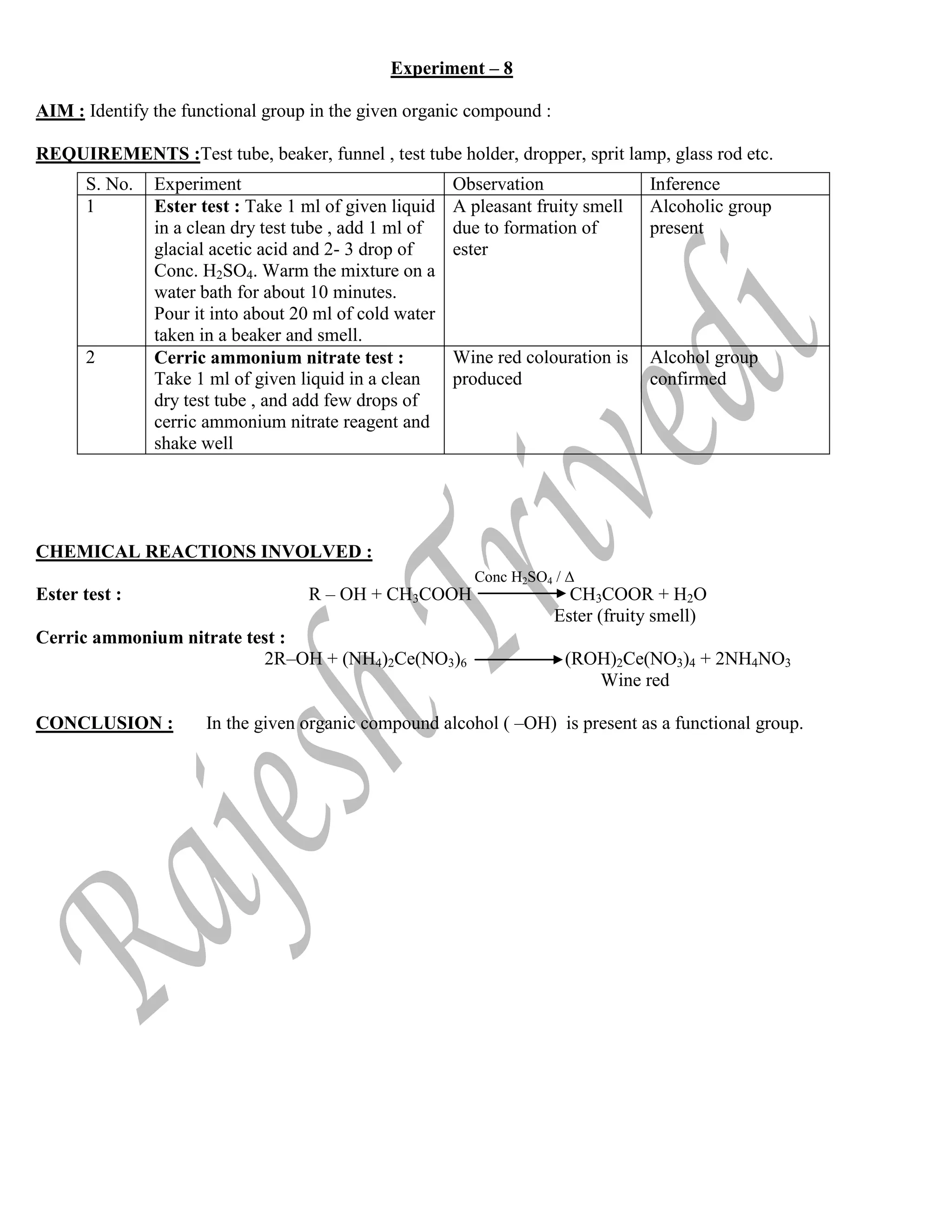
Experiment – 8
AIM : Identify the functional group in the given organic compound :
REQUIREMENTS :Test tube, beaker, funnel , test tube holder, dropper, sprit lamp, glass rod etc.
CHEMICAL REACTIONS INVOLVED :
Ester test : R – OH + CH3COOH CH3COOR + H2O
Ester (fruity smell)
Cerric ammonium nitrate test :
2R–OH + (NH4)2Ce(NO3)6 (ROH)2Ce(NO3)4 + 2NH4NO3
Wine red
CONCLUSION : In the given organic compound alcohol ( –OH) is present as a functional group.
S. No. Experiment Observation Inference
1 Ester test : Take 1 ml of given liquid
in a clean dry test tube , add 1 ml of
glacial acetic acid and 2- 3 drop of
Conc. H2SO4. Warm the mixture on a
water bath for about 10 minutes.
Pour it into about 20 ml of cold water
taken in a beaker and smell.
A pleasant fruity smell
due to formation of
ester
Alcoholic group
present
2 Cerric ammonium nitrate test :
Take 1 ml of given liquid in a clean
dry test tube , and add few drops of
cerric ammonium nitrate reagent and
shake well
Wine red colouration is
produced
Alcohol group
confirmed
Conc H2SO4 / Δ
Experiment – 9
AIM : Identify the functional group in the given organic compound :
REQUIREMENTS: Test tube, beaker, funnel , test tube holder, dropper, sprit lamp, glass rod etc.
CHEMICAL REACTIONS INVOLVED :
Ferric chloride test : FeCl3 + 6 C6H5OH [Fe(OC6H5)6
]–3
+ 3HCl
Violet complex
Libermann’stest :
2NaNO3 + H2SO4 2HNO2 + Na2SO4
OH ON OH
P -nitrophenol
ON OH + OH HO N O
Indo phenol (red)
HO N O Na+
O–
N O
Indo phenol anion (blue)
CONCLUSION : In the given organic compound Phenol ( OH) is present as a functional
group.
S. No. Experiment Observation Inference
1 Ferric chloride test : Take 1 ml of
neutral FeCl3 solution in a test tube
and add few drops of compound
A violet colouration
produced
Phenolic group is
present
2 Libermann’stest : Take 2- 3
crystals of NaNO2 in a test tube and
add about 1 ml of organic compound.
Heat gently for 30 seconds and allow
it to cool. Then add 1 ml of conc.
H2SO4 and shake the test tube .
Then add water carefully.
Finally add excess of NaOH solution.
A deep blue or deeo
green colouration
produced.
Colur turns red
The blue or green colur
appear
Phenolic group is
confirmed.
HNO2
NaOH
Experiment – 10
AIM : Identify the functional group in the given organic compound :
REQUIREMENTS : Test tube, beaker, funnel , test tube holder, dropper, sprit lamp, glass rod etc.
CHEMICAL REACTIONS INVOLVED :
2,4 – dinitrophenylhydrazine test:
RCHO + H2N NH NO2 R HC N NH NO2
NO2 NO2
Aldehyde 2,4 – dinitrophenylhydrazone (orange crystals)
Tollen’s test:
2[Ag(NH3)2]+
+ RCHO + 3OH–
RCOO–
+ 2Ag ↓ + 4NH3 +2H2O
Silver mirror
CONCLUSION : In the given organic compound Aldehyde (–COH) is present as a functional group.
S.No. Experiment Observation Inference
1 2,4- dinitrophenylhydarzine test
:Take 0.5 ml of given compound,
add rectified spirit. Now add 2,4DNP
solution . Cork the test tube , shake
the mixture and allow it to stand.
Yellow or orange
crystals formed
Aldehyde or Ketone is
present
2 Tollen’stest : Take 1 ml of AgNO3
solution in a test tube and add about
2-3 ml of dilNaOH.
Now add dil. Ammonia solution drop
wise.
To this add 3-4 drop of given organic
compound and warm the test tube on
water bath for 5 minutes.
A brown ppt produced.
Brown ppt dissolves.
A shining mirror
appear.
Aldehyde is
confirmed.
Experiment - 11
AIM : Identify the functional group in the given organic compound :
REQUIREMENTS: Test tube, beaker, funnel , test tube holder, dropper, sprit lamp, glass rod etc.
CHEMICAL REACTIONS INVOLVED :
Tollen’s test:
2[Ag(NH3)2]+
+ RCOR + 3OH–
No formation of silver mirror
CONCLUSION : In the given organic compound Ketone (–CO– ) is present as a functional group.
S.No. Experiment Observation Inference
1 2,4- dinitrophenylhydarzine test :
Take 0.5 ml of given compound, add
rectified spirit. Now add 2,4DNP
solution . Cork the test tube , shake
the mixture and allow it to stand.
Yellow or orange
crystals formed
Aldehyde or Ketone is
present
2 Tollen’stest : Take 1 ml of AgNO3
solution in a test tube and add about
2-3 ml of dilNaOH.
Now add dil. Ammonia solution drop
wise.
To this add 3-4 drop of given organic
compound and warm the test tube on
water bath for 5 minutes.
No shining mirror
appear.
Ketone is confirmed.
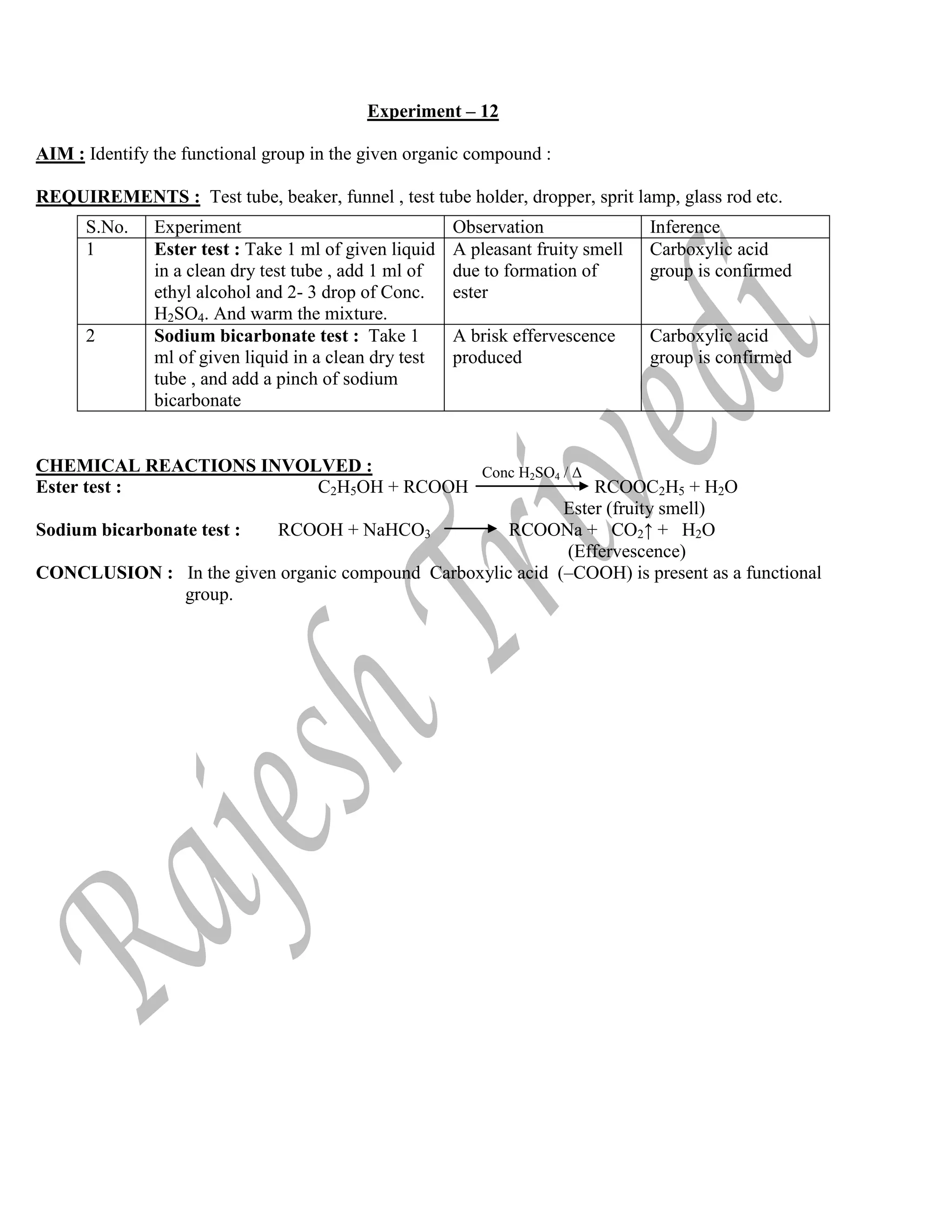
Experiment – 12
AIM : Identify the functional group in the given organic compound :
REQUIREMENTS : Test tube, beaker, funnel , test tube holder, dropper, sprit lamp, glass rod etc.
CHEMICAL REACTIONS INVOLVED :
Ester test : C2H5OH + RCOOH RCOOC2H5 + H2O
Ester (fruity smell)
Sodium bicarbonate test : RCOOH + NaHCO3 RCOONa + CO2↑ + H2O
(Effervescence)
CONCLUSION : In the given organic compound Carboxylic acid (–COOH) is present as a functional
group.
S.No. Experiment Observation Inference
1 Ester test : Take 1 ml of given liquid
in a clean dry test tube , add 1 ml of
ethyl alcohol and 2- 3 drop of Conc.
H2SO4. And warm the mixture.
A pleasant fruity smell
due to formation of
ester
Carboxylic acid
group is confirmed
2 Sodium bicarbonate test : Take 1
ml of given liquid in a clean dry test
tube , and add a pinch of sodium
bicarbonate
A brisk effervescence
produced
Carboxylic acid
group is confirmed
Conc H2SO4 / Δ
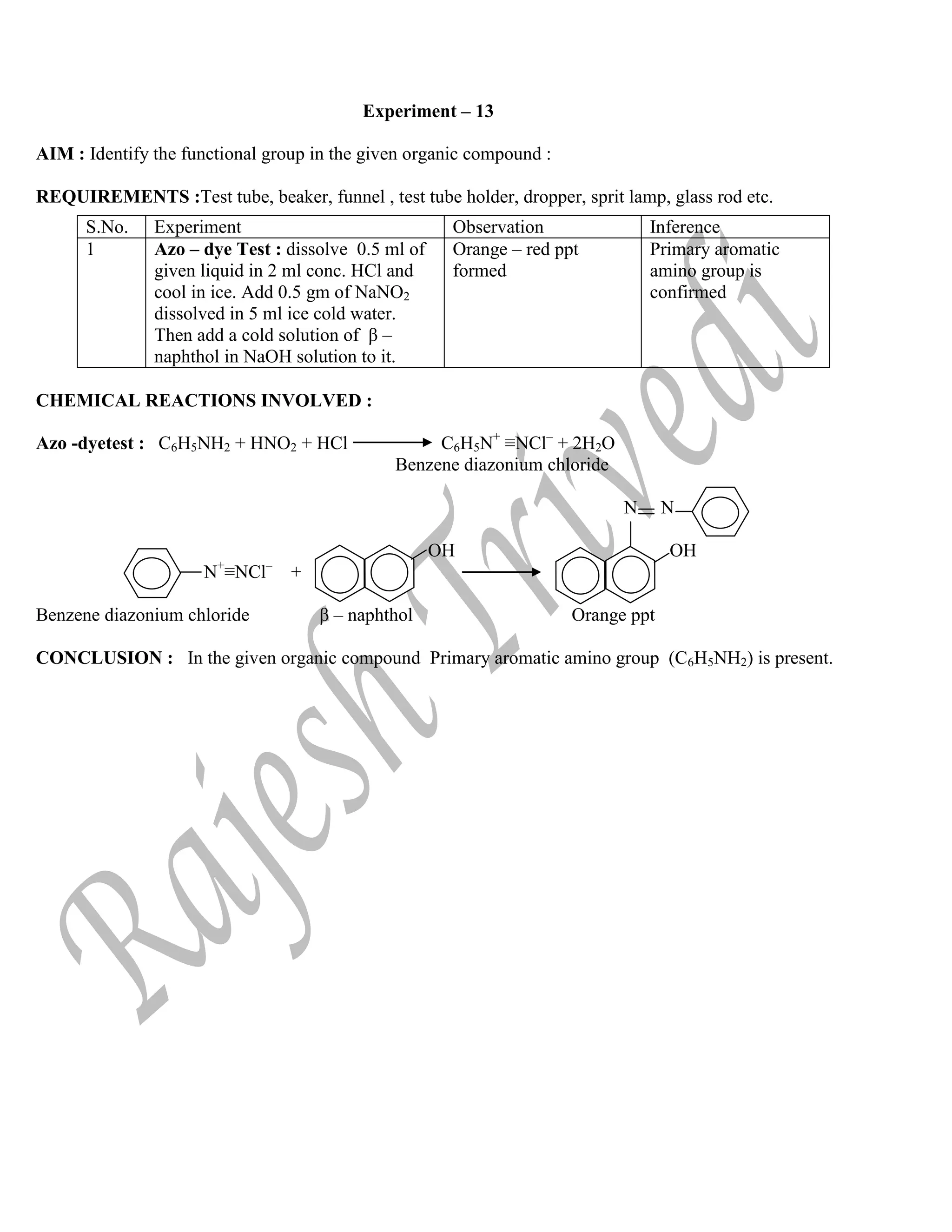
Experiment – 13
AIM : Identify the functional group in the given organic compound :
REQUIREMENTS :Test tube, beaker, funnel , test tube holder, dropper, sprit lamp, glass rod etc.
CHEMICAL REACTIONS INVOLVED :
Azo -dyetest : C6H5NH2 + HNO2 + HCl C6H5N+
≡NCl–
+ 2H2O
Benzene diazonium chloride
N N
OH OH
N+
≡NCl–
+
Benzene diazonium chloride β – naphthol Orange ppt
CONCLUSION : In the given organic compound Primary aromatic amino group (C6H5NH2) is present.
S.No. Experiment Observation Inference
1 Azo – dye Test : dissolve 0.5 ml of
given liquid in 2 ml conc. HCl and
cool in ice. Add 0.5 gm of NaNO2
dissolved in 5 ml ice cold water.
Then add a cold solution of β –
naphthol in NaOH solution to it.
Orange – red ppt
formed
Primary aromatic
amino group is
confirmed
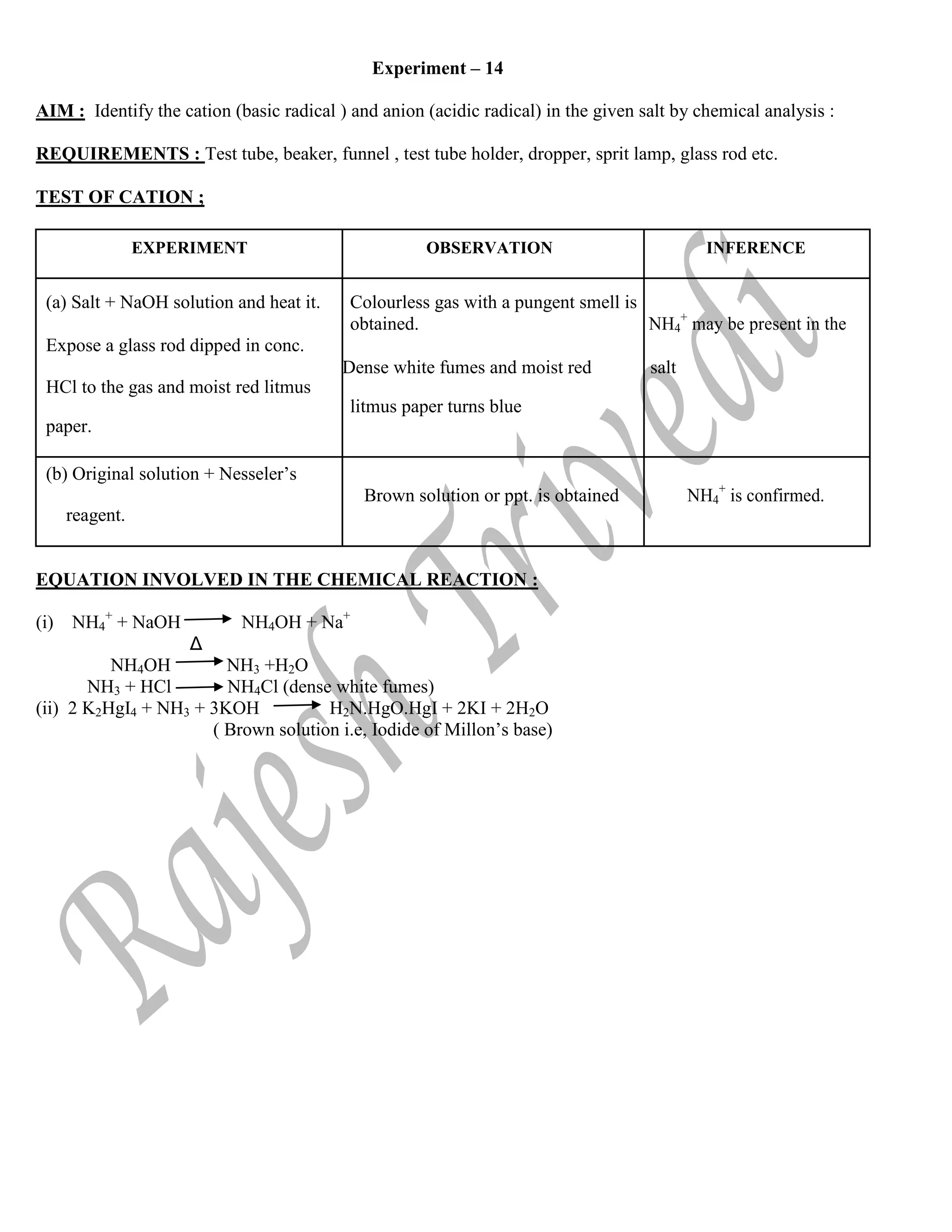
Experiment – 14
AIM : Identify the cation (basic radical ) and anion (acidic radical) in the given salt by chemical analysis :
REQUIREMENTS : Test tube, beaker, funnel , test tube holder, dropper, sprit lamp, glass rod etc.
TEST OF CATION ;
EXPERIMENT OBSERVATION INFERENCE
(a) Salt + NaOH solution and heat it. Colourless gas with a pungent smell is
NH4
+
may be present in the
Expose a glass rod dipped in conc.
obtained.
Dense white fumes and moist red salt
HCl to the gas and moist red litmus
litmus paper turns blue
paper.
(b) Original solution + Nesseler’s
Brown solution or ppt. is obtained NH4
+
is confirmed.
reagent.
EQUATION INVOLVED IN THE CHEMICAL REACTION :
(i) NH4
+
+ NaOH NH4OH + Na+
Δ
NH4OH NH3 +H2O
NH3 + HCl NH4Cl (dense white fumes)
(ii) 2 K2HgI4 + NH3 + 3KOH H2N.HgO.HgI + 2KI + 2H2O
( Brown solution i.e, Iodide of Millon’s base)
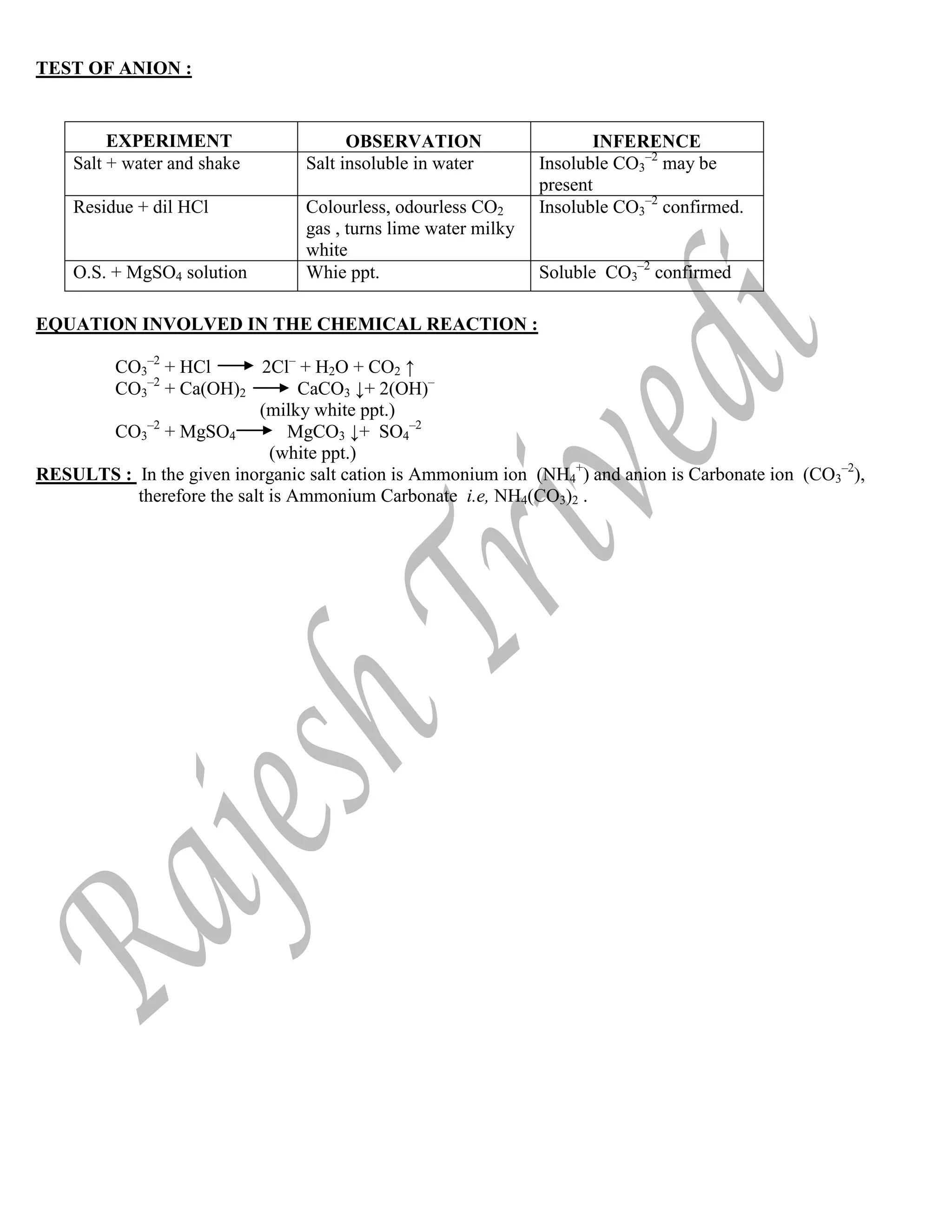
TEST OF ANION :
EXPERIMENT OBSERVATION INFERENCE
Salt + water and shake Salt insoluble in water Insoluble CO3
–2
may be
present
Residue + dil HCl Colourless, odourless CO2
gas , turns lime water milky
white
Insoluble CO3
–2
confirmed.
O.S. + MgSO4 solution Whie ppt. Soluble CO3
–2
confirmed
EQUATION INVOLVED IN THE CHEMICAL REACTION :
CO3
–2
+ HCl 2Cl–
+ H2O + CO2 ↑
CO3
–2
+ Ca(OH)2 CaCO3 ↓+ 2(OH)–
(milky white ppt.)
CO3
–2
+ MgSO4 MgCO3 ↓+ SO4
–2
(white ppt.)
RESULTS : In the given inorganic salt cation is Ammonium ion (NH4
+
) and anion is Carbonate ion (CO3
–2
),
therefore the salt is Ammonium Carbonate i.e, NH4(CO3)2 .
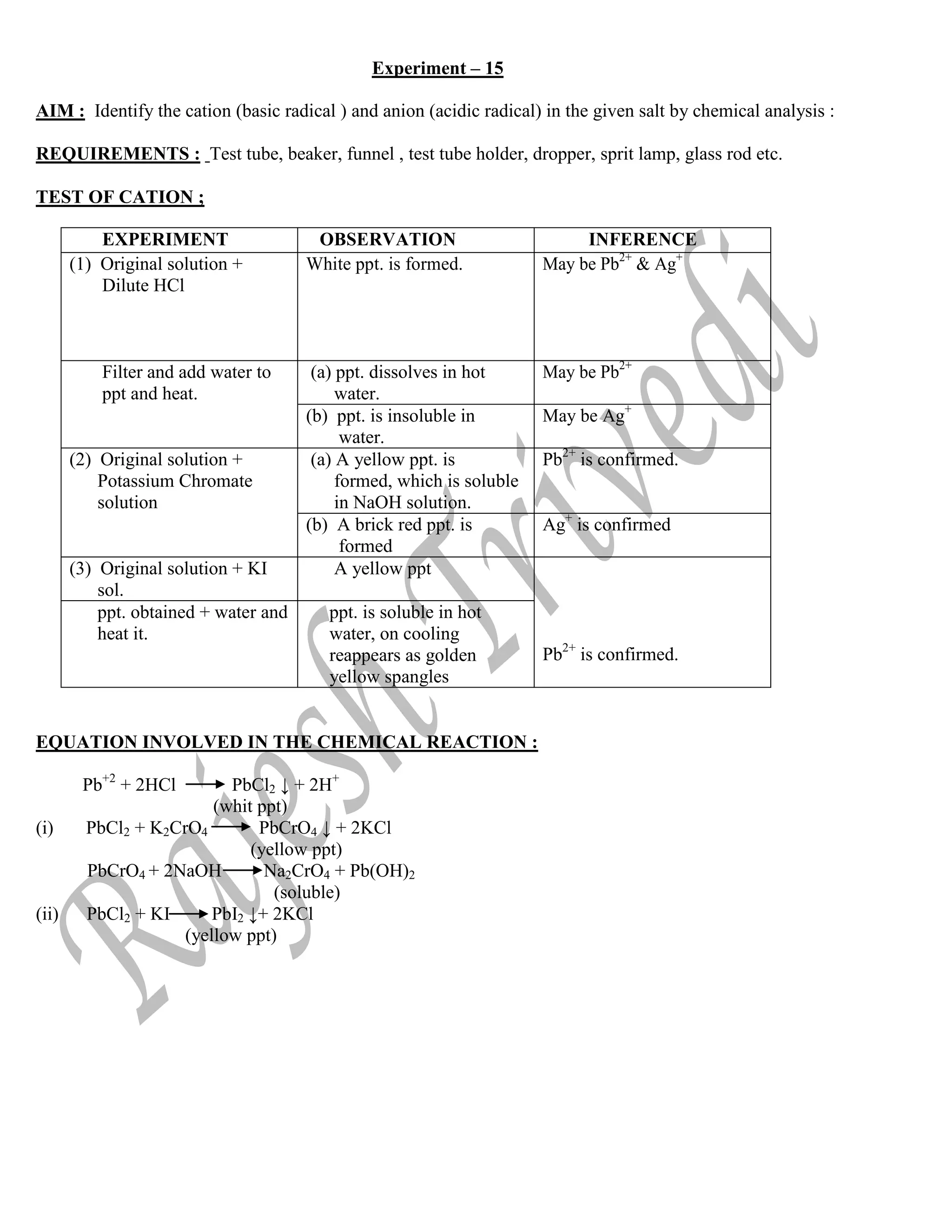
Experiment – 15
AIM : Identify the cation (basic radical ) and anion (acidic radical) in the given salt by chemical analysis :
REQUIREMENTS : Test tube, beaker, funnel , test tube holder, dropper, sprit lamp, glass rod etc.
TEST OF CATION ;
EXPERIMENT OBSERVATION INFERENCE
(1) Original solution +
Dilute HCl
White ppt. is formed. May be Pb2+
& Ag+
Filter and add water to
ppt and heat.
(a) ppt. dissolves in hot
water.
May be Pb2+
(b) ppt. is insoluble in
water.
May be Ag+
(2) Original solution +
Potassium Chromate
solution
(a) A yellow ppt. is
formed, which is soluble
in NaOH solution.
Pb2+
is confirmed.
(b) A brick red ppt. is
formed
Ag+
is confirmed
(3) Original solution + KI
sol.
A yellow ppt
Pb2+
is confirmed.
ppt. obtained + water and
heat it.
ppt. is soluble in hot
water, on cooling
reappears as golden
yellow spangles
EQUATION INVOLVED IN THE CHEMICAL REACTION :
Pb+2
+ 2HCl PbCl2 ↓ + 2H+
(whit ppt)
(i) PbCl2 + K2CrO4 PbCrO4 ↓ + 2KCl
(yellow ppt)
PbCrO4 + 2NaOH Na2CrO4 + Pb(OH)2
(soluble)
(ii) PbCl2 + KI PbI2 ↓+ 2KCl
(yellow ppt)
TEST OF ANION :
EQUATION INVOLVED IN THE CHEMICAL REACTION :
(i) Ring Test :
NaNO3 + H2SO4 NaHSO4 + HNO3
2FeSO4 + 2HNO3 + H2SO4 Fe2(SO4)3 +2H2O + NO
FeSO4 + NO + 5H2O [Fe(H2O)5NO] SO4
(brown ring)
(ii) Copper turning Test :
KNO3 + H2SO4 KHSO4 + HNO3
Cu + 4HNO3 Cu(NO3)2 + H2O + 2NO2 ↑
RESULTS : In the given inorganic salt cation is Lead ion (Pb+2
) and anion is Nitrate ion (NO3
–
), therefore
the salt is Lead nitrate i.e, Pb(NO3)2 .
EXPERIMENT OBSERVATION INFERENCE
Salt + Conc. H2SO4 and heat if
necessary
Light brown gas and brown
gas with pieces of copper
turnings and the solution turns
blue in the test tube. The Acid radical may be NO3
-
Brown ring test: Strong solution
of the substance + 2 or3 drops of
conc. H2SO4, and cool. Add
freshly prepared FeSO4 solution
on the sides of the test tube.
A brown ring is formed at the
junction of two liquids.
Nitrate (NO3
-
) is confirmed
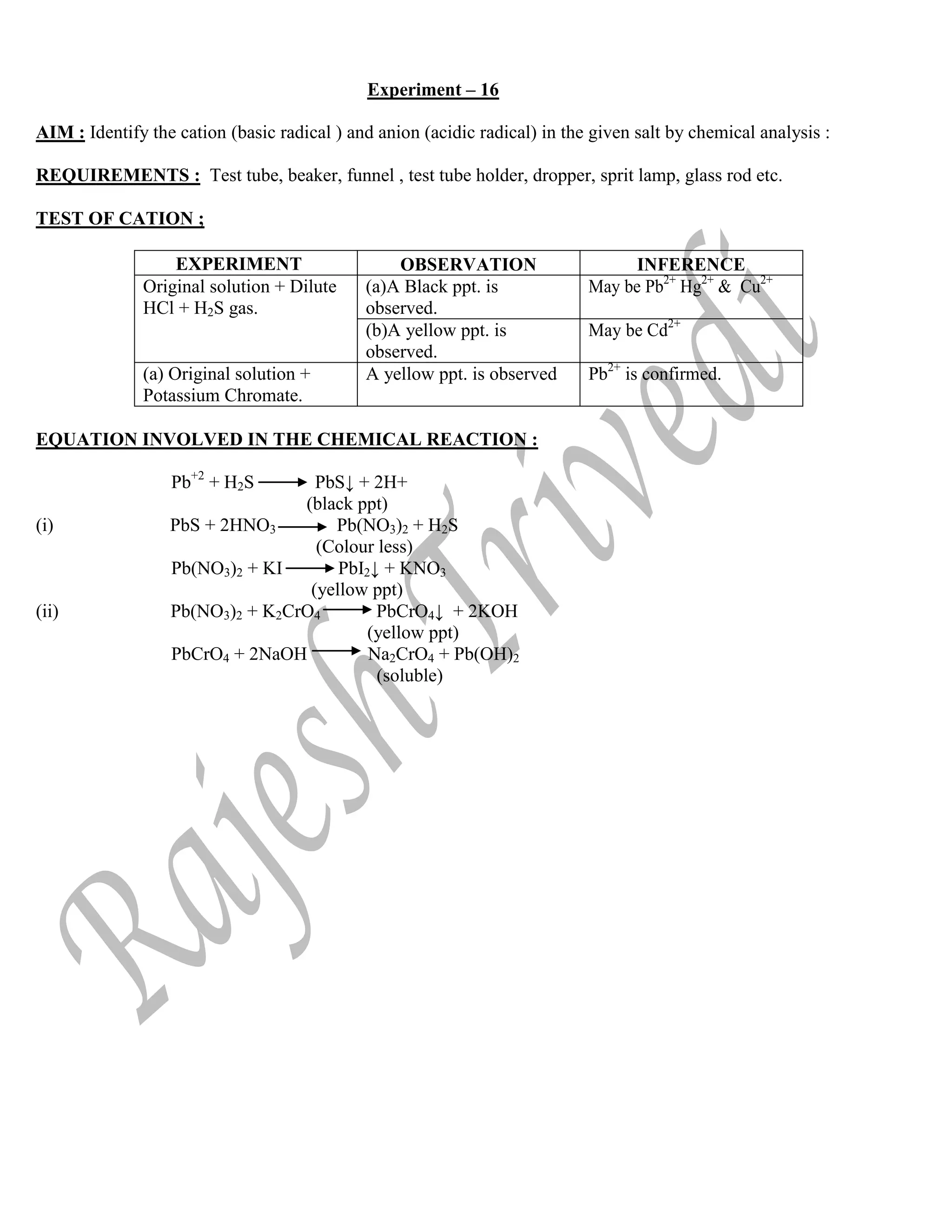
Experiment – 16
AIM : Identify the cation (basic radical ) and anion (acidic radical) in the given salt by chemical analysis :
REQUIREMENTS : Test tube, beaker, funnel , test tube holder, dropper, sprit lamp, glass rod etc.
TEST OF CATION ;
EXPERIMENT OBSERVATION INFERENCE
Original solution + Dilute
HCl + H2S gas.
(a)A Black ppt. is
observed.
May be Pb2+
Hg2+
& Cu2+
(b)A yellow ppt. is
observed.
May be Cd2+
(a) Original solution +
Potassium Chromate.
A yellow ppt. is observed Pb2+
is confirmed.
EQUATION INVOLVED IN THE CHEMICAL REACTION :
Pb+2
+ H2S PbS↓ + 2H+
(black ppt)
(i) PbS + 2HNO3 Pb(NO3)2 + H2S
(Colour less)
Pb(NO3)2 + KI PbI2↓ + KNO3
(yellow ppt)
(ii) Pb(NO3)2 + K2CrO4 PbCrO4↓ + 2KOH
(yellow ppt)
PbCrO4 + 2NaOH Na2CrO4 + Pb(OH)2
(soluble)
TEST OF ANION :
EQUATION INVOLVED IN THE CHEMICAL REACTION :
(i) Chromyl chloride test:
4NaCl + K2Cr2O7 + 6H2SO4 4NaHSO4 + 2KHSO4 + 2CrO2Cl2 + 3H2O
(yellow orange)
CrO2Cl2 + 4NaOH Na2CrO4 + 2NaCl + 2H2O
(yellow colour)
Pb(CH3COO)2 + Na2CrO4 PbCrO4↓ + 2CH3COONa
(yellow ppt)
(ii) Silver nitrate test :
NaCl + AgNO3 AgCl ↓+ NaNO3
(white ppt)
AgCl + 2NH4OH [Ag(NH3)2]Cl + 2H2O
(soluble)
RESULTS : In the given inorganic salt cation is Lead ( Pb+2
) and anion is Chloride (Cl–
), therefore
the salt is Lead Chloride i.e, PbCl2 .
EXPERIMENT OBSERVATION INFERENCE
Salt + Concentrated H2SO4
and heat
Effervescence with
colourless or coloured gases
2nd
group Acid radical is
present
(a) Colourless gas with a
pungent smell and gives
dense white fumes when a
glass rod dipped in
ammonium hydroxide
(NH4OH) is exposed
The Acid radical may be Cl-
(b) Brown gas and the
solution is not blue.
The acid radical may be Br-
(a) Chromyl – Chloride test:
(i) Salt + few K2Cr2O7
crystals + conc. H2SO4
and heat
(ii) Pass the vapours
through the test tube
which contains NaOH
solution
(iii) To this yellow
solution,add dilute
CH3COOH and lead
acetate solution.
Red vapours are obtained.
The solution turns yellow
Yellow ppt. is formed Chloride is confirmed.
(b) Silver Nitrate test:
Salt solution + AgNO3
solution + dilute HNO3
White ppt. is formed
which is soluble in NH4OH.
Chloride is confirmed
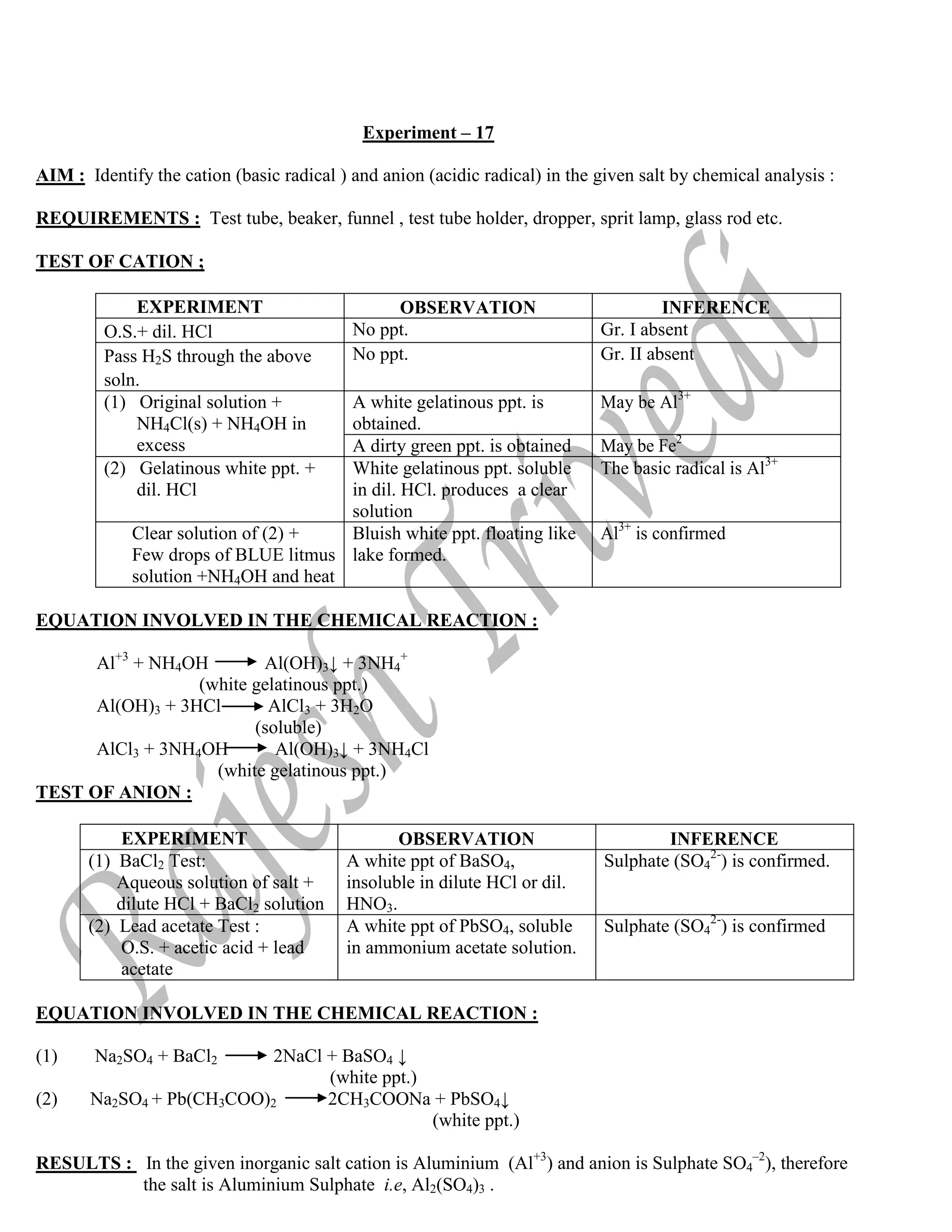
Experiment – 17
AIM : Identify the cation (basic radical ) and anion (acidic radical) in the given salt by chemical analysis :
REQUIREMENTS : Test tube, beaker, funnel , test tube holder, dropper, sprit lamp, glass rod etc.
TEST OF CATION ;
EXPERIMENT OBSERVATION INFERENCE
O.S.+ dil. HCl No ppt. Gr. I absent
Pass H2S through the above
soln.
No ppt. Gr. II absent
(1) Original solution +
NH4Cl(s) + NH4OH in
excess
A white gelatinous ppt. is
obtained.
May be Al3+
A dirty green ppt. is obtained May be Fe2
(2) Gelatinous white ppt. +
dil. HCl
White gelatinous ppt. soluble
in dil. HCl. produces a clear
solution
The basic radical is Al3+
Clear solution of (2) +
Few drops of BLUE litmus
solution +NH4OH and heat
Bluish white ppt. floating like
lake formed.
Al3+
is confirmed
EQUATION INVOLVED IN THE CHEMICAL REACTION :
Al+3
+ NH4OH Al(OH)3↓ + 3NH4
+
(white gelatinous ppt.)
Al(OH)3 + 3HCl AlCl3 + 3H2O
(soluble)
AlCl3 + 3NH4OH Al(OH)3↓ + 3NH4Cl
(white gelatinous ppt.)
TEST OF ANION :
EXPERIMENT OBSERVATION INFERENCE
(1) BaCl2 Test:
Aqueous solution of salt +
dilute HCl + BaCl2 solution
A white ppt of BaSO4,
insoluble in dilute HCl or dil.
HNO3.
Sulphate (SO4
2-
) is confirmed.
(2) Lead acetate Test :
O.S. + acetic acid + lead
acetate
A white ppt of PbSO4, soluble
in ammonium acetate solution.
Sulphate (SO4
2-
) is confirmed
EQUATION INVOLVED IN THE CHEMICAL REACTION :
(1) Na2SO4 + BaCl2 2NaCl + BaSO4 ↓
(white ppt.)
(2) Na2SO4 + Pb(CH3COO)2 2CH3COONa + PbSO4↓
(white ppt.)
RESULTS : In the given inorganic salt cation is Aluminium (Al+3
) and anion is Sulphate SO4
–2
), therefore
the salt is Aluminium Sulphate i.e, Al2(SO4)3 .
Experiment – 18
AIM : Identify the cation (basic radical ) and anion (acidic radical) in the given salt by chemical analysis :
REQUIREMENTS : Test tube, beaker, funnel , test tube holder, dropper, sprit lamp, glass rod etc.
TEST OF CATION ;
EXPERIMENT OBSERVATION INFERENCE
O.S.+ dil. HCl No ppt. Gr. I absent
Pass H2S through the
above soln.
No ppt. Gr. II absent
Boil of H2S cool + 1 ml of
conc. HNO3. boil +
NH4Cl(s) + excess of
NH4OH
No ppt. Gr. III absent
(1) Original solution +
NH4Cl(s) + NH4OH in
excess + H2S(g)
a white ppt. is obtained May be Zn2+
, Mn2+
or Co2+
Buff or pale pink or flash
coloured ppt. soluble in
dilute HCl is obtained.
May be Mn2+
(2) Original solution +
NaOH drop wise in
excess.
The white ppt. is soluble in
excess of NaOH.
Zn2+
is confirmed
(3) Original solution +
NH4OH solution +
K4[Fe(CN)6] solution.
Blish white ppt. Zn2+
is confirmed
EQUATION INVOLVED IN THE CHEMICAL REACTION :
Zn+2
+ H2S ZnS↓ + 2H+
(white ppt.)
ZnS + 2HCl ZnCl2 + H2S
(soluble)
(1) ZnCl2 + NaOH Zn(OH)2↓ + 2 NaCl
(white ppt.)
Zn(OH)2 + 2 NaOH Na2ZnO2 + 2H2O
(soluble)
(2) ZnCl2 + K4[Fe(CN)6] Zn2[Fe(CN)6] + 4KCl
(bluish white ppt.)
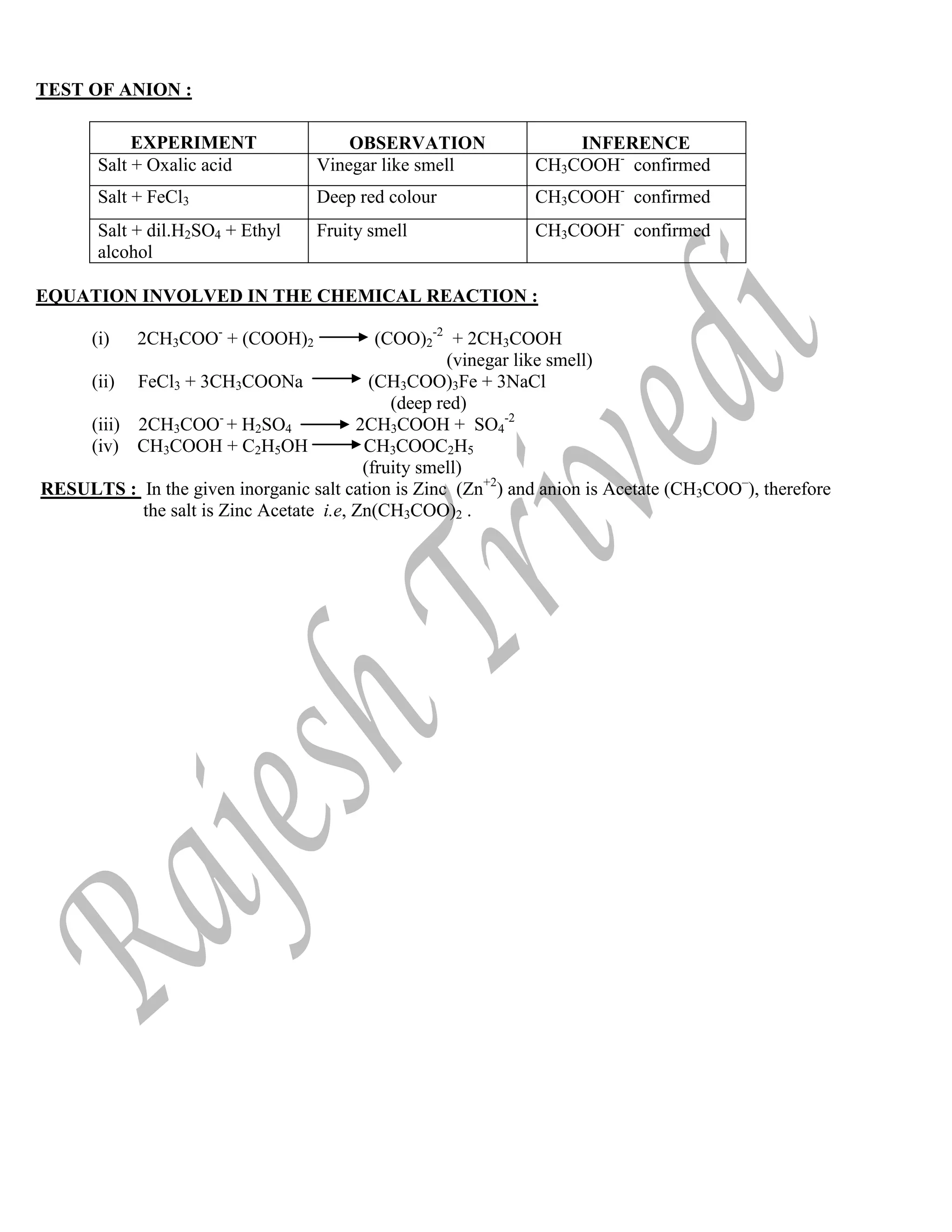
TEST OF ANION :
EXPERIMENT OBSERVATION INFERENCE
Salt + Oxalic acid Vinegar like smell CH3COOH-
confirmed
Salt + FeCl3 Deep red colour CH3COOH-
confirmed
Salt + dil.H2SO4 + Ethyl
alcohol
Fruity smell CH3COOH-
confirmed
EQUATION INVOLVED IN THE CHEMICAL REACTION :
(i) 2CH3COO-
+ (COOH)2 (COO)2
-2
+ 2CH3COOH
(vinegar like smell)
(ii) FeCl3 + 3CH3COONa (CH3COO)3Fe + 3NaCl
(deep red)
(iii) 2CH3COO-
+ H2SO4 2CH3COOH + SO4
-2
(iv) CH3COOH + C2H5OH CH3COOC2H5
(fruity smell)
RESULTS : In the given inorganic salt cation is Zinc (Zn+2
) and anion is Acetate (CH3COO–
), therefore
the salt is Zinc Acetate i.e, Zn(CH3COO)2 .
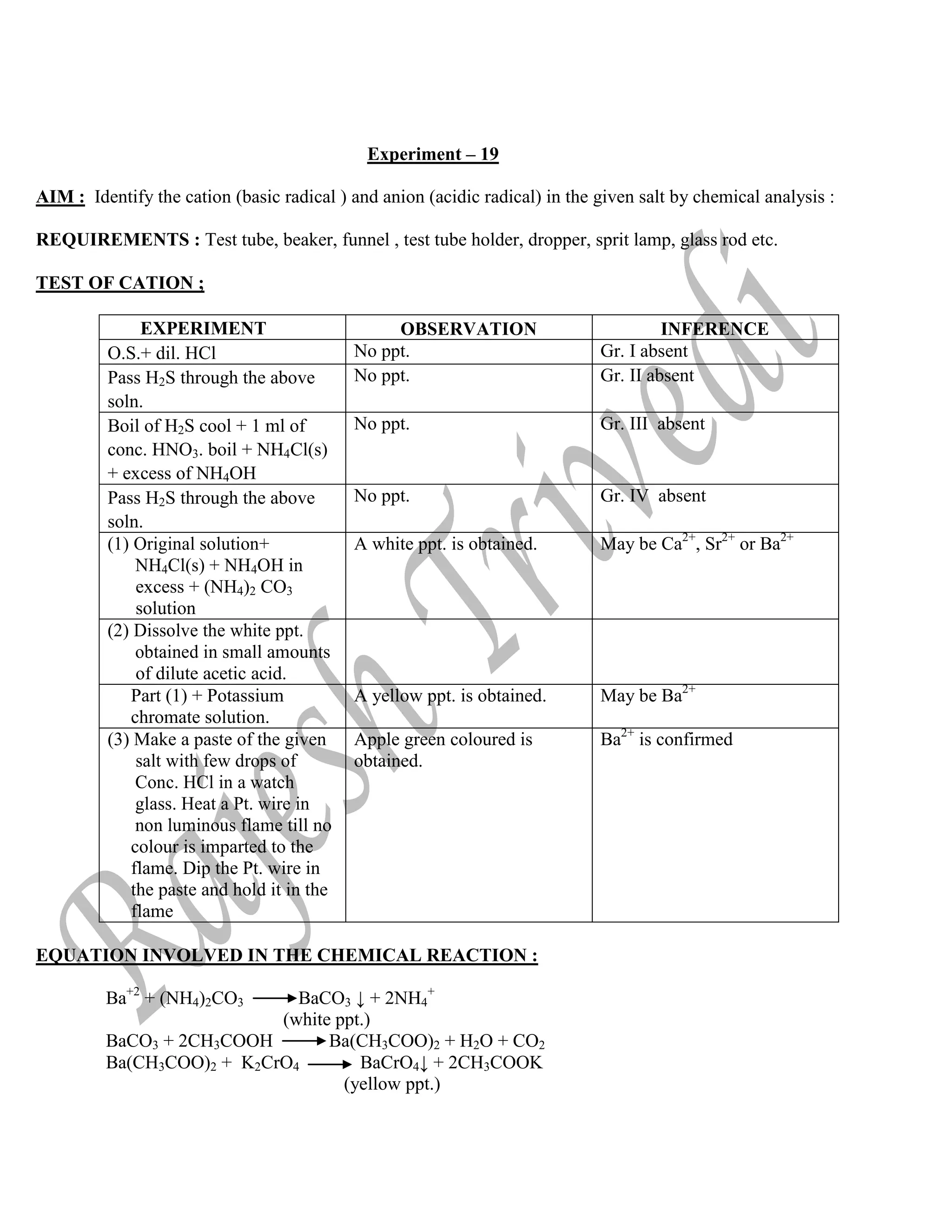
Experiment – 19
AIM : Identify the cation (basic radical ) and anion (acidic radical) in the given salt by chemical analysis :
REQUIREMENTS : Test tube, beaker, funnel , test tube holder, dropper, sprit lamp, glass rod etc.
TEST OF CATION ;
EXPERIMENT OBSERVATION INFERENCE
O.S.+ dil. HCl No ppt. Gr. I absent
Pass H2S through the above
soln.
No ppt. Gr. II absent
Boil of H2S cool + 1 ml of
conc. HNO3. boil + NH4Cl(s)
+ excess of NH4OH
No ppt. Gr. III absent
Pass H2S through the above
soln.
No ppt. Gr. IV absent
(1) Original solution+
NH4Cl(s) + NH4OH in
excess + (NH4)2 CO3
solution
A white ppt. is obtained. May be Ca2+
, Sr2+
or Ba2+
(2) Dissolve the white ppt.
obtained in small amounts
of dilute acetic acid.
Part (1) + Potassium
chromate solution.
A yellow ppt. is obtained. May be Ba2+
(3) Make a paste of the given
salt with few drops of
Conc. HCl in a watch
glass. Heat a Pt. wire in
non luminous flame till no
colour is imparted to the
flame. Dip the Pt. wire in
the paste and hold it in the
flame
Apple green coloured is
obtained.
Ba2+
is confirmed
EQUATION INVOLVED IN THE CHEMICAL REACTION :
Ba+2
+ (NH4)2CO3 BaCO3 ↓ + 2NH4
+
(white ppt.)
BaCO3 + 2CH3COOH Ba(CH3COO)2 + H2O + CO2
Ba(CH3COO)2 + K2CrO4 BaCrO4↓ + 2CH3COOK
(yellow ppt.)
TEST OF ANION :
EQUATION INVOLVED IN THE CHEMICAL REACTION :
(i) Chromyl chloride test:
4NaCl + K2Cr2O7 + 6H2SO4 4NaHSO4 + 2KHSO4 + 2CrO2Cl2 + 3H2O
(yellow orange)
CrO2Cl2 + 4NaOH Na2CrO4 + 2NaCl + 2H2O
(yellow colour)
Pb(CH3COO)2 + Na2CrO4 PbCrO4↓ + 2CH3COONa
(yellow ppt)
(ii) Silver nitrate test :
NaCl + AgNO3 AgCl ↓+ NaNO3
(white ppt)
AgCl + 2NH4OH [Ag(NH3)2]Cl + 2H2O
(soluble)
RESULTS : In the given inorganic salt cation is Barium (Ba+2
) and anion is Chloride (Cl–
), therefore
the salt is Barium Chloride i.e, BaCl2 .
EXPERIMENT OBSERVATION INFERENCE
Salt + Concentrated H2SO4
and heat
Effervescence with
colourless or coloured gases
2nd
group Acid radical is
present
(a) Colourless gas with a
pungent smell and gives
dense white fumes when a
glass rod dipped in
ammonium hydroxide
(NH4OH) is exposed
The Acid radical may be Cl-
(b) Brown gas and the
solution is not blue.
The acid radical may be Br-
(a) Chromyl – Chloride test:
(i) Salt + few K2Cr2O7
crystals + conc. H2SO4
and heat
(ii) Pass the vapours
through the test tube
which contains NaOH
solution
(iii) To this yellow
solution,add dilute
CH3COOH and lead
acetate solution.
Red vapours are obtained.
The solution turns yellow
Yellow ppt. is formed Chloride is confirmed.
(b) Silver Nitrate test:
Salt solution + AgNO3
solution + dilute HNO3
White ppt. is formed
which is soluble in NH4OH.
Chloride is confirmed
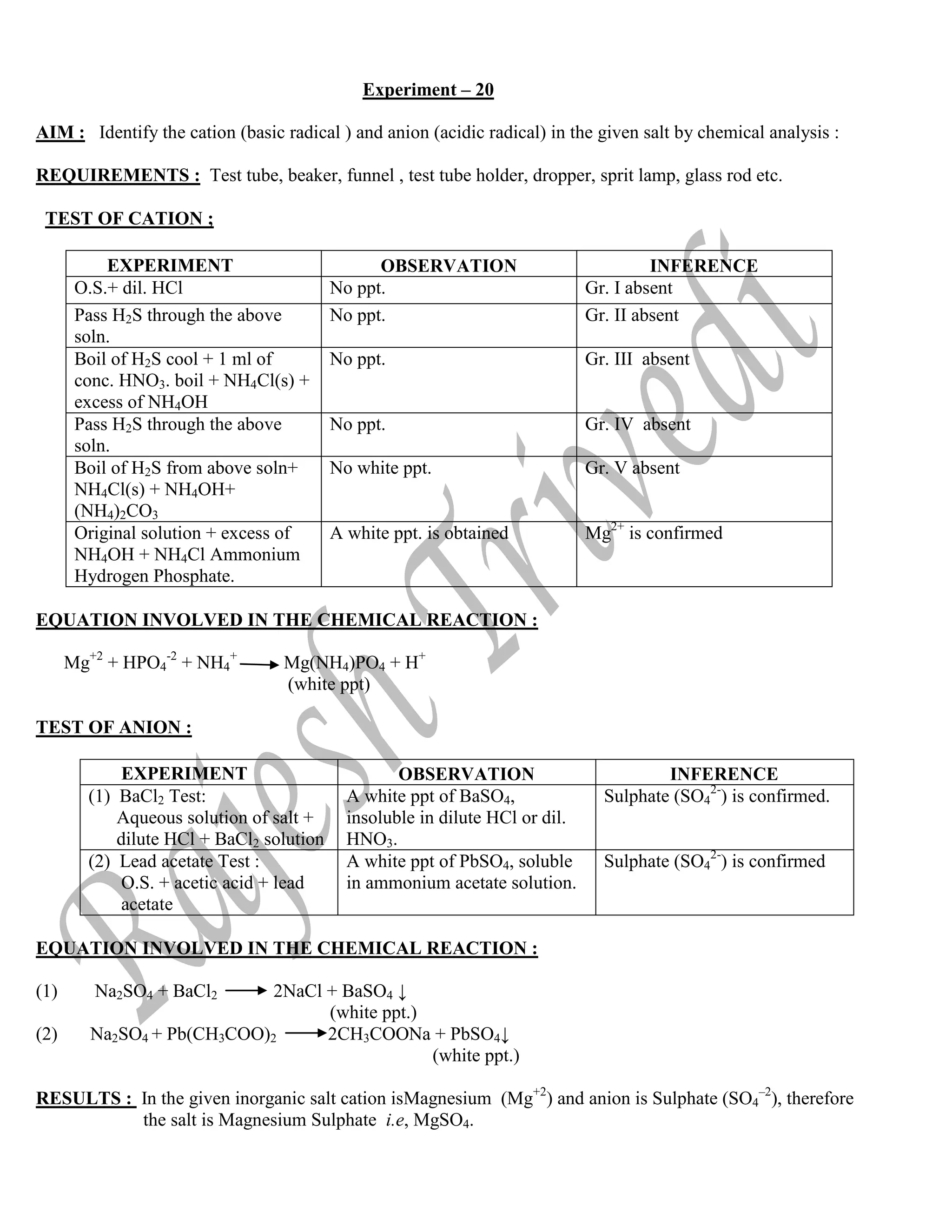
Experiment – 20
AIM : Identify the cation (basic radical ) and anion (acidic radical) in the given salt by chemical analysis :
REQUIREMENTS : Test tube, beaker, funnel , test tube holder, dropper, sprit lamp, glass rod etc.
TEST OF CATION ;
EXPERIMENT OBSERVATION INFERENCE
O.S.+ dil. HCl No ppt. Gr. I absent
Pass H2S through the above
soln.
No ppt. Gr. II absent
Boil of H2S cool + 1 ml of
conc. HNO3. boil + NH4Cl(s) +
excess of NH4OH
No ppt. Gr. III absent
Pass H2S through the above
soln.
No ppt. Gr. IV absent
Boil of H2S from above soln+
NH4Cl(s) + NH4OH+
(NH4)2CO3
No white ppt. Gr. V absent
Original solution + excess of
NH4OH + NH4Cl Ammonium
Hydrogen Phosphate.
A white ppt. is obtained Mg2+
is confirmed
EQUATION INVOLVED IN THE CHEMICAL REACTION :
Mg+2
+ HPO4
-2
+ NH4
+
Mg(NH4)PO4 + H+
(white ppt)
TEST OF ANION :
EXPERIMENT OBSERVATION INFERENCE
(1) BaCl2 Test:
Aqueous solution of salt +
dilute HCl + BaCl2 solution
A white ppt of BaSO4,
insoluble in dilute HCl or dil.
HNO3.
Sulphate (SO4
2-
) is confirmed.
(2) Lead acetate Test :
O.S. + acetic acid + lead
acetate
A white ppt of PbSO4, soluble
in ammonium acetate solution.
Sulphate (SO4
2-
) is confirmed
EQUATION INVOLVED IN THE CHEMICAL REACTION :
(1) Na2SO4 + BaCl2 2NaCl + BaSO4 ↓
(white ppt.)
(2) Na2SO4 + Pb(CH3COO)2 2CH3COONa + PbSO4↓
(white ppt.)
RESULTS : In the given inorganic salt cation isMagnesium (Mg+2
) and anion is Sulphate (SO4
–2
), therefore
the salt is Magnesium Sulphate i.e, MgSO4.

chemistry Practical Class 12th CBSE.

  • 1.
    Syllabus For ChemistryPractical exam (Strictly according to latest guidelines of CBSE) 1. Volumetric Analysis (Titration) (8) (i) To prepare standard solution of Mohr’s salt (M/10 strength) and determine the concentration of given potassium permanganate solution in g/L. (ii) To prepare standard solution of oxalic acid (M/10 strength) and determine the concentration of given potassium permanganate solution in g/L. 2. Qualitative analysis of inorganic salt. (8) 3. Content based Experiment / Test of functional group in the given organic salt. (6) 4. Investigatory project . (i) Study of the presence of oxalate ion in guava fruit at different stages of ripening. (ii) Study of casein quantity present in different sample of milk. (iii) Preparation of soyabean milk and its comparison with natural milk. (iv) Potassium bisulphate as a food preservative. (v) Study of digestion of starch by salivary amylase. (vi) Comparative study of the rate of fermentation of various food material. (vii) To extract the essential oils present in the naturally occurring material. (viii) Study of adulterants in food – stuffs. 5. Practical record and viva – voce (4) 30 Group Basic radical (cation) Group Acidic radical (anion) Zero First S–2 , CH3COO– , , , First Pb+2 , Ag+ , Second Hg+2 , Bi+3 , Pb+2 , Cu+2 , Cd+2 Second Cl– , Br– , I– , , Third Al+3 , Fe+3 , Cr+3 Fourth Zn+2 , Ni+2 , Co+2 , Mn+2 Third , Fifth Ba+2 , Sr+2 , Ca+2 Sixth Mg+2 Functional group Structural formulae. Carboxylic acid –COOH Phenol –OH Alcohol –OH Aldehyde –CHO Ketone –CO– Ester –COOR Amines –NH2 amide –CONH2
  • 2.
    Experiment – 1 AIM:Prepare 0.1 M Mohr’s salt solution . Using this solution determine the molarity and strength of the given potassium permanganate solution. CHEMICAL EQUATION : MnO4 – + 8H+ + 5e– Mn+2 + 4H2O Fe+2 Fe+3 + e– ] × 5 MnO4 – + 8H+ + 5Fe+2 5Fe+3 + Mn+2 + 4H2O INDICATOR : KmnO4 is a self- indicator END POINT: Colourless to permanent pink colour . (KMnO4in burette) OBSERVATION TABLE : CALCULATION : Preparation of 0.1 M solution of Mohr’s salt In fact Mohr’s salt is ferrous ammonium sulphate. Molecular wt. of Mohr’s salt [FeSO4.(NH4)2SO4.6H2O] = 392 As we know w = w = = 9.8 9.8 gm Mohr’s salt needed to prepare 250 ml of 0.1 M solution . From the balanced ionic equation , it is clear that1 mole of KMnO4 reacts with 5 mole of Mohr’s salt. = M1 = Molarity of KMnO4 M2 = Molarity of Mohr’s salt V1 = Volume of KMnO4 V2 = Volume of Mohr’s salt = S.No. Reading of pipette (ml)(FAS) Initial reading of burette (ml) (KMnO4) Final reading of burette (ml) (KMnO4) Volume of KMnO4 used (ml) 1 10 0.00 10 10 2 10 0.00 9.8 9.8 3 10 0.00 10 10
  • 3.
    M1= 0.02 M Strengthof KMnO4 solution in gm / L = Molarity × Mol.wt. Therefore = 0.02 × 158 = 3.16 Therefore Molarity of KMnO4 solution is = 0.02 M Strength of KMnO4 solution is = 3.16 gm / L RESULT : Molarity of given KMnO4 solution is 0.02 M Strength of given KmnO4 solution is 3.16 gm /L
  • 4.
    Experiment – 2 AIM:Prepare 0.25 M Mohr’s salt solution . Using this solution determine the molarity and strength of the given potassium permanganate solution. CHEMICAL EQUATION : MnO4 – + 8H+ + 5e– Mn+2 + 4H2O Fe+2 Fe+3 + e– ] × 5 MnO4 – + 8H+ + 5Fe+2 5Fe+3 + Mn+2 + 4H2O INDICATOR : KmnO4 is a self- indicator END POINT: Colourless to permanent pink colour . (KMnO4in burette) OBSERVATION TABLE : CALCULATION : Preparation of 0.25 M solution of Mohr’s salt In fact Mohr’s salt is ferrous ammonium sulphate. Molecular wt. of Mohr’s salt [FeSO4.(NH4)2SO4.6H2O] = 392 As we know w = w = = 24.5 24.5 gm Mohr’s salt needed to prepare 250 ml of 0.25 M solution . From the balanced ionic equation , it is clear that 1 mole of KMnO4 reacts with 5 mole of Mohr’s salt. = M1 = Molarity of KMnO4 M2 = Molarity of Mohr’s salt V1 = Volume of KMnO4 V2 = Volume of Mohr’s salt = S.No. Reading of pipette (ml)(FAS) Initial reading of burette (ml) (KMnO4) Final reading of burette (ml) (KMnO4) Volume of KMnO4 used (ml) 1 10 0.00 25 25 2 10 0.00 24.8 24.8 3 10 0.00 25 25
  • 5.
    M1= 0.02 M Strengthof KMnO4 solution in gm / L = Molarity × Mol.wt. Therefore = 0.02 × 158 = 3.16 Therefore Molarity of KMnO4 solution is = 0.02 M Strength of KMnO4 solution is = 3.16 gm / L RESULT : Molarity of given KMnO4 solution is 0.02 M Strength of given KmnO4 solution is 3.16 gm /L
  • 6.
    Experiment – 3 AIM:Prepare 0.2 M Mohr’s salt solution . Using this solution determine the molarity and strength of the given potassium permanganate solution. CHEMICAL EQUATION : MnO4 – + 8H+ + 5e– Mn+2 + 4H2O Fe+2 Fe+3 + e– ] × 5 MnO4 – + 8H+ + 5Fe+2 5Fe+3 + Mn+2 + 4H2O INDICATOR : KmnO4 is a self- indicator END POINT: Colourless to permanent pink colour . (KMnO4in burette) OBSERVATION TABLE : CALCULATION : Preparation of 0.2 M solution of Mohr’s salt In fact Mohr’s salt is ferrous ammonium sulphate. Molecular wt. of Mohr’s salt [FeSO4.(NH4)2SO4.6H2O] = 392 As we know w = w = = 19.6 19.6 gm Mohr’s salt needed to prepare 250 ml of 0.2 M solution . From the balanced ionic equation , it is clear that 1 mole of KMnO4 reacts with 5 mole of Mohr’s salt. = M1 = Molarity of KMnO4 M2 = Molarity of Mohr’s salt V1 = Volume of KMnO4 V2 = Volume of Mohr’s salt = S.No. Reading of pipette (ml) (FAS) Initial reading of burette (ml) (KMnO4) Final reading of burette (ml) (KMnO4) Volume of KMnO4 used (ml) 1 10 0.00 20 20 2 10 0.00 19.8 19.8 3 10 0.00 20 20
  • 7.
    M1= 0.02 M Strengthof KMnO4 solution in gm / L = Molarity × Mol.wt. Therefore = 0.02 × 158 = 3.16 Therefore Molarity of KMnO4 solution is = 0.02 M Strength of KMnO4 solution is = 3.16 gm / L RESULT : Molarity of given KMnO4 solution is 0.02 M Strength of given KmnO4 solution is 3.16 gm /L
  • 8.
    Experiment – 4 AIM:Prepare 0.15 M Mohr’s salt solution . Using this solution determine the molarity and strength of the given potassium permanganate solution. CHEMICAL EQUATION : MnO4 – + 8H+ + 5e– Mn+2 + 4H2O Fe+2 Fe+3 + e– ] × 5 MnO4 – + 8H+ + 5Fe+2 5Fe+3 + Mn+2 + 4H2O INDICATOR : KmnO4 is a self- indicator END POINT: Colourless to permanent pink colour . (KMnO4in burette) OBSERVATION TABLE : CALCULATION : Preparation of 0.2 M solution of Mohr’s salt In fact Mohr’s salt is ferrous ammonium sulphate. Molecular wt. of Mohr’s salt [FeSO4.(NH4)2SO4.6H2O] = 392 As we know w = w = = 14.7 14.7 gm Mohr’s salt needed to prepare 250 ml of 0.15 M solution . From the balanced ionic equation , it is clear that 1 mole of KMnO4 reacts with 5 mole of Mohr’s salt. = M1 = Molarity of KMnO4 M2 = Molarity of Mohr’s salt V1 = Volume of KMnO4 V2 = Volume of Mohr’s salt = S.No. Reading of pipette (ml) (FAS) Initial reading of burette (ml) (KMnO4) Final reading of burette (ml) (KMnO4) Volume of KMnO4 used (ml) 1 10 0.00 15 15 2 10 0.00 14.8 14.8 3 10 0.00 15 15
  • 9.
    M1= 0.02 M Strengthof KMnO4 solution in gm / L = Molarity × Mol.wt. Therefore = 0.02 × 158 = 3.16 Therefore Molarity of KMnO4 solution is = 0.02 M Strength of KMnO4 solution is = 3.16 gm / L RESULT : Molarity of given KMnO4 solution is 0.02 M Strength of given KmnO4 solution is 3.16 gm /L
  • 10.
    Experiment – 5 AIM:Prepare 0.1 M solution of Oxalic acid . Using this solution determine the molarity and strength of the given potassium permanganate solution. CHEMICAL EQUATION : MnO4 – + 8H+ + 5e– Mn+2 + 4H2O] × 2 C2O4 –2 2CO2 + 2e– ] × 5 2MnO4 – + 16H+ + 5C2O4 –2 2Mn+2 + 10CO2 + 8H2O INDICATOR : KmnO4 is a self- indicator END POINT: Colourless to permanent pink colour . (KMnO4in burette) OBSERVATION TABLE : CALCULATION : Preparation of 0.1 M Oxalic acid solution Molecular wt. of Oxalic acid [H2C2O4.2H2O] = 126 As we know w = w = = 3.15 3.15 gm Oxalic acid needed to prepare 250 ml of 0.1 M solution . From the balanced ionic equation , it is clear that 2 mole of KMnO4 reacts with 5 mole of Oxalic acid. = M1 = Molarity of KMnO4 M2 = Molarity of Oxalic acid V1 = Volume of KMnO4 V2 = Volume of Oxalic acid = S.No. Reading of pipette (ml) (Oxalic acid) Initial reading of burette (ml) (KMnO4) Final reading of burette (ml) (KMnO4) Volume of KMnO4 used (ml) 1 10 0.00 20 20 2 10 0.00 19.8 19.8 3 10 0.00 20 20
  • 11.
    M1= 0.02 M Strengthof KMnO4 solution in gm / L = Molarity × Mol.wt. Therefore = 0.02 × 158 = 3.16 gm / L Therefore Molarity of KMnO4 solution is = 0.02 M Strength of KMnO4 solution is = 3.16 gm / L RESULT : Molarity of given KMnO4 solution is 0.02 M Strength of given KMnO4 solution is 3.16 gm /L
  • 12.
    Experiment – 6 AIM:Prepare 0.15 M solution of Oxalic acid . Using this solution determine the molarity and strength of the given potassium permanganate solution. CHEMICAL EQUATION : MnO4 – + 8H+ + 5e– Mn+2 + 4H2O] × 2 C2O4 –2 2CO2 + 2e– ] × 5 2MnO4 – + 16H+ + 5C2O4 –2 2Mn+2 + 10CO2 + 8H2O INDICATOR : KmnO4 is a self- indicator END POINT: Colourless to permanent pink colour . (KMnO4in burette) OBSERVATION TABLE : CALCULATION : Preparation of 0.15 M Oxalic acid solution Molecular wt. of Oxalic acid [H2C2O4.2H2O] = 126 As we know w = w = = 4.725 4.725 gm Oxalic acid needed to prepare 250 ml of 0.15 M solution . From the balanced ionic equation , it is clear that 2 mole of KMnO4 reacts with 5 mole of Oxalic acid. = M1 = Molarity of KMnO4 M2 = Molarity of Oxalic acid V1 = Volume of KMnO4 V2 = Volume of Oxalic acid = S.No. Reading of pipette (ml) (Oxalic acid) Initial reading of burette (ml) (KMnO4) Final reading of burette (ml) (KMnO4) Volume of KMnO4 used (ml) 1 10 0.00 30 30 2 10 0.00 29.8 29.8 3 10 0.00 30 30
  • 13.
    M1= 0.02 M Strengthof KMnO4 solution in gm / L = Molarity × Mol.wt. Therefore = 0.02 × 158 = 3.16 gm / L Therefore Molarity of KMnO4 solution is = 0.02 M Strength of KMnO4 solution is = 3.16 gm / L RESULT : Molarity of given KMnO4 solution is 0.02 M Strength of given KMnO4 solution is 3.16 gm /L
  • 14.
    Experiment – 7 AIM:Prepare 0.2 M solution of Oxalic acid . Using this solution determine the molarity and strength of the given potassium permanganate solution. CHEMICAL EQUATION : MnO4 – + 8H+ + 5e– Mn+2 + 4H2O] × 2 C2O4 –2 2CO2 + 2e– ] × 5 2MnO4 – + 16H+ + 5C2O4 –2 2Mn+2 + 10CO2 + 8H2O INDICATOR : KmnO4 is a self- indicator END POINT: Colourless to permanent pink colour . (KMnO4in burette) OBSERVATION TABLE : CALCULATION : Preparation of 0.2 M Oxalic acid solution Molecular wt. of Oxalic acid [H2C2O4.2H2O] = 126 As we know w = w = = 6.3 6.3 gm Oxalic acid needed to prepare 250 ml of 0.2 M solution . From the balanced ionic equation , it is clear that 2 mole of KMnO4 reacts with 5 mole of Oxalic acid. = M1 = Molarity of KMnO4 M2 = Molarity of Oxalic acid V1 = Volume of KMnO4 V2 = Volume of Oxalic acid = S.No. Reading of pipette (ml) (Oxalic acid) Initial reading of burette (ml) (KMnO4) Final reading of burette (ml) (KMnO4) Volume of KMnO4 used (ml) 1 10 0.00 40 40 2 10 0.00 39.8 39.8 3 10 0.00 40 40
  • 15.
    M1= 0.02 M Strengthof KMnO4 solution in gm / L = Molarity × Mol.wt. Therefore = 0.02 × 158 = 3.16 gm / L Therefore Molarity of KMnO4 acid solution is = 0.02 M Strength of KMnO4 solution is = 3.16 gm / L RESULT : Molarity of given KMnO4 solution is 0.02 M Strength of given KMnO4 solution is 3.16 gm /L
  • 16.
    Experiment – 8 AIM: Identify the functional group in the given organic compound : REQUIREMENTS :Test tube, beaker, funnel , test tube holder, dropper, sprit lamp, glass rod etc. CHEMICAL REACTIONS INVOLVED : Ester test : R – OH + CH3COOH CH3COOR + H2O Ester (fruity smell) Cerric ammonium nitrate test : 2R–OH + (NH4)2Ce(NO3)6 (ROH)2Ce(NO3)4 + 2NH4NO3 Wine red CONCLUSION : In the given organic compound alcohol ( –OH) is present as a functional group. S. No. Experiment Observation Inference 1 Ester test : Take 1 ml of given liquid in a clean dry test tube , add 1 ml of glacial acetic acid and 2- 3 drop of Conc. H2SO4. Warm the mixture on a water bath for about 10 minutes. Pour it into about 20 ml of cold water taken in a beaker and smell. A pleasant fruity smell due to formation of ester Alcoholic group present 2 Cerric ammonium nitrate test : Take 1 ml of given liquid in a clean dry test tube , and add few drops of cerric ammonium nitrate reagent and shake well Wine red colouration is produced Alcohol group confirmed Conc H2SO4 / Δ
  • 17.
    Experiment – 9 AIM: Identify the functional group in the given organic compound : REQUIREMENTS: Test tube, beaker, funnel , test tube holder, dropper, sprit lamp, glass rod etc. CHEMICAL REACTIONS INVOLVED : Ferric chloride test : FeCl3 + 6 C6H5OH [Fe(OC6H5)6 ]–3 + 3HCl Violet complex Libermann’stest : 2NaNO3 + H2SO4 2HNO2 + Na2SO4 OH ON OH P -nitrophenol ON OH + OH HO N O Indo phenol (red) HO N O Na+ O– N O Indo phenol anion (blue) CONCLUSION : In the given organic compound Phenol ( OH) is present as a functional group. S. No. Experiment Observation Inference 1 Ferric chloride test : Take 1 ml of neutral FeCl3 solution in a test tube and add few drops of compound A violet colouration produced Phenolic group is present 2 Libermann’stest : Take 2- 3 crystals of NaNO2 in a test tube and add about 1 ml of organic compound. Heat gently for 30 seconds and allow it to cool. Then add 1 ml of conc. H2SO4 and shake the test tube . Then add water carefully. Finally add excess of NaOH solution. A deep blue or deeo green colouration produced. Colur turns red The blue or green colur appear Phenolic group is confirmed. HNO2 NaOH
  • 18.
    Experiment – 10 AIM: Identify the functional group in the given organic compound : REQUIREMENTS : Test tube, beaker, funnel , test tube holder, dropper, sprit lamp, glass rod etc. CHEMICAL REACTIONS INVOLVED : 2,4 – dinitrophenylhydrazine test: RCHO + H2N NH NO2 R HC N NH NO2 NO2 NO2 Aldehyde 2,4 – dinitrophenylhydrazone (orange crystals) Tollen’s test: 2[Ag(NH3)2]+ + RCHO + 3OH– RCOO– + 2Ag ↓ + 4NH3 +2H2O Silver mirror CONCLUSION : In the given organic compound Aldehyde (–COH) is present as a functional group. S.No. Experiment Observation Inference 1 2,4- dinitrophenylhydarzine test :Take 0.5 ml of given compound, add rectified spirit. Now add 2,4DNP solution . Cork the test tube , shake the mixture and allow it to stand. Yellow or orange crystals formed Aldehyde or Ketone is present 2 Tollen’stest : Take 1 ml of AgNO3 solution in a test tube and add about 2-3 ml of dilNaOH. Now add dil. Ammonia solution drop wise. To this add 3-4 drop of given organic compound and warm the test tube on water bath for 5 minutes. A brown ppt produced. Brown ppt dissolves. A shining mirror appear. Aldehyde is confirmed.
  • 19.
    Experiment - 11 AIM: Identify the functional group in the given organic compound : REQUIREMENTS: Test tube, beaker, funnel , test tube holder, dropper, sprit lamp, glass rod etc. CHEMICAL REACTIONS INVOLVED : Tollen’s test: 2[Ag(NH3)2]+ + RCOR + 3OH– No formation of silver mirror CONCLUSION : In the given organic compound Ketone (–CO– ) is present as a functional group. S.No. Experiment Observation Inference 1 2,4- dinitrophenylhydarzine test : Take 0.5 ml of given compound, add rectified spirit. Now add 2,4DNP solution . Cork the test tube , shake the mixture and allow it to stand. Yellow or orange crystals formed Aldehyde or Ketone is present 2 Tollen’stest : Take 1 ml of AgNO3 solution in a test tube and add about 2-3 ml of dilNaOH. Now add dil. Ammonia solution drop wise. To this add 3-4 drop of given organic compound and warm the test tube on water bath for 5 minutes. No shining mirror appear. Ketone is confirmed.
  • 20.
    Experiment – 12 AIM: Identify the functional group in the given organic compound : REQUIREMENTS : Test tube, beaker, funnel , test tube holder, dropper, sprit lamp, glass rod etc. CHEMICAL REACTIONS INVOLVED : Ester test : C2H5OH + RCOOH RCOOC2H5 + H2O Ester (fruity smell) Sodium bicarbonate test : RCOOH + NaHCO3 RCOONa + CO2↑ + H2O (Effervescence) CONCLUSION : In the given organic compound Carboxylic acid (–COOH) is present as a functional group. S.No. Experiment Observation Inference 1 Ester test : Take 1 ml of given liquid in a clean dry test tube , add 1 ml of ethyl alcohol and 2- 3 drop of Conc. H2SO4. And warm the mixture. A pleasant fruity smell due to formation of ester Carboxylic acid group is confirmed 2 Sodium bicarbonate test : Take 1 ml of given liquid in a clean dry test tube , and add a pinch of sodium bicarbonate A brisk effervescence produced Carboxylic acid group is confirmed Conc H2SO4 / Δ
  • 21.
    Experiment – 13 AIM: Identify the functional group in the given organic compound : REQUIREMENTS :Test tube, beaker, funnel , test tube holder, dropper, sprit lamp, glass rod etc. CHEMICAL REACTIONS INVOLVED : Azo -dyetest : C6H5NH2 + HNO2 + HCl C6H5N+ ≡NCl– + 2H2O Benzene diazonium chloride N N OH OH N+ ≡NCl– + Benzene diazonium chloride β – naphthol Orange ppt CONCLUSION : In the given organic compound Primary aromatic amino group (C6H5NH2) is present. S.No. Experiment Observation Inference 1 Azo – dye Test : dissolve 0.5 ml of given liquid in 2 ml conc. HCl and cool in ice. Add 0.5 gm of NaNO2 dissolved in 5 ml ice cold water. Then add a cold solution of β – naphthol in NaOH solution to it. Orange – red ppt formed Primary aromatic amino group is confirmed
  • 22.
    Experiment – 14 AIM: Identify the cation (basic radical ) and anion (acidic radical) in the given salt by chemical analysis : REQUIREMENTS : Test tube, beaker, funnel , test tube holder, dropper, sprit lamp, glass rod etc. TEST OF CATION ; EXPERIMENT OBSERVATION INFERENCE (a) Salt + NaOH solution and heat it. Colourless gas with a pungent smell is NH4 + may be present in the Expose a glass rod dipped in conc. obtained. Dense white fumes and moist red salt HCl to the gas and moist red litmus litmus paper turns blue paper. (b) Original solution + Nesseler’s Brown solution or ppt. is obtained NH4 + is confirmed. reagent. EQUATION INVOLVED IN THE CHEMICAL REACTION : (i) NH4 + + NaOH NH4OH + Na+ Δ NH4OH NH3 +H2O NH3 + HCl NH4Cl (dense white fumes) (ii) 2 K2HgI4 + NH3 + 3KOH H2N.HgO.HgI + 2KI + 2H2O ( Brown solution i.e, Iodide of Millon’s base)
  • 23.
    TEST OF ANION: EXPERIMENT OBSERVATION INFERENCE Salt + water and shake Salt insoluble in water Insoluble CO3 –2 may be present Residue + dil HCl Colourless, odourless CO2 gas , turns lime water milky white Insoluble CO3 –2 confirmed. O.S. + MgSO4 solution Whie ppt. Soluble CO3 –2 confirmed EQUATION INVOLVED IN THE CHEMICAL REACTION : CO3 –2 + HCl 2Cl– + H2O + CO2 ↑ CO3 –2 + Ca(OH)2 CaCO3 ↓+ 2(OH)– (milky white ppt.) CO3 –2 + MgSO4 MgCO3 ↓+ SO4 –2 (white ppt.) RESULTS : In the given inorganic salt cation is Ammonium ion (NH4 + ) and anion is Carbonate ion (CO3 –2 ), therefore the salt is Ammonium Carbonate i.e, NH4(CO3)2 .
  • 24.
    Experiment – 15 AIM: Identify the cation (basic radical ) and anion (acidic radical) in the given salt by chemical analysis : REQUIREMENTS : Test tube, beaker, funnel , test tube holder, dropper, sprit lamp, glass rod etc. TEST OF CATION ; EXPERIMENT OBSERVATION INFERENCE (1) Original solution + Dilute HCl White ppt. is formed. May be Pb2+ & Ag+ Filter and add water to ppt and heat. (a) ppt. dissolves in hot water. May be Pb2+ (b) ppt. is insoluble in water. May be Ag+ (2) Original solution + Potassium Chromate solution (a) A yellow ppt. is formed, which is soluble in NaOH solution. Pb2+ is confirmed. (b) A brick red ppt. is formed Ag+ is confirmed (3) Original solution + KI sol. A yellow ppt Pb2+ is confirmed. ppt. obtained + water and heat it. ppt. is soluble in hot water, on cooling reappears as golden yellow spangles EQUATION INVOLVED IN THE CHEMICAL REACTION : Pb+2 + 2HCl PbCl2 ↓ + 2H+ (whit ppt) (i) PbCl2 + K2CrO4 PbCrO4 ↓ + 2KCl (yellow ppt) PbCrO4 + 2NaOH Na2CrO4 + Pb(OH)2 (soluble) (ii) PbCl2 + KI PbI2 ↓+ 2KCl (yellow ppt)
  • 25.
    TEST OF ANION: EQUATION INVOLVED IN THE CHEMICAL REACTION : (i) Ring Test : NaNO3 + H2SO4 NaHSO4 + HNO3 2FeSO4 + 2HNO3 + H2SO4 Fe2(SO4)3 +2H2O + NO FeSO4 + NO + 5H2O [Fe(H2O)5NO] SO4 (brown ring) (ii) Copper turning Test : KNO3 + H2SO4 KHSO4 + HNO3 Cu + 4HNO3 Cu(NO3)2 + H2O + 2NO2 ↑ RESULTS : In the given inorganic salt cation is Lead ion (Pb+2 ) and anion is Nitrate ion (NO3 – ), therefore the salt is Lead nitrate i.e, Pb(NO3)2 . EXPERIMENT OBSERVATION INFERENCE Salt + Conc. H2SO4 and heat if necessary Light brown gas and brown gas with pieces of copper turnings and the solution turns blue in the test tube. The Acid radical may be NO3 - Brown ring test: Strong solution of the substance + 2 or3 drops of conc. H2SO4, and cool. Add freshly prepared FeSO4 solution on the sides of the test tube. A brown ring is formed at the junction of two liquids. Nitrate (NO3 - ) is confirmed
  • 26.
    Experiment – 16 AIM: Identify the cation (basic radical ) and anion (acidic radical) in the given salt by chemical analysis : REQUIREMENTS : Test tube, beaker, funnel , test tube holder, dropper, sprit lamp, glass rod etc. TEST OF CATION ; EXPERIMENT OBSERVATION INFERENCE Original solution + Dilute HCl + H2S gas. (a)A Black ppt. is observed. May be Pb2+ Hg2+ & Cu2+ (b)A yellow ppt. is observed. May be Cd2+ (a) Original solution + Potassium Chromate. A yellow ppt. is observed Pb2+ is confirmed. EQUATION INVOLVED IN THE CHEMICAL REACTION : Pb+2 + H2S PbS↓ + 2H+ (black ppt) (i) PbS + 2HNO3 Pb(NO3)2 + H2S (Colour less) Pb(NO3)2 + KI PbI2↓ + KNO3 (yellow ppt) (ii) Pb(NO3)2 + K2CrO4 PbCrO4↓ + 2KOH (yellow ppt) PbCrO4 + 2NaOH Na2CrO4 + Pb(OH)2 (soluble)
  • 27.
    TEST OF ANION: EQUATION INVOLVED IN THE CHEMICAL REACTION : (i) Chromyl chloride test: 4NaCl + K2Cr2O7 + 6H2SO4 4NaHSO4 + 2KHSO4 + 2CrO2Cl2 + 3H2O (yellow orange) CrO2Cl2 + 4NaOH Na2CrO4 + 2NaCl + 2H2O (yellow colour) Pb(CH3COO)2 + Na2CrO4 PbCrO4↓ + 2CH3COONa (yellow ppt) (ii) Silver nitrate test : NaCl + AgNO3 AgCl ↓+ NaNO3 (white ppt) AgCl + 2NH4OH [Ag(NH3)2]Cl + 2H2O (soluble) RESULTS : In the given inorganic salt cation is Lead ( Pb+2 ) and anion is Chloride (Cl– ), therefore the salt is Lead Chloride i.e, PbCl2 . EXPERIMENT OBSERVATION INFERENCE Salt + Concentrated H2SO4 and heat Effervescence with colourless or coloured gases 2nd group Acid radical is present (a) Colourless gas with a pungent smell and gives dense white fumes when a glass rod dipped in ammonium hydroxide (NH4OH) is exposed The Acid radical may be Cl- (b) Brown gas and the solution is not blue. The acid radical may be Br- (a) Chromyl – Chloride test: (i) Salt + few K2Cr2O7 crystals + conc. H2SO4 and heat (ii) Pass the vapours through the test tube which contains NaOH solution (iii) To this yellow solution,add dilute CH3COOH and lead acetate solution. Red vapours are obtained. The solution turns yellow Yellow ppt. is formed Chloride is confirmed. (b) Silver Nitrate test: Salt solution + AgNO3 solution + dilute HNO3 White ppt. is formed which is soluble in NH4OH. Chloride is confirmed
  • 28.
    Experiment – 17 AIM: Identify the cation (basic radical ) and anion (acidic radical) in the given salt by chemical analysis : REQUIREMENTS : Test tube, beaker, funnel , test tube holder, dropper, sprit lamp, glass rod etc. TEST OF CATION ; EXPERIMENT OBSERVATION INFERENCE O.S.+ dil. HCl No ppt. Gr. I absent Pass H2S through the above soln. No ppt. Gr. II absent (1) Original solution + NH4Cl(s) + NH4OH in excess A white gelatinous ppt. is obtained. May be Al3+ A dirty green ppt. is obtained May be Fe2 (2) Gelatinous white ppt. + dil. HCl White gelatinous ppt. soluble in dil. HCl. produces a clear solution The basic radical is Al3+ Clear solution of (2) + Few drops of BLUE litmus solution +NH4OH and heat Bluish white ppt. floating like lake formed. Al3+ is confirmed EQUATION INVOLVED IN THE CHEMICAL REACTION : Al+3 + NH4OH Al(OH)3↓ + 3NH4 + (white gelatinous ppt.) Al(OH)3 + 3HCl AlCl3 + 3H2O (soluble) AlCl3 + 3NH4OH Al(OH)3↓ + 3NH4Cl (white gelatinous ppt.) TEST OF ANION : EXPERIMENT OBSERVATION INFERENCE (1) BaCl2 Test: Aqueous solution of salt + dilute HCl + BaCl2 solution A white ppt of BaSO4, insoluble in dilute HCl or dil. HNO3. Sulphate (SO4 2- ) is confirmed. (2) Lead acetate Test : O.S. + acetic acid + lead acetate A white ppt of PbSO4, soluble in ammonium acetate solution. Sulphate (SO4 2- ) is confirmed EQUATION INVOLVED IN THE CHEMICAL REACTION : (1) Na2SO4 + BaCl2 2NaCl + BaSO4 ↓ (white ppt.) (2) Na2SO4 + Pb(CH3COO)2 2CH3COONa + PbSO4↓ (white ppt.) RESULTS : In the given inorganic salt cation is Aluminium (Al+3 ) and anion is Sulphate SO4 –2 ), therefore the salt is Aluminium Sulphate i.e, Al2(SO4)3 .
  • 29.
    Experiment – 18 AIM: Identify the cation (basic radical ) and anion (acidic radical) in the given salt by chemical analysis : REQUIREMENTS : Test tube, beaker, funnel , test tube holder, dropper, sprit lamp, glass rod etc. TEST OF CATION ; EXPERIMENT OBSERVATION INFERENCE O.S.+ dil. HCl No ppt. Gr. I absent Pass H2S through the above soln. No ppt. Gr. II absent Boil of H2S cool + 1 ml of conc. HNO3. boil + NH4Cl(s) + excess of NH4OH No ppt. Gr. III absent (1) Original solution + NH4Cl(s) + NH4OH in excess + H2S(g) a white ppt. is obtained May be Zn2+ , Mn2+ or Co2+ Buff or pale pink or flash coloured ppt. soluble in dilute HCl is obtained. May be Mn2+ (2) Original solution + NaOH drop wise in excess. The white ppt. is soluble in excess of NaOH. Zn2+ is confirmed (3) Original solution + NH4OH solution + K4[Fe(CN)6] solution. Blish white ppt. Zn2+ is confirmed EQUATION INVOLVED IN THE CHEMICAL REACTION : Zn+2 + H2S ZnS↓ + 2H+ (white ppt.) ZnS + 2HCl ZnCl2 + H2S (soluble) (1) ZnCl2 + NaOH Zn(OH)2↓ + 2 NaCl (white ppt.) Zn(OH)2 + 2 NaOH Na2ZnO2 + 2H2O (soluble) (2) ZnCl2 + K4[Fe(CN)6] Zn2[Fe(CN)6] + 4KCl (bluish white ppt.)
  • 30.
    TEST OF ANION: EXPERIMENT OBSERVATION INFERENCE Salt + Oxalic acid Vinegar like smell CH3COOH- confirmed Salt + FeCl3 Deep red colour CH3COOH- confirmed Salt + dil.H2SO4 + Ethyl alcohol Fruity smell CH3COOH- confirmed EQUATION INVOLVED IN THE CHEMICAL REACTION : (i) 2CH3COO- + (COOH)2 (COO)2 -2 + 2CH3COOH (vinegar like smell) (ii) FeCl3 + 3CH3COONa (CH3COO)3Fe + 3NaCl (deep red) (iii) 2CH3COO- + H2SO4 2CH3COOH + SO4 -2 (iv) CH3COOH + C2H5OH CH3COOC2H5 (fruity smell) RESULTS : In the given inorganic salt cation is Zinc (Zn+2 ) and anion is Acetate (CH3COO– ), therefore the salt is Zinc Acetate i.e, Zn(CH3COO)2 .
  • 31.
    Experiment – 19 AIM: Identify the cation (basic radical ) and anion (acidic radical) in the given salt by chemical analysis : REQUIREMENTS : Test tube, beaker, funnel , test tube holder, dropper, sprit lamp, glass rod etc. TEST OF CATION ; EXPERIMENT OBSERVATION INFERENCE O.S.+ dil. HCl No ppt. Gr. I absent Pass H2S through the above soln. No ppt. Gr. II absent Boil of H2S cool + 1 ml of conc. HNO3. boil + NH4Cl(s) + excess of NH4OH No ppt. Gr. III absent Pass H2S through the above soln. No ppt. Gr. IV absent (1) Original solution+ NH4Cl(s) + NH4OH in excess + (NH4)2 CO3 solution A white ppt. is obtained. May be Ca2+ , Sr2+ or Ba2+ (2) Dissolve the white ppt. obtained in small amounts of dilute acetic acid. Part (1) + Potassium chromate solution. A yellow ppt. is obtained. May be Ba2+ (3) Make a paste of the given salt with few drops of Conc. HCl in a watch glass. Heat a Pt. wire in non luminous flame till no colour is imparted to the flame. Dip the Pt. wire in the paste and hold it in the flame Apple green coloured is obtained. Ba2+ is confirmed EQUATION INVOLVED IN THE CHEMICAL REACTION : Ba+2 + (NH4)2CO3 BaCO3 ↓ + 2NH4 + (white ppt.) BaCO3 + 2CH3COOH Ba(CH3COO)2 + H2O + CO2 Ba(CH3COO)2 + K2CrO4 BaCrO4↓ + 2CH3COOK (yellow ppt.)
  • 32.
    TEST OF ANION: EQUATION INVOLVED IN THE CHEMICAL REACTION : (i) Chromyl chloride test: 4NaCl + K2Cr2O7 + 6H2SO4 4NaHSO4 + 2KHSO4 + 2CrO2Cl2 + 3H2O (yellow orange) CrO2Cl2 + 4NaOH Na2CrO4 + 2NaCl + 2H2O (yellow colour) Pb(CH3COO)2 + Na2CrO4 PbCrO4↓ + 2CH3COONa (yellow ppt) (ii) Silver nitrate test : NaCl + AgNO3 AgCl ↓+ NaNO3 (white ppt) AgCl + 2NH4OH [Ag(NH3)2]Cl + 2H2O (soluble) RESULTS : In the given inorganic salt cation is Barium (Ba+2 ) and anion is Chloride (Cl– ), therefore the salt is Barium Chloride i.e, BaCl2 . EXPERIMENT OBSERVATION INFERENCE Salt + Concentrated H2SO4 and heat Effervescence with colourless or coloured gases 2nd group Acid radical is present (a) Colourless gas with a pungent smell and gives dense white fumes when a glass rod dipped in ammonium hydroxide (NH4OH) is exposed The Acid radical may be Cl- (b) Brown gas and the solution is not blue. The acid radical may be Br- (a) Chromyl – Chloride test: (i) Salt + few K2Cr2O7 crystals + conc. H2SO4 and heat (ii) Pass the vapours through the test tube which contains NaOH solution (iii) To this yellow solution,add dilute CH3COOH and lead acetate solution. Red vapours are obtained. The solution turns yellow Yellow ppt. is formed Chloride is confirmed. (b) Silver Nitrate test: Salt solution + AgNO3 solution + dilute HNO3 White ppt. is formed which is soluble in NH4OH. Chloride is confirmed
  • 33.
    Experiment – 20 AIM: Identify the cation (basic radical ) and anion (acidic radical) in the given salt by chemical analysis : REQUIREMENTS : Test tube, beaker, funnel , test tube holder, dropper, sprit lamp, glass rod etc. TEST OF CATION ; EXPERIMENT OBSERVATION INFERENCE O.S.+ dil. HCl No ppt. Gr. I absent Pass H2S through the above soln. No ppt. Gr. II absent Boil of H2S cool + 1 ml of conc. HNO3. boil + NH4Cl(s) + excess of NH4OH No ppt. Gr. III absent Pass H2S through the above soln. No ppt. Gr. IV absent Boil of H2S from above soln+ NH4Cl(s) + NH4OH+ (NH4)2CO3 No white ppt. Gr. V absent Original solution + excess of NH4OH + NH4Cl Ammonium Hydrogen Phosphate. A white ppt. is obtained Mg2+ is confirmed EQUATION INVOLVED IN THE CHEMICAL REACTION : Mg+2 + HPO4 -2 + NH4 + Mg(NH4)PO4 + H+ (white ppt) TEST OF ANION : EXPERIMENT OBSERVATION INFERENCE (1) BaCl2 Test: Aqueous solution of salt + dilute HCl + BaCl2 solution A white ppt of BaSO4, insoluble in dilute HCl or dil. HNO3. Sulphate (SO4 2- ) is confirmed. (2) Lead acetate Test : O.S. + acetic acid + lead acetate A white ppt of PbSO4, soluble in ammonium acetate solution. Sulphate (SO4 2- ) is confirmed EQUATION INVOLVED IN THE CHEMICAL REACTION : (1) Na2SO4 + BaCl2 2NaCl + BaSO4 ↓ (white ppt.) (2) Na2SO4 + Pb(CH3COO)2 2CH3COONa + PbSO4↓ (white ppt.) RESULTS : In the given inorganic salt cation isMagnesium (Mg+2 ) and anion is Sulphate (SO4 –2 ), therefore the salt is Magnesium Sulphate i.e, MgSO4.